
Which Mushroom Is Right for Me? A Goal-Based Guide
- The right mushroom is chosen by your goal, not by trend: reishi for calm and sleep, lion's mane for focus, cordyceps for energy and exertion, turkey tail with reishi for immune and gut support.
- Every row in the table has a human trial behind it, and most trials measured a difference after weeks of daily use, not days.
- Some of the evidence is still preliminary, so the page notes next to each goal what the research showed and what it has not, without promises.
- Start with one extract that matches your most important goal, stay consistent for a few weeks, and only then consider combining.
- The beta-glucan percentage of each extract is measured in an external lab on a dry basis, and that number, not the form or packaging, separates products.
Reishi (Ganoderma lucidum, lingzhi), lion’s mane (Hericium erinaceus, yamabushitake), cordyceps (dong chong xia cao) and turkey tail (Trametes versicolor, yun zhi) are the four medicinal mushrooms most people choose between — and the right one depends on your goal, not on which name is trending.
Match the goal to the mushroom actually studied for it: reishi for calm, night-time waking and stress-linked fatigue; lion’s mane for focus, memory and mood; cordyceps for exertion; turkey tail, with reishi, for immune tuning and the gut. Below: the map, the human trials behind each row, and the β-glucan we measured in each extract.
Why this page reads differently from a “best mushroom for X” list. We sell these extracts, so the only honest way to guide a choice is to show the actual human trials — including the ones that found nothing — and to say where the evidence is thin. When a row below says “no trial”, that is the finding.
Key takeaways
- Goal first: each mushroom was studied in its own lane; the overlap is smaller than the marketing suggests.
- Reishi: 132 adults, 8 weeks — fatigue −28.3% vs −20.1% on placebo. No randomized trial has measured sleep as its primary outcome.
- Lion’s mane: gains by week 8 in adults aged 50–80, gone within 4 weeks of stopping — cumulative and reversible.
- Cordyceps: metabolic threshold +10.5% at 12 weeks (n=20); nothing in 22 trained cyclists. Taken around need, not as a daily tonic.
- Turkey tail: 24 volunteers, 8 weeks — prebiotic-like microbiome shifts. Sold here only blended with reishi (23.21% measured in the blend).
Which mushroom is right for me?
The one studied for the goal that bothers you most. Sleep and calm point to reishi; focus, memory and mood to lion’s mane; energy under exertion to cordyceps; immune tuning and the gut to turkey tail with reishi. Pick one, give it the weeks the trials used — four to sixteen — and judge it by your own goal, not by day two.
Every use-case page is collected on the goals hub. The framing from this guide’s first edition still holds:
The right way to choose a functional mushroom is not by the mushroom’s name — it is by what is bothering you. Each mushroom is researched in different contexts: Reishi around sleep and calm, Lion’s Mane around focus and memory, Cordyceps around energy and endurance, Turkey Tail around the immune system and the gut. The table below maps common goals to the mushroom studied in that context — and each section then expands honestly: what has been examined, what has not, and how to choose an extract you can actually verify.
Most people arrive with the name of a mushroom they heard about — “should I take Reishi?” — but the more productive question is the reverse: what are you trying to improve? Sleep? Focus? Energy? When you start from the goal, the research itself does the sorting: each mushroom has distinct fields of study, and the overlap between them is smaller than it seems.
It is also worth calibrating expectations up front: functional mushrooms are dietary supplements researched in the context of support and balance — not medicines. Any effect builds over weeks of consistent use and varies from person to person. Anyone promising results within days is not showing you the research — they are showing you an advertisement.
How do you read the matching table — goal first, mushroom second?
Start in the first column, find the line that describes your situation, and only then look at the mushroom beside it. The third column says what research examines — “researched in the context of” is not “treats”. The last column is the β-glucan measured in that extract at TÜV Austria, on a dry-matter basis.
This is the whole picture at a glance. Read it correctly: “researched in the context of” is not “treats” — these are each mushroom’s fields of study and traditional use, not promises.
| What’s bothering you | The mushroom studied in this context | What research examines | Measured β-glucan in the extract |
|---|---|---|---|
| Sleep and night-time waking | Reishi | Stress-response regulation over weeks — not sedation | 25.65% |
| Stress, tension and calm | Reishi | An adaptogen — the body’s adaptation to load, the HPA axis | 25.65% |
| Brain fog, focus and memory | Lion’s Mane | Compounds examined in the context of NGF and cognition | 23.93% |
| Mood and emotional balance | Lion’s Mane | Early human evidence; any effect appears gradual | 23.93% |
| Energy, fatigue and endurance | Cordyceps | ATP production and oxygen use — not a stimulant, no crash | 28.16% |
| Immune system | Turkey Tail + Reishi | Beta-glucans as modulators (immunomodulation), not “boosters” | 23.21% in the tested blend |
| Digestion and gut health | Turkey Tail | Prebiotic fibres, short-chain fatty acids | 23.21% in the tested blend |
| Inflammatory response | Reishi | Triterpenes, mostly in preclinical research | 25.65% |
Every percentage was measured in the finished extract at TÜV Austria, and the test report (COA) is open for every tested extract — on our lab results page. For reference: the mycelium-on-grain powder common in the market typically contains under 7%.
Where each row leads — our four extracts
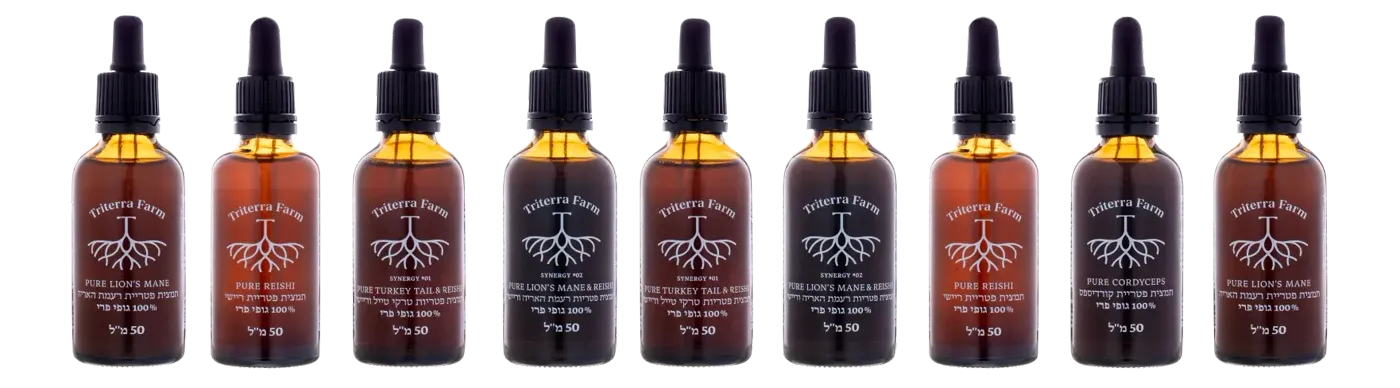
- Reishi — 25.65% β-glucan (dry basis), ratio 1:3: the reishi extract · mushrooms for sleep · reishi for stress and calm.
- Lion’s mane — 23.93%, ratio 1:2: the lion’s mane extract · mushrooms for focus · lion’s mane and brain fog.
- Cordyceps — 28.16%, the highest of our extracts, ratio 1:2.5: the cordyceps extract · cordyceps and energy.
- Turkey tail + reishi — 23.21% measured in the blend, ratio 1:3: the turkey tail & reishi extract · mushrooms for the immune system · mushrooms and digestion.
All goal pages: the goals hub · the farm and the whole range: Triterra Farm.
When do you choose reishi — and what has actually been tested in people?
Reishi when the problem is winding down: waking at night, a stress load that will not let go, the fatigue that follows. The strongest human trial gave 132 adults a reishi polysaccharide extract for 8 weeks — fatigue fell 28.3% versus 20.1% on placebo; in healthy adults, 84 days raised T cells, NK cells and IgA. No randomized trial has measured sleep as its primary outcome.
Reishi regulates; it does not sedate, and the sleep benefit people describe is studied through the stress axis. Four weeks in 40 volunteers changed nothing in coagulation; a Cochrane review (5 trials, 398 people) and a 2025 meta-analysis (17 trials, 971 people) found no effect on lipids or blood pressure. Ours: fresh fruiting bodies, 25.65% β-glucan on a dry-matter basis — the reishi extract · mushrooms for sleep · reishi for stress and calm · reishi science · the complete reishi guide · research hub.
Reishi is the most-studied mushroom in the contexts of sleep and calm — but not in the way most people imagine. It is not a sleeping pill and it does not sedate: research examines an indirect effect, through regulation of the stress response, mostly in people who fall asleep fine but wake during the night. The studied timeframe is weeks of consistent evening use, not one night.
Alongside sleep, Reishi is classed as an adaptogen and researched in the context of coping with load and stress, and on the immune front — as a modulator rather than a “booster”. We went deeper in mushrooms for sleep and Reishi for stress and anxiety, plus the Reishi science page, and the studies themselves are in our research database filtered to Reishi. The extract: Reishi, fruiting bodies only — 25.65% measured β-glucan.
And for a full introduction to reishi — history, evidence grading and safety — Reishi Mushroom: The Complete Guide.
When do you choose lion’s mane — what do the 4-, 12- and 16-week trials show?
Lion’s mane when the complaint lives in the head: brain fog, a memory that used to be sharper, a low mood. In 30 adults aged 50–80, 16 weeks raised cognitive scores at weeks 8, 12 and 16 — and they fell back within 4 weeks of stopping. In healthy adults, 12 weeks improved MMSE but not two other tests. In 30 women, 4 weeks improved depression and anxiety scales; sleep did not change.
Cumulative and reversible — which is why lion’s mane suits a daily routine and why we say judge it at week eight. Same-day data are thinner: 41 young adults were faster on a Stroop task 60 minutes after a dose, with only a trend toward lower stress at 28 days (p=0.051); a 2025 systematic review put the average MMSE gain at 1.17 points. Ours: 1:2 from fresh fruiting bodies, 23.93% β-glucan on a dry-matter basis — the lion’s mane extract · mushrooms for focus · brain fog · mood, study by study · lion’s mane science · research hub.
Lion’s Mane is the mushroom of the head. Its distinctive compounds — hericenones and erinacines — are studied in the laboratory in the context of encouraging NGF production, a protein involved in the growth and maintenance of nerve cells. In humans the research is younger, with small clinical trials around cognition, focus and clarity — the full, honest picture is in Lion’s Mane and brain fog.
On mood, the human evidence is thinner and points to a gradual effect if any — we covered it study by study in Does Lion’s Mane support mood?. More: Lion’s Mane science · the filtered studies · the extract — 23.93% measured β-glucan.
When do you choose cordyceps — and why is it not a daily tonic?
Cordyceps when the fatigue is physical and sits in the active hours — training, a demanding week, a body that runs out before the day does. In 20 adults aged 50–75, 12 weeks raised the metabolic threshold 10.5% while VO2max did not change; in a 3-week subgroup of 10 young adults VO2max rose 4.8 ml/kg/min after one week had shown nothing; 22 trained cyclists gained nothing in 5 weeks.
So: taken around need — before exertion, through a demanding period — not as the daily baseline that reishi and lion’s mane are. Not a stimulant: the trials measured oxygen use and thresholds, not alertness, which is why there is no crash. And the already-trained get the least from it — the cyclists’ null result is in our sources on purpose. Ours carries 28.16% β-glucan on a dry-matter basis, the highest of the four, at 1:2.5 — the cordyceps extract · cordyceps and energy · cordyceps science · research hub.
Cordyceps is researched around cellular energy — ATP production and oxygen use under effort — not around arousal. That is the practical difference from caffeine: it is not a stimulant, so it does not produce the crash afterwards. Human studies mostly examined weeks of use during physical effort, and its traditional use revolves around vitality and everyday endurance — see Cordyceps and energy.
It suits people whose fatigue is concentrated in the active hours — morning and midday — and recreational athletes. More: Cordyceps science · the studies · the extract — 28.16% β-glucan, the highest of our extracts.
When do you choose turkey tail — immune tuning and the gut?
Turkey tail when the goal is the immune system or digestion — and the word to hold on to is tuning, not boosting. The one controlled trial in healthy people gave 24 volunteers turkey tail polysaccharopeptide (PSP) for 8 weeks and found consistent, prebiotic-like shifts in the gut microbiome; no symptom was measured. We sell it only blended with reishi, 23.21% β-glucan measured in the blend.
The mechanism is better mapped than the outcomes: fungal β-glucans bind the Dectin-1 receptor on immune cells, yet a 2021 systematic review of 34 randomized trials called the cellular-level findings “inconsistent” — hence immunomodulation, not boosting. The solo turkey tail extract is not tested and not what we sell; the tested product is the blend — the turkey tail & reishi extract · mushrooms for the immune system · mushrooms and digestion · turkey tail science · research hub.
Turkey Tail is among the most-researched mushrooms worldwide in the immune context, thanks to its distinctive beta-glucans. The precise term is immunomodulation — regulating and balancing the immune response, not blanket “boosting”. In parallel, its fibres are studied as a prebiotic substrate in the gut: beneficial bacteria ferment them into short-chain fatty acids that feed the cells of the gut wall — see medicinal mushrooms and digestion.
We sell Turkey Tail as a blend with Reishi — that is the extract that was lab-tested, with 23.21% β-glucan measured in the blend itself. More: Turkey Tail science · the studies · the Turkey Tail & Reishi extract.
What has actually been tested in people, goal by goal?
Fewer trials than the internet implies, and smaller: most between 10 and 132 people, most between 4 and 16 weeks. This is the evidence behind the matching table — goal, mushroom, the human trial with its size and duration, what it showed, and the column most pages leave out: what it did not show.
| Goal | Mushroom | Human trial (n, duration) | What it showed | What it did not show |
|---|---|---|---|---|
| Sleep | Reishi | No randomized trial with sleep as the primary outcome | Closest: 132 adults, 8 weeks — less fatigue, better well-being | Sleep itself was not measured; no sedation |
| Stress, fatigue | Reishi | 132 adults, 8 weeks | Fatigue −28.3% vs −20.1% on placebo | Cortisol and anxiety scales not measured |
| Immune markers | Reishi β-glucan | Healthy adults, 84 days | T cells, NK cells, IgA up; liver and kidney unchanged | Fewer infections not counted |
| Focus, memory | Lion’s mane | Healthy adults, 12 weeks; 30 adults aged 50–80, 16 weeks | MMSE improved; scores higher at weeks 8, 12, 16 | Two other tests did not improve; gains faded 4 weeks after stopping |
| Mood | Lion’s mane | 30 women, 4 weeks | Depression and anxiety scales improved | Sleep (PSQI) not significant; fruiting body in cookies, not an extract |
| Endurance | Cordyceps | 20 adults 50–75, 12 weeks; 3-week subgroup of 10 | Threshold +10.5%; VO2max +4.8 ml/kg/min at 3 weeks | VO2max unchanged at 12 weeks; nothing at 1 week; a blend and a fermented product, not a fruiting-body extract |
| Trained athletes | Cordyceps | 22 trained cyclists, 5 weeks | No change in aerobic capacity or endurance | The null result — the fitter you are, the less there is to gain |
| Gut | Turkey tail (PSP) | 24 volunteers, 8 weeks | Consistent, prebiotic-like microbiome shifts | No digestive symptoms measured; PSP is one fraction, not a whole extract |
| Inflammation, lipids | Reishi | Cochrane: 5 trials, 398 people; 2025: 17 trials, 971 | No effect on lipids or blood pressure; certainty very low | “Anti-inflammatory triterpenes” remains preclinical |
Can you combine mushrooms — and when should you not?
Yes, and most people eventually do: the mushrooms work in different lanes, so lion’s mane in the morning and reishi in the evening is the classic pairing. Start with one if you want to know what is working. Do not combine anything on your own if you take blood thinners, diabetes medication or immunosuppressants — talk to your doctor first.
That is the truly common case — few people are dealing with just one thing. Two ways to approach it:
- Pick the most pressing goal and start with a single mushroom. Simpler, and it is easier to tell what is working for you.
- Combine two mushrooms — they are studied in different, complementary channels, so pairing is accepted practice: Lion’s Mane in the morning and Reishi in the evening is the classic example (focus by day, calm at night). We also make ready-made blends built around exactly these pairings.
With any combination — especially if you take regular medication, blood thinners in particular — consult a doctor before starting.
The one pairing we test as a single extract is turkey tail with reishi. Morning versus evening, with or without food, whether cordyceps belongs in the routine or only on training days: when to take medicinal mushrooms and how to stack them.
How long before you can judge whether it is working?
Four to sixteen weeks, depending on the goal, because that is how long the trials ran: 4 weeks for mood, 8 for reishi and fatigue, 8 to 12 for lion’s mane and cognition, 12 for cordyceps and threshold. Judge at the trial’s timeline, on the goal you named at the start — not on a feeling at the end of week one.
At the usual 1.4 ml a day, a 50 ml bottle lasts about 35 days and 100 ml about 70 — an honest first trial is one to two bottles. The timeline by mushroom: how long until you feel a difference; amounts: the dosage guide.
How do you verify the extract itself — three checks?
Fruiting body, not mycelium on grain; a real extraction that opens the chitin cell wall; and a β-glucan percentage measured by an outside lab with the certificate open. Once the mushroom is chosen, these three separate an extract from expensive powder — and they are the same three we hold ourselves to, in public.
Once you have chosen a mushroom, the difference between products is bigger than the difference between mushrooms. Three questions separate a real extract from expensive powder:
- Fruiting body or mycelium on grain? The studied compounds are concentrated in the fruiting body; mycelium grown on grain arrives diluted with starch. Look for an explicit “fruiting body” on the label — here is how to read it.
- Which extraction? The mushroom’s cell wall is chitin, which the body does not break down. Dual or triple extraction — water for the beta-glucans, alcohol for the triterpenes — is what actually releases the compounds.
- Is there a measured number? A serious extract comes with a β-glucan percentage measured at an external lab and an open certificate. Without a number, there is no way to know what you bought. Our certificates are open here.
Our answers: fruiting bodies grown on the farm and extracted with no drying step (fresh versus dried · fruiting body versus mycelium); a triple extraction in three phases — cold water, seven weeks in alcohol, hot water under pressure; and TÜV Austria’s measurement on the finished extract, with α-glucan “not detected” as proof that no grain went in — β-glucan versus “polysaccharides” · how to read a COA · what “1:3” describes.

Who should not start on their own — and what are these mushrooms not?
Anyone pregnant or nursing, anyone under 18, anyone on blood thinners, diabetes medication or immunosuppressants, and anyone with surgery ahead — for all of these the first step is a doctor. And for everyone: these are dietary supplements, not medicines; not a replacement for sleep, food, movement or care; and not fast.
The reassuring data are for healthy adults — 40 volunteers, 4 weeks, no change in coagulation — not for someone whose clotting or blood sugar is already managed by a drug. The lists: side effects · drug interactions · who should not take lion’s mane.
So the choice stays realistic: no mushroom cures disease, replaces medication, good sleep or professional care, and none works overnight. If you are dealing with a diagnosed medical condition, the address is a physician — a supplement can at most accompany. This is not legal boilerplate for us; it is what the research actually says, and we would rather have a customer who knows what they are buying.
What this page does not say — and what we do not claim
We do not say any mushroom treats insomnia, anxiety, cognitive decline, fatigue or infection. We do not say a β-glucan percentage predicts what you will feel. We do not say the quiz names the one exact extract for you — it helps you focus. And we do not say “clinically proven”: the trials are small, short, and not all used products like ours.
What we can say is what is in the bottle, because it was measured:
| Extract | β-glucan (dry basis) | α-glucan (starch) |
|---|---|---|
| Cordyceps | 28.16% | Not detected |
| Reishi | 25.65% | Not detected |
| Lion’s mane | 23.93% | Not detected |
| Turkey tail + reishi | 23.21% | Not detected |
Tested at TÜV Austria on the finished extract; all of our tests are open on the lab results page — “How to read a lab report (COA)” · β-glucan versus polysaccharides · extraction ratio.
Our short quiz helps you pin down the goal and leave with a clear starting direction — and our chat is always there for questions.
A few short questions that help narrow the choice — and our chat is here for anything else.
Know your goal? Then you know your row. Fresh fruiting bodies from our farm in the Galilee, triple-extracted over seven weeks, tested at TÜV Austria — with a 100-day trial, free shipping over ₪285 and a 10% club discount on top of quantity pricing. Still between two rows? The quiz helps you focus. Take the matching quiz All extracts
The bottom line
Choose by goal. Reishi has the largest human trial of the four — 132 people, 8 weeks, less fatigue — and no sleep trial at all. Lion’s mane has the clearest time course — gains by week 8, gone within 4 weeks of stopping. Cordyceps has the most honest split — a threshold that rose in older adults, nothing in trained cyclists — and belongs around exertion. Turkey tail has one gut trial and a mechanism, and comes from us only blended with reishi. The mushroom is chosen by what bothers you; the extract by what was measured — and we publish both.
Frequently asked questions
Which mushroom is best for beginners?
The one that fits your goal — there is no “beginner’s mushroom”. If you need a rule of thumb: start from the goal that bothers you most, with a single mushroom, and give it several weeks of consistent use before drawing conclusions.
Can I take several mushrooms together?
Yes, it is accepted practice — the mushrooms are studied in different, complementary channels. A common pairing: Lion’s Mane in the morning for focus and Reishi in the evening for calm. If you take regular medication, consult a doctor before combining.
How long until you feel an effect?
The studies examine weeks of consistent use — not days. Any effect is cumulative and varies from person to person. There is no guaranteed timeline, and anyone promising one is not showing you the research.
Which is better — a single mushroom or a blend?
For one clear goal — a single mushroom; it is also easier to tell what is working for you. For several adjacent goals — a ready-made blend can fit. Our blends are built around accepted pairings such as Lion’s Mane with Reishi.
How do you choose between products of the same mushroom?
Three things: fruiting body only (not mycelium on grain), an extraction method that breaks the cell wall (dual or triple), and a β-glucan percentage measured at an external lab with an open certificate. A product without a measured number is a gamble.
Are functional mushrooms safe for daily use?
For most healthy adults — yes, at customary amounts, and they have been eaten as traditional food for many years. The exceptions: pregnancy and nursing, children, people on regular medication (blood thinners and diabetes medication especially) and before surgery — all of these call for consulting a doctor.
Do you need breaks from taking them?
No uniform protocol has been established in research. Some users take a short break after a few months of continuous use. What the studies do make clear: consistency over weeks matters more than any sophisticated timing.
Where can I see the lab tests?
All of our test reports are open on the lab results page — for every tested extract you can see the full TÜV Austria certificate, with a certificate number you can verify with the lab directly.
Scientific sources (peer-reviewed)
- Reishi polysaccharide extract, 132 adults, 8 weeks: fatigue −28.3% vs −20.1% on placebo. Tang W, Gao Y, Chen G, et al. Journal of Medicinal Food, 2005;8(1):53-58. View on PubMed
- Reishi β-glucan, healthy adults, 84 days: T cells, NK cells and IgA up; liver and kidney unchanged. Chen SN, Nan FH, Liu MW, et al. Foods, 2023;12(3):659. View on PubMed
- Reishi, 40 healthy volunteers, 4 weeks: no change in platelet function or coagulation. Kwok Y, Ng KFJ, Li CCF, Lam CCK, Man RYK. Anesthesia & Analgesia, 2005;101(2):423-426. View on PubMed
- Cochrane review, 5 trials, 398 people: reishi not supported for cardiovascular risk factors. Klupp NL, et al. Cochrane Database of Systematic Reviews, 2015. View on PubMed
- Meta-analysis, 17 trials, 971 participants: no effect of reishi on lipids or blood pressure; GRADE very low. Jafari A, et al. Food Science & Nutrition, 2025. View on PubMed
- Lion’s mane, 30 adults aged 50–80, 16 weeks: scores higher at weeks 8, 12 and 16; fell back 4 weeks after stopping. Mori K, Inatomi S, Ouchi K, Azumi Y, Tuchida T. Phytotherapy Research, 2009;23(3):367-372. View on PubMed
- Lion’s mane, healthy adults, 12 weeks: MMSE improved; Benton and verbal-learning tests did not. Saitsu Y, Nishide A, Kikushima K, Shimizu K, Ohnuki K. Biomedical Research, 2019;40(4):125-131. View on PubMed
- Lion’s mane fruiting body, 30 menopausal women, 4 weeks: depression and anxiety scales improved; sleep not significant. Nagano M, Shimizu K, Kondo R, et al. Biomedical Research, 2010;31(4):231-237. View on PubMed
- Lion’s mane, 41 young adults: Stroop faster at 60 minutes; stress trend at 28 days (p=0.051). Docherty S, Doughty FL, Smith EF. Nutrients, 2023;15(22):4842. View on PubMed
- Systematic review of lion’s mane in humans, 5 RCTs and 3 pilots: average MMSE gain 1.17 points. Menon A, Jalal A, Arshad Z, Nawaz FA, Kashyap R. Frontiers in Nutrition, 2025;12:1641246. View on PubMed
- Cordyceps-containing mushroom blend, 28 young adults: nothing at 1 week; at 3 weeks (n=10) VO2max +4.8 ml/kg/min. Hirsch KR, Smith-Ryan AE, Roelofs EJ, Trexler ET, Mock MG. Journal of Dietary Supplements, 2017;14(1):42-53. View on PubMed
- Fermented cordyceps mycelial product, 20 adults aged 50–75, 12 weeks: metabolic threshold +10.5%; VO2max unchanged. Chen S, Li Z, Krochmal R, et al. Journal of Alternative and Complementary Medicine, 2010;16(5):585-590. View on PubMed
- Cordyceps, 22 trained cyclists, 5 weeks: no effect on aerobic capacity or endurance. Parcell AC, Smith JM, Schulthies SS, et al. International Journal of Sport Nutrition and Exercise Metabolism, 2004;14(2):236-242. View on PubMed
- Cordyceps, 1 g before high-intensity exercise, 14 young adults (crossover): CD34+ cell recruitment brought forward from 24 h to 3 h. Dewi L, Liao YC, Jean WH, et al. Food & Function, 2024;15(8):4010-4020. View on PubMed
- Turkey tail polysaccharopeptide, 24 healthy volunteers, 8 weeks: consistent, prebiotic-like microbiome shifts. Pallav K, Dowd SE, Villafuerte J, et al. Gut Microbes, 2014;5(4):458-467. View on PubMed
- Systematic review of 34 randomized trials of fungal β-glucans: cellular-level findings “inconsistent”. Vlassopoulou M, Yannakoulia M, Pletsa V, Zervakis GI, et al. Food & Function, 2021;12(8):3366-3380. View on PubMed
Read next
- The goals hub — every use-case page in one place
- Mushrooms for sleep
- Reishi for stress and calm
- Mushrooms for focus
- Lion’s mane and brain fog
- Cordyceps and energy
- Mushrooms for the immune system
- Medicinal mushrooms and digestion
- The matching quiz
- Triterra Farm — the farm and the whole range
- How long until you feel a difference
- When to take medicinal mushrooms and how to stack them
- Research hub — every study, including the negative ones
These statements have not been evaluated by the Food and Drug Administration. This product is not intended to diagnose, treat, cure or prevent any disease. The information in this article is for general knowledge only and is not medical advice or a substitute for professional care. Consult a qualified professional before using any dietary supplement, especially if you take medication, are pregnant or nursing, or have a diagnosed medical condition.
This page is educational and does not constitute medical advice. Medicinal mushroom extracts are dietary supplements, not medicines; do not begin use while taking medication, during pregnancy or nursing, or with an existing medical condition without consulting a physician. *These statements have not been evaluated by the Food and Drug Administration. This product is not intended to diagnose, treat, cure, or prevent any disease.*
The research behind Reishi — 16 PubMed studies, the good and the bad →
