
Medicinal Mushroom Dosage: How Many Drops, How to Titrate, and What the Trials Actually Used
- The working daily dose of a fruiting-body tincture is 1-2 ml, about 1.4 ml for most people, reached gradually over three to four weeks.
- One full dropper holds 1 ml, roughly 30 drops, so titration opens near half the target and adds 0.5 ml each week.
- Cordyceps is the exception, capped at 1 ml a day at any body weight, since more brings over-alertness rather than extra energy.
- Human trials used grams of powder or powdered extract, a different unit from a tincture, with no honest conversion between them.
- Before starting, talk to a physician about three things in particular: blood thinners, immunosuppressants and diabetes medication.
Reishi (Ganoderma lucidum, lingzhi), lion’s mane (Hericium erinaceus, yamabushitake), cordyceps and turkey tail (Trametes versicolor, yun zhi) are medicinal mushrooms usually taken as a daily liquid extract — and the first practical question is always the same: how much? For a fruiting-body extract like ours the daily dose is 1–2 ml a day, typically about 1.4 ml, reached gradually over three to four weeks rather than on day one. One full dropper is 1 ml, roughly 30 drops. Cordyceps is the exception: 0.5–1 ml a day, and never more. This page gives you the whole method — drops per ml, the four-week titration protocol by goal and body weight, the cordyceps ceiling, which medications call for a conversation first — and, unlike every other dosage chart online, it puts the doses the human trials actually used next to the bottle, and says plainly where the two cannot be compared.
Why this page reads differently from the usual “dosage guide”. We looked at what ranks for this question in English before writing. Brands publish a flat number (“2 ml per day, per tincture”), capsule sellers publish “500–1,000 mg”, and health portals publish “500–3,000 mg in studies” — three different units for three different products, and none of them explains how to move between them, because you cannot. We grow and extract the mushrooms ourselves and publish the lab test for each extract, so we can tell you exactly what is measured, what is a farm protocol, and what is a number nobody actually has. All three kinds appear below, labelled as such.
Key takeaways
- The daily dose: 1–2 ml of extract a day for most of our mushrooms (about 1.4 ml is typical), reached by titration; the exact dose is printed on each label. Cordyceps: 0.5–1 ml a day, capped at 1 ml regardless of body weight or how you feel.
- Drops and droppers: 1 ml = one full dropper ≈ 30 drops (one drop ≈ 0.033 ml). A 50 ml bottle at 1.4 ml a day lasts about 35 days; 100 ml about 70.
- Titration: start at 0.5–1.5 ml (lower if your gut is sensitive), add 0.5 ml a week, and reach the target in week 3–4. Split into two intakes once you are at 1.5–2 ml.
- Body weight: under 55 kg the protocol takes 75% of the standard doses; under 30 kg it stops and refers you to a practitioner — that is the children’s page, not this one.
- What the trials used: grams of dried mushroom or powdered extract per day — 3 g of lion’s mane powder for 16 weeks, 5.4 g of a reishi polysaccharide extract for 8 weeks, 1 g of a cordyceps preparation for 12 weeks. A tincture in ml is not the same unit, and we will not pretend to convert it.
- Before you dose: blood thinners, immunosuppressants and diabetes medication are the three conversations to have first; pregnancy, breastfeeding, children and liver disease are the cases where this guide does not apply.
How much medicinal mushroom extract should you take per day?
For a triple-extracted fruiting-body tincture, the working daily dose is 1–2 ml, once a day or split in two — for most people about 1.4 ml, which is what we use for supply maths and what the label reflects. You do not start there: the first week runs at roughly half the target, and the full dose arrives in week 3–4. Cordyceps sits apart, at 0.5–1 ml a day with a hard ceiling of 1 ml.
Two things decide the number before any protocol does. The first is what is in the bottle. A 1 ml dose of an extract made from 100% fruiting body, with a measured beta-glucan content of 23–28% on the dry matter of the finished extract, is a different object from 1 ml of a product built on mycelium grown on grain, where the dry matter is mostly starch — the difference is spelled out in beta-glucan vs “polysaccharides” and on the lab-testing page. The second is the form. A liquid extract has already been extracted: the water-soluble beta-glucans and the alcohol-soluble triterpenes are dissolved and ready, which is why the daily volume is millilitres rather than the grams a raw powder needs — the comparison lives on the powder, capsules or tincture page. Everything below assumes an extract like ours. If you are holding a powder or a capsule, the numbers on this page are not your numbers; the trial-dose table further down is closer to your world.
How many drops are in 1 ml — and how do you measure a dose accurately?
One full dropper of our pipette holds 1 ml, which is about 30 drops — one drop is roughly 0.033 ml. So a 1.4 ml daily dose is a full dropper plus about a third, or around 40 drops; a 0.5 ml starting dose is half a dropper, about 15 drops. Counting drops is fine for the low starting doses; from 1 ml upwards it is easier and more accurate to read the dropper.
The technique matters more than people expect. Squeeze the bulb before the pipette enters the liquid (so you are not blowing air into the bottle), release fully to draw a complete millilitre, and dispense under the tongue, holding for 15–30 seconds before swallowing — the sublingual route is the one we recommend, and the one Shlomi demonstrates in the short pipette video on the Hebrew calculator page. If the taste bothers you (reishi is bitter), the drops can go into water, juice or a drink that has cooled below hot — never boiling; we explain why on the storage page. What does not work is guessing “a splash”: the whole point of titration is that you know the number each week.
What is titration, and why do we insist on starting low?
Titration means reaching your maintenance dose in steps rather than in one jump: a low opening dose for the first week, plus 0.5 ml each week, until you are at the target in week 3–4. We insist on it for two reasons — a body meeting concentrated beta-glucans and triterpenes for the first time does better with a controlled introduction (the usual complaint from jumping straight in is mild gut discomfort), and because the titration weeks tell you your own effective dose, which no chart can.
There is a third reason, which is scientific honesty. The controlled trials of these mushrooms measured effects after weeks of a fixed daily dose — 4 to 16 weeks, as we laid out in how long medicinal mushrooms take to work. Nothing in that research supports the idea that a larger first dose gets you there faster; what it supports is reaching a steady daily amount and holding it. Titration is simply the safest way to get to “steady”. The generic four-week shape looks like this:
| Week | Standard start | Sensitive gut | Acute protocol (practitioner-guided) |
|---|---|---|---|
| Week 1 | 1.5 ml | 1 ml | 2 ml |
| Week 2 | 2 ml (target) — split into two intakes | 1.5 ml | 2.5 ml |
| Week 3 | 2 ml | 2 ml (target) | 3 ml (target) — split |
| Week 4 onward | 2 ml | 2 ml | 3 ml, reassess at 6–8 weeks |
That is the reishi and lion’s mane (cognitive) shape from our farm protocol; the gut protocol, the turkey tail blend and cordyceps open lower and stop lower — the full table by goal is next. If at any step you feel gut discomfort, go back one step for 5–7 days and climb again. And if you weigh under 55 kg, read the body-weight section before you use any of these numbers.
What is the dose by goal — the farm’s five protocols in one table?
Our practitioner calculator works from five protocols, each with an opening dose, a target, a split point and a time of day. They are farm protocols — built from practitioner experience with our extracts, not from a dose-finding trial, because no such trial exists for a tincture — and they are the numbers we give in Hebrew, published here in full for the first time in English.
| Goal (extract) | Opening dose / sensitive | Target | Split into two from | When | Acute protocol |
|---|---|---|---|---|---|
| Stress, calm and sleep (reishi) | 1.5 ml / 1 ml | 2 ml | 2 ml | Evening, near bedtime | 2 → 3 ml |
| Focus, memory, cognition (lion’s mane) | 1.5 ml / 1 ml | 2 ml | 2 ml | First half of the day | 2 → 3 ml |
| Gastric lining and digestion (lion’s mane) | 1 ml / 0.5 ml | 1.5 ml | 1.5 ml | Empty stomach, 15–30 min before a meal | 1.5 → 2 ml (ceiling) |
| Energy, endurance, performance (cordyceps) | 0.5 ml / 0.5 ml | 1 ml — hard ceiling | Never | Morning, or 30 min before activity; not in the evening | 1 ml — no increase |
| Gut microbiome and immune support (turkey tail + reishi) | 1 ml / 0.75 ml | 1.5 ml | 1.5 ml | Morning, empty stomach | 2 → 3 ml |
Three notes. The “acute protocol” column is for practitioners working with someone in a demanding period — it opens higher and climbs faster, and it is the only place a 3 ml day appears; it is not the default, and we do not recommend choosing it for yourself. The lion’s mane gut protocol deliberately stops at 2 ml even in acute mode, because mucosal support does not need more. And all five columns, except cordyceps, are reduced by a quarter for lighter bodies — see below. Which goal is yours in the first place is a separate question; which mushroom is right for me and the by-goal hub answer it, and the two-minute quiz does it for you.
How does body weight change the dose?
Our protocol treats weight as an edge-case handler, not a linear multiplier. Above 55 kg, the standard doses apply. Between 30 and 54 kg, opening and target doses are reduced to 75% and rounded to the nearest quarter-millilitre — a 2 ml target becomes 1.5 ml. Under 30 kg the calculator stops and refers to a practitioner: that is a child, and children are a different conversation entirely.
Why not scale by weight all the way up? Because the trials did not: every human study in the table below gave one fixed dose to every adult participant, whatever they weighed, and the outcomes were measured on that basis. Scaling upward would be inventing precision the evidence does not have. Scaling down for smaller adults is a caution we choose, for the same reason we titrate at all. Cordyceps is exempt from the reduction — its 0.5–1 ml range is already the minimum we work with. And the under-30 kg stop is not a formality: the alcohol in an extract (about 32% by volume, so roughly 0.45 ml of ethanol in a 1.4 ml dose) is a real consideration in a small body, which is why the children’s page does the arithmetic rather than offering a dose.
Why is cordyceps capped at 1 ml — and why not “more for more energy”?
Because at our farm cordyceps is not a daily baseline tonic — it is the mushroom you take around need: before physical effort, through a demanding stretch, on the days you want the lift. The protocol opens at 0.5 ml, reaches 1 ml, and stops there for everyone, at every weight, in every mode. Above that, what people report is not more energy but over-alertness and disturbed sleep; the ceiling is where the useful range ends.
It is worth being precise about what cordyceps is not. It is not a caffeine-like stimulant — the research context is oxygen use and ATP, a steadier kind of energy, which is why it is taken in the morning or half an hour before activity and not in the evening. The human trials point the same way: after one week of daily use nothing significant moved; after three weeks maximal oxygen uptake rose in one small study, and after twelve weeks the metabolic threshold rose in older adults — while a five-week trial in trained cyclists at 3 g a day found no effect at all. Give it weeks of consistent use, not a bigger dropper. The trials and their honest limits are on the cordyceps for athletes page and the cordyceps science page.
What doses did the human trials actually use — and how does a tincture compare?
The trials used grams of dried mushroom powder or of a powdered extract per day, taken as tablets or capsules — 3 g a day of lion’s mane fruiting-body powder for 16 weeks, 1.8 g for 28 days, 5.4 g a day of a reishi polysaccharide extract for 8 weeks, 1.5–4 g of reishi in the safety studies, about 1 g a day of a cordyceps preparation for 12 weeks. None of them tested an alcohol-and-water tincture measured in millilitres. The two units describe different products, and there is no honest conversion between them.
| Mushroom | Trial | Daily dose and form | Duration and participants | What it found |
|---|---|---|---|---|
| Lion’s mane | Mori 2009 | 3 g/day — four 250 mg tablets of 96% dry fruiting-body powder, three times a day | 16 weeks, 30 adults with mild cognitive impairment | Cognitive scores above placebo at weeks 8, 12 and 16; fell after stopping |
| Lion’s mane | Saitsu 2019 | Fruiting-body supplement (tablets) | 12 weeks, healthy adults | MMSE improved; two other tests unchanged |
| Lion’s mane | Nagano 2010 | Cookies containing fruiting-body powder | 4 weeks, 30 women | Lower depression and anxiety scores |
| Lion’s mane | Docherty 2023 | 1.8 g/day | 28 days + a single acute dose, 41 young adults | Faster Stroop at 60 min; stress trend at 28 days; null findings alongside |
| Lion’s mane | Surendran 2025 | Single 3 g dose of a 10:1 extract | 90 minutes, 18 young adults | No change in composite cognition or mood; one motor test improved |
| Lion’s mane | La Monica 2023 | Single 1 g dose of a Nordic-grown extract | 1–2 hours, crossover | Working memory and reaction-time measures improved at 2 h |
| Reishi | Tang 2005 | 5.4 g/day — 1,800 mg of a polysaccharide extract, three times a day | 8 weeks, 132 adults with chronic exhaustion | Fatigue down 28.3% vs 20.1% on placebo |
| Reishi | Wicks 2007 | 4 g/day — 2 g of extract twice daily | 10 days, 16 healthy volunteers | Safe and well tolerated; no adverse effects |
| Reishi | Kwok 2005 | 1.5 g/day in capsules | 4 weeks, 40 healthy volunteers | No change in coagulation or platelet function |
| Reishi | Wachtel-Galor 2004 | Single 1.1 g and 3.3 g doses; then 0.72 g/day | 3 hours; 10 days; 10 volunteers | Antioxidant markers rose transiently |
| Reishi | Chen 2023 | Isolated reishi beta-glucan, daily | 84 days, healthy adults 18–55 | T and NK cells up; liver and kidney markers unchanged |
| Cordyceps | Chen 2010 | About 1 g/day — 333 mg of a cordyceps preparation, three times a day | 12 weeks, 20 adults aged 50–75 | Metabolic threshold up 10.5%; VO2max unchanged |
| Cordyceps | Hirsch 2017 | 4 g/day of a mushroom blend containing cordyceps | 1 week (28 adults), 3 weeks (10 of them) | Nothing at one week; VO2max +4.8 ml/kg/min at three |
| Cordyceps | Parcell 2004 | 3 g/day of a cordyceps preparation, tablets | 5 weeks, 22 trained cyclists | No effect on aerobic capacity or time trial |
| Cordyceps + reishi | Tsuk 2017 | A commercial supplement, high- and low-dose groups | 30 days, 96 students | No cognitive difference at either dose |
| Turkey tail | Pallav 2014 | Polysaccharopeptide (PSP), daily | 8 weeks, 24 healthy volunteers | Consistent prebiotic-type microbiome changes |
| Fungal beta-glucan (all sources) | Vlassopoulou 2021, systematic review | 2.5 mg to 1,000 mg of isolated beta-glucan a day across 34 RCTs | Up to 6.5 months | Mostly immune outcomes; findings inconsistent at the cellular level |
Read the middle column and you will see the problem with every “how much” chart online: a 250 mg tablet of dried powder, 1,800 mg of a polysaccharide extract, 3 g of a 10:1 extract and 2.5 mg of isolated beta-glucan are four different substances with four different amounts of active material in them, and they are all quoted as “the dose”. A tincture adds a fifth unit. What connects them is not the number on the label but how much beta-glucan (and, for reishi, triterpene) actually reached the person — and for most of these trials, that figure is not reported at all. So we do not write “our 1.4 ml equals the 3 g in the study”. We write what we can measure, and what we cannot.
Why we won’t convert “ml” into milligrams of beta-glucan
Because the lab number we have is a percentage of the dry matter of the finished extract — 23.21% to 28.16% beta-glucan, tested at TÜV Austria — and turning that into “milligrams per dropper” would require a per-millilitre assay of the liquid that we have not commissioned. Multiplying the percentage by the grams of mushroom that went into the bottle assumes full extraction, which no one has demonstrated. So the honest sentence is: the beta-glucan content is measured and published; the milligrams in your dose are not.
| Extract | Beta-glucan (dry basis) | Alpha-glucan (starch) | Extraction ratio, fresh fruiting body |
|---|---|---|---|
| Cordyceps | 28.16% | Not detected | 1:2.5 — about 20 g of fresh mushroom in every 50 ml |
| Reishi | 25.65% | Not detected | 1:3 — about 16–17 g in every 50 ml |
| Lion’s mane | 23.93% | Not detected | 1:2 — about 25 g in every 50 ml |
| Turkey tail + reishi | 23.21% | Not detected | 1:3 — about 16–17 g in every 50 ml |
Those two columns are the ones that actually tell you what a millilitre is worth — a verified beta-glucan concentration with starch not detected (the chemical proof that no grain filler went in), and a fresh-mushroom extraction ratio that is disclosed as fresh-basis, because a 1:2 on fresh mushroom is not a 1:2 on dried. The certificates are open on the lab page, and how to read a test report walks through them line by line. We wrote the same refusal into the price page, under “the number we won’t publish”, and the reasoning is identical: a number we cannot stand behind is worth less than an honest blank.
Once a day or split in two — does it matter?
Split when you reach 1.5–2 ml a day, mainly for comfort and consistency: two smaller intakes are gentler on a sensitive stomach and easier to remember as a morning-and-evening habit. Below that, one intake is fine. No human trial has compared once-daily with divided dosing of a mushroom extract, so this is practice, not evidence — and the evidence that does exist points at a different variable entirely: taking it every day.
The trials in the table above all used a fixed daily amount, often divided into three doses simply because that is how tablets are prescribed — not because three was tested against one. What every one of them shares is “daily, for weeks”, and what two of them show is that the effect faded within weeks of stopping. So if a split dose helps you not skip days, split; if it makes you forget the second one, don’t. Morning-versus-evening, empty stomach or with food, and whether reishi, lion’s mane and cordyceps can go in the same glass are all on the timing and stacking page — the short version is that consistency beats timing.
Can you take too much — and what happens if you do?
Going above the protocol is not dangerous in the sense of an overdose, but it is not useful either: the benefit curve flattens, and what rises instead is gut discomfort (bloating, wind, loose stools) from a load of polysaccharides the intestine did not get to adapt to — and, with cordyceps, over-alertness and poor sleep. The fix is to step back to the previous dose for 5–7 days and climb again. The one line never to cross is 1 ml of cordyceps a day.
For context on tolerability, the controlled trials are reassuring at doses far above anything on this page: 5.4 g a day of a reishi extract for 8 weeks, 4 g a day for 10 days with no adverse effects, 1.5 g a day for 4 weeks with normal coagulation throughout, 84 days of reishi beta-glucan with liver and kidney markers unchanged, and 3 g a day of lion’s mane powder for 16 weeks. Cochrane’s review of reishi trials in cancer care likewise recorded only scattered minor complaints. Against that stand a handful of published case reports of liver injury after reishi powders or formulations — one of them after a reishi powder was taken together with alcohol — which we mention not because a tincture is the same product, but because “natural” is not a safety argument and because our extract itself contains alcohol. If you have liver disease, this page is not your dosing guide; your physician is. The broader picture — what is documented, what is theoretical, what is animal-only — is in the side-effects guide and, for lion’s mane specifically, in who shouldn’t take lion’s mane.
Which medications require a conversation before you dose?
Three groups: blood thinners (warfarin/Coumadin, apixaban/Eliquis, rivaroxaban/Xarelto), immunosuppressants, and diabetes medication. For each, the basis is different — and we think you deserve to know which is a documented human finding and which is a laboratory signal — but the practical advice is the same: do not start or change a dose without your physician or pharmacist in the loop, and never adjust a medication around a mushroom.
| Medication group | What the evidence actually is | What to do |
|---|---|---|
| Anticoagulants and antiplatelets | Reishi compounds inhibit platelet aggregation in the test tube; a randomized trial of 1.5 g/day reishi for 4 weeks in 40 healthy volunteers found no change in any coagulation measure. Lion’s mane’s hericenone B inhibits platelets in vitro only — no human case. Memorial Sloan Kettering still advises anyone on warfarin to talk to their provider, and so do we. | Consult first; if you proceed, your physician may want closer monitoring around dose changes. Stop 2 weeks before surgery unless told otherwise. |
| Immunosuppressants | Beta-glucans are studied precisely for their effect on immune-cell activity (T and NK cells rose in the 84-day reishi trial). A drug designed to dampen that activity and a supplement studied for tuning it are working on the same system. | Not without your transplant or rheumatology team. This is a theoretical opposition, but the stakes are too high for a farm protocol. |
| Diabetes medication | Lion’s mane lowered blood glucose in diabetic rats; a Cochrane review of five reishi trials (398 participants) on blood glucose, blood pressure and lipids found the evidence too limited to conclude either way. | Consult, and if you proceed, monitor glucose more closely during the titration weeks. Do not change medication doses yourself. |
Beyond these three, the general principle is on the drug-interactions page: any biologically active substance can change how another one behaves, and “natural” is not an exemption. The table above is the whole of what we found for the four mushrooms we grow; where a competitor’s page lists twenty interactions without a source, that is not more information — it is less.
Who should not use this guide at all?
Four groups, and for each there is a dedicated page that explains the reasoning instead of hiding it in a footnote. Pregnancy and breastfeeding: not now — not because harm is proven, but because no human safety study exists for any of the four mushrooms, and an alcohol-based extract adds a second reason. Children under 30 kg: the protocol stops, and the alcohol arithmetic alone rules out our extract. A diagnosed mushroom allergy: no extract, full stop. Liver disease: no alcohol-based extract without a physician.
The pregnancy and breastfeeding page lays out every animal study and the empty LactMed record, so that “no” comes with its evidence. The children’s page does the ethanol maths against the European regulator’s tolerance level for children, which is why the answer for our extract is no even where a physician has approved the mushroom itself. A gut sensitivity to culinary mushrooms is not the same as an allergy and usually does not predict a problem with an extract; a true allergic reaction — hives, wheezing, swelling — is a hard stop, and the documented cases for lion’s mane are on its safety page. Adults over 70 are not excluded, but our protocol slows down for them: open at 0.25–0.5 ml and step up every 7–10 days rather than weekly, with the medication check above done first.
How long should you stay at the maintenance dose before judging?
Eight to twelve weeks at the full dose, counted from the day you reach it — not from the first drop. That is the measurement point of the cognition and immune-cell trials; mood and sleep scales moved at four weeks in the shortest study. A 50 ml bottle at 1.4 ml a day is about 35 days, so the first bottle covers titration plus the first four-week window; the second gets you to twelve.
The reasoning, trial by trial, is on how long medicinal mushrooms take to work, together with a simple n-of-1 protocol: three variables scored 0–10 before the first drop and once a week after, so that at week five you are comparing numbers rather than impressions. Our 100-day trial period is deliberately longer than any 12-week trial in the table. Two mistakes we see most: counting the titration weeks as “a month of use”, and judging a cognitive goal at week four when the research says twelve.
What if you feel nothing — should you increase the dose?
Only after 6–8 weeks at the full target, and only by one step: from 1 ml once a day to 1 ml twice a day, or from 1.5 to 2 ml — never above the protocol ceiling, and never above 1 ml for cordyceps. Before you increase at all, check two things: whether the goal you chose matches the mushroom (reishi will not deliver a burst of energy; it regulates), and whether the measure you are judging by is one that can be felt at all.
Most of what the trials measured — a screening score, a cell count, a metabolic threshold — is not something you feel, and most of what is felt quickly is what expectation produces; the 2005 reishi trial’s placebo group reported 20% less fatigue on an empty capsule. So “nothing after a month” is often not a dosing problem. If the baseline you scored before starting has not moved by week twelve, the useful moves are switching mushroom by goal (the guide or the quiz) or talking to us — not a third dropper. And increasing beyond the protocol “to be sure” is the one thing that reliably produces the gut symptoms people then blame on the mushroom.
Stopping and cycling — do you need to taper?
No. Medicinal mushrooms are not habit-forming and there is no withdrawal to manage; you can stop on any day, and if you stop because of an unusual reaction you should stop immediately. What the research shows is only that the measured effect fades — cognitive scores dropped within four weeks of stopping in the 16-week lion’s mane trial — so stopping simply returns you, gradually, to where you started.
On “cycling” — five days on, two off; three months on, two weeks off — the honest position is that no study has compared continuous with cyclical intake, and the two trials that looked at stopping found the effect wearing off. Some practitioners still like a periodic break as a way to re-check the baseline; that is a preference, not an instruction, and it is worth doing with the same three-line diary so you learn something from it. The longer answer, including the question of dependence, is on are medicinal mushrooms addictive? and the cycling question is on the timing page.
What this guide does not say — and what we do not claim
We do not claim these doses were tested in a clinical trial — they are a farm protocol built on practitioner experience with our own extracts, and we label them as such. We do not convert millilitres into milligrams of beta-glucan, because we have not measured that. We do not say a tincture “works at a lower dose than powder because it absorbs better” — no trial compared them. And we do not offer a dose for any medical condition, pregnancy, breastfeeding or a child.
What we do stand behind is on the label and in the lab report: 100% fruiting body from our farm in the Galilee, fresh into extraction without a drying step, seven weeks in alcohol as part of a triple extraction, a fresh-basis extraction ratio of 1:2 to 1:3, and a beta-glucan figure per extract tested at TÜV Austria with starch not detected. The fresh-or-dried page and the extraction page explain how the bottle is made; this page explains how to use it. For the per-mushroom deep dives, the lion’s mane dosage guide and the reishi dosage guide go further into each.
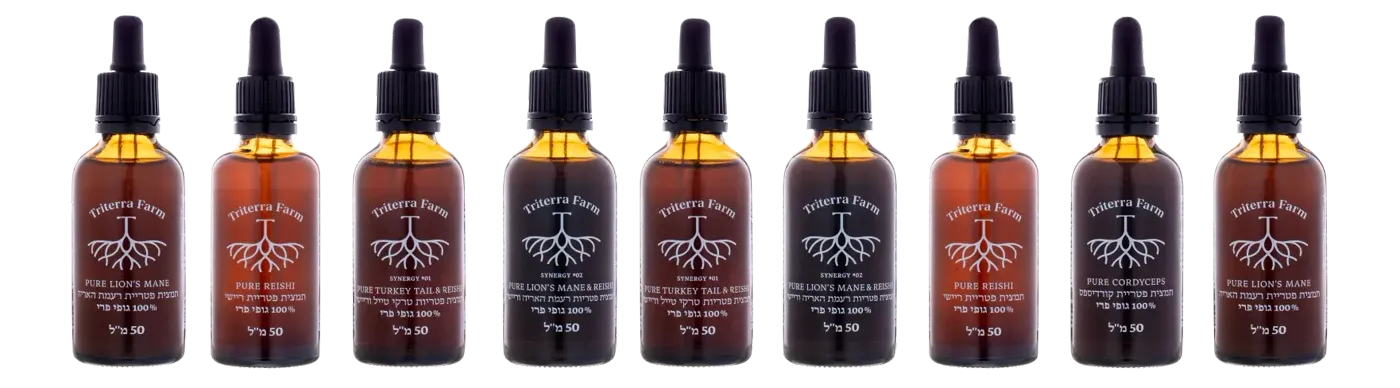
Ready to start your titration? Every Triterra extract — reishi, lion’s mane, cordyceps, turkey tail + reishi and lion’s mane + reishi — ships with a 1 ml dropper, an open lab test per extract, a 100-day trial period, free shipping in Israel over ₪285 and a club discount. Not sure which protocol is yours? The quiz takes two minutes. Take the quiz All extracts
The bottom line
Take 1–2 ml a day of a fruiting-body extract — about 1.4 ml for most people, 0.5–1 ml for cordyceps and never more — and get there by titration: half a dropper to a dropper and a half in week one, half a millilitre more each week, target in week 3–4, split in two from 1.5–2 ml, a quarter less if you weigh under 55 kg. Hold the full dose for 8–12 weeks before you judge, measure something instead of waiting for a feeling, and have the blood-thinner, immunosuppressant or diabetes conversation before the first drop. The trials used grams of powder; we sell millilitres of extract; the two do not convert, and we will not pretend they do. What is in each millilitre, we measure and publish. How many of them you take, this page tells you — and where the evidence ends, so does our advice.
Frequently asked questions
How many drops of mushroom extract should I take a day?
About 40 drops for a typical 1.4 ml daily dose — one full dropper (1 ml, about 30 drops) plus a third. Start lower: a 0.5 ml opening dose is roughly 15 drops, 1 ml is a full dropper. Cordyceps stays at 15–30 drops (0.5–1 ml) a day. From 1 ml upward, reading the dropper is more accurate than counting.
How many ml of mushroom tincture per day?
1–2 ml a day for reishi, lion’s mane and the turkey tail + reishi blend, reached over 3–4 weeks of titration; about 1.4 ml is typical and the exact dose is on the label. Cordyceps: 0.5–1 ml, capped at 1 ml. Under 55 kg, take three-quarters of those figures. The 3 ml “acute” doses in our protocol are for practitioner-guided use only.
Can I take 2 ml at once, or should I split it?
You can take it at once, but from 1.5–2 ml we suggest splitting into morning and evening — it is easier on a sensitive stomach and easier to keep up as a habit. No trial has compared single with divided dosing; what the trials do show is that taking it every day matters more than when.
What happens if I take too much mushroom extract?
Usually gut discomfort — bloating, wind or loose stools — and with cordyceps, over-alertness and poor sleep; not a medical emergency, but not a benefit either. Go back one step for 5–7 days and climb again. The controlled trials used far larger amounts of powder or extract (up to 5.4 g a day for 8 weeks) without notable adverse effects, but a few case reports of liver injury after reishi powders exist — liver disease means no alcohol-based extract without a physician.
Does the dose depend on body weight?
Only at the edges. Above 55 kg the standard protocol applies; between 30 and 54 kg the opening and target doses are reduced to 75%; under 30 kg the protocol stops and refers to a practitioner. Cordyceps is not reduced — it is already at its minimum. Scaling upward for heavier adults is not supported: every human trial gave one fixed dose to everyone.
How much lion’s mane did the studies use?
3 g a day of dried fruiting-body powder (four 250 mg tablets, three times a day) for 16 weeks in the 2009 trial; 1.8 g a day for 28 days in the 2023 pilot; a single 3 g dose of a 10:1 extract in the 2025 acute study; and a single 1 g dose in another. Those are grams of powder or powdered extract — not millilitres of tincture, and there is no honest conversion between them.
Can I take mushroom extract with blood thinners?
Not without your physician. Reishi compounds inhibit platelets in the test tube, although a four-week trial of 1.5 g a day in healthy volunteers found no change in coagulation; Memorial Sloan Kettering still advises anyone on warfarin to consult first, and so do we. Lion’s mane’s platelet effect has only been shown in vitro. Stop about two weeks before surgery unless told otherwise.
How long does a 50 ml bottle last?
About 35 days at a typical 1.4 ml a day, and about 70 days for 100 ml (which ships as two 50 ml bottles). During titration you use less, so the first bottle stretches a little further. Cordyceps at 0.5–1 ml a day lasts roughly 50–100 days.
Scientific sources (peer-reviewed)
- Lion’s mane — 3 g/day of dried fruiting-body powder for 16 weeks in mild cognitive impairment: scores above placebo at weeks 8, 12 and 16; fell after stopping — Mori K, Inatomi S, Ouchi K, Azumi Y, Tuchida T. Phytotherapy Research, 2009;23(3):367-372. View on PubMed
- Lion’s mane — fruiting-body supplement for 12 weeks in healthy adults: MMSE improved; two other tests unchanged — Saitsu Y, Nishide A, Kikushima K, Shimizu K, Ohnuki K. Biomedical Research, 2019;40(4):125-131. View on PubMed
- Lion’s mane — fruiting-body cookies for 4 weeks in 30 women: lower depression and anxiety scores — Nagano M, Shimizu K, Kondo R, et al. Biomedical Research, 2010;31(4):231-237. View on PubMed
- Lion’s mane — 1.8 g/day for 28 days plus an acute dose in 41 young adults: faster Stroop at 60 minutes, stress trend at 28 days, null findings alongside — Docherty S, Doughty FL, Smith EF. Nutrients, 2023;15(22):4842. View on PubMed
- Lion’s mane — a single 3 g dose of a 10:1 extract in 18 young adults: no change in composite cognition or mood at 90 minutes — Surendran G, Saye J, Binti Mohd Jalil S, et al. Frontiers in Nutrition, 2025;12:1405796. View on PubMed
- Lion’s mane — a single 1 g dose of a Nordic-grown extract vs guayusa vs placebo: working memory and reaction-time measures improved at 2 hours — La Monica MB, Raub B, Ziegenfuss EJ, et al. Nutrients, 2023;15(24):5018. View on PubMed
- Lion’s mane — PRISMA systematic review of 5 randomized trials and 3 pilots: a weighted mean MMSE gain of 1.17 points; safety profile — Menon A, Jalal A, Arshad Z, Nawaz FA, Kashyap R. Frontiers in Nutrition, 2025;12:1641246. View on PubMed
- Reishi — 1,800 mg of a polysaccharide extract three times a day for 8 weeks in 132 adults with chronic exhaustion: fatigue down 28.3% vs 20.1% on placebo — Tang W, Gao Y, Chen G, et al. Journal of Medicinal Food, 2005;8(1):53-58. View on PubMed
- Reishi — isolated reishi beta-glucan daily for 84 days in healthy adults: T and NK cells up; liver and kidney markers unchanged — Chen SN, Nan FH, Liu MW, et al. Foods, 2023;12(3):659. View on PubMed
- Reishi — single 1.1 g and 3.3 g doses and 0.72 g/day for 10 days in 10 volunteers: transient rise in antioxidant markers — Wachtel-Galor S, Szeto YT, Tomlinson B, Benzie IF. International Journal of Food Sciences and Nutrition, 2004;55(1):75-83. View on PubMed
- Reishi — 2 g of extract twice daily for 10 days in 16 healthy volunteers: safe and well tolerated — Wicks SM, Tong R, Wang CZ, et al. The American Journal of Chinese Medicine, 2007;35(3):407-414. View on PubMed
- Reishi — 1.5 g/day in capsules for 4 weeks in 40 healthy volunteers: no impairment of coagulation or platelet function, despite in-vitro reports — Kwok Y, Ng KFJ, Li CCF, Lam CCK, Man RYK. Anesthesia & Analgesia, 2005;101(2):423-426. View on PubMed
- Reishi — Cochrane review of 5 trials (398 participants) on blood glucose, blood pressure and lipids: evidence too limited to conclude — Klupp NL, Chang D, Hawke F, et al. Cochrane Database of Systematic Reviews, 2015;(2):CD007259. View on PubMed
- Reishi — Cochrane review of 5 randomized trials in cancer care, including adverse events — Jin X, Ruiz Beguerie J, Sze DM, Chan GC. Cochrane Database of Systematic Reviews, 2016;(4):CD007731. View on PubMed
- Fungal beta-glucans — systematic review of 34 randomized trials: doses from 2.5 to 1,000 mg/day for up to 6.5 months, mostly immune outcomes — Vlassopoulou M, Yannakoulia M, Pletsa V, Zervakis GI, Kyriacou A. Food & Function, 2021;12(8). View on PubMed
- Turkey tail — polysaccharopeptide (PSP) for 8 weeks in 24 healthy volunteers: consistent prebiotic-type microbiome changes — Pallav K, Dowd SE, Villafuerte J, et al. Gut Microbes, 2014;5(4):458-467. View on PubMed
- Lion’s mane — hericenone B inhibits collagen-induced platelet aggregation in vitro (laboratory finding, no human case) — Mori K, Kikuchi H, Obara Y, et al. Phytomedicine, 2010;17(14). View on PubMed
- Lion’s mane — aqueous extract lowered blood glucose and lipids in diabetic rats (animal study) — Liang B, Guo Z, Xie F, Zhao A. BMC Complementary and Alternative Medicine, 2013;13:253. View on PubMed
- Reishi — case report: acute liver injury after reishi powder taken with alcohol, resolved in two weeks — Guedikian R, Kim B, Singh G, Alexander R. Cureus, 2023;15(9):e45953. View on PubMed
- Ethanol as an excipient — cumulative daily tolerance levels are commonly exceeded in neonates and infants (the basis of our under-30 kg stop) — Valeur KS, Hertel SA, Lundstrøm KE, Holst H. Basic & Clinical Pharmacology & Toxicology, 2018;122(5). View on PubMed
- Cordyceps — 4 g/day of a mushroom blend containing cordyceps: nothing at 1 week; VO2max +4.8 ml/kg/min after 3 weeks in 10 participants — Hirsch KR, Smith-Ryan AE, Roelofs EJ, Trexler ET, Mock MG. Journal of Dietary Supplements, 2017;14(1):42-53. View on PubMed
- Cordyceps — 333 mg of a cordyceps preparation three times a day for 12 weeks in 20 adults aged 50–75: metabolic threshold +10.5%, VO2max unchanged — Chen S, Li Z, Krochmal R, et al. Journal of Alternative and Complementary Medicine, 2010;16(5):585-590. View on PubMed
- Cordyceps — 3 g/day of a cordyceps preparation for 5 weeks in 22 trained cyclists: no effect on aerobic capacity or time-trial performance — Parcell AC, Smith JM, Schulthies SS, Myrer JW, Fellingham G. International Journal of Sport Nutrition and Exercise Metabolism, 2004;14(2):236-242. View on PubMed
- Cordyceps + reishi — a commercial supplement at high and low dose for 30 days in 96 students: no cognitive difference at either dose — Tsuk S, Lev YH, Rotstein A, et al. International Journal of Medicinal Mushrooms, 2017;19(8). View on PubMed
Institutional source: Memorial Sloan Kettering Cancer Center, About Herbs — Reishi Mushroom (interaction advice on warfarin and immunosuppressants). mskcc.org
Read next
- How long do medicinal mushrooms take to work? What the trials measured
- When to take mushroom supplements — morning, night, and how to stack them
- Lion’s mane dosage — how much to take per day
- Reishi dosage — the complete guide
- Which mushroom is right for me? The complete guide by goal
- Mushroom powder vs capsules vs tincture — what actually absorbs
- Beta-glucan vs “polysaccharides” — the number that actually matters
- Mushroom extract ratios explained
- Medicinal mushrooms and drug interactions
- Side effects of medicinal mushrooms: what’s important to know
- Medicinal mushrooms in pregnancy and breastfeeding
- Medicinal mushrooms for children
- How to store a mushroom tincture
- The full FAQ
- The research hub
- Functional mushrooms — the complete guide
- Full lab results
This page is educational and does not constitute medical advice. The protocols described are the farm’s general guidance for healthy adults using its own extracts; they are not a treatment plan for any condition, and they do not replace the advice of your physician or pharmacist — especially if you take medication, are pregnant or breastfeeding, or are dosing for a child. *These statements have not been evaluated by the Food and Drug Administration. This product is not intended to diagnose, treat, cure, or prevent any disease.*
