
Does Lion’s Mane Help With Brain Fog? What Every Human Trial Actually Measured, and What a Tincture Can Do
- Brain fog itself was never an outcome in any Lion's Mane study; the trials tracked cognition scores, reaction times and mood.
- The only clear result belongs to 30 older adults with mild cognitive impairment over 16 weeks, and it disappeared a month after stopping.
- In healthy adults the instruments moved and the feelings did not, and a trial of 10 g a day for four weeks moved nothing.
- Brain fog has causes of its own — COVID-19, sleep loss, the thyroid, menopause — and none has been tested with Lion's Mane; assessment comes before a supplement.
- The Triterra extract is fresh fruiting bodies at a 1:2 ratio with 23.93% beta-glucan measured at TÜV Austria; hericenones carry no number.
Lion’s Mane (Hericium erinaceus, yamabushitake in Japanese, hóu tóu gū — “monkey head mushroom” — in Chinese) is the medicinal mushroom sold more than any other “for brain fog”, and the state of the human research, said all the way to the end, is this: no trial has ever recruited people for brain fog or measured brain fog as an outcome.
What exists: one trial in 30 older adults with diagnosed mild cognitive impairment, in which scores rose over 16 weeks and fell back a month after stopping; a 12-week trial in healthy adults in which one of three tests moved; and three single-dose trials in healthy young adults that found faster reaction times on a few tasks, no difference in how clear-headed people felt, and in one case nothing at all. A four-week trial at 10 g a day found nothing. Below: every one of those trials with size, dose and result; what medicine knows about brain fog itself and its causes; what happened when someone tried to isolate the famous “NGF molecule”; and a plain statement of what a 1.4 ml daily dose of fruiting-body extract can and cannot do.
Why this page reads differently from the ones beside it in the search results. “Lion’s Mane for brain fog” is held today by supplement sellers, and they repeat two sentences — “stimulates NGF” and “a 2009 study showed cognitive improvement” — without saying that the 2009 trial was run in people over 50 with a diagnosed cognitive decline, and that the NGF compounds cited most often live mainly in the mycelium, not in the fruiting body most of them sell. We sell a Lion’s Mane extract for this question too, and that is exactly why we owe you the opposite: the human trials first, each with its dose beside it, then what is actually known about brain fog, and only then the bottle. The original version of this article, from July 2026, already said the picture was mixed; today we add every number behind it.
Key facts
- “Brain fog” has never been an outcome in a Lion’s Mane trial: the nine human trials we found measured cognition scores, reaction times, mood and sleep — in people with cognitive decline, in healthy adults, in menopausal women and in people with obesity. None recruited anyone for fog.
- The strong result belongs to people with a diagnosis: 30 Japanese adults aged 50–80 with mild cognitive impairment, 3 g of powder a day for 16 weeks — cognition scores were higher than placebo at weeks 8, 12 and 16, and fell significantly four weeks after stopping.
- In healthy adults the picture is thin: a 12-week trial moved one test of three; 1.8 g in 41 young adults shortened a Stroop task an hour after dosing, with “null and limited negative findings” in the same trial; 3 g of a 10:1 extract in 18 young adults — nothing on the composite; 10 g a day for four weeks in 24 students — nothing.
- The NGF story is more complicated than the label: in the laboratory study that found Lion’s Mane extract induces NGF in human brain cells, hericenones C, D and E — the compounds everyone cites — did not. And erinacines, the other group, are barely produced by the fruiting body at all.
- Brain fog has causes of its own, with numbers of their own: 22% of people report cognitive impairment 12 or more weeks after COVID-19 (a meta-analysis of 13,232); one night of 2–6 hours of sleep slows reaction times on attention tasks; the menopause transition brings small but reliable memory declines. None of these has ever been tested with Lion’s Mane.
- The dose gap is the honest part: the trials used 1–10 g of dried powder a day. Our extract is 1.4 ml a day, from fresh fruiting bodies at a 1:2 ratio, with beta-glucan measured at 23.93% of the dry extract at TÜV Austria. We do not measure or publish a hericenone number.
Does Lion’s Mane help with brain fog?
In humans it has been shown to raise cognition scores in older adults with mild cognitive impairment for as long as they keep taking it, and to shorten reaction times on some computerised tasks one to two hours after a single dose. It has never been tested in people whose complaint is brain fog, no trial has measured “fog” or “clarity” as a primary outcome, and in the trials that did ask participants how they felt, they felt no different from placebo. That is a narrower answer than “the smart mushroom”, and it is the one the trials support.
The table lists every human study we found in PubMed in which Lion’s Mane was taken by mouth and a cognitive or psychological outcome was recorded. The “what it does not mean” column is where the distance between a search-result sentence and a research finding lives.
| Study (humans) | Who, how long, what | What was found | What it does not mean |
|---|---|---|---|
| Lion’s Mane powder in mild cognitive impairment — Mori et al., 2009 | 30 Japanese adults aged 50–80 with diagnosed mild cognitive impairment, 15 vs 15; 16 weeks of four 250 mg tablets (96% fruiting-body powder) three times a day — 3 g a day — vs placebo; double-blind | Cognition-scale scores (HDS-R based) significantly higher than placebo at weeks 8, 12 and 16, rising with duration. Four weeks after stopping — a significant drop. Laboratory tests showed no adverse effects. | People with a diagnosed decline, not brain fog. 3 g of powder a day. And the effect did not stay: it fell when they stopped. |
| Fruiting-body supplement in healthy adults — Saitsu et al., 2019 | Randomised, double-blind, placebo-controlled multicentre trial; 12 weeks of a supplement containing fruiting body; three tests: MMSE, the Benton visual retention test, and a verbal paired-associate learning test (S-PA) | Only the MMSE improved significantly and “prevented deterioration”; the two memory tests did not move. The authors call it “a safe and convenient method for dementia prevention”. | One test of three. The original version of this article (below) explained why an improvement on a scale that starts near its ceiling is too small to be clinically meaningful. |
| 1.8 g in healthy young adults — acute + 28 days — Docherty et al., 2023 | 41 healthy adults aged 18–45, 1.8 g Lion’s Mane vs placebo; measured 60 minutes after a single dose and after 28 days; parallel groups, double-blind, pilot | Faster Stroop performance 60 minutes post-dose (p=0.005); a trend towards lower subjective stress after 28 days (p=0.051). The authors: “null and limited negative findings were also observed”, and the results “should be interpreted with caution”. | Speed on one task, in a small pilot, alongside null results that go uncited. No fog measured, no clarity measured. |
| 1 g vs guayusa tea vs placebo — La Monica et al., 2023 | Crossover, double-blind: a single dose of 1 g Nordic Lion’s Mane, 650 mg guayusa extract (caffeine), or placebo; Go/No-go, N-Back and Serial 7s tasks at baseline, 1 and 2 hours | Lion’s Mane improved Serial 7s attempts and reaction times in N-Back and Go trials. On ratings of “mental clarity, focus, concentration and productivity” guayusa scored higher than both Lion’s Mane and placebo; placebo itself improved focus and concentration at 1 hour. | Improvements against baseline within two hours. The thing people felt was the caffeine. The trial was part-funded by the maker of the guayusa extract, with Lion’s Mane as a comparison arm. |
| 3 g of a 10:1 extract in healthy young adults — Surendran et al., 2025 | 18 healthy adults aged 18–35, double-blind crossover; a single 3 g dose of a 10:1 fruiting-body extract vs placebo; cognition and mood 90 minutes later | “No significant effect” on the composite measures of global cognitive function and mood. One isolated improvement, on the pegboard test (manual dexterity). | A null result with a concentrated extract. The authors note that up to 300 g of fresh fruiting body is eaten as a mushroom steak — the tested dose is not large relative to food. |
| 10 g a day, 4 weeks, college students — Grozier et al., 2022 | 24 college-age participants, single-blind, 10 g of Lion’s Mane a day in muffins vs placebo, 4 weeks; Stroop and mental-arithmetic tasks before and after exercise, plus metabolic-flexibility markers | “No significant interactions or main effects” on any variable. The authors note that only four human studies existed at the time. | The highest dose in the table, and nothing. Small and single-blind, but exactly the kind of trial supplement sellers do not cite. |
| Lion’s Mane cookies in menopausal women — Nagano et al., 2010 | 30 women, 4 weeks, Lion’s Mane cookies vs placebo cookies; depression (CES-D), sleep (PSQI), menopause (KMI) and indefinite-complaints (ICI) questionnaires | Depression and complaint scores fell against baseline; against placebo, “insensitivity” and “palpitation” were significantly lower, and “concentration”, “irritation” and “anxiety” tended to be lower. The authors propose a mechanism other than NGF. | A trend on a “concentration” item in 30 women over a month. It is the closest human hint to “fog” in the literature, and it is a trend, not a finding. |
| 8 weeks in people with overweight or obesity — Vigna et al., 2019 | 77 volunteers with overweight or obesity and a mood, sleep or binge-eating disorder, on a low-calorie diet; 8 weeks of a Lion’s Mane supplement; serum pro-BDNF and BDNF measured | Depression, anxiety and sleep disorders decreased; serum pro-BDNF rose, BDNF itself did not change. | The abstract reports no placebo group, and everyone was dieting. Better mood without a control is not evidence of efficacy. |
| Erinacine A-enriched mycelium in mild Alzheimer’s — Li et al., 2020 | Patients with mild Alzheimer’s disease, 49 weeks, three 350 mg capsules a day of Lion’s Mane mycelium with 5 mg/g erinacine A vs placebo; double-blind pilot | MMSE improved in the mycelium group, CASI fell in the placebo group, a difference in daily functioning (IADL) and in contrast sensitivity; four dropped out for abdominal discomfort, nausea and rash. | A mycelium product standardised to erinacine A — a compound the fruiting body barely produces — in patients. It cannot be carried over to a fruiting-body extract in a healthy adult. |
Three things stand out. First, the only clear effect — the 2009 trial — belongs to people who already had a diagnosed decline, and it vanished when they stopped. Second, in every trial in healthy adults that asked participants how they felt, they felt no different from placebo; what moved was the measuring instrument, and sometimes not even that. Third, the 2025 systematic review that pooled the clinical research found five randomised trials and three pilots, and when it combined the only two that reported MMSE it arrived at a weighted increase of 1.17 points — on a 30-point scale. A broad 2024 review of 34 human studies on mushrooms and the brain concluded that the observational studies were positive and “the results obtained from intervention studies were mixed”. The original answer this article gave in July 2026 is preserved below; the table above is the reason we stand behind it.
The honest answer is a qualified one. In healthy adults, Lion’s Mane has been studied for cognitive performance, and computerised tests picked up slightly faster reaction times two hours after a dose — measured against each person’s own baseline, not proven better than placebo. Asked how clear-headed they felt, participants reported no difference.
What is brain fog, exactly — and what does research measure when it studies it?
Brain fog is not a diagnosis but a word people use for very different experiences, which is why you cannot “test a mushroom for brain fog” without first deciding what to measure. When researchers in Edinburgh analysed 717 Reddit posts that used the term, 141 first-person descriptions spoke of forgetfulness (51), difficulty concentrating (43), dissociative feelings of detachment (34), slowness and excessive cognitive effort (26), communication difficulties (22), “fuzziness” or pressure (10) and fatigue (9). Half the posts were in forums about illness. The neurologist who led the study wrote for clinicians in 2025 that “at least some of the time we are likely to be getting it wrong” about what a patient means.
The consequence for our question is simple: when someone says “fog”, they sometimes mean memory, sometimes attention, sometimes detachment, sometimes fatigue — and the Lion’s Mane trials measured general cognition scales (MMSE, HDS-R), reaction times (Stroop, N-Back, Go/No-go) and mood questionnaires. None measured detachment or “excessive effort”, which are a central part of what people call fog. When a 2025 study of 793 people after COVID-19 looked for objective markers of fog, it found slower reading and typing, slower reaction times on cognitive tasks and changes in information-processing speed — exactly the kind of measure on which Lion’s Mane showed its small improvements in healthy young adults. That is the only point where the two literatures touch, and it is indirect: the study that measured the marker gave no mushroom, and the studies that gave the mushroom recruited nobody with fog. The article’s original explanation of what fog is stands below; it is right, and only the numbers are new.
What is brain fog, exactly?
Brain fog is not a medical diagnosis. It is a common name for a cluster of sensations: the mind running a little slower than usual, the right word not coming, concentration slipping away, everything slightly blurred at the edges. It is less a memory problem than one of mental sharpness and processing speed.
Most people meet it during stretches of heavy workload, poor sleep or stress, and for most it passes. When it persists, it can genuinely interfere with daily functioning. The thing to hold onto is that brain fog is a symptom, not an illness. It can point to something else going on in the body — we come back to that at the end.
What causes brain fog — and why does that matter for a question about a mushroom?
Because each cause has a literature of its own, with numbers of its own, and Lion’s Mane has been tested in none of them. After COVID-19: a meta-analysis of 81 studies found that 32% of people report fatigue and 22% report cognitive impairment 12 or more weeks after the illness (25,268 and 13,232 people respectively). Sleep loss: a single night of 2–6 hours of sleep lengthens reaction times on sustained-attention tasks and increases lapses (44 studies), and a meta-analysis of 70 papers found that lapses in simple attention are the largest single casualty of short-term sleep deprivation. Menopause: longitudinal studies find small but reliable declines in memory performance across the perimenopause, not explained by age alone, and within normal limits for almost all women. Hypothyroidism: a fog described as fatigue, low mood and difficulty with memory and executive function, sometimes predating the diagnosis.
The reason we spell this out on a page that sells a mushroom is that the research on post-COVID fog has already tested interventions — a 2024 systematic review found 17 studies of non-invasive brain stimulation, hyperbaric oxygen, cognitive rehabilitation and a PEA-luteolin supplement — and none of them was a mushroom. We searched ourselves: “Hericium” together with “brain fog” or “COVID” in PubMed returns general reviews of mushrooms and viruses, and zero trials. A Canadian study from 2023 found that women, people who had a relatively mild acute illness, and people with prior mental-health diagnoses were at higher risk of cognitive symptoms eight months after COVID-19, with gradual improvement over 20 months; the 793-person study from 2025 found that at follow-up 82.4% had not remitted. These are numbers a person with fog should know before buying any supplement, because they say the first step is to identify the cause. Our calm, focus and balance page and our mushrooms for sleep page touch the two causes on which indirect mushroom research does exist.
Where this sits in our range
The extract we make for this question is our Lion’s Mane fruiting-body extract — fresh fruiting bodies, no drying step, a 1:2 mushroom-to-liquid ratio, beta-glucan measured at 23.93% of the dry extract at TÜV Austria, with the report open. When fog arrives with load, tension or broken sleep, the Lion’s Mane & Reishi extract pairs it with the mushroom whose trials our Reishi for stress and anxiety page lays out. If you would rather start from the goal than the mushroom: Lion’s Mane for brain fog — the extract page · Lion’s Mane for focus · all solutions by goal · which mushroom is right for me? · Triterra Farm home. Read the dose section below before buying for this reason.
What has actually been studied?
Three forms: dried fruiting-body powder in tablets or capsules (1–3.2 g a day, 12–16 weeks), a single dose of powder or concentrated extract (1–3 g, measured 60–120 minutes later), and food — cookies and muffins with the mushroom baked in (4 weeks, up to 10 g a day). The measures: general cognition scales for older adults, computerised speed and attention tests, and mood and sleep questionnaires. The original version of this article chose three representative trials and explained the chemistry behind them; it is preserved below as written, including its funding disclosure, and the table above completes it to nine.
What has actually been studied?
Several clinical trials in healthy people have examined whether Lion’s Mane (Hericium erinaceus) affects cognitive performance. Three are representative, and the small print matters:
- La Monica and colleagues, 2023 (PMID 38140277): 40 healthy adults were given a single 1 g dose of fruiting-body powder, then completed a battery of computerised attention tests two hours later.
- Saitsu and colleagues, 2019 (PMID 31413233): 31 healthy participants over 50 took 3.2 g of fruiting-body powder daily for 12 weeks and sat three cognitive tests.
- Surendran and colleagues, 2025 (PMID 40276537): 18 healthy adults were given a single 3 g dose of a concentrated (10:1) fruiting-body extract.
The reasoning behind these trials comes from the mushroom’s chemistry. The compounds of interest in the fruiting body are the hericenones. (Erinacines, another studied group, are found mainly in mycelium rather than fruiting bodies.) In laboratory and animal work they encouraged production of proteins called NGF and BDNF, involved in maintaining and growing nerve cells. Said plainly: that mechanism has never been demonstrated in healthy humans taking the mushroom, and there is no evidence it translates into a felt sense of clarity.
These three are representative, not the whole literature. Other trials in healthy adults exist and some found nothing at all; in one, the placebo group actually performed better on a delayed-recall memory test. One further disclosure about the 2023 trial: it was partly funded by a company marketing a competing ingredient, with Lion’s Mane serving as a comparison arm.
What did the research find — and what did it not find?
Found: higher cognition scores in older adults with mild cognitive impairment for as long as they kept taking it; one test of three improved after 12 weeks in healthy adults; faster reaction times on a few tasks one to two hours after a single dose in young adults. Not found: any difference from placebo in felt focus or clarity in any trial; any improvement on the composite cognition measure after 3 g of a concentrated extract; anything at all after 10 g a day for a month; and any effect that outlasted stopping. The original analysis of the three trials is preserved below, including its most important point — that improving from a baseline of 29.19 out of 30 is not an improvement anyone can feel.
What did the research find — and what did it not find?
The results are not clear-cut, and that is precisely the point.
- 2023, single 1 g dose: the computerised tests showed a significant speeding up of reaction time two hours after the dose, measured against those same participants’ own starting point. To be precise: that improvement was not shown to be significantly better than placebo. And on questionnaires about focus, concentration and clarity, no difference from placebo appeared.
- 2019, daily use for 12 weeks: of three cognitive tests, only one showed a small but statistically significant improvement (the MMSE). The two memory tests showed no change. Context matters here too: participants started at 29.19 out of 30 on that test — almost perfect — and improved to 30.00. A gap that small is not clinically meaningful.
- 2025, single dose of concentrated extract: the primary outcome was flat — no significant effect on overall cognitive function or on mood. There was an isolated improvement on a manual dexterity task, a single finding that is hard to draw conclusions from.
The cumulative picture is modest. Changes were recorded on objective measures such as reaction time, but were not shown to beat placebo. On the subjective experience — less fog, more focus — no difference was found at all.
Is the result in people who already have cognitive decline relevant to someone with fog?
Only indirectly, and that is the distinction supplement sellers erase. The 2009 trial — the source of “a Japanese study showed cognitive improvement” on every sales page — recruited people aged 50–80 diagnosed with mild cognitive impairment, a condition in which a cognition scale can rise because it has somewhere to rise to. The 2020 trial recruited patients with mild Alzheimer’s disease and gave them a mycelium product standardised to erinacine A for 49 weeks. Those two trials are the best human evidence for Lion’s Mane, and both were run in people who do not “have fog” but have a diagnosis, using products — 3 g of powder a day, an enriched mycelium — unlike what is sold for fog.
There is also something important here in the mushroom’s favour: the 2009 Japanese trial is one of the better-run trials in the field — double-blind, placebo-controlled, three measurement points showing a trend, and a post-treatment follow-up showing the effect disappear. The drop after stopping is the most convincing evidence that the effect was real and not noise, and in the same breath it says Lion’s Mane does not “repair” something but acts for as long as it is in the body. The 2025 systematic review pooled the only two studies reporting MMSE — the 2020 Alzheimer’s trial and the 2019 healthy-adult trial — into a weighted gain of 1.17 points out of 30, and called for larger trials. Anyone with a diagnosed cognitive decline should be talking to a neurologist, not a web page; anyone with fog should know that the trial being quoted to them was run on someone else. Our Lion’s Mane and cognitive function page and our Lion’s Mane and memory page go deeper into that literature.
What happens in healthy adults — the full picture?
Four trials in healthy young and middle-aged adults, four thin results: 1.8 g shortened a Stroop task an hour after dosing in 41 young adults, alongside null results the authors themselves caution about; 1 g improved reaction times on two of three tasks against baseline, while participants rated the caffeine tea as the thing that gave them “clarity”; 3 g of a concentrated extract did not move the composite in 18 young adults; and 10 g a day for four weeks moved nothing in 24 students. The 12-week trial in healthy adults moved one test of three.
The pattern matters more than any single trial. When you measure healthy people on sensitive computerised tests, an improvement of a few milliseconds in reaction time can be statistically significant and completely imperceptible — and that is exactly what came out: instruments moved, people did not feel it. The 2023 trial that compared Lion’s Mane to guayusa tea is a lesson in itself, because it showed what people do feel: participants rated the caffeine drink higher on clarity, focus, concentration and productivity than both Lion’s Mane and placebo, and their blood pressure rose with it. Lion’s Mane changed a measure; caffeine changed a feeling. Someone looking to “not feel foggy” is looking for the second, and the research does not supply it. The 10 g trial from 2022 deserves special mention because it is the only one to test a genuinely high dose over time in young adults — and found nothing, on attention or metabolism; it is single-blind and small, but had it been positive it would be quoted on every blog. Our mushrooms for focus page lays out the same trials from the angle of concentration.
Does Lion’s Mane affect concentration and mood — the hint from menopausal women?
Two small trials found better mood, and one of them is the closest human hint to “fog” in the whole literature: in 30 menopausal women who ate Lion’s Mane cookies for four weeks, the “concentration”, “irritation” and “anxiety” items of the complaints questionnaire tended to be lower than placebo, and the “insensitivity” and “palpitation” items were significantly lower. In 77 people with overweight or obesity and a mood or sleep disorder, eight weeks of a supplement reduced depression, anxiety and sleep disorders and raised serum pro-BDNF without changing BDNF — but the abstract reports no placebo group, and all of them were dieting.
Why this is relevant to fog: because much of what people describe as fog — the dissociation, the effort, the fatigue on the Reddit list — is closer to mood and sleep than to memory, and that is exactly where Lion’s Mane has shown signals in human trials, small as they are. The Japanese authors wrote explicitly that their results “suggest a different mechanism from NGF-enhancing action” — in other words, even the researchers who found the effect did not attribute it to the molecule on the bottles. Menopausal women are also the group in which real fog research exists — the small, reliable memory declines of the perimenopause — so that overlap deserves a trial that has not yet been run. Our Lion’s Mane and mood page and our Lion’s Mane, calm and mood page detail these trials; the distinction between mood and cognition matters because it changes what you should write down before testing it on yourself.
Why does everyone talk about NGF — and what did the lab actually find?
Because in 2008 a Japanese group compared ethanol extracts of four edible mushrooms in human brain cells (1321N1 astrocytoma cells), and only Lion’s Mane raised NGF gene expression and protein secretion, while mice fed 5% Lion’s Mane powder for seven days showed more NGF in the hippocampus. What goes uncited: in the same paper, hericenones C, D and E — the compounds that appear on every sales page as “NGF stimulators” — failed to promote NGF expression, and the authors concluded that the active compounds “are not hericenones”. The chemical story is real; the label simply attributes it to the wrong molecule.
Then there is the mycelium question. The second group of compounds, the erinacines, is the one most studied in models of nerve disease — and the fruiting body barely produces it. A 2025 study that measured both the compounds and the expression of the genes that make them found erinacines “generally not detectable” in fruit-body tissue, with production happening in the mycelium and depending heavily on the growth substrate; a 2019 Italian study found erinacine A in the mycelium and hericenones C and D in the fruiting bodies, with the highest content in cultivated fruiting bodies compared with wild ones. That says two honest things: our extract, from fruiting bodies, does not contain erinacines in any meaningful amount, and the hericenones it does contain — we do not measure and do not publish a number for. The animal work itself is interesting: two months of a Lion’s Mane supplement standardised for hericenones and erinacine restored recognition memory in frail aged mice and raised markers of neurogenesis in the hippocampus and cerebellum; in the same research group, healthy mice showed better recognition memory and hippocampal transmission, but zero change in spatial memory. A 2023 review concludes that the field needs “standardization processes for dietary supplements” before efficacy and safety can be discussed. Our Lion’s Mane science page and our fruiting body or mycelium page explain why we would rather prove a measured beta-glucan than tell a story about a molecule that was not measured.
Why doesn’t a measured improvement feel like anything?
Because a computerised test detects a difference of milliseconds, and a person detects a difference in their morning. In the trials in healthy people, the improvements were in reaction times against baseline, within one to two hours, on tasks nobody performs in daily life; the questionnaires about felt focus did not move. In the Edinburgh neurologist’s study, what people call fog includes detachment, effort and fatigue — sensations an N-Back task does not measure at all. The article’s original explanation of the gap is preserved below; it is still the best explanation there is.
Why doesn’t a measured improvement feel like anything?
How can an instrument detect an improvement the person does not notice? Several answers are plausible. The measured change — a few thousandths of a second on a reaction-time task — may be too small to register in everyday life. Questionnaires may not be sensitive enough to capture subtle shifts. Any effect may be cumulative, or more noticeable in people starting from a lower baseline. These trials ran in healthy people with normal cognitive function, where there is little room to improve.
How much Lion’s Mane did the trials use — and how much is in a tincture?
Grams of dried powder, versus drops. The 2009 trial gave 3 g a day; the 2019 trial — per the original article below — 3.2 g a day; the 2023 trial in young adults 1.8 g; the single-dose trials 1 and 3 g; the 2022 trial 10 g a day. Our label dose is 1.4 ml of extract a day, about a quarter of a teaspoon. We will not convert that number into grams of powder and we will not tell you that “2 ml equals a trial”, because no such conversion exists — the original version of this page attempted one, and we are correcting it today.
Here is exactly what we do know about our extract, so you decide with the numbers in front of you. It is a triple extraction — water, alcohol and ultrasonic — of fresh Lion’s Mane fruiting bodies that go from harvest to extraction without a drying step, with the alcohol extraction running for seven weeks. The mushroom-to-liquid ratio is 1:2 in fresh mushroom, meaning about 25 g of fresh mushroom went into each 50 ml bottle — and fresh mushroom is mostly water, so 25 g fresh is not 25 g of powder, and a fresh 1:2 is not a dried 1:2; our extract ratios page explains why the two ratios cannot be compared, and our fresh vs dried page explains why we chose not to dry anyway. The beta-glucan content of the dry extract is 23.93%, measured at TÜV Austria, with the report published on our lab-testing page, and alpha-glucan — the starch that betrays grain-grown mycelium — was not detected. What we do not measure is hericenone content, and we will not convert the beta-glucan percentage into a per-drop figure, because that requires an extraction-yield figure we have not verified — our beta-glucan page explains why. And beta-glucan, to be clear, is a measure of the extract’s quality and honesty, not the molecule the cognition studies point to. Our dosage guide sets the trial doses beside the bottle; the article’s original dosing paragraphs are preserved below with one correction: the original sentence stated the ratio on a dry-weight basis, and our ratios are stated in fresh mushroom — so the two comparison sentences derived from that error (“2 ml matches the trial”, “3.2 g corresponds to 6.4 ml”) have been removed and not replaced, because the correct number does not exist.
How does the studied dose compare to the dose people actually take?
The trials used different amounts and preparations, and only the 2019 one tested sustained daily use. Our extract is produced at a mushroom-to-liquid ratio of 1:2, stated in fresh mushroom. That ratio describes how much raw material went into the process, not how much of the active compounds ended up in the finished extract.
Our guidance is one dropper (roughly 1 ml) a day to start, 2 ml for regular use, up to 3 ml during demanding periods. In practice the dose goes under the tongue for about 30 seconds, or into coffee or tea, in the morning or at midday.
Our triple-extraction process is designed to draw out a wider range of components and break down the mushroom’s cell walls. No study has compared our extract directly with powder, so we cannot claim it is more effective — only that it is different in composition.
What Lion’s Mane does not do (the honesty section)
It does not treat brain fog, because no trial tested that; it does not replace working out the cause — COVID-19, sleep, thyroid, iron, menopause — each of which has its own literature and zero mushroom trials; it does not give a feeling of clarity within an hour, because in the only trial that compared, that feeling came from caffeine; and it does not leave an effect behind after you stop, according to the only trial that measured. The article’s original honesty section is preserved below because it was right, and we have only added the four boundaries the table sharpened.
What Lion’s Mane does not do
Lion’s Mane is a food supplement, not a medicine. On the existing research, it does not clear, remove or treat brain fog. The evidence points to modest potential in very specific areas, and even that needs further research. We would rather say so openly, commercially inconvenient as it is. Anyone promising guaranteed mental clarity within a week is not showing you the whole of the research.
Who should not take Lion’s Mane for brain fog?
Anyone whose fog is new, persistent or worsening and has not yet been assessed by a doctor — because the first step is to identify a cause, not to cover it; anyone with a mushroom allergy or asthma — a 2003 case report described a 63-year-old man who developed acute respiratory distress syndrome four months after starting a Lion’s Mane extract, with a positive lymphocyte stimulation test, and recovered; anyone on blood thinners or diabetes medication, as a precaution based on laboratory and animal work rather than a human trial; and by our own rule rather than any evidence of harm — women who are pregnant or nursing and anyone under 18, because our extracts contain alcohol and there is no safety research in those groups.
In the controlled trials the profile is quiet: the laboratory tests in the 2009 trial showed nothing, four people dropped out of the 49-week trial for abdominal discomfort, nausea and rash, and the 2025 systematic review lists stomach discomfort, headache and allergic reactions as the “commonly unreported” side effects. Our extract is 32–33% alcohol by volume, and 1.4 ml of it is a little under half a millilitre of alcohol — a number that matters to anyone avoiding alcohol for any reason. Our Lion’s Mane side effects page holds the full case-report table, and our drug interactions, pregnancy and breastfeeding and children pages hold the detail.
How do you use a Lion’s Mane extract for brain fog?
Daily, at the same time, for at least four to eight weeks as in the trials, with a note of what you want to change written down before you start — and, before that, a conversation with a doctor if the fog is new or persistent. The article’s original instructions are preserved below; the “morning or midday” logic is convenience, not evidence — no trial compared times of day, and our timing and stacking guide explains why consistency matters more than timing. Our powder, capsules or tincture page explains why we make a liquid, and also why the “absorbed under the tongue” claim does not hold for polysaccharides.
How is the extract taken?
One dropper (about 1 ml) a day to start, 2 ml for regular use, up to 3 ml during demanding periods. The dose goes under the tongue for about 30 seconds, or into coffee or tea, in the morning or at midday. As with most supplements, consistency is the point.
How long until you see a change — and how do you test it on yourself?
The only trial with a clear result saw a first difference at week 8 and the largest at week 16; the trials in healthy people saw changes on an instrument within one to two hours that nobody felt; the 28-day trial saw a trend in stress that did not reach significance. Nothing in the human literature supports a feeling of “fog lifting” within days. A 50 ml bottle at 1.4 ml a day lasts about 35 days, and that is a fair first window — shorter than the Japanese trial, longer than any trial in healthy adults.
So the fair test is the one we propose on our how long do medicinal mushrooms take to work page: before you start, write down what exactly you call “fog” — trouble finding words? slowness in the morning? losing concentration after lunch? — and how many times a week it happens. Give it a month, and compare lists rather than impressions; remember that the placebo in the 2023 trial improved “focus and concentration” after an hour, so even the feeling that something is working is a data point to check. And if you changed sleep, caffeine or workload at the same time, the list will tell you what actually changed. If after a bottle nothing has moved, the 100-day trial exists so you can stop without losing money, and we would rather you did that than kept buying on hope.
When is brain fog a reason to see a doctor?
When it lasts more than a few weeks, when it appeared after an illness, when it interferes with work or driving, when it comes with fatigue, weight change, insomnia or low mood, and when it is new in someone over 50. The article’s original list — preserved below — gives the six causes a blood test and a conversation can rule out; after the research of recent years we would add COVID-19 to it explicitly, because 22% of people report cognitive impairment 12 or more weeks after the illness and most have never been assessed for it.
When is brain fog a reason to see a doctor?
This is the most important section here. If brain fog is persistent and interfering with your ability to function, the first step is not a supplement — it is a doctor. Brain fog can be a symptom of conditions that need proper assessment:
- Iron or vitamin B12 deficiency
- Thyroid dysfunction
- Sleep apnoea
- Depression or anxiety
- A side effect of medication
- Chronic sleep deprivation
A simple blood test and a conversation with a doctor can rule these out and point you in the right direction. Supplements can be part of a healthy lifestyle, but never a substitute for medical diagnosis and care.
What does the research still not know?
Whether Lion’s Mane changes anything in people whose complaint is brain fog — because no trial recruited them. Whether it helps after COVID-19, in the menopause or under sleep loss — the common causes of fog — because no trial was run in those groups. Whether the reaction-time improvement in healthy people translates into anything a person feels after a month, because the longer trials in healthy people did not find it. Which compound is responsible — when hericenones failed the NGF test and erinacines live in the mycelium — and therefore which form of product is even the right one. And whether there is a dose: 1.8 g moved a Stroop task, 10 g moved nothing.
The reviews agree. The 2025 systematic review ended with a call for larger trials; the 2024 review of 34 human studies ended with “further acute and chronic human intervention studies are needed, using adequate sample sizes, employing appropriately sensitive neurocognitive tests”; and the 2023 review of neuroprotection with “standardization processes for dietary supplements … are essential”. What we can measure, we measure: the beta-glucan content of the finished extract, its heavy-metal, pesticide and PAH results, and the fresh-mushroom-to-liquid ratio. “Clears brain fog” is not something you can put on a certificate. A lab result is, which is why the proof band on this page shows a percentage with a report number and not a sentence about NGF. Our how to read a COA page explains what to look for on such a certificate from any producer.
The bottom line
Lion’s Mane has one solid human result — higher cognition scores in 30 older adults with mild cognitive impairment over 16 weeks, gone a month after stopping — a handful of trials in healthy people that moved instruments rather than feelings, two small trials with mood signals, and one 10 g-a-day trial that found nothing. “Brain fog” has never been measured. The NGF story belongs to different compounds than the ones on the bottles, and the erinacines belong to the mycelium. A tincture delivers material from a different source than the trials’ powder, and we do not claim otherwise. If you have fog — find the cause first, because COVID-19, sleep, the thyroid and the menopause have numbers of their own and no mushroom has been tested against them. If you want the extract for the cognition and mood evidence around it, choose one from fruiting bodies with beta-glucan measured on the finished product, take it daily for a month with a list you wrote beforehand, and talk to a doctor before starting if you take any medication. The original closing of the article, on the line between a supplement and a diagnosis, is preserved below — it was the truest part of the previous version.
What is worth taking from this page is the shape of the evidence rather than a verdict. Lion’s Mane has been studied in small groups, over short periods, in people whose thinking already worked well — and what came out was a small measured change that nobody could feel. An interesting starting point for further research; not a reason to expect your fog to lift, and not a reason to delay finding out what is causing it.
Frequently asked questions about Lion’s Mane and brain fog
So does Lion’s Mane help with brain fog or not?
It has not been tested. The nine human trials measured cognition scores, reaction times and mood, and none recruited people for brain fog. The only strong result — in 30 older adults with mild cognitive impairment over 16 weeks — disappeared a month after stopping. In healthy adults, measuring instruments moved, feelings did not, and in one 10 g-a-day trial nothing moved at all.
How long does it take to feel an effect from Lion’s Mane?
In the only trial with a clear result the first difference appeared at week 8 and the largest at week 16. Reaction-time changes were measured in healthy people within one to two hours, but participants did not feel them. There is no evidence of a feeling of clarity within days. A 50 ml bottle at 1.4 ml a day lasts about 35 days — a fair first trial window.
Why do supplement sellers cite the 2009 study?
Because it is the only trial with an unambiguous effect: cognition scores significantly higher than placebo at weeks 8, 12 and 16. What goes uncited: the participants were 30 Japanese adults aged 50–80 diagnosed with mild cognitive impairment, the dose was 3 g of powder a day, and the scores fell significantly four weeks after stopping.
Does Lion’s Mane really raise NGF?
Lion’s Mane extract raised NGF expression in human brain cells and in mouse hippocampus in a 2008 study — but in the same study, hericenones C, D and E, the compounds cited on the bottles, did not. Erinacines, the other group, are found in the mycelium and hardly at all in the fruiting body. No trial has measured NGF in healthy people taking the mushroom.
What is the dose of the extract, and how does it relate to the trials?
The label dose is 1.4 ml a day; our dosage guide describes a gradual increase from one dropper. The trials used 1–10 g of dried powder a day, and there is no conversion from millilitres of an extract made from fresh mushroom to grams of powder — so we do not write “X ml equals a trial”. What is measured: 23.93% beta-glucan in the dry extract, at TÜV Austria.
Does Lion’s Mane have side effects?
In the controlled trials, almost none: the laboratory tests in the 2009 trial were clean, and four people left the 49-week trial for abdominal discomfort, nausea and rash. The 2025 systematic review lists stomach discomfort, headache and allergic reactions. One 2003 case report described acute respiratory distress in a 63-year-old man who had taken a Lion’s Mane extract for four months. Anyone sensitive to mushrooms or on blood thinners should consult first.
Can I take Lion’s Mane with coffee?
You can add the extract to coffee or any drink, and no interaction is known — the question has not been studied. Worth knowing: in a 2023 trial that compared Lion’s Mane with a caffeine drink, participants rated the caffeine higher on clarity and concentration; if you feel “focus” within an hour, check which of the two you are feeling.
Does persistent brain fog need medical assessment?
Yes. Fog can stem from iron or B12 deficiency, the thyroid, sleep apnoea, depression, medication, sleep loss — and from COVID-19: 22% of people report cognitive impairment 12 or more weeks after the illness. Each cause has a path to assessment, and none has been tested with Lion’s Mane. A supplement is not a substitute for a diagnosis.
The original questions and answers from the article
So does Lion’s Mane help with brain fog or not? Research recorded improvement on objective measures such as reaction speed, but found no difference from placebo in people’s own sense of clarity or concentration. Nobody can promise you will feel a change, even where an instrument registers one.
How long does it take to notice an effect? One trial measured faster reaction times two hours after a single dose. Another tested 12 weeks of daily use. There is no clear-cut answer, and a subjective sense of change has not been demonstrated at all.
What dose of the extract is recommended? One dropper (about 1 ml) a day to start, 2 ml for regular use, up to 3 ml during demanding periods. The 2019 long-term study used considerably more than our maximum.
Does Lion’s Mane have side effects? It is considered safe for most people and has been eaten as food for many years, though the safety data on prolonged use is limited. Anyone sensitive to mushrooms should be cautious, and it is worth consulting a doctor before combining it with medication — blood thinners in particular.
Is it better to take in the morning or the evening? Morning or midday. The reasoning is simply that the studies tested daytime dosing, not that any effect on alertness has been established.
Can I take Lion’s Mane with coffee? You can add the extract to coffee or any other drink. No negative interaction is known — though the question has simply not been studied.
Does persistent brain fog need medical assessment? Yes. It can stem from conditions such as iron or B12 deficiency, thyroid problems or sleep apnoea. A food supplement is not a substitute for a medical diagnosis.
Scientific sources (peer-reviewed)
- Lion’s Mane powder in 30 older adults with mild cognitive impairment, 3 g a day, 16 weeks — scores above placebo at weeks 8–16, a drop 4 weeks after stopping. Mori K, Inatomi S, Ouchi K, et al. Phytotherapy Research, 2009. View on PubMed
- Fruiting-body supplement in adults, 12 weeks — only the MMSE of three tests improved. Saitsu Y, Nishide A, Kikushima K, et al. Biomedical Research, 2019. View on PubMed
- 1.8 g in 41 healthy young adults — faster Stroop at 60 minutes, a trend to lower stress at 28 days, alongside null findings; pilot. Docherty S, Doughty FL, Smith EF. Nutrients, 2023. View on PubMed
- 1 g Lion’s Mane vs guayusa tea vs placebo, single dose — reaction times vs baseline; guayusa rated higher for clarity and focus. La Monica MB, Raub B, Ziegenfuss EJ, et al. Nutrients, 2023. View on PubMed
- 3 g of a 10:1 extract in 18 healthy young adults, single dose — no effect on the composite cognition and mood measures. Surendran G, Saye J, Binti Mohd Jalil S, et al. Frontiers in Nutrition, 2025. View on PubMed
- 10 g a day in 24 college students, 4 weeks — no effect on cognition or metabolic flexibility. Grozier CD, Alves VA, Killen LG, et al. International Journal of Exercise Science, 2022. View on PubMed
- Lion’s Mane cookies in 30 women, 4 weeks — lower depression and complaint scores; “concentration” and “anxiety” tended to be lower than placebo. Nagano M, Shimizu K, Kondo R, et al. Biomedical Research, 2010. View on PubMed
- 8 weeks in 77 people with overweight and a mood or sleep disorder — depression, anxiety and sleep improved; pro-BDNF rose. Vigna L, Morelli F, Agnelli GM, et al. Evidence-Based Complementary and Alternative Medicine, 2019. View on PubMed
- Erinacine A-enriched mycelium in mild Alzheimer’s, 49 weeks — better MMSE and daily functioning than placebo; 4 dropouts. Li IC, Chang HH, Lin CH, et al. Frontiers in Aging Neuroscience, 2020. View on PubMed
- Systematic review of the clinical research on Lion’s Mane — 5 randomised trials and 3 pilots; MMSE +1.17 weighted; side effects. Menon A, Jalal A, Arshad Z, et al. Frontiers in Nutrition, 2025. View on PubMed
- 34 human studies on mushrooms, mood and cognition — observational studies positive, “intervention results mixed”; review. Cha S, Bell L, Shukitt-Hale B, et al. Neuroscience & Biobehavioral Reviews, 2024. View on PubMed
- What is brain fog — analysis of 717 first-person accounts: forgetfulness, difficulty concentrating, detachment, slowness and effort, fatigue. McWhirter L, Smyth H, Hoeritzauer I, et al. Journal of Neurology, Neurosurgery & Psychiatry, 2023. View on PubMed
- Brain fog in the neurology clinic — the range of experiences the term covers and how to ask; review. McWhirter L. Practical Neurology, 2025. View on PubMed
- Menopause and brain fog — small but reliable memory declines in perimenopause, within normal limits for almost all women. Maki PM, Jaff NG. Menopause, 2024. View on PubMed
- Brain fog in hypothyroidism — fatigue, low mood, memory and executive function; review. Samuels MH, Bernstein LJ. Thyroid, 2022. View on PubMed
- Fatigue and cognitive impairment 12 or more weeks after COVID-19 — 32% and 22%; meta-analysis of 81 studies. Ceban F, Ling S, Lui LMW, et al. Brain, Behavior, and Immunity, 2022. View on PubMed
- Long-COVID brain fog — women, milder illness and prior mental-health diagnoses as risk factors; gradual improvement over 20 months. Lam GY, Damant RW, Ferrara G, et al. Journal of Neurology, 2023. View on PubMed
- 793 people after COVID-19 — markers of fog: slower reading, typing and reaction times; 82.4% had not remitted at follow-up. Staggs H, Furst A, Mills-Finnerty C. Psychiatry Research, 2025. View on PubMed
- Interventions for long-COVID brain fog — 17 studies: brain stimulation, hyperbaric oxygen, rehabilitation, PEA-luteolin; systematic review. Gorenshtein A, Liba T, Leibovitch L, et al. Neurological Sciences, 2024. View on PubMed
- Short-term sleep deprivation and cognition — 70 papers; lapses in simple attention the largest effect; meta-analysis. Lim J, Dinges DF. Psychological Bulletin, 2010. View on PubMed
- One night of 2–6 hours of sleep — sleepiness, reaction times and lapses in sustained attention; 44 studies; meta-analysis. Wüst LN, Capdevila NC, Lane LT, et al. Sleep Medicine Reviews, 2024. View on PubMed
- Lion’s Mane extract induces NGF in human brain cells and mouse hippocampus — hericenones C, D and E did not. Mori K, Obara Y, Hirota M, et al. Biological & Pharmaceutical Bulletin, 2008. View on PubMed
- Erinacines are produced in the mycelium and are “generally not detectable” in the fruit body; substrate changes the content. Doar E, Meyer KW, Bair ZJ, et al. Fungal Biology and Biotechnology, 2025. View on PubMed
- Erinacine A in mycelium, hericenones C and D in fruiting bodies — higher content in cultivated than wild fruiting bodies. Corana F, Cesaroni V, Mannucci B, et al. Molecules, 2019. View on PubMed
- Two months of Lion’s Mane in frail aged mice — recognition memory restored, neurogenesis in hippocampus and cerebellum. Ratto D, Corana F, Mannucci B, et al. Nutrients, 2019. View on PubMed
- Lion’s Mane in healthy mice — more locomotor activity, no effect on spatial memory. Rossi P, Cesaroni V, Brandalise F, et al. International Journal of Medicinal Mushrooms, 2018. View on PubMed
- Neuroprotective effects of Lion’s Mane — review: “standardization processes for dietary supplements are essential”. Szućko-Kociuba I, Trzeciak-Ryczek A, Kupnicka P, et al. International Journal of Molecular Sciences, 2023. View on PubMed
- Acute respiratory distress syndrome linked to a Lion’s Mane extract — case report, a 63-year-old man, recovered. Nakatsugawa M, Takahashi H, Takezawa C, et al. Internal Medicine, 2003. View on PubMed
Further reading on this site: Lion’s Mane science · Lion’s Mane and memory · Lion’s Mane and cognitive function · the research hub, filtered for cognition · Lion’s Mane for brain fog — the extract page · the complete guide to functional mushrooms · all solutions by goal · mushrooms for focus · Lion’s Mane and mood · Reishi for stress and anxiety · Lion’s Mane side effects · Lion’s Mane dosage · fresh vs dried mushroom extract · fruiting body or mycelium · how to read a COA.
These statements have not been evaluated by the Food and Drug Administration. This product is not intended to diagnose, treat, cure or prevent any disease. This page is an educational review of published research and is not medical advice. Consult a physician before using any dietary supplement, especially if you take medication, are pregnant or nursing, or have a diagnosed medical or psychiatric condition.
The dose that was studied requires an extract, not a powder
The studies used concentrated, standardised extracts. That is why the number on the bottle matters: we extract from fruiting bodies only, measure specific beta-glucan at an external lab, and publish the full certificate for every extract.
How to start with Lion's Mane
Two routes, depending on where the fog comes from: focused Lion's Mane for clarity, or the blend with Reishi — for when the fog arrives with load, tension or poor sleep.

Lion's Mane — Fruiting Body Extract
The mushroom you just read about, in concentrated form: triple extraction from fruiting bodies, 23.93% beta-glucan lab-verified.
“Excellent product — it sharpens thinking and gives energy. Good for the morning hours.” — Tamer A., verified review (translated from the original Hebrew)
₪250
about 35 days of use (1.4 ml/day) · free shipping over ₪285
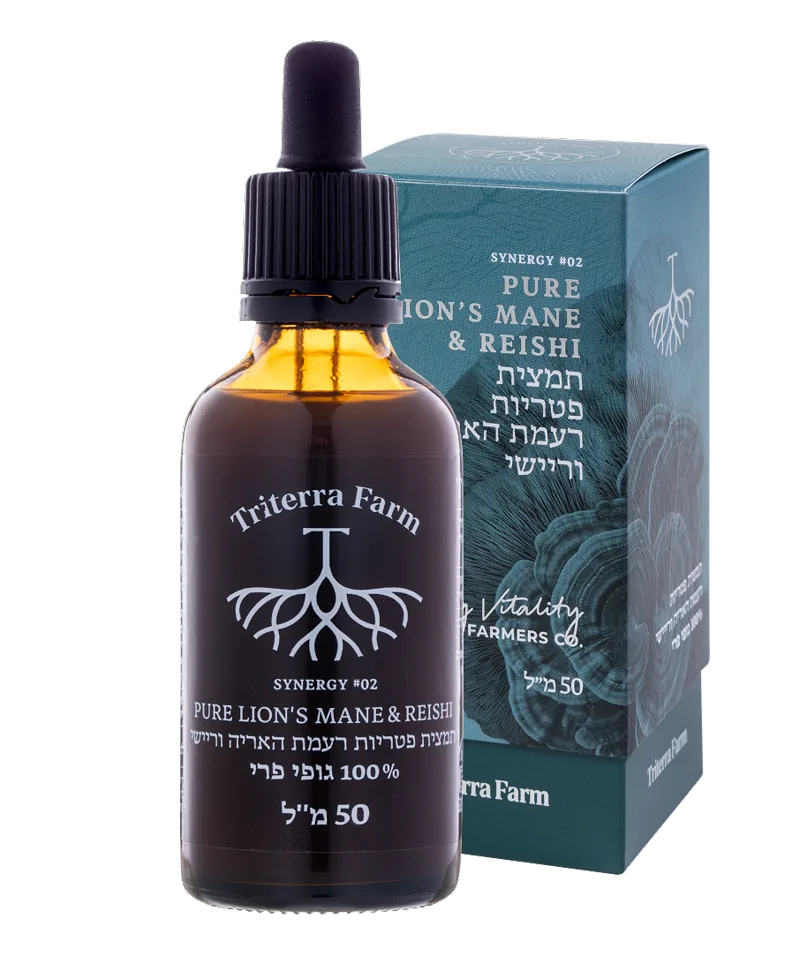
Lion's Mane + Reishi — Fruiting Body Extract
When the fog comes with load and broken sleep: Lion's Mane for clarity, Reishi for calm and sleep — both in one bottle.
“Over the weeks focus, sharpness and clarity start to stand out.” — Tamer A., verified review (translated from the original Hebrew)
₪250
about 35 days of use (1.4 ml/day) · free shipping over ₪285
Triterra club members get a standing 10% discount on every order, plus a quantity discount on more than one extract. Joining is free, through the matching quiz →
What people who started tell us
Real verified reviews from our customers, translated from the original Hebrew
“Excellent product — it sharpens thinking and gives energy. Good for the morning hours.”
Tamer A.Lion's Mane Extract
“Over the weeks focus, sharpness and clarity start to stand out.”
Tamer A.Lion's Mane & Reishi Extract
“Lion's Mane and Cordyceps may be the ultimate combination for focus and energy.”
Mor B.Cordyceps + Lion's Mane
Ready for a slightly clearer head?
Start with a 100-day trial — if you feel no difference, you get your money back.
Choose my extract Not sure what fits? Take the matching quiz — under a minute →Want the mechanism itself, not just the conclusion? Lion’s Mane Science →
Wondering about mood rather than focus? Lion’s Mane and mood — what human research shows →
These statements have not been evaluated by the Food and Drug Administration. This product is not intended to diagnose, treat, cure or prevent any disease. The information here is for general knowledge only and is not medical advice or a substitute for consulting a physician. Consult a qualified professional before using any dietary supplement, especially if you take medication, are pregnant or nursing, or have a diagnosed medical condition.
The research behind Lion's Mane — 19 PubMed studies, the good and the bad →
