Triple Extraction (Triple Extract): How We Unlock the Full Potential of Medicinal Mushrooms
59-Word Summary:
Triple extraction (cold water, alcohol, hot water) is a holistic method for drawing a broad spectrum of bioactive compounds from medicinal mushrooms.
It is essential for overcoming the tough, chitinous cell wall, enabling efficient extraction of polysaccharides (such as beta-glucans) in hot water,
and triterpenes in alcohol. Despite its complexity, quality producers use it to create a comprehensive (“full-spectrum”) extract.
Introduction:
Mushrooms have always been regarded as a significant cultural object; the Romans called them “food of the gods,” and the ancient Greeks believed they gave warriors strength.
Diverse mushrooms such as button mushroom (Agaricus bisporus), shiitake (Lentinula edodes), oyster mushrooms (Pleurotus, especially Pleurotus ostreatus),
enoki (Flammulina velutipes), wood ear / Judas’s ear (Auricularia auricula-judae), and maitake (Grifola frondosa) are part of the human diet for their nutritional and culinary value.
In the modern era, with growing awareness of healthy eating, mushrooms have become even more popular.
They are rich in nutrients such as polysaccharides*, polyphenols (phenols*), proteins*, niacin, potassium, riboflavin, selenium, vitamin D, and dietary fiber.
They are gluten-free, low in calories, low in fat, and contain low levels of simple sugars and sodium.
Mushroom extracts are now also incorporated into functional foods such as frozen yogurt, fruit juice, and soy milk.
In Traditional Chinese Medicine, mushrooms have long been regarded as an “elixir of life” and have been valued in traditional wellness practices for centuries.
A fascinating piece of evidence for the ancient use of mushrooms was found on the preserved body of “Ötzi,” the Iceman, who lived about 5,300 years ago.
Among his belongings were Fomes fomentarius mushrooms, used to light fires and in traditional wound-care practices,
and Piptoporus betulinus mushrooms, known in traditional use for their reputed medicinal and anti-parasitic properties.
This attests to the ancient knowledge and early application of mushrooms for medicinal and practical needs.
Introduction: The Need for Comprehensive Extraction
Extracting bioactive compounds* from plants and mushrooms is a central pillar of traditional medicine, drug development, and the production of dietary supplements.
These organisms produce a vast range of chemical compounds, which are commonly divided into two groups:
primary metabolites – essential to the organism’s basic existence (such as carbohydrates, proteins*, and fats),
and secondary metabolites* – which are not directly essential for growth but fulfill important ecological roles such as defense, communication, and more.
These secondary metabolites are usually the source of the organism’s biological or medicinal activity.
Examples include phytochemicals* in plants (such as flavonoids* and alkaloids*), and parallel compounds in mushrooms, such as unique triterpenes* and polysaccharides*.
The efficiency of the extraction process – that is, the ability to separate and extract the compounds from the biological matrix – depends critically on the choice of solvent and the process conditions.
Using a single solvent (single-solvent extraction) may lead to only selective extraction and to missing important groups of secondary metabolites*,
especially given their differing chemical properties (such as water- versus fat-solubility) and sometimes because of resilient structures such as the fungal cell wall.
Triple extraction offers a holistic approach, based on three sequential extraction stages under different conditions:
cold water, alcohol, and then hot water. This makes it possible to extract a wide range of compounds and to create an extract that faithfully reflects the complexity of the raw material.
The Secret to Making a Triple Extract from Medicinal Mushrooms
In this video, Shlomi Hayun, co-founder of Triterra Farm, takes you behind the scenes and reveals our unique "triple extraction" method – a meticulous process that draws the best from the medicinal mushrooms we grow with love here in the Galilee.
Historical Background: From Traditional Preparations to the Modern Method
The principle of using several solvents or preparation methods is not a modern invention.
In the writings and practices of ancient traditional medicine – such as Traditional Chinese Medicine (TCM), Indian Ayurveda,
and the Western herbalism traditions – one can find evidence of intuitive use of differential* extraction methods.
The empirical understanding was that a short water infusion, prolonged boiling (decoction*), or steeping in wine or alcohol (tincture*)
draw different qualities and therapeutic properties from the plant or mushroom.
For example, classical TCM texts may describe a parallel preparation of an herbal decoction in water and of a “medicinal wine” from the same herbs.
The modern scientific approach of triple extraction is based on these same traditional insights, but applies them in a systematic, controlled way.
Drawing on an understanding of the chemical principles of solubility and the biochemical composition of natural materials, triple extraction seeks to maximize the extraction of secondary metabolites*,
especially from complex raw materials such as medicinal mushrooms – a central field of research and application in contemporary mycomedicine (Mycomedicine).
The Challenge of the Fungal Cell-Wall Structure and Chitin: The Barrier to Releasing Active Compounds*
One of the main obstacles to efficiently extracting medicinal mushrooms is the unique, resilient structure of the fungal cell wall.
Unlike the plant cell wall, which is composed mainly of cellulose, the cell wall of fungi is composed mainly of chitin* – an especially rigid structural polysaccharide*,
similar to that found in the exoskeleton of insects and arthropods. Chitin forms a dense fibrous matrix,
which often combines with glucans* (mainly beta-glucans*, and sometimes also alpha-glucans) to form a chitin-glucan complex,
which gives the cell wall structural strength but makes it very difficult to break down.
This insoluble, rigid structure creates a real physical barrier, “locking” secondary metabolites* inside it – both intracellular compounds and active structural components in the wall itself,
such as high-molecular-weight beta-glucans*, known for their contribution to the immune-related activity of many mushrooms.
Without appropriate treatment, especially when using water at room temperature, solvents fail to penetrate the chitinous matrix,
and extraction efficiency is impaired. Even physical grinding, which increases surface area, is usually not enough to overcome the chemical-structural barrier.
The challenge of penetrating the cell wall and releasing the compounds trapped within it underscores the need for advanced extraction methods –
such as the hot-water stage in triple extraction – capable of “breaking through” or bypassing the barrier.
Even in laboratory research settings, preliminary treatments are sometimes required, such as enzymatic breakdown (for example using chitinase)
or chemical treatment (for example, acids), to allow better access to the active compounds.
All of these illustrate how much the structural-chemical challenge of the mushroom wall directly affects the success of the extraction process.
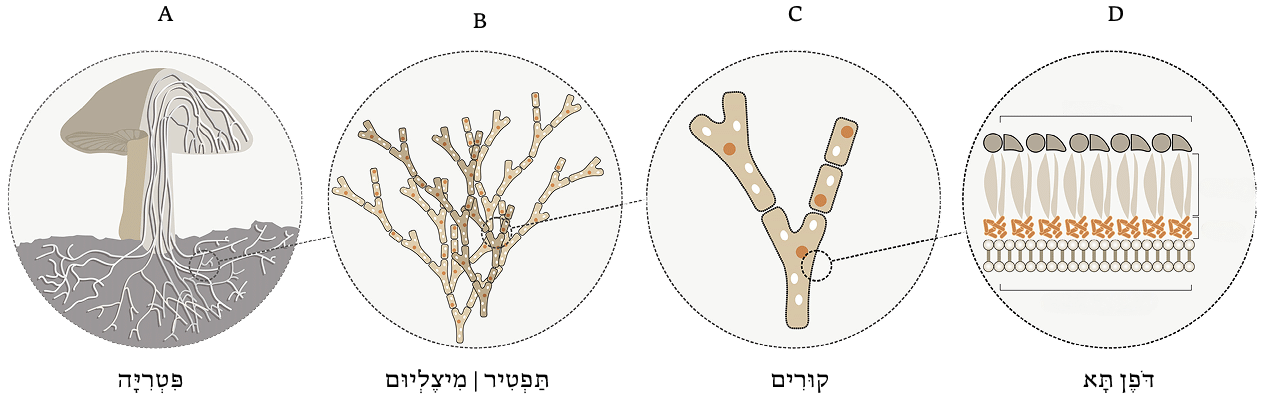
This image is an illustration demonstrating the hierarchical structure of a mushroom, from the macroscopic level (the whole mushroom) down to the microscopic level of its cell wall. The image is divided into four main parts (A, B, C, D):
Part A (Mushroom): shows the whole mushroom as we know it – the fruiting body (cap and stem) and its underground network of threads, the mycelium.
Part B (Mycelium): zooms in on and enlarges the mycelium, which is essentially the main body of the fungus, made up of a branching network of fine threads usually found in the growing substrate (soil, wood, etc.).
Part C (Hyphae): zooms in further and shows the individual “threads” or “fibers” that make up the mycelium. Each such thread is called a hypha, and the plural is hyphae. These are the building blocks of the fungus.
Part D (Cell Wall): this is the most detailed part, presenting a close-up cross-section of the cell wall of the fungal hypha. It shows the main layers that make up the fungal cell wall (from inside out):
Cell membrane: the innermost membrane enveloping the cell’s contents.
Chitin: a rigid structural layer made of the polysaccharide chitin. This is a key component of the cell wall of fungi (and also of the exoskeleton of insects). (Note: the illustration uses marks that look like Japanese/Chinese characters to represent the chitin, probably a graphic error or some symbol in the original illustration source.)
Glucans: another layer of polysaccharides, mainly beta-glucans, which are an important structural component and also of research interest in the context of biological activity (such as immune support).
Proteins: protein molecules embedded in or bound to the outer layers of the cell wall, which can serve various roles (enzymes, receptors, etc.).
In summary: the illustration breaks down the mushroom’s structure into different levels and demonstrates the composition of the cell wall unique to fungi, which includes chitin, glucans, and proteins over the cell membrane. Understanding this structure is important for understanding the biology of fungi and also the way we digest them or extract active components from them.
Solvent Principles in Triple Extraction and Their Potential Benefits
Triple extraction leverages the principle of differential solubility* of different compounds sequentially:
Cold Mineral-Water Extraction: Delicate Compounds, Potential Benefits
This stage, carried out at room temperature or under refrigeration (4°C-25°C), is intended to extract polar* compounds soluble in water at low temperatures, and heat-sensitive compounds. This group includes enzymes*, certain proteins*, water-soluble vitamins*, as well as small secondary metabolites* and low-molecular-weight polysaccharides* not trapped deep in the chitin* matrix. This stage aims to capture the most delicate components before moving to the more aggressive conditions. Potential benefits: In terms of wellness potential, these compounds may include proteins* with biological activity (such as lectins or Fungal Immunomodulatory Proteins – FIPs), which are studied in the context of effects on the immune system. Certain enzymes* that may contribute to metabolic processes are also obtained, along with water-soluble vitamins* essential for the body’s normal function. In traditional medicine this stage is sometimes considered to capture the more ‘delicate’ or ‘energetic’ components of the mushroom, contributing to overall balance, although the specific activity of this group of compounds is sometimes less scientifically defined compared with the other stages. The use of fresh raw material (as detailed below) may be especially significant for preserving these sensitive compounds.
Alcohol Extraction: Lipophilic Compounds, Potential Benefits*
This stage uses alcohol (usually ethanol) at various concentrations, sometimes as a hydro-alcoholic solution. Alcohol is effective at dissolving compounds of low polarity (lipophilic*) or non-polar*, which are not readily soluble in water. Notable examples are triterpenoids* (such as ganoderic acids from reishi mushrooms (Ganoderma lucidum) or betulinic acid and sterols* from chaga (Inonotus obliquus)), additional sterols* (such as ergosterol) and certain phenols*. The choice of alcohol concentration (for example, 40%, 70%, or 95%) affects the polarity range of the extracted compounds; lower concentrations (more water) will extract slightly more polar* compounds, while higher concentrations (less water) will focus on more lipophilic* compounds. Potential benefits: These compounds are of great importance to the activity attributed to many medicinal mushrooms. Triterpenoids*, for example, are widely studied in the context of adaptogenic* activity (supporting the body’s ability to cope with physical and mental stress), anti-*
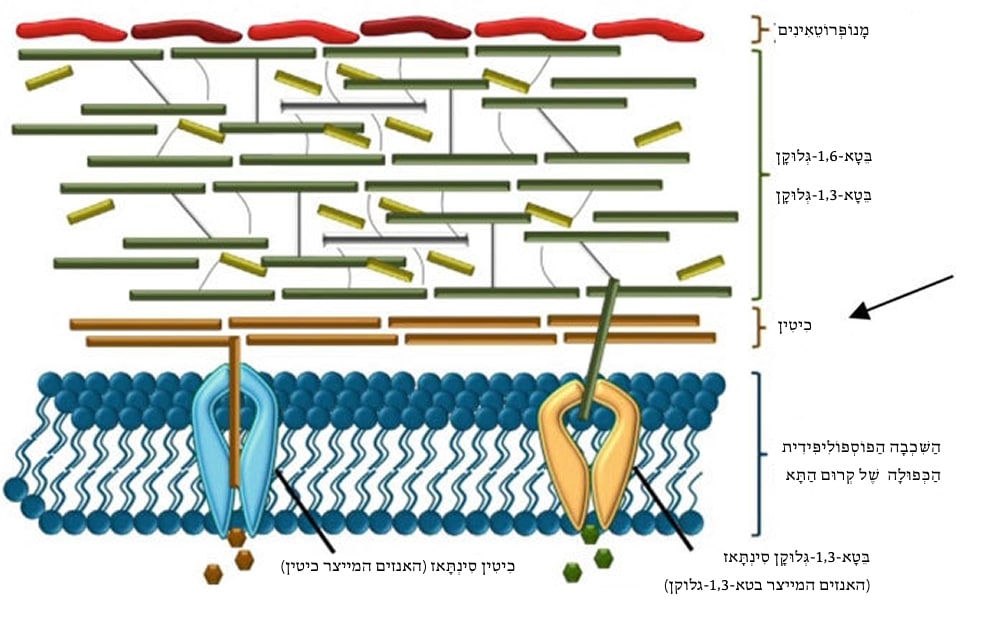
This image is a schematic diagram demonstrating the molecular structure and the way a fungal cell wall is built. The main layers can be seen from the inside out:
Cell membrane: the phospholipid bilayer that bounds the cell.
Enzymes: embedded within the membrane are enzymes such as chitin synthase and beta-1,3-glucan synthase, which use precursors such as UDP-GlcNAc and UDP-Glc to produce the wall components.
Chitin: the first structural polysaccharide layer above the membrane.
Glucans: a branching network of beta-glucans (mainly β-1,3 and β-1,6) forming the bulk of the wall.
Mannoproteins: proteins bound to mannose-type sugars, coating the outermost layer of the wall.
In short, the diagram shows how the enzymes in the cell membrane build the chitin and glucan layers that make up the cell wall, with mannoproteins located on the outermost part.
The Methodology in Practice: The Triple Extraction Process (Sample Protocol with an Emphasis on Quality)
Raw-Material Preparation: This critical stage begins with careful selection of the raw material. Unlike the common practice of using dried material (oven- or freeze-dried) prevalent in the industry for preservation, shelf-life extension, and standardization* of extraction ratios by dry weight, an approach based on full control of cultivation and processing allows unique work with fresh fruiting bodies* immediately after harvest. Accordingly, the process in this approach involves careful cleaning of fresh fruiting bodies* only, with particular attention to harvesting them at the optimal stage of development. The timing of the harvest and the freshness of the raw material are critically important, since it is known that the composition of the bioactive* and molecular compounds in the fruiting body* changes dynamically over its life cycle; for example, a young, developing fruiting body* will differ substantially in composition from a mature fruiting body* in the spore*-release stage. The deliberate avoidance of the drying stage stems from the understanding that any preservation process – and particularly one involving heat (oven drying) or prolonged exposure (storage of dry material) – may harm the integrity and concentration of delicate, important bioactive* components. These components can include active enzymes*, certain vitamins*, free amino acids, volatile aromatic compounds, and even secondary metabolites* sensitive to heat or oxidation. Using fresh raw material aims to minimize this potential harm and to preserve the mushroom’s biochemical profile as close as possible to its natural state. After cleaning, the fresh fruiting bodies* are ground or processed as needed in preparation for extraction. It should be noted that working with fresh material requires precise adjustment of the extraction ratios (for example, the initial alcohol concentration) to compensate for the mushroom’s high and variable water content, a challenge that underscores the need for control and expertise in the process, but the benefit of preserving the delicate components is seen as being of supreme value.
Stage 1: Cold-Water Extraction: Steeping the processed fresh material in clean water (weight/volume ratio adjusted for fresh material) for 12-24 hours at a low temperature (4°C-25°C). Filter the liquid (cold-water extract) and set aside.
Stage 2: Alcohol Extraction (Tincture):* Adding alcohol (at a concentration adjusted for the water content of the fresh material) to the solid material remaining after filtration. Steeping in a sealed, dark container for a prolonged period of at least 6 weeks (and sometimes longer, depending on the producer and the specific protocol), with daily shaking, to allow optimal extraction of the lipophilic* compounds. Filter the liquid (tincture*) and set aside.
Stage 3: Hot-Water Extraction (Decoction):* Adding water to the solid material remaining after the alcohol filtration. Heating to a high temperature (80°C-100°C) for 2-4 hours (decoction*). Filter the hot liquid (hot-water extract) and set aside.
Stage 4 (optional): Combining and Concentrating: Gently evaporating the alcohol from the tincture* (if needed). Mixing the three liquid extracts. Optional: further concentrating the combined extract to reduce volume or increase concentration.
Main Applications: Mycomedicine and Medicinal Herbs
Mycomedicine: As noted, this is the main field of application for triple extraction. The method makes it possible to extract both water-soluble polysaccharides* (such as beta-glucans*) and alcohol-soluble triterpenes* from mushrooms such as reishi (Ganoderma lucidum), chaga (Inonotus obliquus), cordyceps (Cordyceps spp.), turkey tail (Trametes versicolor), and lion’s mane (Hericium erinaceus), thereby capturing as fully as possible the profile attributed to them. Medicinal herbs: The triple extraction method can also suit plants with a complex phytochemical* composition, including compounds of differing solubility (for example, roots containing both saponins and resins), with the aim of creating a “full-spectrum” extract.
Advantages of the Method: Comprehensive Extraction and Synergy
Comprehensive extraction (broad spectrum): The ability to extract a wide range of bioactive* compounds, with different chemical properties (polar*, non-polar*, large, small), from the same raw material. Synergistic potential (“entourage effect”): Preserving the diversity of compounds may enable enhanced biological activity through synergistic effects among the various components (Entourage Effect), similar to the way they act in the whole organism. The idea is that the whole, in its raw form, or an extract that reflects it, is more effective than the sum of its isolated parts. Efficient use of the raw material: Maximizing the yield from the expensive raw material, since each stage extracts a different group of compounds from the same solid material.
Limitations and Challenges: Time, Standardization, and the Industrial Context – and Models of Quality Differentiation*
Alongside its clear advantages in producing a comprehensive extract, triple extraction also has inherent limitations and challenges to consider, mainly in the context of mass production:
Complexity and duration: The multi-stage process is significantly long (days to many weeks, with the alcohol stage alone requiring at least 6 weeks), logistically complex (requiring several extraction rounds, filtration, interim storage, and control), and requires a greater investment of labor, equipment, and resources compared with simpler, faster extraction methods.
Potential breakdown of compounds: The prolonged heating stage in hot water, essential for releasing the polysaccharides* from the chitin*, carries a risk of degradation of heat-sensitive compounds not fully extracted in the cold-water stage. This requires careful control of the temperature and duration of heating to minimize damage.
Dilution of the final extract: Combining the relatively large volumes of the three extracts (cold water, alcohol, hot water) without an efficient concentration stage at the end of the process may lead to a relatively dilute final extract. In such a case, the concentration of each specific group of compounds may be low, which may affect the required dosage.
Standardization and characterization challenges:** The difficulty of precisely and uniformly controlling all the many parameters throughout the complex process (alcohol concentrations adjusted for fresh material, precise temperatures, steeping and cooking times, filtration efficiency, and more) makes it difficult to ensure uniformity and reproducibility* in the chemical composition of the extract across different production batches. In addition, the full chemical characterization* and precise quantification* of the range of compounds in such a complex extract constitute a challenging analytical task.
The Commercial Production Context – Pressures, Different Approaches, and Differentiation Through Quality:
In large-scale commercial production, there is constant pressure to streamline processes, shorten production time, and reduce costs. Therefore, most mass production of mushroom extracts tends to use shortened protocols, usually single-solvent extraction (typically hot water only, aimed at extracting beta-glucans* but missing triterpenes* and heat-sensitive compounds), or other fast industrial extraction methods, and usually using dried and/or insufficiently controlled raw material in terms of source and quality. These approaches are more economically and operationally efficient, but often come at the expense of the full, holistic extraction of the range of bioactive* compounds the mushroom offers.
That said, it is important to emphasize that not all commercial production takes shortcuts. There are producers and market niches where the choice is consciously to adhere to the full, traditional triple extraction process, despite the costs and time involved. These producers base their competitive differentiation precisely on this extra care, and present a business model that prioritizes quality and biological efficacy over purely economic efficiency.
This differentiation strategy is usually based on a combination of several key principles:
Control of the raw material: Often, these producers grow the mushrooms themselves under controlled, optimal conditions. This vertical-integration approach (“from field to bottle” or “from spore* to bottle”) gives them full control over strain quality, substrate cleanliness, absence of contaminants, and full traceability. Most importantly – this approach allows them to determine the precise harvest time of the fruiting bodies.* This control over harvest timing is critical, since, as noted, the composition of the active compounds in the mushroom changes dynamically over its development (for example, between a young stage and a spore*-production stage). Harvesting at the right stage ensures raw material with optimal potency and biochemical profile, an advantage that is very difficult to achieve when working with imported raw material or external sources whose harvest time is unknown or inconsistent.
Working with fresh raw material: Another significant advantage stemming from self-cultivation and immediate processing is the exceptional ability to bypass the mushroom-drying stage entirely. While almost all producers work with dried material, the exclusive use of fresh fruiting bodies harvested and extracted “on the spot” makes it possible to optimally preserve delicate, volatile, heat- or oxidation-sensitive components that may break down or be lost in drying processes or during prolonged storage of dry material.* This ‘from field to extraction’ approach without a drying stage represents an even higher level of commitment to quality and to preserving the mushroom’s full natural profile.
Focus on the highest-quality raw material: These producers insist on the exclusive use of fresh fruiting bodies*, harvested at the optimal time, and avoid using mycelium* grown on grain substrate (MOG), a common and cheaper practice that may lead to a product containing a high percentage of starches from the substrate and a lower concentration of the active components unique to the fruiting body*. The care is not only about the type of part (fruiting body*), but also about its quality, freshness, and stage of development at harvest.
Commitment to the full extraction process: They not only perform triple extraction, but emphasize the care taken over a long duration (for example, alcohol extraction lasting six weeks and even more) and the meticulous execution of every stage of the process. They see the complex, prolonged process as a guarantee of true “full-spectrum” extraction, reflecting the natural, complex chemical profile of the mushroom and enabling synergistic* potential among its components.
For these producers, the emphasis on self-cultivation, harvest-timing control, use of fresh fruiting bodies only (without drying), and the thorough triple extraction process constitutes a central differentiation strategy.* It positions the product as a premium, high-quality, authentic, “full-spectrum” product. This approach appeals to a conscious, quality-seeking consumer audience that understands the differences between production methods and is willing to invest more in a product perceived as more effective and complete thanks to its meticulous production process. Thus, while time and complexity are an inherent limitation for mass production, there are business models that see them as an opportunity for unique, robust market positioning.
The Big Mistake You're Making With Your Mushroom Extract, or Why You Should Never Put a Mushroom Extract in Hot Water
Bought a Triterra Farm mushroom extract? Great. Just before you add it to your cup of tea, stop everything and watch this short, important video. You're about to discover the secret that will ensure you get 100% of the unique potency of your product.
Microwave-assisted extraction diagram
Ultrasonic-assisted extraction diagram
Conclusions and Recommendations for Future Research
Triple extraction is a highly valuable method that bridges traditional knowledge and modern scientific understanding, enabling comprehensive extraction of bioactive* compounds from complex natural materials, with an emphasis on medicinal mushrooms and the challenge posed by their chitinous* cell wall. Despite the practical and industrial limitations in mass production, it serves as a benchmark for holistic, quality extraction, and a model to emulate for producers striving for excellence and differentiation through quality, especially when combined with controlled cultivation and the use of fresh, high-quality raw material.
Users and practitioners are advised to be aware of the potential differences between extracts prepared by this method with attention to high-quality raw material (fresh fruiting bodies* grown under controlled conditions and harvested at the optimal time), and mass-market commercial products, and to examine the extraction methods, the raw material (fresh or dried fruiting body*, or mycelium*), its source, and the processing time declared by the producers.
Future research should focus on several directions:
Technological optimization: Examining the integration of advanced extraction technologies (such as ultrasound-assisted extraction – UAE*, microwave-assisted extraction – MAE*, or supercritical-fluid extraction – SFE*) at certain stages of the process, with the aim of shortening times and increasing efficiency while preserving the quality and integrity of the compounds, and in particular methods that assist in more efficient breakdown of the chitin* matrix or in more efficient extraction from fresh raw material.
Standardization and analysis:* Developing advanced analytical methods and quality-control (QC) protocols for full characterization* and reliable quantification* of the range of compounds in the complex extract, and to ensure product uniformity (reproducibility*), even in complex processes such as triple extraction, while addressing the variability arising from working with fresh raw material and at different stages of development.
Comparative research: Conducting preclinical and clinical studies that compare, in a controlled manner, the biological activity and clinical efficacy of triple-extraction extracts (and in particular those based on fresh fruiting bodies* from controlled cultivation and at an optimal harvest stage) against extracts prepared by other methods (such as single-solvent extraction, extraction from dry material, or mycelium*-based extracts on substrate).
Disclaimer: These statements have not been evaluated by the Food and Drug Administration. This product is not intended to diagnose, treat, cure, or prevent any disease.