
How to Read a Mushroom Supplement COA (Test Report)
- A test report, not a label, is what proves the contents of a supplement — in one study only 5 of 19 reishi products matched their labels.
- Four lines decide it: a verifiable certificate number, a matching sample description, a beta-glucan 1,3/1,6 percentage with a named method, and starch not detected.
- Total polysaccharides without a breakdown inflates the figure, since grain starch and filler fibers such as inulin both count toward it.
- An external lab writes and signs a TEST REPORT, which is a stronger document than a certificate the manufacturer issues for itself.
- A report proves what is in the bottle, never that a product works — efficacy belongs to separate clinical research.
Key takeaways
- A Certificate of Analysis (COA) is the only proof that what the label claims is actually in the bottle. In a study published in Scientific Reports, only 5 of 19 reishi products tested matched their labels.
- Four lines decide everything: a certificate number you can verify with the lab · a sample description matching the product · a beta-glucan 1,3/1,6 percentage with a named method · starch and fillers — “not detected.”
- “Total polysaccharides” with no breakdown is an inflation trick: starch and inulin count toward it. The only honest number is beta-glucan.
- In this guide we read a real TÜV Austria test report of ours, line by line — including what it does not say.
A Certificate of Analysis — COA — is the document that separates a marketing promise from a measured fact in the world of mushroom supplements: reishi (Ganoderma lucidum), lion’s mane (Hericium erinaceus), cordyceps, and turkey tail (Trametes versicolor). Without it, all you have is a label. In this guide you will learn to read such a report in practice — not on a theoretical example, but on a real test report of ours from TÜV Austria — and to spot exactly which lines decide whether a product is genuine and which ones exist to impress you.
Why can’t you trust the label alone?
Because this market has been tested — and failed. A study published in Scientific Reports (a Nature Portfolio journal) examined 19 reishi products purchased in the United States, measuring their polysaccharides and triterpenes against the label claims. The result: only 5 products — 26.3% — matched what was declared. In other words, roughly three of every four products contained something different from what was written on them. That number is not our claim about any particular competitor; it is a peer-reviewed finding about an entire market, and it is the reason a guide like this needs to exist.
The practical conclusion is simple: a label is a statement, a test report is evidence. A brand that wants your trust should not ask for it — it should publish the report and hand you the tools to read it. That is exactly what we will do here.
COA or TEST REPORT — what’s the difference, and which is stronger?
Both terms describe a results document, but they are not the same. A COA in the strict sense is often issued by the manufacturer itself — an internal certificate summarizing tests the manufacturer ran or commissioned, in a format it chose. A TEST REPORT from an external laboratory is a third-party document: the lab writes it, signs it, and numbers it in its own system — so it can be verified directly with the lab, without going through the brand at all.
That is why, when you open our documents, you will find they actually say “TEST REPORT” rather than “Certificate of Analysis” — and that is not a weakness but the strong point: these are reports written by TÜV Austria, not by us. In everyday language everyone says COA, and so do we — but when you compare products, it is worth checking who exactly wrote the document you are being shown.
How do you verify that a report is real?
A real report stands on three anchors, all independently checkable: a laboratory name with contact details — a real lab can be found, called, and asked; a certificate number — the number is registered in the lab’s system, and you can ask the lab to confirm it exists and matches the content; and a sample description line — the sample described in the report must match the product in front of you. A report missing any of these three is a pretty picture, not evidence.
Note the wording we hold ourselves to: our extracts were tested at TÜV Austria — not “approved” by it. A test report measures values in a sample; it is not a certification mark and not an endorsement of a product. A brand that writes “lab approved” is phrasing something that the report itself — as you are about to see — explicitly denies.
Our TÜV report, line by line
Below is the test report for our lion’s mane extract — the full document is open for download, and here we break down the important lines with numbered notes. This is the same structure you will meet in any serious lab report, so what you learn here will serve you with every product on the market.
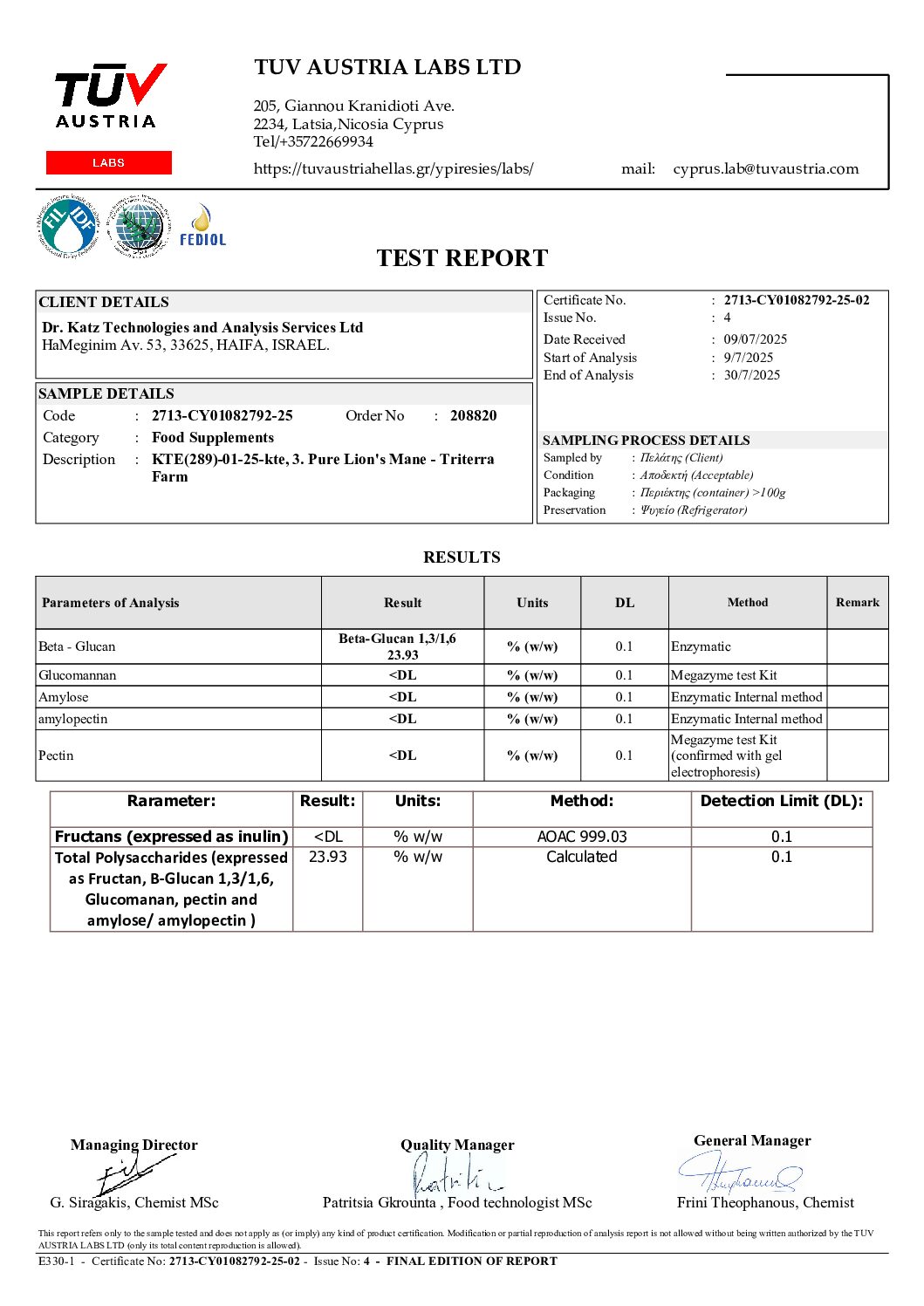
- The document title. “TEST REPORT” — a report written by the laboratory itself, not a certificate a brand issued for its own product. Of the two, this is the stronger document.
- The certificate number. The most important anchor: this number is registered in TÜV Austria’s system and can be verified directly with the lab. A report without a certificate number cannot be verified at all.
- Final issue number. “FINAL EDITION” marks this as the report’s final version, after all of the lab’s quality controls — not an interim draft.
- The sample description. “Pure Lion’s Mane – Triterra Farm”: this line ties the results to one specific extract. Always confirm the product in front of you is the one named here — a result for one product is no proof about another.
- The beta-glucan line. The number that actually matters: 23.93 percent beta-glucan 1,3/1,6 — the fungal form — by enzymatic assay (Megazyme), on a dry-weight basis of the finished extract. We explain how to read it properly below.
- Starch — “not detected.” Amylose and amylopectin are the two components of grain starch. When both sit below the detection limit, that is chemical proof the extract contains no milled grain substrate — the hallmark of mycelium-on-grain products.
- Inulin — “not detected.” A quiet line with a big meaning: inulin is a filler fiber that inflates “total polysaccharides” in some products. On our report it is below the detection limit. More on that trick below.
- The lab’s own disclosure. The report itself is explicit: it refers to the sample tested and is not a product certification. That is why we say “tested at TÜV Austria” and never “approved by” — the lab itself asks for that precision.
How do you read the beta-glucan line correctly?
A good beta-glucan line answers three questions: which beta-glucan was measured (1,3/1,6 — the fungal linkage; oat beta-glucan, for instance, is linked differently), how it was measured (a specific enzymatic assay — in our case the Megazyme kit — which distinguishes beta-glucan from other sugars), and on what it was measured. That last point matters most: our percentages are measured on a dry-weight basis of the finished extract — the product you actually take — not on the raw material that entered the process. A raw-material number is the weaker claim, because it says nothing about what actually reached the bottle.
And what number should you expect? Public market testing gives a useful scale:
| Product type | Typical beta-glucan | What it means |
|---|---|---|
| Mycelium on grain | Usually under 7% | Most of the powder is grain substrate; starch will show up in testing |
| Quality fruiting body | 25%–40% | Real mushroom; quality depends on origin and process |
| Our tested extracts | 23.21%–28.16% | Measured on the finished extract at TÜV Austria, with starch “not detected” — reports open |
Our full numbers, extract by extract: Cordyceps 28.16%, Reishi 25.65%, Lion’s Mane 23.93%, Turkey Tail & Reishi 23.21% — each with its own report on the lab testing page. And why fresh mushrooms yield an extract that measures this way — we cover that in depth in Fresh or Dried Mushrooms.
Why is “total polysaccharides” an inflation trick?
“Polysaccharides” is a broad chemical family — and it includes grain starch as well as filler fibers like inulin. A product can display “60% polysaccharides” where the overwhelming majority is substrate starch or added fiber — with no fungal beta-glucan behind it at all. So “total polysaccharides” without a breakdown is not a quality figure; it is a way to show a big number while saying nothing.
This is not a theoretical scenario: a real test certificate of a cordyceps product on the market, which we reviewed, showed 14%–17% fructans (inulin) — a filler fiber inflating “total polysaccharides” by nearly half, while the beta-glucan line itself was lower than ours. On our report, as you saw above, that exact line — fructans expressed as inulin — reads “not detected.” That is why we cite beta-glucan 1,3/1,6 only, and invite you to demand the same standard from every brand: not “how many polysaccharides,” but how much beta-glucan, by which method, and what the starch and filler lines say.
What else gets tested beyond beta-glucan?
A potency report is the start; a product that goes into your body also needs purity reports. We send our extracts for heavy-metals, pesticide-residue, and PAH (polycyclic aromatic hydrocarbons) testing at the VELTIA laboratory. The bottom line of the open reports: lead, arsenic, and mercury — not detected in any of the four tested extracts; in the 610-compound pesticide screen no active ingredient was quantified, conforming to EU regulation; and all PAH values came in below the quantification limit. Every remaining value is reported in full, product by product, in the reports themselves — we publish the whole document, not just the convenient lines.
The checklist: seven things to check before you buy
| What to check | What to look for | Red flag |
|---|---|---|
| 1. Who wrote the document | An external lab’s TEST REPORT with a name and contact details | A self-issued certificate with no lab name |
| 2. Certificate number | A number you can verify directly with the lab | No number, or the brand “can’t share it” |
| 3. Sample description | A sample line matching the product in front of you | A generic report with no clear product identity |
| 4. The beta-glucan line | Explicit beta-glucan 1,3/1,6 with an enzymatic method | Only “total polysaccharides,” no breakdown |
| 5. The starch lines | Amylose/amylopectin (alpha-glucan) — “not detected” | Starch present, or the line never tested |
| 6. Measured on what | Measured on the finished extract/product | A raw-material number presented as the product’s |
| 7. Recency and finality | Recent test dates and a FINAL edition | A years-old report, or an unsigned draft |
What a test report does not say
Honesty requires saying this part too. A test report proves what is in the bottle — it does not prove the product “works.” Efficacy is examined in clinical research, which is an entirely separate arena; a brand waving a lab certificate as proof of effectiveness is mixing two different things. The report also refers, in its own words, “only to the sample tested” — it is a snapshot of what was sent to the lab, not an eternal seal.
And in the same spirit, about ourselves: all of our tests are open on the lab testing page — they refer to the relevant extracts, and the page shows exactly which extract was tested. Blended products rest on the separate tests of their components, and where something has not been tested, we simply do not cite a number. That is precisely the standard this page teaches you to demand, and there is no reason it should not apply to us. For the research itself — on the mushrooms, not the products — our research hub, filtered to quality and quality-control studies, is waiting.
The extracts behind the reports
Fresh fruiting bodies from our Galilee farm · Tested at TÜV Austria · Starch and inulin: not detected · All reports open
100-day trial · Free shipping over ₪285 · Standing club discount
Not sure what fits you? Our short matching quiz will point you right.
The bottom line
A market where only 5 of 19 products match their labels is a market where the consumer has to know how to read a report — and it takes two minutes: who wrote the document, what the certificate number is, which sample was tested, how much beta-glucan 1,3/1,6 was measured and by which method, and what the starch and filler lines say. A serious brand will not fear those questions; it will publish the full report and invite you to verify. Our reports are open, the notes above are the invitation — and this standard now belongs to you, in front of every product you meet.
Frequently asked questions
Scientific sources (peer-reviewed)
- Wu DT, et al. Evaluation on quality consistency of Ganoderma lucidum dietary supplements collected in the United States. Scientific Reports, 2017. PubMed
- Yamanaka D, et al. Quantification of mushroom-derived soluble beta-1,6-glucan using the function-modified recombinant beta-1,6-glucanase. International Journal of Medicinal Mushrooms, 2020. PubMed
- Ohno N. Fungal beta-glucans: structure and effect on host immune responses. Yakugaku Zasshi, 2021. PubMed
- Zhang X, et al. Edible mushroom polysaccharides: structural characteristics, chemical modification strategies, and structure-activity relationship: A review. International Journal of Biological Macromolecules, 2025. PubMed
Study data source: PubMed. All commercial numbers on this page come exclusively from our open lab reports. This content is an educational review and is not medical advice.
Disclaimer: These statements have not been evaluated by the Food and Drug Administration. This product is not intended to diagnose, treat, cure, or prevent any disease.
