
What Does an “Extraction Ratio” Really Mean? (And Why 8:1 Isn’t Automatically Stronger)
- An extraction ratio describes the quantity of raw material entering the process, and says nothing about what actually came out.
- 8:1 is not eight times stronger, since extraction is never fully efficient and very high ratios usually need a starchy carrier.
- No standard defines how the ratio is counted, so figures cannot be compared across brands without knowing the basis behind them.
- Triterra quotes ratios on fresh mushroom: Cordyceps 1:2.5, Lion's Mane 1:2, Reishi and the Turkey Tail blend 1:3.
- The fair comparison is the outcome, the beta-glucan measured on the finished extract, 23.21% to 28.16% at TÜV Austria.
Key Takeaways
- An extraction ratio (1:3, 8:1) tells you how much raw material went into the process — not how much active compound came out. There is no binding standard, and every brand is free to count differently.
- A ratio quoted on fresh mushroom and a ratio quoted on dried mushroom are different currencies — so ratios are not comparable between brands unless you know the basis.
- Our ratios are quoted on fresh mushroom, in full disclosure: Cordyceps 1:2.5 · Lion’s Mane 1:2 · Reishi and Turkey Tail + Reishi 1:3 — roughly 16 to 25 grams of fresh mushroom in every 50 ml bottle.
- The only fair comparison is measuring the outcome: beta-glucan 1,3/1,6 percentage on the finished extract. Ours: 23.21%–28.16%, tested at TÜV Austria, with all reports open.
The extraction ratio is one of the most prominent numbers on medicinal mushroom extract labels — reishi (Ganoderma lucidum), lion’s mane (Hericium erinaceus), cordyceps and turkey tail (Trametes versicolor) — and one of the least understood. 1:3, 1:2, 8:1, even 20:1 — the numbers look like a strength scale, but they are not. This page explains what the ratio actually measures, why 8:1 is not “eight times stronger,” why ratios cannot be compared across brands — and discloses a detail few in the industry talk about: what basis the ratio is quoted on in the first place.
What is an extraction ratio in a mushroom extract?
An extraction ratio describes how much raw material stands behind each unit of finished product. In a liquid extract, a 1:3 ratio means one gram of mushroom per 3 ml of extract; 1:2 is more concentrated — one gram per 2 ml. The smaller the second number, the more raw material per milliliter. That is all the ratio says: how much went in. Not what came out.
With concentrated powders the direction flips: 8:1 means eight grams of raw material were concentrated into one gram of extract powder. Both notations are legitimate, but they already illustrate the problem — the same symbol (two numbers around a colon) describes opposite things in a tincture and in a powder. Comparing a tincture’s “1:3” to a powder’s “8:1” is comparing a coin to a banknote without knowing the exchange rate.
Is an 8:1 extract eight times stronger than a 1:1?
No. A higher ratio means more raw material went in — it does not guarantee that more active compounds came out. Extraction is not a 100%-efficient process: some compounds stay behind, different compounds extract at different rates, and the solvent determines what makes it into the extract at all. Two products with the exact same ratio can therefore contain completely different amounts of beta-glucan.
There is also a darker side to the very high numbers: extract powders at extreme ratios — 10:1, 20:1 — are usually hygroscopic and sticky, so they need a carrier to stay stable. That carrier is almost always a starch or a carbohydrate fiber — exactly the ingredients that inflate the “total polysaccharides” line on the label while the real beta-glucan percentage drops. We covered that inflation trick in depth in Beta-Glucan vs. Polysaccharides. Bottom line: an unusually high ratio is sometimes a warning sign, not a badge of potency.
Why can’t extraction ratios be compared between brands?
Because there is no standard. No regulator defines how an extraction ratio must be counted, so every brand answers four open questions for itself — usually without telling you the answers: Is the ratio quoted on fresh or dried raw material? Was it measured before or after filtration? What solvent was used? And in powders — does the number include the carrier? Four different answers, the same “1:3” on the label.
The result: an extraction ratio is a useful number within one brand — for comparing two extracts made by the same producer who counts the same way — but nearly meaningless across brands. Choosing a product by “the highest ratio on the shelf” means choosing by the number that is easiest to inflate and hardest to verify.
A fresh-basis ratio and a dried-basis ratio — why are they different currencies?
This is the detail almost no label discloses, and it changes the number fundamentally: fresh mushrooms are mostly water, so a kilogram of fresh mushroom contains far less dry matter than a kilogram of dried mushroom. The implication is simple and sharp — a 1:2 ratio on a fresh basis is not a 1:2 ratio on a dried basis. The same pair of digits, two entirely different quantities of material.
We write that sentence about ourselves, in full disclosure: our ratios are quoted on fresh mushroom. On our farm, the mushroom goes from harvest to extraction without a drying stage — as far as we know, one of the very few in the world working this way — and whatever is harvested but not processed immediately is kept in deep-freeze, for preservation only. We freeze; we don’t dry. Why most of the industry dries, and what that means, is covered in Fresh vs. Dried Mushroom Extract.
Why disclose this proactively? Because the disclosure proves the very thesis of this page: if one brand’s ratio is quoted on fresh material and another’s on dried, comparing them is meaningless — and anyone waving a ratio as proof of potency is counting on you not asking about the basis. We would rather you ask. Our proof doesn’t live in the ratio anyway — it lives in a measurement on the finished product, which we get to below.
What are our ratios — and how much fresh mushroom is in each bottle?
These are our ratios, extract by extract, quoted on fresh mushroom. The consumer math is simple: divide the bottle volume by the ratio.
| Extract | Extraction ratio (fresh basis) | Per 50 ml bottle | Per 100 ml bottle |
|---|---|---|---|
| Cordyceps | 1:2.5 | ~20 g | ~40 g |
| Lion’s Mane | 1:2 | ~25 g | ~50 g |
| Reishi · Turkey Tail & Reishi | 1:3 | ~16–17 g | ~33 g |
Two points of order: for bundles that combine several extracts we do not quote a single ratio — each component has its own, and any single number would be false for another component. And the extraction method is a separate fact from the ratio: our extracts go through triple extraction — water, alcohol, and ultrasonic — and the ratio is not part of the method’s definition. Two data points, two separate lines on the label.
What else matters besides the ratio? The solvent — and time
The exact same ratio with a different solvent gives you a different product. Different compounds in the mushroom dissolve in different solvents: polysaccharides — above all the beta-glucans of the cell wall — move into the extract mainly in water extraction; triterpenoids, like the ganoderic acids studied in reishi, require alcohol extraction. A label that declares a ratio without saying what solvent was used leaves you without the important half of the story.
And there is a third variable the ratio is completely silent about: time. Extraction is a process of patience — in our process, the alcohol stage alone runs for seven weeks, with ultrasonic extraction as a complementary step. You can “meet the ratio” with a rushed extraction too; the number on the label will look identical. Here as well, the only way to know what actually happened in the process is to measure what came out of it.
What does the extraction ratio not tell you?
Let’s say it explicitly, because this is the part marketing leaves out: the ratio does not tell you how much beta-glucan is in the bottle. It does not tell you whether the raw material was fruiting body or mycelium on grain — a difference that is settled by the alpha-glucan line of a lab report, not by any ratio (see our guide to beta-glucan vs. polysaccharides). It does not tell you whether the extraction succeeded. And it is not a substitute for lab testing — no ratio makes measurement unnecessary.
What the ratio does give you, when it is declared honestly together with its basis: transparency about the quantity of raw material. The two numbers complement each other and are not interchangeable — the extraction ratio says how much raw material went in, and the beta-glucan percentage says what actually came out. A serious product shows both and lets you verify the second in an open report.
So how do you compare products? Measure the outcome, not the recipe
The ratio is the recipe; the outcome is what gets measured in the finished extract. The only fair benchmark for comparing products is the beta-glucan 1,3/1,6 percentage measured on the final product, by a specific enzymatic method, on a dry-matter basis. In our tested extracts: Cordyceps 28.16%, Reishi 25.65%, Lion’s Mane 23.93%, and the Turkey Tail & Reishi blend 23.21% — tested at TÜV Austria, with the alpha-glucan (starch) line “not detected” in all four. All our tests are open on the lab testing page.
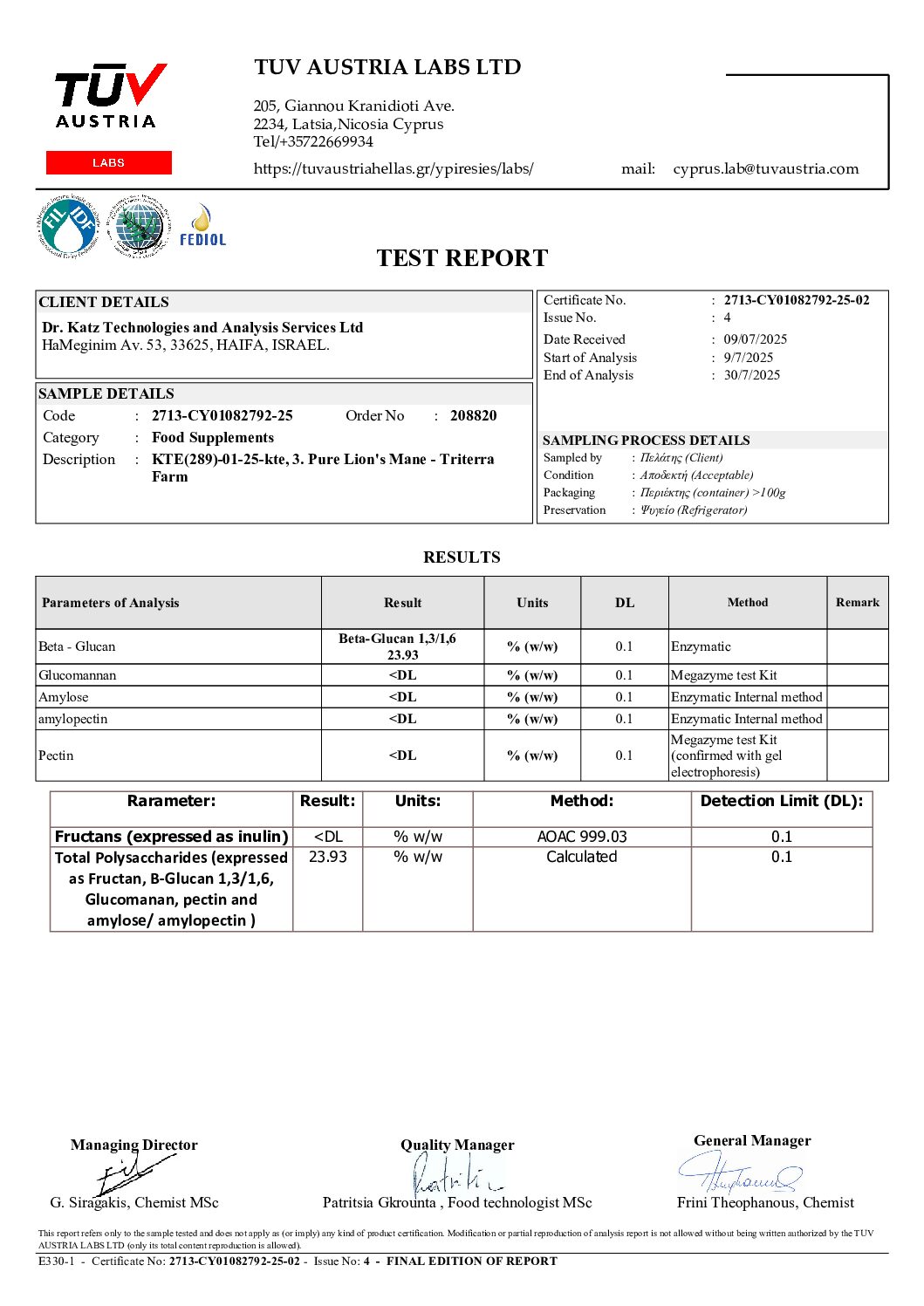
Note what we do not do with the two numbers: we do not multiply them into “milligrams of beta-glucan per ml.” That multiplication assumes everything that went in made it into the extract — an assumption that requires an extraction-yield figure that was never measured. Each number stands on its own, on the basis it was measured on. How to read a full lab report, line by line — in our guide to reading a mushroom supplement COA.
How do you check a label with three questions?
Facing any product that flaunts an extraction ratio, three questions are enough: One — what basis is the ratio quoted on, fresh or dried? Two — what solvent was used, and how long did the process run? Three — is there a beta-glucan measurement on the finished product, in an open third-party lab report with a certificate number? A brand that answers all three gives you numbers to compare; a brand that answers “our ratio is 8:1” has only answered what is easiest to print. And for the research itself — on the mushrooms and on quality control — our research hub, filtered to quality studies, is waiting.
The extracts behind the numbers
Fresh fruiting body from our Galilee farm · ratios fully disclosed on a fresh basis · beta-glucan 23.21%–28.16% tested at TÜV Austria · all reports open
100-day trial · free shipping over ₪285 · permanent club discount
Not sure which is right for you? Our short matching quiz will point you in the right direction.
The Bottom Line
An extraction ratio is a transparency datum, not a potency scale. It tells you how much raw material went in — provided you were told on what basis — and stays silent about everything else: the solvent, the time, and what actually reached the bottle. 8:1 is not “eight times,” and a fresh-basis 1:2 is not a dried-basis 1:2. We present our ratios in full disclosure, on a fresh-mushroom basis — and we put our proof where it is actually measured: the beta-glucan percentage on the finished extract, in open reports. From now on, when you see a big ratio on a label, you will know exactly which three questions to ask.
Frequently Asked Questions
Scientific Sources (Peer-Reviewed)
- Wu DT, et al. Evaluation on quality consistency of Ganoderma lucidum dietary supplements collected in the United States. Scientific Reports, 2017. View on PubMed
- Zhang X, et al. Edible mushroom polysaccharides: structural characteristics, chemical modification strategies, and structure-activity relationship: A review. International Journal of Biological Macromolecules, 2025. View on PubMed
- Ohno N. Fungal beta-glucans: structure and effect on host immune responses. Yakugaku Zasshi, 2021. View on PubMed
- Galappaththi MCA, et al. A Review of Ganoderma Triterpenoids and Their Bioactivities. Biomolecules, 2022. View on PubMed
- Yamanaka D, et al. Quantification of mushroom-derived soluble beta-1,6-glucan using the function-modified recombinant beta-1,6-glucanase. International Journal of Medicinal Mushrooms, 2020. View on PubMed
Study data source: PubMed. Commercial numbers on this page come from our open lab reports only. This content is an educational review and does not constitute medical advice. These statements have not been evaluated by the Food and Drug Administration. This product is not intended to diagnose, treat, cure, or prevent any disease.
