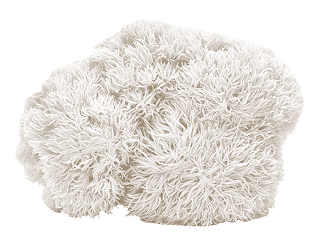
Lion's Mane (Hericium erinaceus) is a medicinal mushroom studied mainly for supporting cognitive function, memory and focus, as well as mood and nervous-system health. Its signature active compounds are hericenones and erinacines, alongside beta-glucans — Triterra's fruiting-body extract measured 23.93% beta-glucans (TÜV, 07/2025).
Scientific name
Hericium erinaceus
Active compounds
Hericenones, erinacines, beta-glucans
Verified β-glucan
23.93% — fruiting body, TÜV 07/2025
Researched for
Cognition · Focus · Mood · Nervous system
Extraction
Triple extract, full spectrum
Grown in the Galilee · triple-extracted · lab-verified β-glucan (TÜV).
Not Just Cognition and the Brain: Discover the Diverse Support of the Lion’s Mane Medicinal Mushroom for Overall Wellbeing
In brief5 points · 1-minute read
Lion's Mane is studied in the context of cognition, mood, digestion and immune function, with NGF production as the mechanism most explored.
Two compound groups anchor the research: hericenones in the fruiting body and erinacines in the mycelium, both linked to nerve growth factor.
9 human clinical trials have been published, and a 2023 double-blind trial in healthy young adults found faster processing speed on the Stroop task.
Much of the evidence is still preliminary laboratory or animal work, and Lion's Mane is not a substitute for conventional medication or medical care.
Chitin locks the active compounds inside the cell wall, so triple extraction, water for beta-glucans and alcohol for hericenones, makes them available.
Welcome to a journey of discovery into the wondrous world of the Lion’s Mane medicinal mushroom. At Triterra Farm, this journey is part of our DNA – it begins with blue-and-white Israeli cultivation in the Galilee, under controlled conditions and with attention to every detail, and continues with harvesting at the optimal time for full-spectrum extraction. [(Read more about our commitment to quality and locality)]. Drawing on the experience and knowledge we have accumulated, we have prepared this guide for you, blending fascinating stories, up-to-date research, and everything worth knowing about the supportive potential of the Yamabushitake mushroom.
The Lion’s Mane Mushroom – Diverse and Surprising Properties
Beyond its impressive cognitive influence, the Lion’s Mane mushroom is considered one of the richest and most fascinating medicinal mushrooms. Its properties extend far beyond the brain and memory: it contributes to emotional balance, to a sense of calm, to supporting the digestive system, and even to supporting immune function. No wonder it has become a cornerstone among natural-health communities and researchers around the world.
But How Exactly Does Lion’s Mane Support the Brain?
Research indicates that the mushroom encourages the production of NGF – Nerve Growth Factor – which is essential for the renewal and normal function of nerve cells in the brain and nervous system. In this way, Lion’s Mane is studied in the context of supporting mental sharpness and memory, and is researched in the context of the nervous system’s natural maintenance and renewal processes.
To enjoy the maximum effect, it is important to consume a quality Lion’s Mane extract that ensures high bioavailability of the active compounds. At Triterra Farm we use a dual extraction process – both in water and in alcohol – to extract the full range of the mushroom’s active compounds: polysaccharides, triterpenes, and unique antioxidants. This method ensures a concentrated, potent product that is easily absorbed by the body – exactly as a quality medicinal mushroom should be.
The Lion’s Mane Medicinal Mushroom – The Story Behind the Name “Yamabushitake”
Here’s an interesting twist: have you ever wondered why the Japanese named this mushroom “Yamabushitake” (山伏茸)?
The name comes from the Yamabushi monks – ascetic monks who live in the mountains of Japan. The word “Yamabushi” translates to “one who prostrates on the mountain”, but the connection to this mushroom is not only visual!
A Medicinal Mushroom Valued for Supporting Concentration and Spirituality
The Yamabushi believed that the Lion’s Mane mushroom supports brain activity, and so they would consume it to support concentration during lengthy meditations. They attributed to it properties that support cognition and spirituality, which made it an important tool on their spiritual journey.
The monks were ahead of modern science – it turns out that the monks intuitively identified aspects that science is only beginning to explore and understand today.
Over the past 40 years, the Hericium erinaceus mushroom has drawn growing scientific interest, with more than 300 scientific publications attempting to decipher the health potential attributed to it.
A Glimpse into the Science Behind the Lion’s Mane Mushroom
How many studies are there already on Hericium erinaceus? A quick search on Google Scholar for the term “Hericium erinaceus” returns about 17,000 results – an impressive number that reflects broad academic interest. In the PubMed database, which focuses on biomedical research, you can find more than 420 studies examining the potential health effects of the Lion’s Mane mushroom.
If you are wondering how far the research has come, the good news is that to date 9 human clinical trials have been published.
The first published trial took place back in 1985 and included 50 participants who received Lion’s Mane mushroom in the context of chronic gastritis. The most recent trial (2023) was the first to focus on healthy participants, examining how the mushroom affects certain aspects of their cognitive function.
In total, more than 400 participants have already taken part in published clinical trials examining various effects of the mushroom.
A research trend – a focus on cognitive health: one of the most fascinating facts is that most of the studies on the Lion’s Mane mushroom were published between 2019–2023. In fact, more than 60% of the studies on the mushroom were published in just the last four years!
It appears that scientific interest is growing, especially around topics of brain health, memory, cognitive function, and mental wellbeing.
Early studies show interesting results, and to date, in the published trials, no significant side effects have been reported at the doses tested. The research focuses, among other things, on the possible link between the mushroom and cognitive function and mood.
What’s next? As research advances, we can expect larger-scale clinical trials and examination of the mushroom’s potential in the context of brain health in older age, including in neurodegenerative conditions. It is important to emphasize that this should not be seen as a promise of treatment for these conditions.
What is certain – the Lion’s Mane mushroom continues to fascinate the world of science, and it is certainly worthy of the research attention it is receiving!
Not sure if Lion’s Mane is the right mushroom for you?
Fill out our short clinical matching questionnaire, and the algorithm will match the precise medicinal mushroom to your biology and goals.
The story of Shennong: Shennong chewing a branch (1503). The short horns on his head are the result of acquiring a trait of immortal turtles. Painting by Guo Xu (1456-1529). In the painting, Shennong’s garment appears like a furry cloak, bearing a surprising resemblance to the distinctive appearance of the Lion’s Mane mushroom, the subject of our article. Shennong is the mythological forefather of Chinese medicine and is called the Divine Farmer and Wise King. In addition to inventing the plow, the hoe, the axe, and other items of civilization, he is credited with teaching people farming methods, irrigation techniques, how to dig wells, and how to preserve and store food. It is also said that he personally tested hundreds of herbal remedies for the benefit of the people. The legendary Yellow Emperor, Huangdi, believed to be his son, is known for inventing wheeled chariots, astronomy, the compass, and the calendar, and is known for advancing the secrets of dietetics, immortality, and the golden elixir. He is believed to be immortal.
7 researched aspects of the Lion’s Mane medicinal mushroom (Lion’s Mane) worth knowing:
The Lion’s Mane mushroom (Hericium erinaceus) is studied in the context of supporting cognitive health, digestive-system health, mood balance, and supporting concentration naturally. Many studies examine its health potential, making it one of the most researched and fascinating mushrooms.
The main aspects studied in the Lion’s Mane mushroom:
Supporting brain health and research in the context of older age
Supporting mood balance and related research
Enhancing the effect of morning coffee (subjective experience)
Supporting the body’s ability to cope with stress (adaptogenic properties)
Supporting concentration and cognitive functions
Supporting digestive-system health
Research on myelin and attention
To support physical energy levels in addition to mental focus, you can read about the Cordyceps mushroom.
1. Supporting Brain Health and Research in the Context of Older Age
As life expectancy rises, so does research interest in brain health in older age and in neurodegenerative conditions such as Alzheimer’s disease. Studies examine various factors that may support brain health, including natural components.
How is the Lion’s Mane mushroom studied in this context?
Research in animal models: a 2016 study in a mouse model (with brain physiology similar to that seen in Alzheimer’s) examined the effect of the mushroom extract on amyloid plaques, and found a reduction in these plaques and an improvement in the activity of certain enzymes. A positive effect on learning abilities in specific tasks was also observed in these rodents. Early human studies: a 2009 study was conducted among adults with mild cognitive impairment (MCI). In this study, the group that consumed Lion’s Mane mushroom extract showed improvement in certain measures of cognitive function compared with the placebo group. It is important to emphasize: these studies are preliminary and point to interesting directions for research. They do not constitute proof that the Lion’s Mane mushroom prevents or treats Alzheimer’s disease or other degenerative diseases. Further large, long-term clinical studies are required. *This information should not be regarded as a recommendation for treating degenerative diseases. Consult a physician.
2. Supporting Mood Balance and Related Research
Beyond the cognitive domain, studies examine the possible link between the Lion’s Mane mushroom and emotional balance and mood.
A specific, small 2010 study, conducted among Japanese menopausal women, found that those who consumed cookies containing Lion’s Mane mushroom extract for four weeks subjectively reported a decrease in feelings of anxiety and depression compared with a placebo group that consumed cookies without the extract. The research hypothesis is that the mushroom may affect levels of the neurotrophin NGF (Nerve Growth Factor), a protein linked to the health of nerve cells and possibly also to emotional regulation, but this link is still under study. It is important to note: this study and similar ones do not constitute proof of the mushroom’s efficacy as a treatment for clinical depression or anxiety. *This information should not be regarded as a substitute for professional psychological counseling or treatment.
3. Enhancing Your Morning Coffee
Combining the Lion’s Mane mushroom with coffee has become a popular trend. The reason is the combination of caffeine’s stimulating effect with the mushroom’s potential support for concentration and focus over time.
Many report subjectively a more stable sense of alertness, without the sharp energy “crashes” sometimes characteristic of consuming caffeine alone.
4. Supporting the Body’s Ability to Cope with Stress (Adaptogenic Properties)
The Lion’s Mane mushroom is sometimes considered an adaptogen – a term describing plants or mushrooms that help the body maintain internal balance and cope better with physical and mental stressors. Adaptogenic properties support the body’s natural adaptation mechanisms.
5. Supporting Concentration and Cognitive Functions
The Lion’s Mane mushroom is widely studied in the context of supporting brain function, among other reasons because of the link found in studies between it and the encouragement of NGF production, which is essential for the growth, maintenance, and normal function of nerve cells.
Studies point to potential to contribute to mental processing speed, memory, and concentration. It therefore attracts interest among students, professionals, and anyone who wants to support their cognitive function naturally.
6. Supporting Digestive-System Health
Early studies, mainly in laboratory models (in vitro) or animals (in vivo), indicate that components in the Lion’s Mane mushroom may contribute to protecting the stomach lining.
There is also preliminary evidence that the mushroom may help balance the gut microbiota (the population of gut bacteria), which is of great importance for the normal function of the immune system and for general health. Further research in humans is required in this area.
7. Research on Myelin and Attention
Myelin is the fatty sheath that insulates nerve cells and enables fast, efficient nerve conduction.
Myelin: very early studies (mainly in the laboratory) have shown that certain components in the Lion’s Mane mushroom may affect processes related to myelin production. This field of research is in its infancy. Attention (ADHD): as of today, there is not enough well-established scientific evidence from controlled clinical trials to support the use of the Lion’s Mane mushroom as a treatment or significant aid for ADHD symptoms. Despite anecdotal evidence or very early studies, further large, well-controlled clinical studies are required to establish such a link. The mushroom should not be relied upon as a substitute for conventional ADHD treatment.
So why is the Lion’s Mane mushroom one of the most impressive mushrooms in research?
The Lion’s Mane mushroom (Lion’s Mane) is much more than just an interesting nutritional component – it is studied in the context of its effects on the brain, the nervous system, the digestive system, and even mood.
As science advances, the Lion’s Mane mushroom appears to be one of the most intriguing and researched mushrooms with regard to its potential – and that is certainly a good reason to keep following the studies published about it!
Dietary supplement. The above is based on preliminary research and traditional uses. The information does not constitute medical advice or a therapeutic indication. These statements have not been evaluated by the Food and Drug Administration. This product is not intended to diagnose, treat, cure, or prevent any disease. Read the label carefully before use. Pregnant women, nursing women, people taking prescription medications, and children – consult a physician. Keep out of reach of children.
The Global FAQ Database: Common Clinical Questions About Lion’s Mane
Below is a collection of science-based answers to the most frequently asked questions online about the Hericium mushroom. The information is phrased clinically and precisely, and is intended to bring order to the existing marketing clutter and to serve as a reliable database for you and for search engines.
1. What is the scientific mechanism of action of the Lion’s Mane mushroom in the brain?
The mushroom contains two groups of small bioactive molecules: hericenones (Hericenones), found in the fruiting body, and erinacines (Erinacines), found in the mycelium. The low molecular weight of hericenone allows it to cross the blood-brain barrier (BBB) and stimulate the synthesis of a protein called NGF (Nerve Growth Factor). NGF is critical for the survival, maintenance, and renewal of nerve cells (neurogenesis) and for preserving brain plasticity.
2. Does Lion’s Mane help with attention and concentration disorders (ADHD)?
Clinically speaking: as of today, there are no large-scale RCT (randomized controlled trials) studies proving that Lion’s Mane is a substitute for prescription ADHD medications (such as Ritalin or Attent). That said, the mushroom’s demonstrated effect on improving concentration and mental processing speed in the general population makes it a very popular support tool (Adjuvant). It does not raise dopamine artificially and sharply, but rather supports the long-term function of the neural network.
3. How long does it take for Lion’s Mane to begin having an effect?
The physiological response is divided into two axes: in the short term (a few days to a week), consumers report a subjective increase in focus, mental clarity (reduced brain fog), and moderate energy. In the long term, structural changes in the neural network (neuroplasticity) and support for memory require a continuous, consistent intake protocol of at least 4 to 12 weeks.
4. Why is a triple-extraction (Triple Extract) process necessary for Lion’s Mane?
Eating the ground mushroom powder is not effective because the active compounds are trapped within chitin (Chitin) – a rigid polymer that the digestive system cannot break down. Extraction in boiling and cold water draws out the polysaccharides (β-glucans) responsible for immune and digestive support. Alcohol maceration (for 7 weeks, as applied at Triterra Farm) is essential to extract the hericenones (lipophilic compounds that are not water-soluble), which are the ones that cross the blood-brain barrier.
5. What are the side effects of Lion’s Mane (does it cause itching)?
Lion’s Mane is considered extremely safe. That said, a unique and interesting side effect is a report by some consumers of a mild tingling or itching sensation in the skin at the start of use. This phenomenon is not an allergic reaction (unless there is a known allergy to mushrooms), but is attributed to the rise in NGF levels, which encourages the growth and renewal of peripheral sensory nerve endings. The phenomenon usually resolves on its own.
6. Does Lion’s Mane interact with prescription medications?
Lion’s Mane has a high safety profile, but like most medicinal mushrooms, it has a mild effect of inhibiting platelet aggregation (natural blood thinning) and a slight effect on lowering blood sugar levels. Therefore, people taking anticoagulants (such as Coumadin) or blood-sugar-lowering medications (insulin) are obligated to monitor their measurements and consult a physician. Also, use should be discontinued about two weeks before a surgical procedure. For exactly who should be careful, what the case reports show and what remains theoretical — see our complete guide: who shouldn’t take lion’s mane.
7. What is the best time of day to take Lion’s Mane?
For focus and productivity, the clinical recommendation is to consume the extract in the morning or early afternoon (excellent combined with coffee, to prolong the duration of concentration and prevent an energy crash). That said, there is a school of consumers who take it before sleep to encourage deep REM sleep and lucid dreaming (Lucid Dreaming). Personal adjustment according to the therapeutic goal is recommended.
8. How is Lion’s Mane connected to the digestive system (the gut-brain axis)?
Although most of the publicity is directed at the brain, the mushroom is very powerful in the digestive system. Studies (in vitro and in animal models) show that its polysaccharides inhibit the proliferation of the Helicobacter pylori (H. pylori) bacterium and help restore the stomach lining. Supporting the gut microbiome directly affects the production of neurotransmitters (such as serotonin), which explains the mushroom’s positive effect also on reducing mild anxiety and balancing mood.
9. What liquid dose of Lion’s Mane is considered effective?
Since clinical studies report doses in dry powders/extracts (usually 1-3 grams per day), one must rely on the concentration of the liquid extract. In products with triple extraction a mushroom-to-liquid ratio of 1:2 of pure fruiting bodies (as at Triterra Farm), a common clinical dose for starting is about 1.5 ml per day. In situations requiring acute focus or heavy cognitive load, it is customary to titrate (gradually increase) up to 3 ml per day.
Not sure where to start?
Fill out our short clinical matching questionnaire, and the algorithm will match the precise medicinal mushroom to your biology and goals.
Important note: Dietary supplement. The above is based on preliminary research and traditional uses. The information does not constitute medical advice or a therapeutic indication. These statements have not been evaluated by the Food and Drug Administration. This product is not intended to diagnose, treat, cure, or prevent any disease. Read the label carefully before use. Pregnant women, nursing women, people taking prescription medications, and children – consult a physician.