
Mushrooms for Focus: What Lion’s Mane, Cordyceps and Reishi Have Actually Been Tested For
- Lion's mane is the only one of the three mushrooms with controlled human cognition trials, and its clearest results are in adults over 50 with early memory complaints.
- In healthy young adults the trials are small and mixed: a faster Stroop test 60 minutes after one dose in one study, no effect after four weeks in another.
- Cordyceps has one acute trial in 12 men showing faster reaction times only after exhausting exercise; its other human data is about endurance, not attention.
- Reishi has no human cognition trial; its human data concerns fatigue and calm, which is a different route to concentration.
- Give lion's mane four weeks of daily morning use and judge it against a written baseline rather than a feeling of sharpness.
Lion's Mane is the mushroom studied in the context of cognitive function, and the only one of them tested in controlled human trials. It does not improve focus immediately — the tested window is four to eight weeks of consistent use, and the human research is still small in scale.
Lion’s mane (Hericium erinaceus, yamabushitake), cordyceps and reishi (Ganoderma lucidum, lingzhi) are the three medicinal mushrooms sold “for focus” — and only one of them has been tested for cognition in controlled human trials: lion’s mane. Its clearest results are in adults over 50 with mild cognitive impairment, over 12–16 weeks; in healthy young adults the trials are small and mixed — a faster Stroop test an hour after a single dose in one, no effect at all after four weeks in another. Cordyceps has one acute trial in 12 men (faster reaction time after exhausting exercise) and a handful of endurance studies; reishi has no human cognition trial at all. This page lays out every one of those studies, what “focus” meant in each, and why we still think lion’s mane is worth a four-week test — with a written baseline.
What you will not find here. The pages that currently hold “best mushroom for focus” give an “optimal dosage of 1.8–3 g daily”, promise “acute effects within 60–90 minutes” and “cerebral blood flow” from cordyceps, and say lion’s mane “stimulates NGF” as if that were a finding in people. NGF is a cell-culture and animal finding. The human “60 minutes” result is one Stroop test in 41 people, alongside null results in the same study. We sell lion’s mane — the cards below are ours — which is exactly why the trial sizes and the null results are printed next to every claim.
Key facts
- Lion’s mane in older adults: 30 Japanese adults aged 50–80 with mild cognitive impairment took 3 g a day of dried lion’s mane for 16 weeks; their cognitive scores rose above placebo from week 8 on — and fell back within 4 weeks of stopping. A 12-week trial of a fruiting-body supplement in older adults improved one cognitive test (MMSE) and not the other two.
- Lion’s mane in healthy young adults: 41 people, 1.8 g: quicker on a Stroop task 60 minutes after one dose, a trend to less subjective stress after 28 days, and “null and limited negative findings” alongside. 18 people, 3 g of a 10:1 extract: no overall effect on cognition or mood 90 minutes later. 24 students, 10 g a day for 4 weeks: no effect on cognition at all.
- Cordyceps: one placebo-controlled crossover in 12 young men — 1 g before exhausting cycling produced faster Stroop reaction times after exercise, not before. The rest of the human data is about endurance, not attention.
- Reishi: no human trial of cognition or attention; a 2023 review of its cognitive effects is titled “crucial knowledge is still lacking”. Its human data is about fatigue and calm — which is a different route to concentration.
- Eating mushrooms: in 663 Singaporeans over 60, those eating more than two portions a week had less than half the odds of mild cognitive impairment; in 2,203 Chinese adults over 55, more mushroom on the plate went with better cognitive scores. Associations, not trials.
- The honest window: four weeks of daily lion’s mane before you judge — and a written baseline, because “I feel sharper” is the easiest thing in the world to imagine.
Which mushroom is best for focus and concentration?
Lion’s mane — because it is the only one of the three with placebo-controlled human trials of cognition, and because in the people most likely to benefit (adults over 50 with early memory complaints) those trials are positive. In healthy adults under 45 the picture is a single faster reaction-time test against several null results, so the honest answer for a 30-year-old is “possibly, for some tasks, and you will have to test it on yourself”. Cordyceps is the choice when the focus problem is fatigue; reishi when it is tension.
The table is every controlled human trial we could find in PubMed in which one of these three mushrooms was given and attention, memory or another cognitive measure was scored. Read the “who” column before the “found” column: half the difference between a promising study and a disappointing one is who was in it.
| Study | Who, how long, what | What was found | What it does not mean |
|---|---|---|---|
| Lion’s mane — Mori et al., 2009 | 30 adults aged 50–80 with mild cognitive impairment; 16 weeks; 3 g/day of tablets (96% dried fruiting body) vs placebo; double-blind | Cognitive-scale scores higher than placebo at weeks 8, 12 and 16, rising with duration; 4 weeks after stopping, scores fell significantly. No adverse effects in lab tests. | Fifteen people per group, one cognitive scale, one country. Not healthy adults, not “focus” — early memory decline. The effect did not persist without the mushroom. |
| Lion’s mane — Saitsu et al., 2019 | Older adults; 12 weeks; fruiting-body supplement vs placebo; double-blind, multicentre | MMSE scores improved and did not deteriorate on lion’s mane; two other tests (Benton visual retention, verbal paired-associate learning) showed no difference. | One positive test out of three. The abstract does not give the number of participants. |
| Lion’s mane — Li et al., 2020 | Patients with mild Alzheimer’s disease; 49 weeks; three capsules a day of erinacine-A-enriched mycelium vs placebo; pilot, double-blind | MMSE improved on the mushroom while the placebo group declined on a screening instrument; better daily-living and contrast-sensitivity scores. | A disease population and a mycelium product standardised on erinacine A — not a fruiting-body extract, and not a focus question. |
| Lion’s mane — Nagano et al., 2010 | 30 women in menopause; 4 weeks; lion’s mane cookies vs placebo cookies; randomised | Depression and “indefinite complaints” scores fell; the “concentration”, “irritating” and “anxious” items tended lower than placebo. | A trend on a self-rated “concentration” item is not a cognitive test. Thirty people, four weeks. |
| Lion’s mane — Docherty et al., 2023 | 41 healthy adults aged 18–45; a single 1.8 g dose (tested at 60 min) and 28 days of daily use; double-blind pilot | Faster Stroop performance 60 minutes after one dose; a trend toward lower subjective stress after 28 days (p = 0.051); “null and limited negative findings were also observed”. | The “60-minute” claim on competing pages comes from this single test. The authors ask for caution and larger samples. |
| Lion’s mane — Surendran et al., 2025 | 18 healthy adults aged 18–35; one 3 g dose of a 10:1 fruiting-body extract, tested at 90 min; double-blind crossover | No significant effect on overall cognition or mood; better performance on a pegboard (fine-motor) test only. | A null result for an acute “focus” effect from a large fruiting-body dose. |
| Lion’s mane — La Monica et al., 2023 | Healthy adults; single 1 g dose of Nordic-grown lion’s mane vs 650 mg guayusa tea extract vs placebo; double-blind crossover, tested at 1 and 2 h | Lion’s mane improved attempts on a serial-sevens task and reaction time on an N-back and Go/No-go task; the caffeinated guayusa did more on most measures and raised blood pressure. | Reaction-time gains on two tasks, against a caffeine comparator that outperformed it. Acute only. |
| Lion’s mane — Grozier et al., 2022 | 24 college-age adults; 4 weeks; 10 g/day baked into muffins vs placebo muffins; single-blind | No effect on cognition (Stroop + mental arithmetic, before and after exercise) or on metabolic flexibility. | A null result at a high daily dose — though baked into muffins, and single-blind. |
| Cordyceps — Farzan & Koushkie Jahromi, 2026 | 12 recreationally active young men; 1 g of standardised extract 30 minutes before cycling to exhaustion; double-blind crossover | No difference in Stroop reaction time before exercise; faster reaction time 3 minutes after exercise on cordyceps (964 vs 1,034 ms); resting oxygen uptake higher. | Twelve people, one acute dose, an effect only after maximal exercise. Not a study of concentration at a desk. |
| Cordyceps — Chen et al., 2010; Hirsch et al., 2017 | 20 healthy adults aged 50–75, 12 weeks (Cs-4 capsules); 28 young adults, 1–3 weeks (4 g/day of a mushroom blend) | Endurance markers improved (metabolic and ventilatory threshold; time to exhaustion, VO₂max after 3 weeks); no cognitive measures. | These are the “cordyceps for energy” trials. They say nothing about attention. See our energy page. |
| Reishi | — | No controlled human trial of cognition or attention found. A 2023 review of reishi’s cognitive effects: mechanisms in animals and cells, “crucial knowledge is still lacking”. | Reishi’s human data is about fatigue, well-being and calm — see our sleep and stress pages. |
Two reviews sum the field up fairly. A 2024 systematic review of 34 human studies of mushrooms and neurocognition found that the 24 observational studies were consistently positive, while the 10 intervention studies — mostly lion’s mane, mostly in middle-aged and older adults — were “mixed”. A 2025 systematic review of lion’s mane counted five randomised trials and three pilot trials, and pooled the two that shared a test into a combined MMSE gain of 1.17 points. That is the state of the art: real, small, and mostly in people older than the ones buying “focus” supplements.
Does lion’s mane actually improve focus? What the trials measured
In adults over 50 with early cognitive decline, yes, on standard cognitive scales, over 12–16 weeks — and the effect faded within a month of stopping, which is the best evidence it was real. In healthy younger adults, the trials measured reaction time and accuracy on laboratory tasks, and found one faster Stroop test at 60 minutes, faster reaction times on two tasks at 1–2 hours in a crossover, and no effect at 90 minutes or after four weeks in two others. “Focus” as you experience it at a desk has not been measured in anyone.
The reason the older-adult trials are more convincing is design, not size: 16 weeks, a placebo, a scale that tracks memory decline, and the tell-tale drop after washout in the Mori trial. The young-adult trials are acute snapshots on tests that reward alertness — a cup of coffee moves them, and in the one study that included a caffeinated comparator, the tea beat the mushroom. If you are under 45 and healthy, the fair expectation from lion’s mane is a subtle change you will only detect against a baseline, not a switch. We say the same on our brain-fog page, where the question is the flip side of this one.
The original description of lion’s mane from this article is kept below. Its mechanism paragraph is accurate as far as it goes — NGF stimulation is a robust laboratory finding — but note that it describes what happens in a dish, not in a person:
The lion that purrs in the brain: meet Lion’s Mane (Hericium erinaceus)
If there is one mushroom you must know when talking about the brain and focus, it is Lion’s Mane (Hericium erinaceus). It looks like a white, furry clump. A little strange. But don’t let the outward appearance fool you. This mushroom is heavily researched in the context of the brain, and has been used for thousands of years in traditional Chinese medicine to strengthen body and mind.
- What is researched about it? The central story around Lion’s Mane is its ability, as examined in research, to encourage the production of nerve growth factor (NGF). This is a critical protein that plays a key role in the growth, maintenance, and survival of nerve cells in the brain. Think of it as premium fertilizer for your neurons.
- Why is this interesting to researchers? More NGF means potential for supporting connectivity between brain cells. In this context, memory, learning ability, and mental sharpness are researched. Many people report a sense of “clarity” and mental quiet, as if someone cleared away the brain fog. It is a bit like upgrading your computer’s processor — only it happens in your head.
- To learn more, see the science of Lion’s Mane.
How quickly does lion’s mane work — is there really a 60-minute effect?
There is one trial behind that number: 41 healthy adults, a single 1.8 g dose, and a faster Stroop test at 60 minutes — published alongside null results in the same paper and a request for caution from its own authors. A second acute trial (18 adults, 3 g of a 10:1 extract, 90 minutes) found no overall effect, and a third found reaction-time gains at 1–2 hours that a caffeinated tea beat. So: an acute effect on speed is possible on some tasks; it is not established, and it is not “focus”.
The effect that does have consistent support is slow: 8 weeks before scores separated from placebo in the mild-cognitive-impairment trial, 12 weeks in the MMSE trial, 28 days for the stress trend in young adults. That is why we suggest one bottle — about 35 days at 1.4 ml a day — as the minimum honest test, and why our how-long-does-it-take page walks through a one-person trial with a written baseline. The question “when will I feel it” is also, unavoidably, “how will I know”, and memory is not a measuring instrument.
Does cordyceps help with concentration, or only with energy?
Mainly energy. The human trials on cordyceps measure endurance — lactate and ventilatory thresholds in 20 older adults over 12 weeks, time to exhaustion and VO₂max in 28 young adults over 1–3 weeks — and none of them measured attention. The one cognitive result is an acute crossover in 12 men in 2026: faster Stroop reaction times three minutes after exhausting exercise, and no difference before it. If your concentration collapses in the afternoon because you are physically drained, cordyceps addresses the cause; if you are rested and simply distracted, it is the wrong tool.
The “cerebral blood flow” and “oxygen to the brain” language on competing pages is extrapolated from those endurance trials and from animal work; no human study has measured cordyceps and brain blood flow in a focus task. Our cordyceps and energy page holds the endurance evidence in full, and the athletes page the training side. The original description is kept here:
The mushroom that saw it all: Cordyceps — the energy you need
Cordyceps is a mushroom that has been used extensively in Chinese and Tibetan medicine for centuries. It is especially known for its ability to support physical endurance and energy. But don’t think it’s only for athletes. The link between physical and mental energy is tight. When we are tired, our focus is the first to suffer. Cordyceps enters the picture at exactly this point.
- The inner powerhouse: Cordyceps is researched in the context of the body’s ATP levels. ATP is the main energy molecule of our cells. When there is more ATP, there is more energy. Simple, right? This is linked to support for endurance, to reducing the sense of fatigue, and to blood flow.
- The link to focus: When we are less tired, less exhausted, and blood flows better to the brain (bringing oxygen and nutrients with it), it becomes easier for us to focus. The brain doesn’t have to fight fatigue in order to function — it simply does what it does best: think. Cordyceps doesn’t “stimulate” like coffee. It is researched in the context of a more stable functioning of the body and brain over time, without energy crashes. It is a bit like getting a slow but steady charge for the battery.
Can reishi help you focus by calming you down?
That is the theory, and it has never been tested as a cognition trial. What reishi has in people is an 8-week trial in 132 patients with neurasthenia — chronic fatigue, poor concentration and low well-being — in which fatigue fell and well-being rose more than on placebo, and a 4-week pilot in 48 cancer patients with less fatigue and anxiety. Neither scored attention. The 2023 review of reishi and cognition is explicit that the mechanisms are animal and cell findings and that “crucial knowledge is still lacking”.
So reishi belongs in this conversation only for one kind of person: the one whose focus is wrecked by tension rather than tiredness. For that person the blend of lion’s mane with reishi further down the page exists, and the fuller story is on our reishi for stress and mushrooms and sleep pages. The original paragraph on reishi and the original note on combinations are kept here:
The imperial mushroom: Reishi — the ultimate calmer?
Reishi, known as the “mushroom of immortality” or the “mushroom of kings,” is another ancient star from the East. It is not exactly known as a “stimulant” or “sharpener.” Its role is different. Reishi is the maestro of calm. And focus, as we know, requires inner quiet.
- The quiet within: Reishi is considered an adaptogenic mushroom. This means it is researched in the context of helping the body adapt to stressful situations. It does not sedate; it soothes. It balances. It is researched in the context of reducing mental load, supporting sleep quality, and generally inducing a sense of calm.
- An indirect effect on focus: When we are calmer, less stressed, and sleep better, our brain works more efficiently. Scattered thoughts and worries take up less space, which leaves more cognitive “storage room” for the real tasks. Sometimes, the best way to support focus is simply to turn down the internal background noise. Reishi is your private noise-canceller.
A winning combination? Maybe it’s not 1+1=2, but 1+1=10
Beyond specific mushrooms, many discover the power of combinations. Each mushroom brings unique advantages to the table. Lion’s Mane for nerve connections, Cordyceps for energy, Reishi for calm. Imagine the synergy when these forces combine. Your brain gets the full toolkit needed for optimal function. It is like assembling a dream team of superheroes for your brain.
Not sure which mushroom is right for you? Start with our complete guide to medicinal mushrooms, and see how we verify every extract on our transparency page.
One honest word on that “1+1=10” line, which we wrote ourselves: no trial has tested a lion’s mane and reishi combination for focus. The blend is a reasoned choice for a specific person, not a proven synergy, and we would rather you buy it knowing that.
Does eating mushrooms protect thinking as you age?
The population studies say people who eat more mushrooms think better in later life: in 663 Singaporeans over 60, more than two portions a week went with 0.43 times the odds of mild cognitive impairment; in 2,203 Chinese adults over 55, higher intake went with better global cognition and faster processing-speed tests. These are cross-sectional associations — people who eat mushrooms may differ in a dozen other ways — and they are about mushrooms on a plate, not extracts. But they are the strongest signal in the whole field, and they cost nothing to act on.
They also explain why the 2024 review found the observational studies “consistently positive” and the trials “mixed”: a diet pattern over decades and a capsule over four weeks are not the same experiment. If you take one thing from this page beyond the lion’s mane trials, take this one — and it is a reason we grow culinary mushrooms too.
How is lion’s mane thought to work on the brain?
Through two families of compounds: hericenones in the fruiting body and erinacines in the mycelium, both of which stimulate nerve growth factor (NGF) synthesis in cell cultures, and both of which have been linked in animals to nerve repair and to brain-derived neurotrophic factor (BDNF). In people, the only mechanistic signal so far is a rise in pro-BDNF in blood after 8 weeks in the overweight-adults study. Whether NGF stimulation happens in a human brain at supplement doses is not known — the molecules are large, and the trials never measured it.
This matters for a buying decision in one way: hericenones are fruiting-body compounds, erinacines are mycelium compounds, and the only mycelium trial that succeeded used a product standardised on erinacine A at a stated content. A grain-grown “lion’s mane mycelium” powder with no erinacine number is neither of those things — see our fruiting body or mycelium guide and the mycelium debate page for the full argument, and the lion’s mane science page for the compound chemistry.
How much lion’s mane for focus, and when?
The trials used 3 g a day of dried fruiting body (16 weeks), 1.8 g (28 days) and 3 g of a 10:1 extract as a single dose; the muffin trial used 10 g a day and found nothing. None of those converts into drops of a tincture, and we will not pretend it does. Our label dose is 1.4 ml a day, taken in the morning because the acute data, such as it is, points to speed and alertness rather than calm. The four-week titration we use is on the dosage page, and the lion’s-mane-specific notes on the lion’s mane dosage page.
What we can state exactly is what is in the bottle: a triple extraction of fresh lion’s mane fruiting bodies at a mushroom-to-liquid ratio of 1:2, beta-glucan measured at 23.93% of the dry extract by TÜV Austria, and the report open on our lab page. Beta-glucan is not the compound behind the cognition trials — hericenones are — but it is the number that proves the bottle contains fruiting body rather than starch, which is the first thing any lion’s mane product has to prove. The beta-glucan page explains why we cite it and not “total polysaccharides”. The original practical advice from this article is kept here:
Dosage, timing, and quality: the guide to sipping wisdom the right way
So you’ve decided to try? Great! But before you jump into the deep end, here are a few rules of thumb that will improve your chances of success:
- Quality above all: this is the most important thing. The mushroom market is flooded with different products. Look for reliable suppliers, ones that perform third-party lab testing, and that clearly state the source of the mushrooms and the extraction method — a subject we expand on our transparency page. Not every “mushroom powder” is created equal. You want extracts, which contain high concentrations of the active compounds. For illustration: our Lion’s Mane extract (fruiting body only) was tested at an external lab (TÜV) and was found to contain a beta-glucan (β-glucan) concentration of 23.93%, as documented in its COA.
- Start small: as with any new supplement, start with a dose lower than recommended and increase gradually. Let your body get used to it. Listen to it.
- Consistency is the name of the game: the mushrooms work cumulatively. It is not magic that happens in a moment. It is like training at the gym for your brain. You need to keep at it to see results.
- Timing: mushrooms like Lion’s Mane and Cordyceps tend to be taken in the morning or before mental/physical activity. Reishi, because of its calming properties, is often taken in the evening or before sleep. But again, listen to your body.
- Professional advice: if you take medication or have any medical conditions, you must consult a physician or qualified practitioner before adding mushrooms to your diet.
Which focus problems are not a mushroom question?
Attention problems that have been there since childhood, a sudden change in concentration or memory, difficulty focusing together with low mood or poor sleep for weeks, and any concentration problem in a child. Those are questions for a physician — and none of the trials above included people with diagnosed attention disorders. Lion’s mane is a food supplement; it is not a substitute for assessment or for prescribed medication, and it has not been tested alongside them.
We keep this section on a sales page on purpose. The lion’s mane side-effects page lists who should not take it — including people with mushroom allergy and a small number of reports of worsened anxiety — the interactions page covers blood thinners and blood-sugar medication, and the children’s page explains why “lion’s mane for kids’ focus” gets a no from us. The original questions and answers from this article are preserved in the FAQ section below.
What makes a lion’s mane extract worth testing for focus?
That it is made from fruiting bodies — the source of hericenones and of the beta-glucan you can measure — or, if it is mycelium, that it states an erinacine content, as the one successful mycelium trial did; that an external laboratory has measured its beta-glucan and the report is open; and that the maker tells you what the trials found, including the null ones. A “lion’s mane” grown on grain with “polysaccharides” on the label instead of beta-glucan fails the first test before you open it.
Our answers to those checks: fresh fruiting bodies from our farm in the Galilee, extracted without a drying step (see fresh vs dried), beta-glucan 23.93% by TÜV Austria with the report explained line by line, and this page. The original section on where the evidence stands is kept here, because its central sentence — most research is still early — remains true:
Okay, this sounds amazing. But wait — is there a catch?
In life, there is always a catch, right? In the case of medicinal mushrooms, “catch” is maybe too strong a word. But there are definitely things worth knowing. This is not instant magic. It is not a miracle pill. It is an investment — an investment in the health of your brain. And investments, as we know, require patience, consistency, and a little prior knowledge.
Lab evidence and grandmother’s tales: where do we stand?
Most research on medicinal mushrooms is still in its infancy in terms of comprehensive clinical research in humans. There are plenty of promising studies in animals and in test tubes. There are also thousands of years of traditional use, and countless anecdotal accounts from people who experienced improvement. But Western science, with all its meticulousness, demands conclusive evidence at large scale. So where does that leave us? In an interesting place.
- The traditional side: thousands of years of experience are not to be dismissed. Ancient cultures did not use these mushrooms for no reason. They saw results. They knew what they were doing.
- The scientific side: the existing studies, though many of them are still limited, are very encouraging. They point to possible mechanisms of action. They examine why these mushrooms may have an effect. They give us the logical backing for that ancient wisdom. And it is only developing further.
What does the research still not know?
Whether lion’s mane improves focus in healthy adults under 50 (the trials are small and split), whether an effect that appears in a laboratory reaction-time test means anything at a desk, which compound does the work in people and whether it reaches the brain, what a tincture dose corresponds to in any trial, and whether cordyceps has any cognitive effect outside the minutes after exhausting exercise. Reishi and cognition is an open field. We do not know these things, and neither does anyone selling these mushrooms as “nootropics”.
What we can measure, we do, and print with a report number. What has been measured in people, we list with its size and its null results. The rest is a four-week experiment you run on yourself — and the proof panel below shows the numbers we can stand behind, not a sentence about neurons in a dish.
The bottom line
Lion’s mane is the mushroom to test for focus, with a fair expectation: convincing in older adults with early memory complaints over 12–16 weeks; possible, subtle and task-specific in healthy younger adults; and undetectable without a written baseline. Take cordyceps if the real problem is exhaustion, and reishi if it is tension. Choose a fruiting-body extract with an open lab report, take it in the morning for a month, and score yourself before and after on something concrete — a timed task, a work log — rather than on how sharp you feel. The original closing of this article is kept below.
So what did we learn? We learned that nature, as usual, holds fascinating directions for research. We learned that mushrooms are much more than we thought. They are researched as a potential aid in the context of focus, energy, and mental clarity. They invite us to look inward, to seek the quiet, and to realize our potential. If you want to go deeper, you can start with our complete guide to medicinal mushrooms, explore the science of Lion’s Mane and the science of Cordyceps, and browse our questions and answers.
Frequently asked questions about mushrooms and focus
Which mushroom is best for focus — lion’s mane or cordyceps?
Lion’s mane for concentration and memory: it is the only one of the two with controlled human cognition trials, and they are positive in adults over 50 with early memory complaints. Cordyceps is the better choice when the focus problem is physical exhaustion, because its human trials are about endurance, with one acute reaction-time result after exhausting exercise. Many people who work long days use both, lion’s mane for the mind and cordyceps for the tank.
Does lion’s mane work immediately, or does it take weeks?
The consistent effects in trials took 8 to 16 weeks of daily use in older adults; the acute results in young adults are a single faster Stroop test at 60 minutes in one study and no overall effect at 90 minutes in another. Plan on a month of daily use before you judge, with a written baseline, rather than expecting a change after one dose.
Can mushrooms for focus replace prescription medication for attention disorders?
No. None of the lion’s mane trials included people with diagnosed attention disorders, and no mushroom has been tested against or alongside those medications. Lion’s mane is a food supplement for healthy adults. If you take medication for attention, or suspect you need it, that is a conversation with your physician — not a reason to add a supplement on your own.
Does lion’s mane really increase NGF in the brain?
In cell cultures and animals, yes — hericenones from the fruiting body and erinacines from the mycelium stimulate nerve growth factor synthesis, which is the basis of most of the interest in this mushroom. In people it has not been measured: the human trials scored cognition, and one measured a rise in pro-BDNF in blood. Whether NGF stimulation happens in a human brain at supplement doses is an open question.
Is it better to take lion’s mane in the morning or at night?
Morning, in our view. The acute human data — faster reaction times an hour or two after a dose — points to alertness rather than calm, and there is no sedation to worry about. Reishi is the mushroom usually taken in the evening. No trial has compared times of day, so this is a practical choice, not an evidence-based one.
Are there side effects from lion’s mane, cordyceps or reishi?
In the trials on this page they were rare and mild, mostly digestive, and the 16-week lion’s mane trial found nothing abnormal on laboratory tests. Outside trials there are case reports of allergic reactions to lion’s mane and a small number of reports of increased anxiety, and reishi can interact with blood thinners. Our side-effects and interactions pages list everything reported; start low and watch how you respond.
Do these mushrooms help with mood as well as focus?
Lion’s mane has the most human data here: lower depression and anxiety scores in 30 menopausal women after 4 weeks, and in 77 overweight adults after 8 weeks (without a placebo group), plus a trend to lower subjective stress in young adults after 28 days. Reishi’s human data is about fatigue and well-being. These are early findings on questionnaires, not a treatment for any mood condition — which is a matter for a professional.
Does eating mushrooms help with memory and thinking as you age?
The population studies say yes: in 663 Singaporeans over 60, eating more than two portions a week went with less than half the odds of mild cognitive impairment, and in 2,203 Chinese adults over 55, higher intake went with better cognitive scores. These are associations, not proof of cause, and they are about mushrooms as food. They are also the best-supported sentence on this page.
The original questions and answers from this article
Q&A 1
Q: Can mushrooms for focus replace prescription medication for attention and concentration disorders?
A: It is important to understand that mushrooms are a natural supplement and are researched in the context of general cognitive function. That said, they are not a substitute for prescription medication for attention and concentration disorders approved by a physician. If you take medication, it is essential to consult your treating physician before adding any new supplement, including mushrooms.
Q&A 2
Q: Are there any known side effects to using these mushrooms?
A: Generally, mushrooms such as Lion’s Mane, Cordyceps, and Reishi are considered safe to consume and have few side effects. Rarely, some people may experience mild digestive discomfort. It is always recommended to start with a low dose and monitor your body’s response. It is also important to buy from reliable sellers who perform lab testing to verify the quality and safety of the product.
Q&A 3
Q: How long does it take to feel the effect of the mushrooms?
A: The response varies from person to person. Some people report a sense of improvement within a few days, while others will feel a more significant change after several weeks of consistent use. Patience and consistency are key.
Q&A 4
Q: Are these mushrooms researched in the context of mood?
A: Reishi is researched in the context of balancing the nervous system and reducing mental load, and in this way also in the context of a sense of calm and general well-being. Lion’s Mane, by virtue of its effect on neurogenesis (the creation of new nerve cells), is also researched in the context of mood and emotional well-being. These are early research directions and not a therapeutic indication; for any mental or medical condition, consult a physician or qualified practitioner.
How this article began (the original opening, kept)
This page was first published as an educational overview and rebuilt in August 2026 around the trial table above. Nothing was thrown away: every section of the original sits in a grey box under the question it answers, and the opening, the “armada” introduction and the practical tips are here. They are a fair record of how the conversation about mushrooms and focus usually starts — and the reason we wanted the trial table to come first.
We live in an era where information flows nonstop. Every feed, every message, every notification is a desperate call for our attention. As a result, the ability to concentrate, to focus, and to dive deep into a single task becomes a rare luxury. We long for mental clarity. We want to be more productive, to free ourselves from the chains of distraction. And what if we told you that part of the answer has been researched deep inside an ancient forest? From beneath the decaying leaves emerges the kingdom of fungi, researched in the context of focus and mental clarity. Yes, it sounds a little like a fairy tale. But this tale is backed by more and more research. You are about to discover a whole world that many are not yet familiar with — a world researched in the context of the way we think, work, and concentrate. For a broader introduction to the field, you can start with our complete guide to medicinal mushrooms.
The relentless race for focus: does nature hold a key?
Let’s be honest. Our world is a never-ending party for our brain. Beeps, alerts, emails that demand “immediate” attention — as if the fate of humanity hangs on your reply. It is almost funny how obsessed we are with multitasking, as if it were a virtue. In practice? Our brain mostly gets tired from jumping from thing to thing. It is exhausted. It is scattered. And when it is like that, creativity disappears, efficiency collapses, and we are left with a vague sense of “I didn’t get anything done.”
Why are we so distracted? A grim look at the digital reality
The main culprit? Screens — and the false promise they offer. Supposedly they connect us to the world; in practice they disconnect us from the present moment, from the task in front of us, from the real potential of our brain. We trigger the brain’s reward loop so many times a day. Every like, every share, every new message is a small hit of dopamine. The brain gets used to constant stimulation. And then, when it needs to sit down with something more boring — like a spreadsheet or writing an article (ahem!) — it simply says “not interested,” and focus evaporates. This is not laziness. It is a built-in physiological response. A sad one, but a real one.
Return to the forest: when mushrooms were more than just food
While we fight tooth and nail against the digital revolution, ancient stories from the forest may offer us some comfort. Various cultures, from East Asia to Native American tribes, used mushrooms not only for food. They saw them as components for healing, as purifiers of body and mind. They believed in their power to enhance abilities. Some of these mushrooms earned an almost sacred status. They were not just “healthy food.” They were a “key” — a key to focus, a key to energy, a key to longevity. And today? Modern science, with all its pride, is beginning to scratch the surface of that ancient wisdom. And what it finds is simply fascinating.
An armada of medicinal mushrooms for focus: who’s king of the brain’s jungle?
Okay, so we’ve established that mushrooms are not just a topping on the pizza. They have powers. But there are so many kinds! Which of them is researched more than the rest in the context of focus? Let’s dive in to meet the real stars, the ones that earned the title “medicinal mushrooms” — mushrooms researched in the context of cognitive function. Get ready to meet the nobility of the fungal kingdom.
So how do you bring this “magic” into modern life? 3 tips you hadn’t thought of
Today, it is easier than ever to incorporate these wonderful mushrooms into your daily routine. The days when you had to hike through remote forests are over. Now they come to you at home, in convenient and tasty formats.
Beyond coffee: drinks, shakes, and even chocolate!
Forget bitter black coffee. These mushrooms are making their way into tasty and varied drinks. You can find them:
- In coffee alternatives: mushroom coffee — a drink that contains coffee plus mushroom extracts like Lion’s Mane and Cordyceps. It gives the “kick” of coffee along with the mushroom components, and often reduces the familiar caffeine “crash.”
- As shake add-ins: simply add a teaspoon of mushroom extract powder to your morning shake. It blends great with fruit, vegetables, and even almond milk.
- In tea and herbal tea: many mushroom extracts can easily be added to a cup of hot tea, to create a calming (or energizing, depending on the mushroom) drink. More on extraction terms in the glossary.
- In foods: feeling creative? Add Lion’s Mane powder to yogurt, oatmeal, or even certain recipes. Some people incorporate them into chocolate, energy bars, and more. The sky is the limit.
Listening to your body: everyone’s personal journey
The most important thing on this trip into the kingdom of mushrooms? Listen to yourself. Your body is the best laboratory. What works great for a friend of yours may not work the same way for you. That’s okay. Each of us is a whole world of unique chemistry.
It is a process of trial and error. Patience. Watch for the signs. Do you feel more focused? Less tired? Has your sleep improved? Are you experiencing a new mental clarity? The answers to these questions are the ones that will guide you in the right direction. Remember, the goal is not just to “take mushrooms.” The goal is to support your quality of life — your ability to function at your best, your inner calm. The mushrooms are just one tool on the path to that goal.
Note: This content is an educational overview, based on preliminary research and traditional uses, and does not constitute a medical recommendation or a therapeutic indication. Medicinal mushroom extracts are dietary supplements only — this product is not intended to diagnose, treat, cure, or prevent any disease. Do not begin use, especially while taking medication, or during pregnancy, nursing, or an existing medical condition, without consulting a physician or qualified practitioner.
Sources (peer-reviewed)
- Lion’s mane in 30 adults with mild cognitive impairment — 16-week double-blind trial; scores rose, then fell after stopping. Mori K, Inatomi S, Ouchi K, Azumi Y, Tuchida T. Phytotherapy Research, 2009. View on PubMed
- Lion’s mane fruiting-body supplement for 12 weeks in older adults — MMSE improved; two other tests unchanged. Saitsu Y, Nishide A, Kikushima K, Shimizu K, Ohnuki K. Biomedical Research, 2019. View on PubMed
- Erinacine-A-enriched lion’s mane mycelium for 49 weeks in mild Alzheimer’s disease — pilot, double-blind. Li IC, Chang HH, Lin CH, et al. Frontiers in Aging Neuroscience, 2020. View on PubMed
- Lion’s mane for 4 weeks in 30 menopausal women — lower depression and anxiety scores. Nagano M, Shimizu K, Kondo R, et al. Biomedical Research, 2010. View on PubMed
- Lion’s mane in 41 healthy young adults — faster Stroop at 60 minutes, stress trend at 28 days, null findings alongside. Docherty S, Doughty FL, Smith EF. Nutrients, 2023. View on PubMed
- A single 3 g dose of lion’s mane fruiting-body extract in 18 healthy young adults — no overall effect on cognition or mood at 90 minutes. Surendran G, Saye J, Binti Mohd Jalil S, et al. Frontiers in Nutrition, 2025. View on PubMed
- Acute lion’s mane vs guayusa tea vs placebo — crossover; reaction-time gains on two tasks, caffeine did more. La Monica MB, Raub B, Ziegenfuss EJ, et al. Nutrients, 2023. View on PubMed
- Four weeks of 10 g/day lion’s mane in 24 college-age adults — no effect on cognition or metabolic flexibility. Grozier CD, Alves VA, Killen LG, et al. International Journal of Exercise Science, 2022. View on PubMed
- Acute cordyceps extract in 12 young men — faster Stroop reaction time after exhausting exercise, not before; crossover. Farzan H, Koushkie Jahromi M. PLoS One, 2026. View on PubMed
- Cordyceps (Cs-4) for 12 weeks in 20 healthy adults aged 50–75 — higher metabolic and ventilatory thresholds, VO₂max unchanged. Chen S, Li Z, Krochmal R, et al. Journal of Alternative and Complementary Medicine, 2010. View on PubMed
- A cordyceps-containing mushroom blend in 28 young adults — time to exhaustion and VO₂max improved after 3 weeks. Hirsch KR, Smith-Ryan AE, Roelofs EJ, Trexler ET, Mock MG. Journal of Dietary Supplements, 2017. View on PubMed
- Reishi and cognition — review of neuroprotective, neurogenic and anticholinergic evidence: “crucial knowledge is still lacking”. Luz DA, Pinheiro AM, Fontes-Júnior EA, Maia CSF. Medicinal Research Reviews, 2023. View on PubMed
- Mushrooms, mood and neurocognitive health across the lifespan — systematic review of 34 human studies; trials “mixed”. Cha S, Bell L, Shukitt-Hale B, Williams CM. Neuroscience & Biobehavioral Reviews, 2024. View on PubMed
- Lion’s mane as a supplement — systematic review of benefits, side effects and uses; five RCTs, combined MMSE gain 1.17. Menon A, Jalal A, Arshad Z, Nawaz FA, Kashyap R. Frontiers in Nutrition, 2025. View on PubMed
- Mushroom consumption and mild cognitive impairment in 663 Singaporeans over 60 — odds ratio 0.43 for more than two portions a week. Feng L, Cheah IK, Ng MM, et al. Journal of Alzheimer’s Disease, 2019. View on PubMed
- Mushroom consumption and cognitive performance in 2,203 Chinese adults over 55 — cross-sectional. Yan Y, Li B, Li F, et al. Food & Function, 2023. View on PubMed
Further reading on this site: Lion’s mane science · Cordyceps science · Reishi science · the research hub, filtered for cognition · lion’s mane for focus — our extract page · which mushroom is right for me · the complete guide to medicinal mushrooms · all solutions by goal.
*These statements have not been evaluated by the Food and Drug Administration. This product is not intended to diagnose, treat, cure, or prevent any disease.* This page is an educational overview of published research and does not constitute medical advice. Medicinal mushroom extracts are dietary supplements. Do not begin use while taking medication, during pregnancy or nursing, or with an existing medical condition, without consulting a physician.
Decided to try it? This is what a testable extract looks like
Most Lion's Mane powders on the market are mycelium grown on grain, and what is measured there as "polysaccharides" is largely starch. We extract from fruiting bodies only, measure specific beta-glucan at an external lab, and publish the full certificate.
How to start with Lion's Mane
Two routes, depending on what breaks your focus: focused Lion's Mane for mental clarity, or the blend with Reishi — for when the difficulty concentrating comes from load and tension.
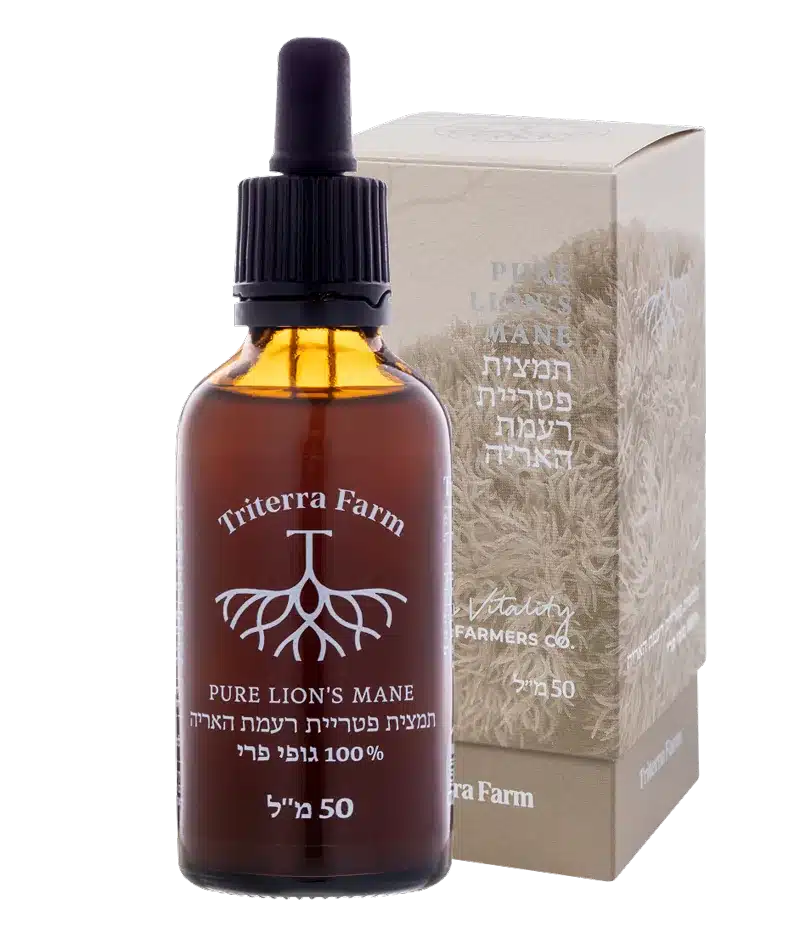
Lion's Mane — Fruiting Body Extract
The mushroom you just read about, in concentrated form: triple extraction from fruiting bodies, 23.93% beta-glucan lab-verified.
“Excellent product — it sharpens thinking and gives energy. Good for the morning hours.” — Tamer A., verified review (translated from Hebrew)
₪250
about 35 days of use (1.4 ml/day) · free shipping over ₪285

Lion's Mane + Reishi — Fruiting Body Extract
For a mind too loaded to settle: Lion's Mane for clarity, Reishi to bring the alertness level down — both in one bottle.
“Over the weeks focus, sharpness and clarity start to stand out.” — Tamer A., verified review (translated from Hebrew)
₪250
about 35 days of use (1.4 ml/day) · free shipping over ₪285
Triterra club members get a standing 10% discount on every order, plus a quantity discount on more than one extract. Joining is free, through the matching quiz →
What people who started tell us
Real verified reviews from our customers, translated from the original Hebrew
“Excellent product — it sharpens thinking and gives energy. Good for the morning hours.”
Tamer A.Lion's Mane Extract
“Lion's Mane and Cordyceps may be the ultimate combination for focus and energy.”
Mor B.Cordyceps + Lion's Mane
“Over the weeks focus, sharpness and clarity start to stand out.”
Tamer A.Lion's Mane & Reishi Extract
Ready for a slightly clearer head?
Start with a 100-day trial — if you feel no difference, you get your money back.
Choose my extract Not sure what fits? Take the matching quiz — under a minute →Want the mechanism itself, not just the conclusion? Lion’s Mane Science →
These statements have not been evaluated by the Food and Drug Administration. This product is not intended to diagnose, treat, cure or prevent any disease. The information here is for general knowledge only and is not medical advice or a substitute for consulting a physician. Consult a qualified professional before using any dietary supplement, especially if you take medication, are pregnant or nursing, or have a diagnosed medical condition.
The research behind Lion's Mane — 19 PubMed studies, the good and the bad →
