
Shlomi Hayun — Founder & Head Grower of Triterra Farm
Key takeaways
- Shlomi Hayun is the co-founder and head grower of Triterra Farm, a medicinal-mushroom farm in the Galilee, Israel, which he runs with co-founder Avishag Shaulski.
- Before mushrooms: a documentary filmmaker, a graduate of the Sam Spiegel film school, whose debut film screened at the Jerusalem Film Festival in 2010. He has been growing mushrooms in the Galilee since 2015.
- He works in a way that, as far as we know, very few producers anywhere do: extraction from fresh fruiting bodies, with no drying step — including a seven-week alcohol phase.
- He doesn’t ask you to take his work on trust: β-glucan on the finished extracts is tested at TÜV Austria — 23.21%–28.16% — and all of our lab reports are open.
Shlomi Hayun — co-founder, head grower, and working mycologist — is the person behind every Triterra Farm extract: from the agar plate in the farm lab, through the grow rooms in the Galilee, to the triple extraction and the bottle. This page introduces the man whose name stands behind the work — who he is, where he came from, what he actually does with his own hands, and how his work gets checked.
Who is Shlomi Hayun?
Shlomi Hayun is the co-founder and head grower of Triterra Farm: the person who personally grows the farm’s functional mushrooms — reishi (Ganoderma lucidum), lion’s mane (Hericium erinaceus), cordyceps, and turkey tail (Trametes versicolor) — and who developed and runs their extraction process. He leads the farm together with Avishag Shaulski, his partner in life and in the work. He lives in the Galilee, and the mushrooms he grows there are the only raw material that goes into Triterra’s extracts.
Unlike most supplement brands, Shlomi is not a marketer buying ready-made extracts or imported powders — he is the grower and extractor himself. That single fact shapes everything else: when the person whose name is on the product is the person who grew the mushroom, there is one address for every question, from the substrate the fruiting body grew on to the lab report.
How did a documentary filmmaker become a mushroom grower?
Shlomi’s first career was behind a camera. He is a graduate of the Sam Spiegel film school in Jerusalem, a documentary director whose debut film, “The Acting Teacher,” screened at the Jerusalem Film Festival in 2010. Since 2005 he has run Studio Hanabi, a film and editing studio, together with Avishag. That documentary eye — the habit of watching something until you truly understand it — is the tool he brought with him to the farm.
In 2015 the family moved to Hararit, a small community in the Lower Galilee, and the journey into mushrooms began — from foraging and observation, through systematic self-study, to building a working cultivation farm. The full story — including the moment one mushroom in the forest changed the direction of his life — is told on the farm’s About page. This page focuses on what happened since: the work itself.
| Year | Milestone |
|---|---|
| 2005 | Founds Studio Hanabi with Avishag — film, editing, and production |
| 2010 | His debut documentary, “The Acting Teacher,” screens at the Jerusalem Film Festival |
| 2015 | The move to Hararit in the Lower Galilee — foraging, study, and the first cultivation |
| Since then | Builds Triterra Farm with Avishag: growing fruiting bodies in the Galilee and developing fresh-mushroom extraction |
| 2025 | β-glucan testing of the finished extracts at TÜV Austria — reports published openly on the site |
What does Shlomi actually do on the farm — from agar plate to bottle?
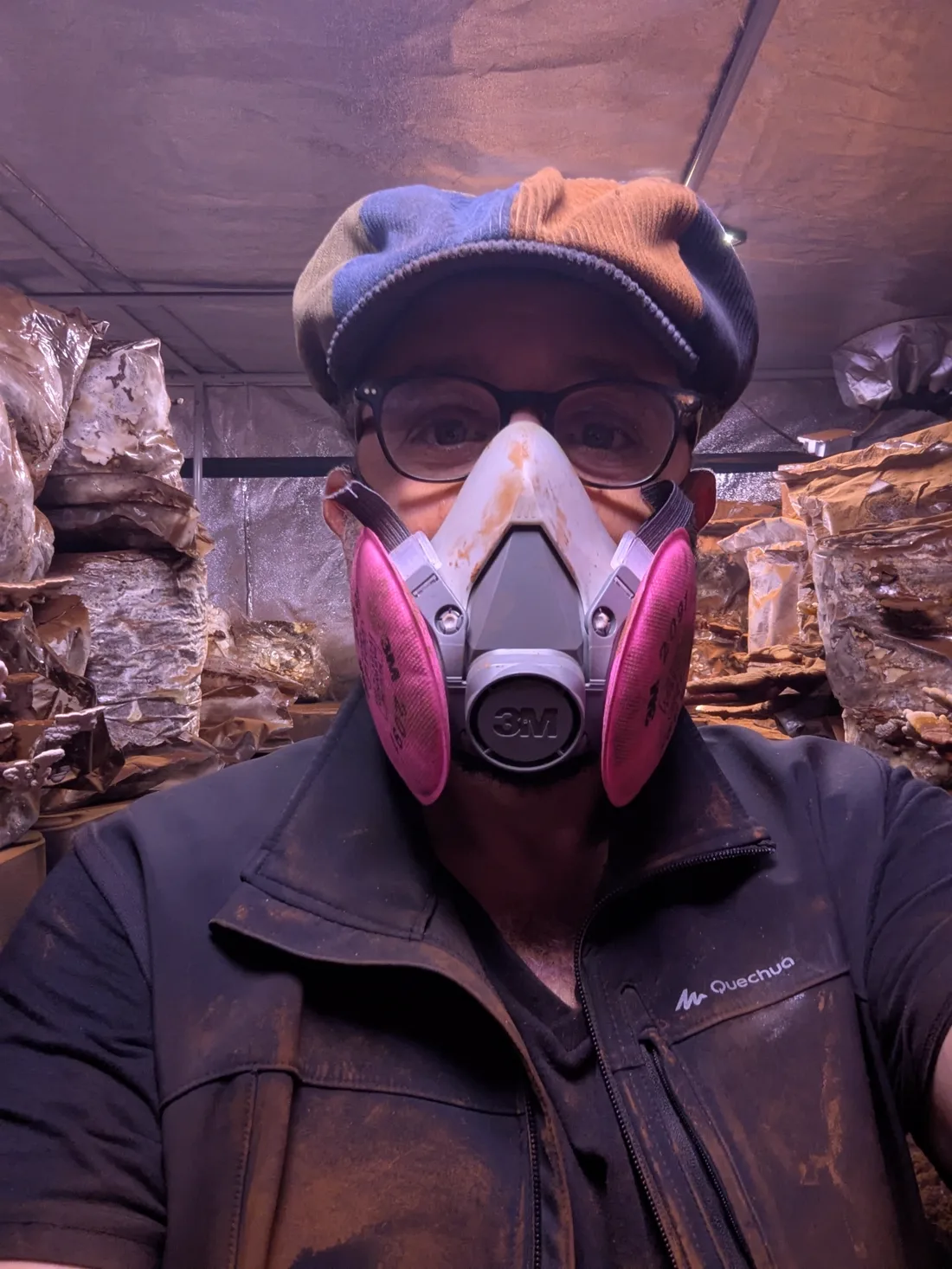
Everything happens in-house, from the very first step: isolating cultures on agar plates in the farm lab, preparing substrates, inoculating the grow rooms, growing the fruiting bodies to maturity, harvesting — and straight into extraction. No purchased powders, no imported raw material, no “step that happens at someone else’s facility.” When something goes wrong in a grow room, Shlomi is the one who walks in to fix it; when spore season arrives in the reishi tent, it’s his jacket that gets covered in orange dust.
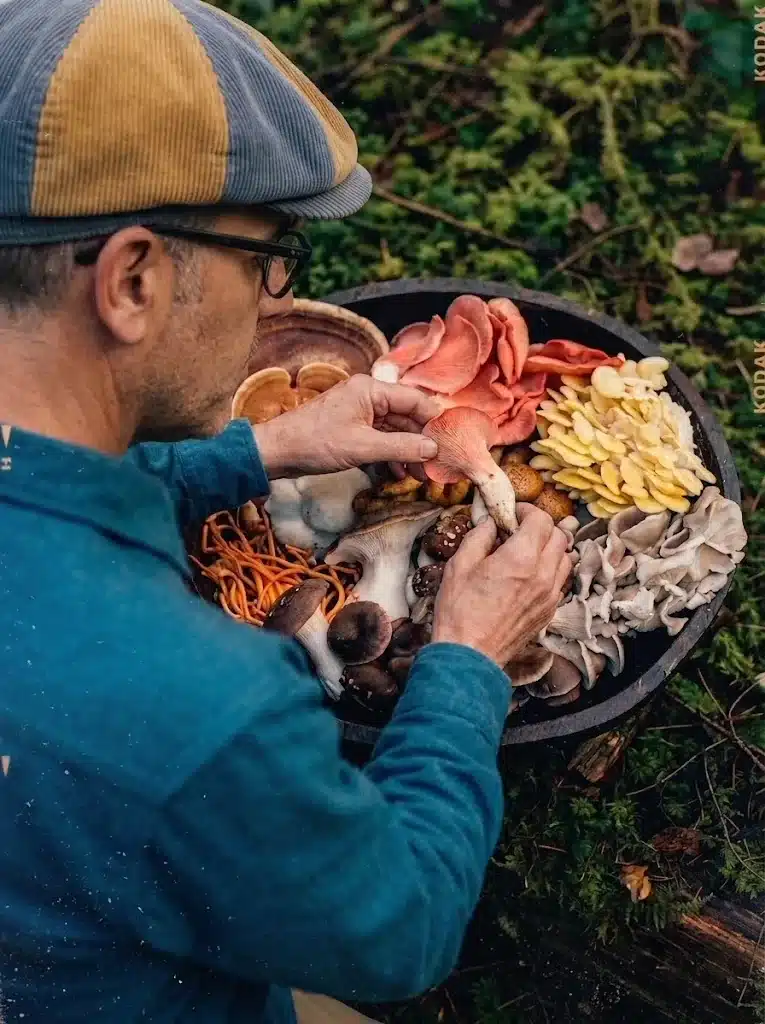
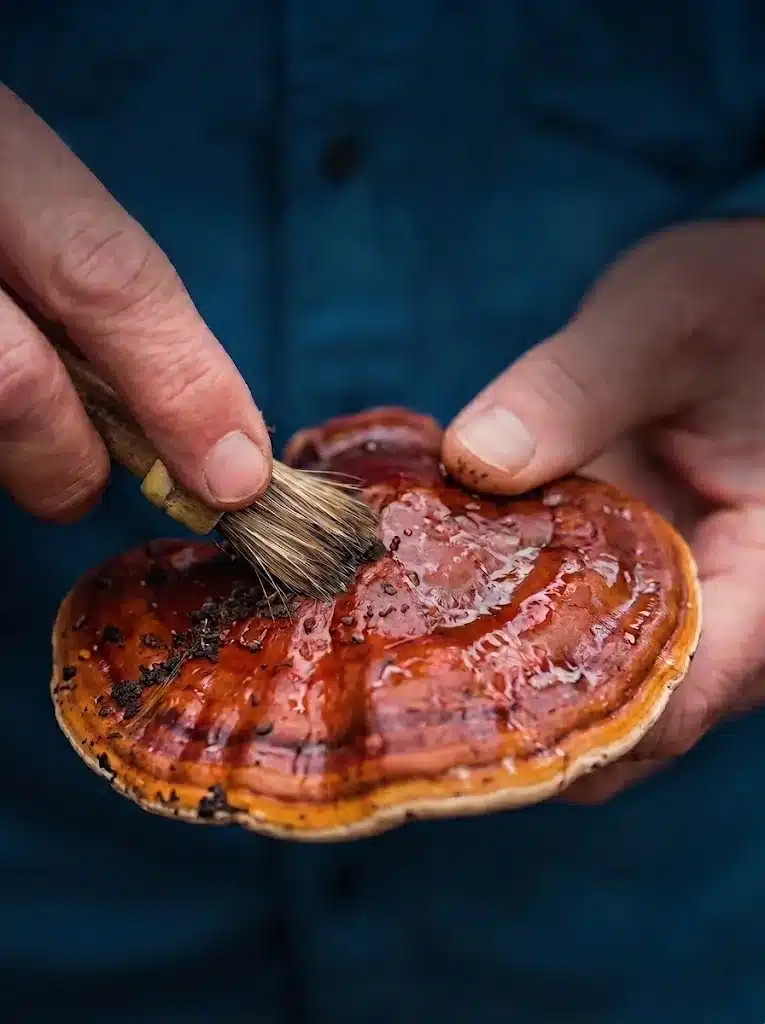

The work covers four species in constant cultivation for extracts — reishi, lion’s mane, cordyceps, and turkey tail — each with completely different growing requirements, and each with its own extraction ratio: cordyceps 1:2.5, lion’s mane 1:2, reishi and turkey-tail-&-reishi 1:3 — all ratios stated on a fresh-mushroom basis, in full disclosure. What an extraction ratio actually means, and why the fresh basis changes the number — we explain on a dedicated page.
Why does Shlomi insist on extracting from fresh mushrooms?
Because it’s the practical privilege of someone who grows his own. Most of the world’s supplement industry runs on dried raw material — that’s how it survives shipping and storage on the way from the grower (usually overseas) to the brand. Drying is a logistics solution, not a quality advantage. At Shlomi’s farm, the distance between the grow room and the extraction room is a few steps, so the mushroom goes from harvest to extraction with no drying step — as far as we know, among the very few in the world who work this way. Whatever is harvested and not processed immediately is deep-frozen, purely for preservation: we freeze, we don’t dry.
The full comparison between the fresh path and the dried path — what happens to the mushroom in each, and what that means for what ends up in the bottle — is on our fresh vs. dried mushroom extract page, along with Triterra’s place on the raw-material quality ladder: mycelium-on-grain, imported dried fruiting body, fresh fruiting body from the farm. It’s also important to say what we do not claim: we make no measured chemical-superiority claim for fresh. Our claim is modest and testable — we measure the outcome, not the story, and the measurement is below.
What does the extraction process look like — and why does it take seven weeks?
The extracts go through triple extraction — water, alcohol, and ultrasonic — to capture both water-soluble compounds such as the cell-wall β-glucans and alcohol-soluble compounds such as the triterpenoids studied in reishi. The heart of the process is time: the alcohol phase alone runs seven weeks. Shlomi holds an unfashionable position here — no technological shortcut has yet, in his view, outperformed slow, patient extraction; ultrasonic serves as a complementary stage, not a substitute. The full method is described on our triple-extraction page.
Who checks Shlomi’s work — and where can you see the numbers?
A grower who is also the extractor and the seller could tell you anything — which is why Shlomi chose not to tell, but to measure. The finished extracts are sent for 1,3/1,6 β-glucan testing at the TÜV Austria laboratory, using a specific enzymatic method, on a dry-matter basis. These are the results for the tested extracts:
| Tested extract | β-glucan 1,3/1,6 | α-glucan (starch) |
|---|---|---|
| Cordyceps | 28.16% | Not detected |
| Reishi | 25.65% | Not detected |
| Lion’s Mane | 23.93% | Not detected |
| Turkey Tail & Reishi | 23.21% | Not detected |
The α-glucan line is the quiet integrity proof: starch “not detected” means there is no grain in the extract — the fingerprint of mycelium-on-grain powders. All of our lab reports are open on the lab-testing page, with certificate numbers you can verify directly with the laboratory, and we teach you to read such a report line by line in our guide to reading a mushroom supplement COA. Beyond the lab, the scientific content on this site is reviewed by Dr. Evyatar Shaulsky, Ph.D., a Yale graduate — an outside eye checking that our wording never runs ahead of what the research actually shows. The farm is also kosher-certified by the Mateh Yehuda Rabbinate, under the supervision of Rabbi Gad Atias.
What Shlomi is not — and why that matters
Shlomi is not a physician, not a naturopath, and not an academic researcher — and he doesn’t pretend to be. He is a grower and extractor, and that is exactly the authority he claims: the raw material and the process. Questions of use are answered from research literature with careful, hedged wording — “studies examine,” never promises — and personal medical questions always belong with your doctor, especially where medications are involved. If you’re looking for promises, we will disappoint you; if you’re looking for growing and extraction work you can actually verify, that is precisely what this page is for.
Where else can you meet Shlomi?
In the interviews and articles collected on the About page, in the farm videos on Triterra’s YouTube channel, and across the research pages of this site, where his work meets the scientific literature: our research hub, filtered to quality-and-testing studies, gathers the sources behind everything you’ve read here.
The extracts Shlomi grows and makes
Fresh fruiting body from the Galilee farm · triple extraction with a seven-week alcohol phase · β-glucan 23.21%–28.16% tested at TÜV Austria · all lab reports open
100-day trial · free shipping over ₪285 · fixed club discount
Not sure which extract fits you? Our short matching quiz will point you to the right one.
The bottom line
Behind every supplement brand stands someone — usually you’ll never learn who. Behind Triterra Farm stands Shlomi Hayun: a documentary filmmaker turned grower who chose to do the hard thing — grow it himself, extract it fresh, wait seven weeks — and then put the result on an outside laboratory’s bench and publish the report. You can question any choice he makes in the process; you can’t argue with the fact that he shows you exactly what he does.
Frequently asked questions
These statements have not been evaluated by the Food and Drug Administration. This product is not intended to diagnose, treat, cure, or prevent any disease.
