
Who Shouldn’t Take Turkey Tail? Side Effects, Interactions and Safety — What the Trials Actually Recorded
- In trials in healthy adults, 3.5 to 12 g a day of turkey tail extract caused no serious event and left liver and kidney tests unchanged.
- Most of turkey tail's safety record belongs to the PSK and PSP drugs given to cancer patients alongside chemotherapy, not to a home supplement.
- PubMed lists no human case report of injury linked to turkey tail, and the online platelet warning traces back to two other mushrooms.
- Turkey tail alone has no human coagulation data; the reishi in the blend means asking a physician about blood thinners and pausing two weeks before surgery.
- Immunosuppressants, autoimmune disease, cancer treatment, pregnancy, children and mushroom allergy call for a physician's approval, because no trial covered these groups.
Turkey tail (Trametes versicolor, yun zhi in Chinese medicine, kawaratake in Japan) is the medicinal mushroom with the largest human safety record — and most of that record belongs to two prescription drugs made from it, not to a supplement.
Japan’s PSK and China’s PSP were given to thousands of cancer patients alongside chemotherapy, in hospitals, for decades; the “turkey tail side effects” lists online — dark stools, dark fingernails, “low platelets,” a ban with autoimmune disease — were lifted from those trials, or from other mushrooms, without saying so. This page keeps them apart: in controlled trials in healthy adults, turkey tail extracts at 3.5 to 12 grams a day for up to four months produced no serious event and did not change liver or kidney function; in the only dose-escalation trial — up to 9 grams a day — nine adverse events were recorded, seven of them mild, with no nausea and no stomach upset. The medical literature holds not one case report of harm from turkey tail in humans, and the large 2025 safety review of immunomodulating natural products does not mention it at all. We grow and sell turkey tail. That is exactly why every claim below carries a PubMed link — including the claims about what does not exist.
Why this page is different from every “turkey tail side effects” list you will find. We searched the question in English and in Hebrew before writing. The Hebrew results repeat “avoid in pregnancy, not with blood thinners, not with autoimmune disease” without a single source, and a “cleansing reaction” appears in them as an expected phase; the English results — including the Memorial Sloan Kettering monograph — list “dark stools” and “darkening of fingernails” from a 1992 study of the PSP drug in chemotherapy patients, and a “drop in platelets” that, when we traced it, came from two entirely different mushrooms. The difference between “measured in 100 healthy adults over four months” and “observed in cancer patients on mitomycin” is, in our view, the whole answer. So this page sorts every finding by product type and by kind of evidence, and says plainly where the evidence is “none.”
Key takeaways
- What the trials in healthy people found: 100 healthy adults taking a turkey tail extract (50 mg per kg, about 3.5 g a day) with danshen for four months — “no adverse effects” on liver, kidney or bone chemistry; 12 healthy adults taking 3.6 g of PSP a day for two weeks — the drug-metabolizing enzyme CYP3A4 did not move; 90 adults taking 12 g a day of turkey tail and agarikon mycelium around a COVID vaccine — zero adverse events, liver and kidney unchanged.
- What the cancer patients found: in 9 women after breast-cancer treatment, 3 to 9 g a day for six weeks produced nine adverse events — seven mild, one moderate, one severe (an anxiety event) — and no nausea; a network meta-analysis of 23 PSK trials in 10,684 patients found “no increase in side effects”; a 2022 Cochrane review of 1,569 colorectal-cancer patients found “very low-certainty” evidence in every direction.
- What does not exist: no case report of harm from turkey tail in humans on PubMed; no trial in people on anticoagulants, with autoimmune disease, in pregnancy or in children; and no human trial of a fruiting-body tincture — the trials used mycelium extracts and drugs.
- The blood: turkey tail itself has no human coagulation data. Our blend contains reishi, and reishi has two contradictory trials — so the blend’s rule: anticoagulants — physician first; surgery — stop two weeks before.
- Who should not, without a doctor: anyone on immunosuppressants and anyone in active cancer treatment (the evidence that exists is for a drug, in hospital); autoimmune disease (no trial); pregnancy and breastfeeding (no trial has ever included them); children — certainly not with an alcohol tincture; and mushroom allergy.
Does turkey tail have side effects?
Yes — rare, mild, and mostly digestive, when the product is an identified extract at study doses. In the trials in healthy people no serious event was recorded and no liver, kidney or bone test changed; in the dose-escalation trial in breast-cancer survivors, seven of nine adverse events were mild — heartburn, constipation, a passing chest pain — and not one was nausea. The two items that recur in the lists — dark stools and dark fingernails — were reported as rare in chemotherapy patients taking the PSP drug, and appeared in no trial in healthy people. A case report of actual harm: none.
That sentence hides a question most safety pages skip: which turkey tail? The name covers three fundamentally different products. The first is PSK and PSP — two protein-bound polysaccharides extracted from fermented mycelium of the fungus, in clinical use as drugs in Japan and China since the 1970s, with dozens of randomized trials in cancer patients behind them; this is the product behind the “400 clinical trials” that brands like to quote, and behind most of the warnings. The second is mycelium grown on grain, dried and milled into capsules — most of what is sold as “turkey tail” worldwide, usually low in beta-glucan and high in starch, and without a safety trial of its own. The third is the fruiting body — the coloured fans themselves, growing on wood in the forest or on a substrate on a farm, the ones we grow in the Galilee and extract. The three products share a family of compounds (beta-glucans, protein-bound polysaccharides) but do not share evidence: the large trials belong to the first, the trials in healthy people to extracts of the first kind and to mycelium, and no human trial has been done on a fruiting-body tincture. This page writes next to every finding which product it concerns.
Which turkey tail? Three products, three bodies of evidence
The most important distinction in turkey tail safety is not between “safe” and “dangerous” but between drug and supplement: PSK and PSP are standardized drugs, at gram doses, given to cancer patients under oncological monitoring — and everything recorded about them, good and bad, was recorded in that population. A fruiting-body supplement is a different product, at a different dose, in different people. The table sorts the three products and what is known about each.
| The product | What it is | What the safety literature holds | What can be tested |
|---|---|---|---|
| PSK (Krestin) and PSP — drugs | Protein-bound polysaccharides from fermented mycelium of the CM-101 and COV-1 strains; in clinical use in Japan and China since the 1970s; clinical dose 3 g a day | The big evidence base: 23 PSK trials in 10,684 gastrointestinal-cancer patients — “no increase in side effects”; 7 trials in 1,569 colorectal patients (Cochrane 2022) — very low-certainty evidence; the side effects recorded belong to the chemotherapy given alongside | A standardized drug with a manufacturing record — not available as a supplement |
| Mycelium on grain (most capsules) | Mycelium grown on rice or oats, dried and milled — grain included | One trial in healthy people on a mycelium blend (90 participants, 12 g a day, four days — zero adverse events); the breast-cancer escalation trial used freeze-dried mycelial powder (up to 9 g a day) | Depends on the maker; low beta-glucan and high alpha-glucan (starch) when grain is present |
| Fruiting body (what we grow) | The fans themselves, growing on wood or on a farm substrate, harvested and extracted | No dedicated human trial of a fruiting-body tincture; the evidence on it is chemical (beta-glucan, the YZP protein) and laboratory | Everything: beta-glucan, alpha-glucan, metals, pesticides, PAH — a lab report on the finished extract |
We do not present the table to claim a fruiting-body supplement is as safe as PSK — the opposite: we present it to say that PSK’s safety record cannot be copied onto a supplement, and neither can its warnings. Whoever quotes “400 trials” as proof of safety and whoever quotes “hematological toxicity” as a warning are making the same mistake in opposite directions. What does carry across the products is the mushroom itself — the same beta-glucans, the same protein — and it has been drunk as a decoction in East Asia for centuries without a poisoning literature. In our guide to what turkey tail has actually been tested for in people we drew this distinction for efficacy; here it serves safety only.
What did the controlled trials in healthy adults actually record?
Four trials gave turkey tail extracts to healthy people and measured something that bears on safety. The largest and longest: 100 healthy adults in Hong Kong, 50 mg per kg a day of a yun zhi extract (about 3.5 g for a 70 kg adult) with danshen, four months in each arm of a crossover — “no adverse effects on liver and renal functions, and the biochemical bone profile.” The rest are small and short, but they measured exactly what many warnings assume: drug enzymes, kidney, liver.
| Trial | Who and how long | Dose and form | Safety finding | What it does not mean |
|---|---|---|---|---|
| Wong 2004 | 100 healthy adults, 4 months per arm (crossover) | Yun zhi 50 mg/kg + danshen 20 mg/kg, capsules | “No adverse effects on liver and renal functions, and the biochemical bone profile”; T-helper cells and CD4/CD8 rose | A blend with a second herb; not turkey tail alone |
| Nicandro 2007 | 12 healthy adults (8 women, 4 men), 14 days | 1,200 mg PSP three times a day = 3.6 g | CYP3A4 activity (erythromycin breath test) changed by 0.08% — “no clinically significant inhibition or induction” | One enzyme; 14 days; other enzymes and transporters not tested |
| Pallav 2014 | 24 healthy volunteers, 8 weeks of follow-up | PSP from turkey tail (versus amoxicillin and versus no treatment) | “Clear and consistent” microbiome changes consistent with prebiotic activity; 22 of 24 completed | Safety was not an endpoint; the study was about gut bacteria |
| Saxe 2026 | 90 adults around a COVID-19 vaccine, 4 days + follow-up at 14 days and 6 months | Eight 500 mg capsules three times a day = 12 g of turkey tail and agarikon mycelium | “There were no adverse events”; transitions from normal to abnormal kidney or liver function — no difference from placebo; 100% completed | Four days only; a blend; mycelium |
Three things to read from the table. First, the doses: 3.5 to 12 grams of extract a day — and a daily tincture dose of about 1.4 ml delivers far less material than any of them; we say so explicitly rather than convert. Second, what was measured: liver, kidney, bone and the CYP3A4 enzyme — precisely the systems the generic warnings (“liver burden,” “drug interactions”) assume are affected, and over 14 days to four months they did not move. Third, what is missing: none of these trials reported coagulation, glucose or blood pressure, none included pregnant women or children, and none tested a fruiting-body tincture. Where the table is silent, so are we.
What do ten thousand cancer patients in Japan and China teach about safety?
The largest human record on turkey tail is PSK in gastrointestinal cancer: a 2017 network meta-analysis covered 23 randomized trials in 10,684 patients and found better survival “with no increase in side effects”; a 2007 meta-analysis covered 8,009 gastric-cancer patients from eight trials; a 2006 one — 1,094 colorectal patients. The 2022 Cochrane review, which looked specifically at adverse effects, covered 7 trials in 1,569 patients and found “very low-certainty” evidence — withdrawal from treatment because of adverse events did not change (risk ratio 1.03), and neutropenia may have fallen. Two caveats are mandatory: every one of these trials gave PSK alongside chemotherapy, so the “side effects” in them belong to mitomycin and 5-FU; and the product is a drug, not a tincture.
| Trial | Who and how long | Dose and form | Safety finding | What it does not mean |
|---|---|---|---|---|
| Torkelson 2012 | 9 women after breast-cancer treatment, 6 weeks + 3 weeks washout | 3, 6 or 9 g a day, freeze-dried mycelial powder in capsules | 9 adverse events: 7 mild (heartburn, palpitations, constipation, passing chest pain, fever with radiation dermatitis), 1 moderate (fatigue secondary to a urinary infection), 1 severe (an anxiety event at 6 g — “possibly related”); “neither nausea nor GI upset was reported”; no serious adverse event | 9 women; after radiotherapy; no maximum tolerated dose was found — 9 g was the ceiling tested |
| Tsang 2003 | 68 advanced lung-cancer patients after conventional treatment, 28 days | PSP capsules versus placebo, double-blind | “No reported adverse reaction attributable to the trial medications”; leukocyte and neutrophil counts, IgG and IgM rose | 28 days; a very ill population |
| Chay 2017 | 15 advanced liver-cancer patients unfit for standard therapy, 2:1 versus placebo | Yun zhi extract, 2.4 g a day | Less appetite loss and pain, higher quality-of-life scores; time to progression unchanged | 15 participants; poor liver function to begin with |
| Ohwada 2004 | 205 stage II–III colorectal-cancer patients, 2 years | PSK 3 g a day + UFT, after mitomycin | “Adverse effects were mild and compliance was good”; 6.6% in the PSK group versus 5.9% in controls paused temporarily for adverse effects — digestive, marrow, liver — of the chemotherapy in both arms | Chemotherapy identical in both arms; PSK cannot be isolated |
| Ogawa 2024 | 186 colorectal-cancer patients, 6 or 12 months | UFT/LV alone versus UFT/LV + PSK 3 g a day | Grade 3 or higher adverse events: 13.5% without PSK versus 9.6% and 9.9% with PSK; “reduced adverse effects” | Phase II; difference not significant; survival unchanged |
| Okuno 2018 (JFMC38) | 111 stage II rectal-cancer patients, surgery alone versus UFT + PSK | UFT + PSK | Disease-free survival slightly worse in the UFT + PSK arm (76.0% versus 84.0% at three years, not significant); leading adverse events — bilirubin, nausea, fatigue, raised liver enzymes — attributed to UFT; trial closed early | Not a safety trial of PSK but of the combination; included because it is the one trial with an unfavourable trend |
| Pilkington 2022 (Cochrane) | 7 trials, 1,569 colorectal patients (6 in Japan, 1 in China), 4 weeks to 3 years | PSK extract alongside chemotherapy | Withdrawal for adverse events: risk ratio 1.03; neutropenia 0.41; oral dryness and mucositis 0.37; nausea 0.73; diarrhoea 0.77 — all “very low certainty” | The evidence is insufficient for any confident conclusion — in either direction |
| Ma 2017 (network meta-analysis) | 23 trials, 10,684 gastrointestinal-cancer patients | PSK with or without chemotherapy | Higher 5-year survival; “no increase in side effects was observed” | Older Japanese trials of variable quality |
The most important thing in this table for a healthy consumer is not the survival — we do not sell turkey tail to cancer patients, and we will not suggest you take a supplement instead of or alongside treatment without your oncologist — but the direction: thousands of people in the most immunologically and hepatically vulnerable state took 3 g a day of a turkey tail extract for years, under close laboratory monitoring, and no meta-analysis identified a toxicity signal from the mushroom itself. A 2023 systematic review of 39 clinical studies of mushrooms in cancer summarized that most adverse effects were grade 2 or lower — nausea, vomiting, diarrhoea, muscle pain — and that the evidence is “inconclusive” for routine recommendation. And what we do take from here: our position for an oncology patient is a question for the oncologist — not because the evidence points to harm, but because the evidence that exists is for a drug in a medical setting, and a supplement at home is not that.
Zero case reports — what that means, and what it does not
We searched PubMed for case reports of turkey tail in humans. The results: two. One is a dog with a sarcoma given turkey tail extract after surgery; the other is Paul Stamets’ report on his mother — a recovery story, not harm. The 2025 safety review of adaptogenic and immunomodulating natural products, which analysed 45,042 adverse-event reports from the WHO’s VigiBase and covered reishi, shiitake, chaga and cordyceps, does not mention turkey tail — not PSK, not PSP, not Coriolus — once in its full text.
There is a right and a wrong way to read an absence. The wrong one: “completely safe” — an absence of reports is also a product of relatively low use in the West and of the under-reporting that exists for every supplement. The right one: a mushroom given at gram doses to tens of thousands of cancer patients, and registered as a drug in two countries, has a safety literature large enough that a specific harm would have been recorded in it — as lead poisoning was recorded for wild cordyceps and the liver reports for reishi, and we write about those on the sister pages. The one death we found with PSK in the regimen: a 70-year-old woman with metastatic gastric cancer in 1987, who received mitomycin, UFT, OK-432 and PSK and developed hemolytic uremic syndrome; the authors attributed it “to antineoplastic agents” — and mitomycin is a known cause of that syndrome. We include it because that is what a record looks like when you read it to the end, not because it teaches anything about the mushroom.
Immunosuppressants and autoimmune disease — what the evidence says and what it does not
The standard warning: turkey tail “stimulates the immune system,” so it is off-limits with immunosuppressants and in autoimmune disease. The evidence is more complicated. In healthy people, a yun zhi extract raised T-helper cells and the CD4/CD8 ratio; but a protein isolated from the fruiting body (YZP) increased IL-10 production more than 60-fold in mice and drove regulatory B cells — a pathway that restrains inflammation rather than boosting it — and eased gut inflammation in them. And in the human trials, PSK was given alongside chemotherapy that suppresses the bone marrow — and neutropenia, per Cochrane, may actually have fallen. This is a mushroom that modulates; the direction depends on the state, and no trial has measured it in autoimmune disease or after a transplant.
So our position, and we want to state it precisely: not “forbidden” — there is no evidence of harm — but “no data,” and when the disease is one where the direction of the immune response is the whole difference, “no data” belongs with the treating physician and not with a supplement page. Anyone on cyclosporine, tacrolimus, methotrexate or a biologic, anyone after a transplant, and anyone with active autoimmune disease — rheumatoid arthritis, lupus, multiple sclerosis, Crohn’s — does not start a beta-glucan supplement without asking. And what we will not do is turn the mechanism into a forecast: “modulates” sounds reassuring, but the only thing that can say what happens to a person with a given disease is a trial in people with that disease, and there is none. Our guide to mushrooms and the immune system sets out what was measured in healthy people and what was not.
Does turkey tail thin the blood?
For turkey tail alone there is no human data: no trial has measured coagulation, platelets or INR, and there is no case report of bleeding. The only evidence is a 2025 materials study in which a polymer fibre loaded with turkey tail extract inhibited platelet activity in the test tube — a laboratory finding on a product that is not a supplement. But the blend we sell contains reishi, and on reishi there are two human trials that contradict each other — so the blend’s rule is reishi’s rule.
The contradiction: in 1990, 33 atherosclerotic patients taking 1 g of reishi three times a day for two weeks showed platelet-aggregation inhibition of up to 31.49%; in 2005, 40 healthy volunteers taking 1.5 g a day for four weeks showed no change in platelets or coagulation, and the authors concluded reishi “is unlikely to increase surgical bleeding.” We laid this out on who shouldn’t take reishi; the short version for our blend: anticoagulants or antiplatelets — warfarin, apixaban, rivaroxaban, clopidogrel, daily aspirin — ask the prescriber before you start; surgery or a tooth extraction — stop two weeks before, and tell the anaesthetist. That is a precaution we can defend because of the reishi, not a finding about turkey tail — and we mark the difference because it is exactly what the online lists erase.
Where did the “low platelets” warning come from?
English-language sites write that turkey tail “has been associated with low platelet counts.” We traced the source. A 2020 narrative review of medicinal mushrooms in oncology wrote that the only adverse effects reported were gastrointestinal reactions and “a decrease in platelet count” — and in the body of the review it turns out the decrease, within the normal range, was seen in two trials: one of Antrodia cinnamomea (30 days) and one of Agaricus sylvaticus (six months). Not turkey tail. The one turkey tail trial in that review — 15 liver-cancer patients — was not the source of that finding.
And what was measured in turkey tail points the other way: in 68 lung-cancer patients, 28 days of PSP raised leukocyte and neutrophil counts; in the Memorial Sloan Kettering monograph, the source for “dark stools” is a 1992 study that examined blood counts in chemotherapy patients on PSP — not a study of low platelets; and in a randomized trial of 82 gastric-cancer patients in which both arms received PSK, thrombocytopenia was more frequent in the arm that received its chemotherapy intravenously — that is, it belonged to the chemotherapy. It is a good example of how a warning travels: a finding in one mushroom, in the summary sentence of a review, becomes a property of another mushroom on a page that copies the sentence. If you take a drug that lowers platelets or have a blood disorder, that is still a reason to ask — but because of “no data,” not because of a finding.
Which medications interact with turkey tail?
Turkey tail is one of the few mushrooms with a human interaction trial, and it is negative: 14 days of 3.6 g of PSP a day neither inhibited nor induced CYP3A4 — the enzyme that clears roughly half the drugs on the market — in 12 healthy adults. Two clinical pharmacokinetic studies found no interaction between PSK and the chemotherapy drug tegafur. What exists beyond that is a rat study: PSP lengthened the time to peak tamoxifen concentration by 228% after a single dose, without changing total exposure. The table writes next to every row what the evidence is.
| If you take | What the evidence is | Our position |
|---|---|---|
| Drugs cleared by CYP3A4 (many statins, calcium-channel blockers, benzodiazepines, and more) | Trial in 12 healthy adults: zero change in enzyme activity after 14 days of 3.6 g PSP | No signal; other enzymes untested — tell your pharmacist |
| Chemotherapy | 56 clinical studies of yun zhi alongside cytotoxic drugs; two PK studies with no interaction with tegafur; “no reported adverse effects” — but methodological quality “modest” | Only with the oncologist’s knowledge — the evidence is for a drug in a medical setting |
| Tamoxifen and hormonal therapies | Rats: time to peak tamoxifen lengthened by 228% (single dose) and 93% (repeated dosing); AUC and Cmax unchanged; zero human data | Tell the oncologist; an absorption mechanism in animals, not a human finding |
| Anticoagulants and antiplatelets | Turkey tail: zero human data; our blend contains reishi — two contradictory human trials | Physician first; stop two weeks before surgery (because of the reishi) |
| Immunosuppressants, biologics | No trial; a modulating mechanism in both directions (T-helper rises in healthy people; IL-10 and regulatory B cells in mice) | Not without the treating specialist |
| Diabetes medication | No human glucose trial with turkey tail; the trials in healthy people did not report glucose | No signal and no data — monitor as usual and inform |
| Antibiotics | A trial in 24 healthy people compared PSP with amoxicillin on the microbiome — it did not test them together | No known interaction; PSP acted as a prebiotic |
Our general guide to medicinal mushrooms and drug interactions covers the other species; this table is turkey tail only, and deliberately writes “zero data” instead of filling it with adjectives.
Dark stools and dark fingernails — what was actually recorded?
Both items appear in the Memorial Sloan Kettering cancer monograph as “rare” adverse reactions: dark-coloured stools “not originating from occult blood,” from a 1992 study of PSP in chemotherapy patients; and darkening of fingernails, from a 2000 review that concluded the mushroom preparations studied in humans, PSK and PSP among them, are “non-toxic and very well tolerated.” Both were reported in cancer patients on the PSP drug at gram doses; neither appeared in the four trials in healthy people, nor in the escalation trial up to 9 g.
What that means for you: if your stools turn dark after starting turkey tail, do not assume it is the mushroom. Black stools are also a sign of bleeding in the upper digestive tract, and that is checked by a physician before it is attributed to a supplement — especially if you take aspirin, anti-inflammatories or anticoagulants. Nail darkening is a cosmetic effect reported with prolonged high-dose use of a drug; we have not seen it, and we will not claim it is impossible. Both resolve on stopping, according to the same sources.
Digestive side effects — and the “cleansing reaction” no trial ever measured
Bloating, gas and loose stools are the ordinary side effect of any supplement rich in beta-glucan and fibre, and turkey tail is a prebiotic in the precise sense: in 24 healthy people it changed the composition of the gut bacteria “clearly and consistently.” What is surprising is how little of this was recorded: in the escalation trial up to 9 g a day “neither nausea nor GI upset was reported,” and in the Cochrane review diarrhoea on PSK was no more frequent than without it (risk ratio 0.77, very low certainty). A “cleansing reaction,” “healing crisis” or “Herxheimer reaction” — which Hebrew pages present as an expected phase — was measured in no trial, and no trial described symptoms that worsen and then pass.
We say this against our own commercial interest, because “that’s the cleanse working” is the most convenient sentence a seller can offer a customer who feels unwell. The evidence-based reading of new symptoms after a supplement is that the dose is too high, the product is not for you, or something else is going on — not that toxins are leaving. Start low and increase over one to three weeks, as the dosage guide describes; if bloating or diarrhoea lasts more than a few days at the lowest dose, that bottle is not for you, and our 100-day trial period exists precisely so that it costs you nothing. The question of turkey tail and the gut — what was measured and what was not — is on how turkey tail supports your microbiome.
Can you be allergic to turkey tail?
We found no case report of an allergic reaction to turkey tail in humans — not to the food, not to a supplement, not to the spores. That does not mean it cannot happen: turkey tail is a fungus, allergy to mushrooms and moulds exists as a class, and the 2025 review documented contact dermatitis and allergic alveolitis from spores in shiitake growers with occupational exposure. In the trials in healthy people and in patients, no allergic reaction was reported.
What that means for you: if you have a known allergy to mushrooms as food or to moulds, start with a tiny amount and watch your skin and breathing for the first few days; itching, hives, wheeze or facial swelling are the signs to stop on. We will not promise that any mushroom product is allergy-free — none is — and anyone allergic to mushrooms should not test that on us. What is in our hands: an extract from fruiting body grown on a controlled substrate on a farm, not a powder of a mushroom picked from a forest log with everything that grew on it.
Is turkey tail safe in pregnancy or while breastfeeding?
Nobody knows, because no trial has ever included pregnant or breastfeeding women — not in healthy volunteers, not in patients. The Memorial Sloan Kettering monograph puts it this way: “Until safety data become available, pregnant or breastfeeding women should avoid taking Coriolus.” Our position is the same as for every medicinal mushroom, and we wrote a whole page about it: not now. Not because of known harm, but because “no data” is not “safe,” and an alcohol tincture is the wrong vehicle regardless.
Turkey tail has an additional reason of its own: it modulates the immune system, and pregnancy is a state in which the immune system is deliberately recalibrated — so as not to reject the foetus. Nobody has measured what happens when you mix them. If a practitioner recommended turkey tail in pregnancy “for immunity,” the question to hand back is which study they are relying on — because we did not find one.
Can children take turkey tail?
There is no trial in children. There is no case report either — for good or ill — and that leaves the question exactly where it should be: with a paediatrician. Our page on medicinal mushrooms for children sets out what has been studied in other mushrooms and why the decision is not ours; the short version for turkey tail is that there is no data, and that our product is an alcohol tincture — two separate reasons, each sufficient on its own.
And one sentence for anyone who has read about “a mushroom for the kindergarten years”: the extracts given to children in trials of other mushrooms were alcohol-free products, within a study, under monitoring. Alcohol drops from a bottle are a different thing, and nothing in the turkey tail literature justifies the leap.
Why the product matters more than the mushroom: what is actually in your bottle
When there are no reports of harm from the mushroom, the safety question moves entirely to the product: what is inside, and what is not. Three questions decide it. Identity — turkey tail is one of the most commonly misidentified mushrooms in the world, because “false turkey tail” (Stereum) and other bracket fungi look alike to an inexperienced picker, and a capsule carries no picture. Composition — mycelium on grain gives low beta-glucan and high starch, and an alpha-glucan test exposes that. And cleanliness — mushrooms growing on wood in the wild accumulate cadmium and metals from their substrate, and that is measured only by a screen. Our answer is a test report, not an adjective.
| What was tested | Result | Laboratory / report |
|---|---|---|
| Beta-glucan (1,3/1,6), dry basis — the Turkey Tail & Reishi blend extract | 23.21% | TÜV Austria, CY01082793 |
| Alpha-glucan (starch — the grain marker) | Not detected | TÜV Austria |
| Heavy metals in turkey tail: lead, arsenic, mercury, aluminium | Not detected | VELTIA, report 46-168 |
| Cadmium in turkey tail — the metal wood-rotting fungi accumulate | 0.10 mg/kg, stated as a number and not as “traces” (in the reishi of the blend: 0.03, report 46-175) | VELTIA |
| Pesticides (610-compound screen) | No active ingredient quantified | VELTIA, report 44-39 |
| Polycyclic aromatic hydrocarbons (PAH) | Below 0.2 µg/kg for all four | VELTIA, report 46-412 |
| Product identity | Trametes versicolor fruiting body from our farm in the Galilee — no mycelium on grain, no wild harvest | The grower |
| The single-mushroom turkey tail extract | Has no beta-glucan test of its own, and we do not quote a number for it; it is currently not on sale | — |
Note the first row: 23.21% is the number for the blend extract — Turkey Tail & Reishi — which is the extract that was sent for testing, and the extract we sell. The single-mushroom turkey tail extract has no number of its own, and we write that instead of lending it the blend’s number, because the difference between “tested” and “sounds tested” is the whole point of this page. The full reports are open, and how to read a test report walks through them line by line. Fresh fruiting body from our farm, with no drying step, seven weeks in alcohol within a triple extraction, and a lab report on the finished extract: that is our entire safety claim about the product itself. What the mushroom does in your body at that dose, the trials above describe better than we can.
Who shouldn’t take turkey tail — the list
Almost every item here is a “no data” precaution rather than a finding, and we mark which is which. Without a physician’s explicit approval, our blend is not for: anyone on immunosuppressants or biologics, transplant recipients, and anyone with active autoimmune disease; anyone in active cancer treatment; anyone on anticoagulants or antiplatelets (because of the reishi); pregnant or breastfeeding women; children; and anyone with a known allergy to mushrooms or moulds.
Turkey tail is not for you, or not yet, if:
- You take immunosuppressants or a biologic, or have had a transplant — no trial; the mechanism modulates in both directions. Only with the specialist’s knowledge.
- You have active autoimmune disease — no trial in this population. The physician decides.
- You are in active cancer treatment — the large evidence is for a drug in a medical setting, not a supplement at home. The oncologist, always — including because of the tamoxifen finding in rats.
- You take a blood thinner or antiplatelet — a precaution because of the reishi in the blend; turkey tail itself has no data. Physician first.
- You have surgery or a tooth extraction planned — precaution: stop two weeks before and tell the anaesthetist.
- You are pregnant or breastfeeding — no data, therefore no.
- You are giving it to a child — no trial, and the extract is alcoholic.
- You are allergic to mushrooms or moulds — no specific report, but it is a fungus. Start tiny or do not start.
- You have a “turkey tail” capsule with no lab report — the risk that remains when the mushroom has no harm reports is what is inside the capsule: identity, starch, cadmium. Do not take an untested product.
If none of these applies to you, the trials’ answer is the one at the top of the page: rare, mild side effects, no organ signal at study doses, and no reports of harm. Turkey tail is a daily-baseline mushroom — it tunes rather than spikes, so it is taken consistently, not “before an event” — and we cover the timing question and how long before you feel anything on separate pages. If you are not sure turkey tail is even the right mushroom for your goal, “Which mushroom is right for me” answers that before you spend a shekel, and the quiz does it in two minutes.
What this page does not claim
We do not claim turkey tail is “completely safe” — an absence of reports is not proof, and under-reporting exists for every supplement. We do not claim the PSK record belongs to our supplement — it belongs to a drug, at a different dose, in different people. We do not claim our extract was tested for safety in a trial; our lab report measures what is in the bottle, not what it does. And we do not convert study doses into drops, because no study tested drops.
Three things we would like to see, and cannot offer: a human trial of a turkey tail fruiting-body tincture, a trial in any autoimmune disease, and any human data in pregnancy. Until they exist, the honest safety page is a list of precautions with the evidence grade written next to each — and on most rows here the grade is “none.” Our reishi, cordyceps and lion’s mane safety pages are built the same way — and there, unlike here, there are case reports to tell — and the general guide to side effects of medicinal mushrooms covers the rest.
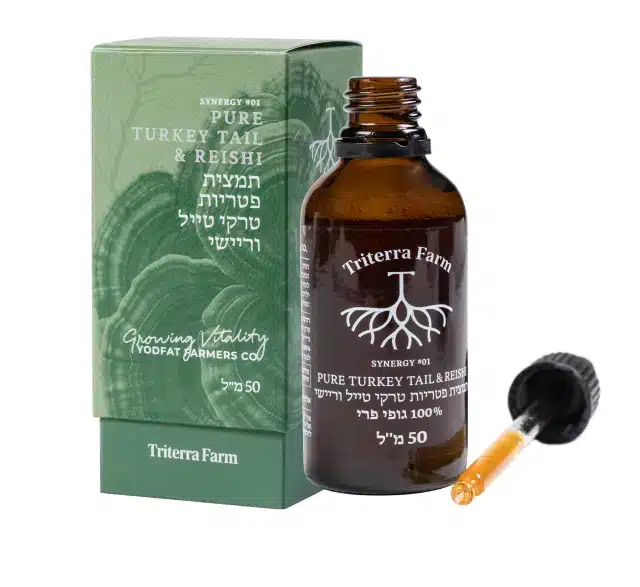
Decided turkey tail is for you? Our Turkey Tail & Reishi fruiting-body extract comes with an open lab test, a 100-day trial period, free shipping in Israel over ₪285 and a club discount. Start low, take it consistently, and give it weeks before you judge. Not sure it is the right mushroom for your goal? Take the quiz All extracts
The bottom line
In controlled trials in healthy adults, turkey tail extracts at 3.5 to 12 g a day for up to four months produced no serious event and did not change liver, kidney, bone or the drug enzyme CYP3A4; in ten thousand cancer patients who took the PSK drug alongside chemotherapy for years, no meta-analysis identified an increase in adverse events — in trials where the adverse events were the chemotherapy’s. The literature holds no case report of harm from the mushroom in humans, and the “drop in platelets” attributed to it online belongs to two other mushrooms. That evidence supports “no data” precautions, not alarm: immunosuppressants, autoimmune disease, active cancer treatment, pregnancy, children and mushroom allergy are the situations where turkey tail waits for a physician — and anticoagulants and surgery join them because of the reishi in our blend. For everyone else, the risk that remains when the mushroom has no harm reports is what is inside whatever is sold under its name — and that one is checkable.
Frequently asked questions
What are the most common side effects of turkey tail?
Bloating, gas and loose stools — the effects of a supplement rich in beta-glucan and fibre, managed by titrating the dose. In the escalation trial up to 9 g a day “neither nausea nor GI upset was reported”; in 100 healthy adults over four months no adverse effects on liver, kidney or bone were recorded; in 90 adults taking 12 g a day of mycelium there were no adverse events at all. Dark stools and dark fingernails were reported as rare in chemotherapy patients on the PSP drug.
Does turkey tail thin the blood?
For turkey tail alone there is no human data — no trial has measured coagulation and there is no bleeding report; the only evidence is a 2025 in-vitro materials study. Our blend contains reishi, and on reishi a 1990 trial found platelet inhibition while a 2005 trial found no change. The blend’s rule: with anticoagulants — physician first; before surgery — stop two weeks ahead.
Can I take turkey tail with an autoimmune disease or immunosuppressants?
Not without your physician — not because there is evidence of harm, but because there is no trial in this group. Turkey tail modulates immunity in both directions: in healthy people T-helper cells rose; a fruiting-body protein activated regulatory B cells and IL-10 in mice, which restrain inflammation. The direction in a person with a given disease is measured only by a trial in people with that disease, and there is none.
Does turkey tail lower platelets?
Not according to what has been measured. The online “low platelets” warning comes from a 2020 review in which the decrease was seen in trials of Antrodia cinnamomea and Agaricus sylvaticus — other mushrooms. In turkey tail: 28 days of PSP raised leukocyte and neutrophil counts in 68 lung-cancer patients, and in a trial where both arms received PSK the thrombocytopenia belonged to the intravenous chemotherapy.
Does turkey tail interact with medications?
The only human trial is negative: 14 days of 3.6 g PSP did not change CYP3A4 activity in 12 healthy adults, and two pharmacokinetic studies found no interaction between PSK and tegafur. In rats, PSP lengthened the time to peak tamoxifen without changing exposure. With chemotherapy, immunosuppressants or tamoxifen — the oncologist decides.
Why do sites say turkey tail causes dark stools and dark fingernails?
Because the Memorial Sloan Kettering monograph lists them as rare adverse reactions, based on a 1992 PSP study in chemotherapy patients and a 2000 review. Neither appeared in any trial in healthy people. Black stools are also a sign of upper-digestive bleeding — checked by a physician before being attributed to a supplement.
Is turkey tail safe during pregnancy?
No trial has ever included pregnant or breastfeeding women, and the Memorial Sloan Kettering monograph advises avoiding it “until safety data become available.” Turkey tail modulates immunity, and pregnancy deliberately recalibrates the immune system — nobody has measured what happens when they are combined. Our position: not now, and an alcohol tincture is the wrong vehicle regardless.
Is the “cleansing reaction” from turkey tail real?
No trial has measured a “cleansing reaction” or “Herxheimer reaction,” and no trial described symptoms that worsen and then pass; in the escalation trial up to 9 g, no GI upset was reported at all. New symptoms after a supplement are information: the dose is too high, the product does not suit you, or something else is going on. Reduce or stop — do not persist.
Scientific sources (peer-reviewed)
- 100 healthy adults, yun zhi 50 mg/kg + danshen for 4 months (crossover): no adverse effects on liver, kidney or bone profile; T-helper cells and CD4/CD8 rose — Wong CK, Tse PS, Wong EL, Leung PC, Fung KP, Lam CW. International Immunopharmacology, 2004;4(2):201-211. View on PubMed
- 12 healthy adults, 1,200 mg PSP three times a day for 14 days: 0.08% change in CYP3A4 activity — no inhibition or induction — Nicandro JP, Tsourounis C, Frassetto L, Guglielmo BJ. Journal of Herbal Pharmacotherapy, 2007;7(1):39-56. View on PubMed
- 24 healthy volunteers, PSP versus amoxicillin: “clear and consistent” microbiome changes consistent with prebiotic activity; 22 of 24 completed — Pallav K, Dowd SE, Villafuerte J, et al. Gut Microbes, 2014;5(4):458-467. View on PubMed
- 90 adults around COVID-19 vaccination, 12 g/day of turkey tail and agarikon mycelium for 4 days: no adverse events; kidney and liver function no different from placebo — Saxe G, Smith CN, Golshan S, et al. BMC Immunology, 2026;27(1):24. View on PubMed
- Phase 1 trial — 9 women after breast cancer, 3/6/9 g/day for 6 weeks: 9 adverse events (7 mild, 1 moderate, 1 severe); up to 9 g/day “safe and tolerable” — Torkelson CJ, Sweet E, Martzen MR, et al. ISRN Oncology, 2012;2012:251632. View on PubMed
- 68 advanced lung-cancer patients, PSP for 28 days versus placebo: “no reported adverse reaction attributable to the trial medications”; leukocytes and neutrophils rose — Tsang KW, Lam CL, Yan C, et al. Respiratory Medicine, 2003;97(6):618-624. View on PubMed
- 82 post-treatment breast-cancer patients, PSP 50 mg/kg + danshen for 6 months: T-helper and B cells rose — Wong CK, Bao YX, Wong EL, Leung PC, Fung KP, Lam CW. American Journal of Chinese Medicine, 2005;33(3):381-395. View on PubMed
- 15 advanced liver-cancer patients, yun zhi extract 2.4 g/day versus placebo: less appetite loss and pain, better quality of life; time to progression unchanged — Chay WY, Tham CK, Toh HC, et al. Journal of Alternative and Complementary Medicine, 2017;23(8):648-652. View on PubMed
- Randomized trial — 205 colorectal-cancer patients, PSK 3 g/day + UFT for 2 years: “adverse effects were mild and compliance was good”; 6.6% versus 5.9% paused temporarily — Ohwada S, Ikeya T, Yokomori T, et al. British Journal of Cancer, 2004;90(5):1003-1010. View on PubMed
- Randomized phase II trial — 186 colorectal-cancer patients, UFT/LV with or without PSK: grade ≥3 adverse events 13.5% versus 9.6% and 9.9% — Ogawa H, Shiraishi T, Okada T, et al. Anticancer Research, 2024;44(2):805-814. View on PubMed
- Randomized phase III trial (JFMC38) — 111 rectal-cancer patients, surgery alone versus UFT + PSK: disease-free survival slightly worse in the treatment arm; closed early — Okuno K, Aoyama T, Oba K, et al. Cancer Chemotherapy and Pharmacology, 2018;81(1):65-71. View on PubMed
- Cochrane review — turkey tail to reduce chemotherapy adverse effects in colorectal cancer: 7 trials, 1,569 participants; withdrawal for adverse events RR 1.03; neutropenia RR 0.41; very low-certainty evidence — Pilkington K, Wieland LS, Teng L, Jin XY, Storey D, Liu JP. Cochrane Database of Systematic Reviews, 2022;11(11):CD012053. View on PubMed
- Network meta-analysis — PSK in gastrointestinal cancer: 23 trials, 10,684 patients; higher survival; “no increase in side effects was observed” — Ma Y, Wu X, Yu J, Zhu J, Pen X, Meng X. Oncotarget, 2017;8(51):89108-89118. View on PubMed
- Meta-analysis — PSK after curative gastric-cancer resection: 8,009 patients from 8 trials; survival hazard ratio 0.88 — Oba K, Teramukai S, Kobayashi M, Matsui T, Kodera Y, Sakamoto J. Cancer Immunology, Immunotherapy, 2007;56(6):905-911. View on PubMed
- Meta-analysis — PSK after curative colorectal-cancer resection: 1,094 patients from 3 trials; survival RR 0.71 — Sakamoto J, Morita S, Oba K, et al. Cancer Immunology, Immunotherapy, 2006;55(4):404-411. View on PubMed
- Systematic review and meta-analysis — yun zhi and survival in cancer: 13 trials; 9% absolute reduction in 5-year mortality — Eliza WL, Fai CK, Chung LP. Recent Patents on Inflammation & Allergy Drug Discovery, 2012;6(1):78-87. View on PubMed
- Systematic review — mushroom supplements in cancer, 39 clinical studies: most adverse effects grade 2 or lower (nausea, vomiting, diarrhoea, muscle pain); evidence “inconclusive” — Narayanan S, de Mores AR, Cohen L, et al. Current Oncology Reports, 2023;25(6):569-587. View on PubMed
- Systematic review — interactions of yun zhi and reishi with cytotoxic drugs: 56 clinical studies of yun zhi; two PK studies with no PSK–tegafur interaction; “no reported adverse effects” — Lam CS, Cheng LP, Zhou LM, Cheung YT, Zuo Z. Chinese Medicine, 2020;15:75. View on PubMed
- Rats — PSP lengthened time to peak tamoxifen by 228% (single dose) and 93% (repeated dosing), with AUC and Cmax unchanged; 19 of 23 biochemical parameters maintained — Razmovski-Naumovski V, Kimble B, Laurenti D, Nammi S, Norimoto H, Chan K. Frontiers in Pharmacology, 2022;13:857864. View on PubMed
- Narrative review — medicinal mushrooms in oncology: “decrease in platelet count” seen in trials of Antrodia cinnamomea and Agaricus sylvaticus, not turkey tail; adverse events “poorly reported” — Jeitler M, Michalsen A, Frings D, et al. Frontiers in Pharmacology, 2020;11:580656. View on PubMed
- Randomized trial — 82 gastric-cancer patients, both arms on PSK 3 g/day: neutropenia, thrombocytopenia and vomiting more frequent in the intravenous-chemotherapy arm — Ahn MS, Kang SY, Lee HW, et al. Onkologie, 2013;36(7-8):421-426. View on PubMed
- Case report — fatal hemolytic uremic syndrome in a metastatic gastric-cancer patient on mitomycin, UFT, OK-432 and PSK; attributed “to antineoplastic agents” — Anai H, Okada Y, Okubo K, et al. Nihon Gan Chiryo Gakkai Shi, 1990;25(7):1487-1491. View on PubMed
- Pharmacovigilance — scoping review and analysis of VigiBase reports on adaptogenic and immunomodulating natural products; turkey tail is not mentioned — Liang CJW, Woerdenbag HJ, Ekhart C, Vitalone A, van Hunsel FPAM. Pharmaceuticals, 2025;18(8):1208. View on PubMed
- Mechanism — the fruiting-body protein YZP increased IL-10 more than 60-fold in mouse B cells and activated regulatory B cells; eased colitis in mice — Kuan YC, Wu YJ, Hung CL, Sheu F. PLoS One, 2013;8(9):e72422. View on PubMed
- Review — mushroom glucans and proteoglycans in cancer treatment: the preparations studied in humans, PSK and PSP among them, “non-toxic and very well tolerated” (the source for nail darkening in the MSKCC monograph) — Kidd PM. Alternative Medicine Review, 2000;5(1):4-27. View on PubMed
- Reishi (in the blend) — 33 atherosclerotic patients, 1 g three times a day for 2 weeks: platelet-aggregation inhibition of 31.49% and 17.7% — Tao J, Feng KY. Journal of Tongji Medical University, 1990;10(4):240-243. View on PubMed
- Reishi (in the blend) — 40 healthy volunteers, 1.5 g/day for 4 weeks: no change in platelets or coagulation — Kwok Y, Ng KFJ, Li CCF, Lam CCK, Man RYK. Anesthesia & Analgesia, 2005;101(2):423-426. View on PubMed
- Review — PSP as an immunotherapeutic in China: obtained from mycelium or fermentation broth; in clinical use in Japan and China since the 1970s — Dou H, Chang Y, Zhang L. Progress in Molecular Biology and Translational Science, 2019;163:361-381. View on PubMed
- Review — PSK and PSP: protein-bound polysaccharides from the CM-101 and COV-1 strains; PSK used in Asia for over 30 years — Fisher M, Yang LX. Anticancer Research, 2002;22(3):1737-1754. View on PubMed
- Systematic review — PSK and turkey tail extracts for lung cancer: 28 studies, 6 randomized trials — Fritz H, Kennedy DA, Ishii M, et al. Integrative Cancer Therapies, 2015;14(3):201-211. View on PubMed
- In vitro — a polymer fibre loaded with turkey tail extract inhibited platelet activity (a materials study, not a supplement) — Gualtero DF, Buitrago DM, Pinzón-García AD, et al. International Journal of Molecular Sciences, 2025;26(10):4949. View on PubMed
- Case report — the only human “case report” on turkey tail in PubMed: a recovery story, not harm — Stamets P. Global Advances in Health and Medicine, 2012;1(5):20. View on PubMed
- Monograph — Coriolus versicolor, Memorial Sloan Kettering Cancer Center: rare reactions (dark stools, nail darkening), avoidance in pregnancy “until safety data become available” — Memorial Sloan Kettering Cancer Center, About Herbs. View the monograph
Read next
- Medicinal Mushrooms and Blood Pressure: What the Research Actually Tested — and What It Found
- Medicinal Mushrooms and Prostate Health: What Was Measured in Humans — and What Came Out
- Side effects of medicinal mushrooms: what’s important to know
- Medicinal mushrooms and drug interactions
- Who shouldn’t take reishi? Side effects, interactions and safety
- Who shouldn’t take cordyceps? Side effects, interactions and safety
- Who shouldn’t take lion’s mane? Side effects, interactions and safety
- Turkey tail benefits — what PSK, PSP and the whole mushroom have been tested for
- Turkey tail science — polysaccharides and immune support
- What is turkey tail (Trametes)?
- How turkey tail supports your microbiome
- Mushrooms for the immune system — what has been tested in people
- Turkey Tail & Reishi for immune support — the goal page
- Medicinal mushrooms in pregnancy and breastfeeding
- Medicinal mushrooms for children
- Medicinal mushroom dosage — drops, titration and what the trials used
- When to take mushroom supplements — morning, night, and stacking
- How long do medicinal mushrooms take to work?
- Fruiting body or mycelium? How to read a mushroom supplement label
- Fresh or dried mushrooms — what really goes into your extract
- How to read a mushroom supplement test report (COA)
- Beta-glucan vs “polysaccharides” — the number that actually matters
- The full FAQ
- The research hub — turkey tail studies
- Functional mushrooms — the complete guide
- Full lab results
This page is educational and does not constitute medical advice. It describes what published trials and case reports recorded — and what was not recorded; it is not a prediction of what any individual will experience, and it is not a recommendation to start, stop or combine any supplement with any medication — those decisions belong with your physician. *These statements have not been evaluated by the Food and Drug Administration. This product is not intended to diagnose, treat, cure, or prevent any disease.*
