
Who Shouldn’t Take Cordyceps? Side Effects, Interactions and Safety — What the Trials Actually Recorded
- Across the controlled trials in healthy volunteers, cultivated cordyceps at 1 to 4 grams daily produced only rare and mild side effects, and liver, kidney and blood tests stayed unchanged.
- The serious events on record — lead poisoning, a dental bleed and cross-allergy with silkworm pupae — involve wild cordyceps and unidentified products, not cultivated fruiting body.
- Cordycepin inhibits platelets in the test tube and no human trial has measured coagulation, so anyone on blood thinners asks a physician and pauses two weeks before surgery.
- Cordyceps modulates immunity rather than boosting it: NK-cell activity rose in healthy people, while Chinese transplant recipients receive it alongside cyclosporine.
- Pregnant or breastfeeding women, children, and people on immunosuppressants or diabetes medication should not use it without medical advice.
Cordyceps (dong chong xia cao in Chinese medicine — “winter worm, summer grass”) is the medicinal mushroom whose online warnings are the most uniform and the least sourced: “thins the blood,” “lowers blood sugar,” “stimulates the immune system, so avoid it with autoimmune disease.
” Most of those lists were written about three completely different products — the wild-harvested Tibetan caterpillar fungus, fermented-mycelium capsules from China, and cultivated fruiting body — as if they were one thing. This page keeps them apart: in controlled trials in healthy adults, cultivated cordyceps was well tolerated at 1 to 4 grams a day for up to 16 weeks, with rare, mild side effects and no signal in liver, kidney or blood tests. The serious events in the literature — lead poisoning, bleeding after a tooth extraction, cross-allergy with silkworm pupae — belong almost entirely to wild cordyceps and unidentified products. And “stimulates the immune system” has to be read next to the fact that in China, cordyceps is given to kidney-transplant recipients alongside the drugs that suppress it. We grow and sell cordyceps. That is exactly why every claim below carries a PubMed link.
Why this page is different from every “cordyceps side effects” list you will find. We searched the question in English and in Hebrew before writing. The top results repeat the same five items — stomach upset, bleeding, low blood sugar, autoimmune disease, pregnancy — without saying which product they mean and without noting that most of the items rest on laboratory and animal studies, not on people. The difference between “measured in 79 healthy men over four weeks” and “observed in platelets in a test tube” is, in our view, the whole answer. So this page sorts every finding by product type and by kind of evidence, and the case reports get their own section, described exactly as published.
Key takeaways
- What the trials found: in 79 healthy men taking 1.5 g of cultivated cordyceps a day for four weeks, no significant adverse reaction was recorded; in 40 healthy adults drinking a cordyceps beverage for eight weeks, liver, kidney, glucose and lipid indices did not change; and 59 patients with depression and insomnia who took cordyceps alongside their medication for six weeks reported side effects at the same rate as the placebo group.
- Which cordyceps: the two lead-poisoning reports (up to 20,000 parts per million in the product), the arsenic, the silkworm-pupa cross-allergy and the bleeding report belong to the wild-harvested caterpillar and to unidentified preparations. The trials in healthy people were done on cultivated fruiting body and fermented mycelium — products that can be lab-tested.
- The blood: cordycepin and cordyceps polysaccharides inhibit platelet aggregation in the test tube, and a mouse study found this “without increasing bleeding risk.” In humans there is one case report of prolonged bleeding after a tooth extraction. No trial has measured coagulation in people — so our rule: anticoagulants or antiplatelets — ask your doctor first; planned surgery — stop two weeks before.
- The immune system: in healthy people cordyceps raised NK-cell activity; in Chinese kidney-transplant recipients it is given alongside cyclosporine and lowers its liver and kidney toxicity. That is not a contradiction — it is a mushroom that modulates rather than “boosts,” which is exactly why, with immunosuppressants or autoimmune disease, the decision belongs to a physician.
- Who should not, without a doctor: anyone on blood thinners, immunosuppressants or diabetes medication; anyone with a hormone-sensitive condition; pregnancy and breastfeeding (no trial has ever included them); and children — certainly not with an alcohol tincture.
Does cordyceps have side effects?
Yes — rare and mild, when the product is cultivated and identified. In controlled trials in healthy adults the recorded side effects were mild digestive discomfort, loose stools and occasionally a feeling of over-alertness; no trial reported a serious event, and the trials that measured liver enzymes, kidney function, blood counts, glucose and lipids found no change. The serious events in the literature — lead poisoning, surgical bleeding, allergy — are case reports, almost all involving wild cordyceps or unidentified preparations, and they are described in full below.
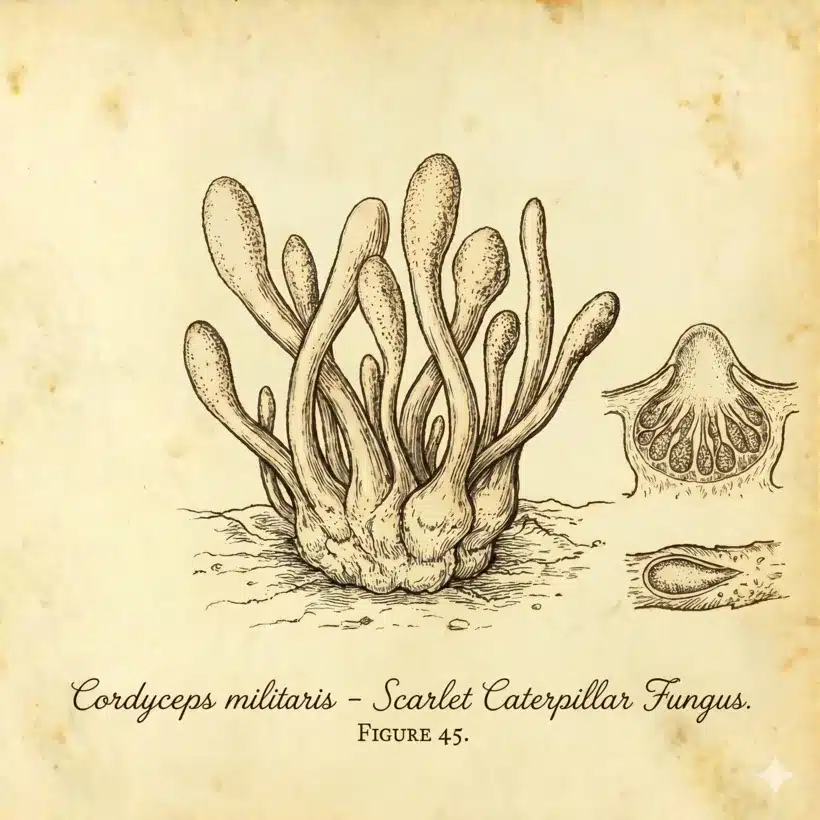
That sentence hides a question most safety pages skip: which cordyceps? The word covers three fundamentally different products. The first is the Tibetan caterpillar fungus — a fungus that grows out of a moth larva on the high plateaus of China, Nepal and Bhutan, is harvested wild, sells by weight at gold-like prices, and is adulterated accordingly. The second is mycelium grown by fermentation in the Chinese industry and packed into capsules; that is the product behind the hundreds of trials in kidney patients and transplant recipients, and what usually sits behind “cordyceps” in an imported capsule. The third is cultivated fruiting body — the orange mushroom grown on a substrate on a farm, the one you can harvest, weigh and send to a laboratory, and the one we grow in the Galilee. The three products share compounds (cordycepin, adenosine, polysaccharides) but do not share a safety profile: the lead and arsenic belong to the first, the large clinical evidence base belongs to the second, and the trials in healthy adults to the second and third. This page writes next to every finding which product it concerns, because without that, every warning is true of something and false of something else.
Which cordyceps? Three products, three safety profiles
The first safety warning about cordyceps is not about the mushroom but about identity: what is called “cordyceps” in a capsule or a bag can be wild caterpillar fungus with lead, fermented mycelium, cultivated fruiting body, or a different fungus altogether. A 2018 Korean study developed a DNA test precisely because “substitution and adulteration of herbal material and dietary supplements originating from cordyceps seriously affects the safety” of those products — their wording, not ours.
| The product | What it is | What the safety literature found on it | What can be tested |
|---|---|---|---|
| Wild cordyceps (the Tibetan caterpillar fungus) | A fungus grown out of a moth larva, harvested wild on the high plateaus, sold whole or ground | Two lead-poisoning reports (1996, up to 20,000 ppm); arsenic that accumulates mainly in the caterpillar body (2018); five allergy cases with cross-reactivity to silkworm pupae (2010); a bleeding report after a tooth extraction (2018) | Almost nothing — expensive, frequently counterfeited, no consumer lab report |
| Fermented mycelium (capsules, most Chinese preparations) | Mycelium grown in fermentation tanks and dried; the basis of preparations such as Cs-4 | The large trial base: 22 trials in 1,746 kidney patients (Cochrane 2014), 38 trials in 3,167 diabetic-kidney patients, 202 transplant recipients — mostly “no difference in adverse events,” but “most trials either did not monitor adverse events or poorly documented them” | Depends on the manufacturer; relatively low beta-glucan, sometimes starch from the growth medium |
| Cultivated fruiting body (what we grow) | The orange mushroom itself, grown on a substrate on a farm, harvested and extracted | Trials in healthy adults: 79 men, 1.5 g a day, 4 weeks — “no significant adverse reaction”; 40 adults, 8 weeks — liver, kidney, blood, glucose and lipids unchanged; 59 patients, 6 weeks — side effects same as placebo | Everything: beta-glucan, alpha-glucan, metals, pesticides, PAH — a lab report on the finished extract |
We do not present the table to say wild cordyceps is dangerous — it has been eaten in Tibet for centuries, and a 2018 Chinese study that measured arsenic in wild samples found only 8.69% of it in the toxic inorganic form and a risk index below threshold “in a reasonable taking way.” We present it because every warning about cordyceps should first ask which product it is about, and most warnings online do not. If you have a capsule in your hand and do not know which of the three products it is, that is the first safety problem, before any interaction.
What did the controlled human trials actually record on safety?
Every randomized trial of cultivated cordyceps or mycelium that we found in healthy adults or outpatients, and that reported safety data, is in the table — with dose, duration, what was measured and what was found. The pattern is uniform: rare, mild side effects and no signal in liver enzymes, kidney function, blood counts, glucose or lipids, at 1 to 4 grams a day for up to 16 weeks.
| Trial | Who and how long | Dose and form | Safety finding | What it does not tell you |
|---|---|---|---|---|
| Kang 2015 | 79 healthy Korean men, 4 weeks | 1.5 g a day, cultivated fruiting body in capsules | “No statistically significant adverse reaction”; NK-cell activity and lymphocyte proliferation rose | Men only; four weeks |
| Ontawong 2024 | 40 healthy Thai adults (10 men and 10 women per group), 8 weeks | Fermented cultivated-cordyceps beverage, 2.85 mg cordycepin | Liver, kidney, blood, glucose and lipid indices “not different between groups”; NK activity rose | Low cordycepin dose; small groups |
| Jung 2019 | 79 healthy Korean adults, 8 weeks | 1.68 g a day, mycelium culture extract in capsules | “Safe”; NK cytotoxic activity up 38.8% | Mycelium, not fruiting body; side-effect detail not in the abstract |
| Zhou 2021 | 59 patients with depression and insomnia in Beijing, 6 weeks | Cultivated cordyceps alongside duloxetine | Incidence of adverse events “not significantly different” from placebo; 5 vs 6 withdrew | Sleep improved more in the placebo group — see the sleep section |
| Farzan 2026 | 12 active young men, single dose before a maximal exercise test | 1 g standardized cultivated-cordyceps extract | No change in blood glucose, blood pressure or heart rate; higher resting oxygen uptake | One dose; 12 participants |
| Nakamura 2024 | 22 long-distance runners, 16 weeks of pre-season training | Cultivated-cordyceps mycelium extract | Creatine kinase (a muscle-damage marker) lower at week 16; ferritin and hemoglobin maintained | Athletes’ blood markers, not a full safety panel |
| Liao 2019 | 14 sedentary young adults, 8 weeks of endurance training | Rhodiola + cordyceps blend, 20 mg per kg a day | No difference from placebo in fasting glucose, insulin, blood lipids or oxidative-stress markers | A blend; 7 participants per arm |
| Hirsch 2017 | 28 adults (10 continued to three weeks) | 4 g a day of a mushroom blend containing cultivated cordyceps | The paper reported no adverse-event data at all | A performance trial, not a safety trial; a blend |
Three things to read from the table. First, the doses: the trials used 1 to 4 grams of cordyceps a day, and a daily tincture dose of about 1.4 ml delivers far less material than any of them — we say so explicitly rather than convert. Second, the longest controlled exposure in healthy people is 16 weeks; in transplant recipients there are one- to two-year follow-ups, but on fermented mycelium and alongside drugs, not on fruiting body in healthy people. Third, none of these trials was designed as a safety trial — safety was recorded as a secondary measure in immune and performance studies — so the case reports below matter more than their number suggests, and so do the gaps: there is no human trial in people on anticoagulants, none in pregnancy, and none in children.
What do thousands of kidney patients in China tell us about safety?
The largest body of human evidence on cordyceps is not on athletes but on kidney patients: a 2014 Cochrane review included 22 trials in 1,746 people with chronic kidney disease; a 2022 meta-analysis included 38 trials in 3,167 people with diabetic kidney disease; and a 2019 meta-analysis, 51 trials in 3,955. In all of them the product is fermented mycelium in capsules, taken alongside medication. The recurring safety finding: “no significant difference in adverse events” — and a reservation just as recurring: “most trials either did not monitor adverse events or poorly documented them.”
Why does this matter for a safety page? Because the kidney is exactly the organ where we would expect to see damage from a supplement taken for years — and instead the Chinese literature uses cordyceps to protect it: the Cochrane review found a fall in serum creatinine, and a review of 14 trials in 1,271 patients given contrast dye found less acute kidney injury (5.35% versus 14.62%) “with no statistical difference in adverse events.” Two caveats are mandatory: the quality of these trials is low — in the Cochrane review four trials were at high risk of bias and 18 unclear, and “definitive conclusions could not be made” — and the product is Chinese mycelium packaged as a drug, not a fruiting-body tincture. What we do take from it: thousands of patients with diseased kidneys took cordyceps at gram doses alongside medication, in trials that measured creatinine, and no toxicity signal was found. That is not “protects the kidney” and not “kidney-safe” — it is “the kidney is not the front where the evidence points to danger.”
Immunosuppressants and autoimmune disease — the opposite direction from what you read online
The standard warning says cordyceps “boosts” immunity and is therefore off-limits in autoimmune disease and with immunosuppressants. The evidence is more complicated. In healthy people, cordyceps did raise NK-cell activity and lymphocyte proliferation in two randomized trials. But in Chinese kidney-transplant recipients it is given alongside cyclosporine as an adjuvant immunosuppressant: in a randomized trial of 202 recipients, 1 g three times a day cut the incidence of liver toxicity from 24.77% to 12.90% and kidney toxicity from 33.94% to 19.35%, allowed lower cyclosporine doses, and did not raise rejection rates. A 2015 Cochrane review of five trials in 447 recipients found that, against azathioprine, cordyceps improved graft function, anaemia, leucopenia and liver function, and may have reduced infections.
How are both true at once? Because cordyceps is an immune modulator, not a booster — and in a lupus trial (61 patients with lupus nephritis, cordyceps powder at 2 to 4 g a day for three years alongside artemisinin, five-year follow-up) the recurrence rate was lower “and the side effects fewer” in the cordyceps group — a classic autoimmune disease, in the opposite direction from the warning. We are not presenting this so that you take cordyceps with an autoimmune disease. We are presenting it to say the honest thing: the direction of the immune effect is not predictable in advance, and that is exactly why, with immunosuppressants, after a transplant, or in active autoimmune disease, the decision belongs to the treating physician and not to a supplement page. The transplant trials were run in hospitals with weekly drug-level monitoring — not at home. And what no trial tested is the simplest combination: a person with rheumatoid arthritis or multiple sclerosis taking cultivated cordyceps drops on their own. For that person there is no data point, and we will not invent one.
Does cordyceps thin the blood?
In the test tube — yes: cordycepin, an adenosine analogue, inhibits human platelet aggregation dose-dependently, and two polysaccharides from cordyceps mycelium did the same in 2022 and reduced clot formation in mice — “without increasing bleeding risk,” in the authors’ words. In humans there is one case report: an elderly patient who took wild cordyceps daily as a tonic bled for a prolonged period after dental surgery. No randomized trial has measured coagulation, platelets or INR in people taking cordyceps.
A 2022 review of supplements and bleeding placed cordyceps in the category “loosely associated with surgical bleeding independent of anticoagulants” — less than garlic or ginkgo, more than nothing — and recommended what we recommend: stop non-essential supplements two weeks before surgery. The large 2025 safety review of immune-modulating natural products, which analysed 45,042 adverse-event reports from the WHO’s VigiBase, mentions cordyceps in exactly one specific finding: that same dental bleeding. What no study has examined is the situation that actually matters — someone already on warfarin, apixaban, rivaroxaban, clopidogrel or daily aspirin who adds cordyceps. For that person there is no trial, there is a mechanism, and a mechanism is enough for a rule: ask the prescribing physician before starting, and if you start, tell them, so that INR or bleeding is monitored. And before surgery or a tooth extraction — a two-week pause, and tell the anaesthetist. That is a defensible precaution, not a citable finding.
Does cordyceps lower blood sugar?
In mice and rats — yes, clearly: a polysaccharide from cordyceps mycelium lowered blood glucose by 12.0% and 22.5% in healthy mice and raised insulin in diabetic animals. In humans the picture is far weaker: an 8-week trial in sedentary adults found no difference from placebo in fasting glucose or insulin; a single 1 g dose did not change blood glucose in 12 men; and a 2022 meta-analysis of 38 trials in diabetic-kidney patients found no significant change in fasting glucose or HbA1c.
And there is a second side that has to be presented: another meta-analysis, from 2019, of 51 trials in 3,955 diabetic-kidney patients given a mycelium preparation alongside ACE-inhibitor or ARB therapy did find a reduction — fasting glucose lower by 0.85 mmol/L and HbA1c lower by 0.52 points. Two meta-analyses on the same population, different conclusions; both on Chinese mycelium at gram doses, both from low-quality trials. The fair statement: if you take insulin or a sulfonylurea, cordyceps is no reason to stop monitoring, and it is worth telling your physician — but in humans there is no evidence that it will push your sugar down, and certainly not at a dose measured in drops. “Hypoglycemia” is a warning that comes from mice, and we write that because that is how it is.
Which medications interact with cordyceps?
There is no human interaction trial of cordyceps in healthy people. What exists: a randomized transplant trial in which cordyceps allowed lower cyclosporine doses (a deliberate pharmacodynamic interaction, in hospital), a platelet mechanism in the test tube, and glucose studies in animals. The table writes next to every row what the evidence is, and where it says “no trial” — that is the finding.
| If you take | What the evidence is | Our position |
|---|---|---|
| Anticoagulants or antiplatelets (warfarin, apixaban, rivaroxaban, clopidogrel, daily aspirin) | Cordycepin and polysaccharides inhibit platelets in vitro; one case report of dental bleeding; no trial in people on these drugs | Physician first; if you start — report it, so bleeding measures are monitored |
| Planned surgery or tooth extraction | The same case report; 2022 review: “loosely associated with surgical bleeding” | Stop two weeks before, and tell the anaesthetist |
| Immunosuppressants (cyclosporine, tacrolimus, after a transplant) | Trial in 202 recipients: cyclosporine doses and blood levels fell; less liver and kidney toxicity; weekly level monitoring | Only with the treating specialist’s knowledge and under monitoring — never on your own |
| Autoimmune disease (lupus, rheumatoid arthritis, multiple sclerosis) | In healthy people: NK cells and lymphocytes rise; in lupus: fewer recurrences in one trial; no trial in arthritis or MS | The direction is not predictable — the physician decides |
| Diabetes medication (insulin, sulfonylureas) | Mice: glucose falls; humans: no change in three studies, a small fall in one meta-analysis in kidney patients | Monitor as usual and inform your physician; no hypoglycemia signal in humans |
| Hormone therapy or a hormone-sensitive condition | Cordycepin raised testosterone in mice; zero human data | See the hormone section — not without a physician |
| Stimulants, caffeine | No interaction study; cordyceps is not a stimulant in the trials (no change in heart rate or blood pressure) | No signal; if over-alert — move it to the morning |
Our general guide to medicinal mushrooms and drug interactions covers the other species; this table is cordyceps only, and deliberately sparing with adjectives.
“Too much energy?” — cordyceps, alertness and sleep
Cordyceps is not a stimulant: in the trials it did not change heart rate, blood pressure or glucose, and in our cordyceps and energy guide we explain why “energy” here means oxygen use, not caffeine. But one trial deserves attention: in 59 patients with depression and insomnia, the placebo group slept better than the cordyceps group over six weeks — not because cordyceps did harm (side effects were identical), but because it did not help sleep, and perhaps interfered slightly.
That sentence connects to a house rule that predates the trial: cordyceps is an “around the need” mushroom — before exertion, before a demanding day, in the morning — not a fixed daily baseline like reishi or lion’s mane, and certainly not in the evening. After a single 1 g dose, resting oxygen uptake in 12 men was higher under cordyceps — a small physiological signal that fits “alert” rather than “calm.” If you find yourself wide awake at night after an afternoon dose, that is not harm and not a reason to stop — it is a reason to move the dose to the morning, and we cover the timing question on a separate page. And what cordyceps does not do: it does not raise heart rate, does not raise blood pressure, and does not produce a “crash” — in the three trials that measured it.
Cordyceps and testosterone — where does the “prostate cancer” warning come from?
Some pages warn prostate-cancer patients away from cordyceps. We looked for the source: mouse studies. In 2011, cordycepin raised plasma testosterone in mice and stimulated their Leydig cells to produce it, and earlier work from the same laboratory showed this with mycelium fractions too — and sometimes the opposite. In humans there is no measurement of testosterone under cordyceps alone, and no trial in prostate patients.
It is a good example of how a warning is born: a mouse finding becomes “raises testosterone” on a marketing page, then “not for prostate cancer” on a precaution page — both from the same study, with not one human in between. Our position is conservative for a different reason: a hormone-sensitive disease (prostate, breast, uterus) and a patient on hormone therapy are situations where any supplement that acts on a hormonal pathway in animals belongs with the oncologist, not with us. Not because there is evidence of harm — because there is evidence of nothing, and “no data” is not “safe” when the disease is that one. What was measured in humans and touches hormones: in the lupus trial and the transplant trials nobody reported a hormonal effect, and in 79 healthy men over four weeks no adverse reaction was recorded at all.
Lead, arsenic and counterfeits — the risk actually documented in humans
The only two people in the medical literature seriously harmed by cordyceps were not harmed by the mushroom. In 1996, Taiwan’s Department of Health reported two cases of lead poisoning from wild-cordyceps powder: one patient’s blood lead was 130 micrograms per decilitre, with anaemia and loss of appetite; the other’s was 46, without symptoms. The powder contained up to 20,000 parts per million of lead — an amount that does not enter a mushroom from the soil but is put into it, because the caterpillar sells by weight. Both patients recovered after stopping, one with chelation therapy.
Arsenic is a different story: it does accumulate naturally in wild cordyceps, mainly in the caterpillar body, and a 2018 Chinese study that measured it in samples from Qinghai found high content — but only 8.69% of it in the toxic inorganic form, and a risk index below threshold. Then there is counterfeiting itself: a 2018 Korean study developed a DNA assay to tell authentic cordyceps from other species sold under the name, and wrote that substitution “seriously affects the safety” of the products. These three findings say one thing: the risk actually documented in humans is not what cordyceps does, but what is found inside what is sold as cordyceps. And that is a risk you can eliminate — not by choosing a different mushroom, but by choosing a product that has been tested: heavy metals, botanical identity, and what is actually inside. The table further down shows what that looks like with us.
Can you be allergic to cordyceps?
Yes, and it was documented in an interesting way: in 2010, physicians in Korea described five patients with food allergy to wild cordyceps — urticaria, rhinitis, conjunctivitis — who showed cross-reactivity with silkworm pupae. The likely explanation: wild cordyceps grows out of an insect larva, and the allergen is probably the insect’s, not the fungus’s. In the trials in healthy people with a cultivated product no allergic reaction was reported, but cordyceps is a fungus, and an allergy to mushrooms or moulds is reason enough for caution.
What that means for you: if you have a known allergy to mushrooms as food, to moulds, or — following the Korean finding — to insects and silkworm pupae (a food in East Asian cuisine), start with a tiny amount and watch your skin and breathing for the first few days. Itching, hives, wheeze or facial swelling are the signs to stop on. Cultivated fruiting body grown on a plant-based substrate does not carry the larval allergen, but we will not promise it is allergy-free — no mushroom product is, and anyone allergic to mushrooms should not test that on us.
Is cordyceps safe in pregnancy or while breastfeeding?
Nobody knows, because no trial has ever included pregnant or breastfeeding women — not in healthy volunteers, not in kidney patients, not in transplant recipients. Our position is the same as for every medicinal mushroom, and we wrote a whole page about it: not now. Not because of known harm, but because “no data” is not “safe,” and an alcohol tincture is the wrong vehicle regardless.
Cordyceps has an additional reason of its own: it modulates the immune system in directions that are not predictable in advance, and it affected sex hormones in animals. Those are exactly the two systems that pregnancy changes, and nobody has measured what happens when you mix them. If a practitioner recommended cordyceps in pregnancy “for energy,” the question to hand back is which study they are relying on — because we did not find one.
Can children take cordyceps?
There is no trial in children, and there is a 2026 case report worth knowing: a nine-year-old boy with cerebral palsy and well-controlled epilepsy developed myoclonic seizures, hallucinations and confusion after his parents escalated the dose of a multi-component mushroom supplement containing reishi and cordyceps; the work-up excluded infection and structural or metabolic causes, and the symptoms resolved completely on discontinuation. The authors concluded a supplement-related mechanism. That is a child with a neurological condition, a multi-mushroom preparation and a dose escalation — not proof that cordyceps harms children, but exactly the kind of case that explains why “no data in children” is not an invitation to try.
Our page on medicinal mushrooms for children sets out what has been studied and why the decision belongs with a paediatrician; the short version for cordyceps is that there is no trial, there is one worrying case report in a child with an underlying condition, and our product is an alcohol tincture — three separate reasons, each sufficient on its own.
Digestive side effects — and the “cleansing reaction” no trial ever measured
Mild digestive discomfort — bloating, loose stools, occasionally nausea — is the most ordinary side effect of any mushroom supplement and the easiest to manage: start low and increase over one to three weeks, as the dosage guide describes. What no trial has ever measured is a “cleansing reaction” or “healing crisis”; if a supplement makes you feel worse, the evidence-based reading is that the dose is too high or the product is not for you, not that toxins are leaving.
We say this against our own commercial interest, because “that’s the cleanse working” is the most convenient sentence a seller can offer a customer who feels unwell. The controlled trials give us a better sentence: at study doses, cordyceps produced mild effects in a minority and nothing serious — so a strong reaction is information, and the right response is to reduce or stop, not to persist. If nausea or diarrhoea lasts more than a few days at the lowest dose, that bottle is not for you, and our 100-day trial period exists precisely so that it costs you nothing.
Why the product matters more than the mushroom: what is actually in your bottle
Every serious report on this page — lead, arsenic, insect allergen, counterfeit — concerns what is sold as cordyceps rather than what cordyceps does. A safety page that does not ask “which cordyceps, and what is in it?” answers the wrong question. Our answer is a test report, not an adjective: the beta-glucan of the cordyceps extract measured 28.16% on a dry basis — the highest of our four extracts — starch (alpha-glucan) was not detected, and in the heavy-metals screen lead, cadmium, arsenic, mercury and aluminium were not detected.
| What was tested (cordyceps extract) | Result | Laboratory / report |
|---|---|---|
| Beta-glucan (1,3/1,6), dry basis | 28.16% | TÜV Austria |
| Alpha-glucan (starch — the grain marker) | Not detected | TÜV Austria |
| Lead, cadmium, arsenic, mercury, aluminium | Not detected — all five | VELTIA, report 46-169 |
| Pesticides (610-compound screen) | No active ingredient quantified | VELTIA, report 44-40 |
| Polycyclic aromatic hydrocarbons (PAH) | Below 0.2 µg/kg for all four | VELTIA, report 46-414 |
| Product identity | Cultivated fruiting body from our farm in the Galilee — no larva, no mycelium on grain | The grower |
The safety point is narrow and important: the 1996 lead poisoning is the only harm documented in humans from “cordyceps,” and it is cancelled by one line of a lab report — “lead: not detected.” The full reports are open, and how to read a test report walks through them line by line. Fresh fruiting body from our farm, an extraction ratio of 1:2.5 in fresh mushroom — about 20 grams of mushroom in every 50 ml — seven weeks in alcohol, and a lab report for every extract: that is our entire safety claim about the product itself. What cordyceps does in your body at that dose, the trials above describe better than we can.
Who shouldn’t take cordyceps — the list
Some of these items are findings, most are precautions, and we mark which is which. Without a physician’s explicit approval, cordyceps is not for: anyone on anticoagulants or antiplatelets; anyone on immunosuppressants, after a transplant, or with active autoimmune disease; anyone in active cancer treatment or with a hormone-sensitive disease; pregnant or breastfeeding women; children; and anyone with a known allergy to mushrooms, moulds or insects.
Cordyceps is not for you, or not yet, if:
- You take a blood thinner or antiplatelet — precaution, based on a test-tube mechanism and one case report; no trial in this group. Physician first.
- You have surgery or a tooth extraction planned — precaution: stop two weeks before and tell the anaesthetist.
- You take immunosuppressants or have had a transplant — finding: cordyceps changes cyclosporine dosing in trials. Only with the specialist’s knowledge and under monitoring.
- You have active autoimmune disease — the direction is unpredictable: raises NK cells in healthy people, fewer recurrences in lupus. The physician decides.
- You are in active cancer treatment or have a hormone-sensitive disease — the oncologist; cordycepin affected testosterone in mice and there is no human data.
- You take insulin or a sulfonylurea — monitor as usual and inform; in humans there is no hypoglycemia signal.
- You are pregnant or breastfeeding — no data, therefore no.
- You are giving it to a child — no trial, one worrying case report, and the extract is alcoholic.
- You are allergic to mushrooms, moulds or insects — finding: five allergy cases with cross-reactivity to silkworm pupae. Start tiny or do not start.
- You have a “cordyceps” capsule with no lab report — the one risk documented in humans: lead. Do not take an untested product.
If none of these applies to you, the trials’ answer is the one at the top of the page: rare, mild side effects, no organ toxicity at study doses, and the first two weeks at a low dose, in the morning, will tell you whether digestive discomfort or alertness is going to be your experience. If you are not sure cordyceps is even the right mushroom for your goal — and for most people searching “energy” the answer is sleep and reishi first — “Which mushroom is right for me” answers that before you spend a shekel, and the quiz does it in two minutes.
What this page does not claim
We do not claim cordyceps is “completely safe” — the case reports are real, even if most concern other products. We do not claim it is dangerous — the trials are real, and larger. We do not claim our extract was tested for safety in a trial; the trials used capsules, beverages and mycelium, and our lab report measures what is in the bottle, not what it does. And we do not convert study doses into drops, because no study tested drops.
Three things we would like to see, and cannot offer: a human trial of cordyceps in people on anticoagulants, a trial in an autoimmune disease other than lupus, and any human data in pregnancy. Until they exist, the honest safety page is a list of precautions with the evidence grade written next to each — which is what this one tries to be. Our reishi safety page and lion’s mane safety page are built the same way, and the general guide to side effects of medicinal mushrooms covers turkey tail and the rest.
Decided cordyceps is for you? Our cordyceps fruiting-body extract and the cordyceps and reishi blend come with an open lab test per extract, a 100-day trial period, free shipping in Israel over ₪285 and a club discount. Start low, take it in the morning or before exertion, and give it two weeks before you judge. Not sure it is the right mushroom for your goal? Take the quiz All extracts
The bottom line
In controlled trials in healthy adults, cultivated cordyceps was well tolerated at 1 to 4 g a day for up to 16 weeks, with rare, mild side effects and no signal in liver, kidney, blood, glucose or lipids; in thousands of kidney patients and transplant recipients in China, cordyceps mycelium was taken alongside medication “with no difference in adverse events” — in trials that did not monitor them well. The serious events on record are lead poisoning from adulterated wild powder, one dental bleed, and five cases of cross-allergy with silkworm pupae — all involving wild cordyceps or unidentified products. That evidence supports precautions, not alarm: anticoagulants, immunosuppressants and autoimmune disease, cancer treatment or a hormone-sensitive disease, pregnancy, children, and allergy to mushrooms or insects are the situations where cordyceps waits for a physician. For everyone else, the risk the evidence actually identifies is a product nobody has tested for what is in it — and that one is checkable.
Frequently asked questions
What are the most common side effects of cordyceps?
In the controlled trials of a cultivated product: mild digestive discomfort, loose stools, and occasionally over-alertness. In 79 healthy men taking 1.5 g a day for four weeks no significant adverse reaction was recorded; in 40 adults drinking a cordyceps beverage for eight weeks liver, kidney and blood indices did not change; in 59 patients over six weeks the rate of side effects matched placebo. No trial reported a serious event.
Does cordyceps thin the blood?
In the test tube, yes — cordycepin and cordyceps polysaccharides inhibit platelet aggregation, and in mice this happened “without increasing bleeding risk.” In humans there is one case report of prolonged bleeding after a tooth extraction, and no trial has measured coagulation. Our rule: with anticoagulants or antiplatelets, ask the prescriber first, and stop two weeks before surgery.
Can I take cordyceps with an autoimmune disease or immunosuppressants?
Not without your physician, and not for the reason written online. In healthy people cordyceps raised NK-cell activity; in Chinese kidney-transplant recipients it is given alongside cyclosporine and allows a lower dose, and in a lupus trial the recurrence rate was lower. It modulates rather than “boosts” — and the direction is not predictable in advance, so the decision belongs to the treating specialist.
Does cordyceps lower blood sugar?
In mice and rats, yes. In humans: no change in glucose or insulin in an 8-week trial, no change after a single dose, and no change in HbA1c in a meta-analysis of 38 trials in diabetic-kidney patients — alongside another meta-analysis that found a small fall. With insulin or a sulfonylurea: monitor as usual and inform your physician; there is no hypoglycemia signal in humans.
Why are prostate-cancer patients warned off cordyceps?
Because cordycepin raised testosterone in mice in a 2011 study. There is no human measurement of testosterone under cordyceps alone and no trial in prostate patients. Our position: with a hormone-sensitive disease or on hormone therapy, any supplement that acts on a hormonal pathway in animals belongs with the oncologist — “no data” is not “safe.”
Is cordyceps safe during pregnancy?
No trial has ever included pregnant or breastfeeding women. Cordyceps modulates the immune system and affected sex hormones in animals — two systems pregnancy changes — and nobody has measured what happens when they are combined. Our position is not now, and an alcohol tincture is the wrong vehicle regardless.
Is wild cordyceps dangerous?
The mushroom itself has been eaten in Tibet for centuries. The documented risk is what is found inside it: two lead-poisoning cases in 1996 from a powder containing up to 20,000 ppm of lead, arsenic that accumulates in the caterpillar body, and counterfeits of other species. Cultivated fruiting body with a lab report removes that risk — in ours, lead, cadmium, arsenic, mercury and aluminium were “not detected.”
Cordyceps keeps me awake — is that normal?
Yes. Cordyceps is not a stimulant — it did not change heart rate, blood pressure or glucose in the trials — but in a six-week trial the placebo group slept better than the cordyceps group, and after a single dose resting oxygen uptake rose. It is a morning and “before exertion” mushroom, not an evening one. Move the dose to the morning for a week and compare.
Scientific sources (peer-reviewed)
- Cultivated cordyceps — 79 healthy men, 1.5 g/day for 4 weeks: no significant adverse reaction; NK activity and lymphocyte proliferation rose — Kang HJ, Baik HW, Kim SJ, et al. Journal of Medicinal Food, 2015;18(10):1164-1172. View on PubMed
- Cultivated cordyceps — fermented beverage for 8 weeks in 40 healthy adults: liver, kidney, blood, glucose and lipid indices unchanged; NK activity rose — Ontawong A, Pengnet S, Thim-Uam A, et al. Scientific Reports, 2024;14(1):7994. View on PubMed
- Cordyceps mycelium culture extract — 79 healthy adults, 1.68 g/day for 8 weeks: “safe”; NK cytotoxic activity up 38.8% — Jung SJ, Jung ES, Choi EK, Sin HS, Ha KC, Chae SW. BMC Complementary and Alternative Medicine, 2019;19(1):77. View on PubMed
- Cultivated cordyceps — 59 patients with depression and insomnia, 6 weeks alongside duloxetine: adverse events same as placebo; sleep improved more on placebo — Zhou J, Chen X, Xiao L, Zhou J, Feng L, Wang G. Frontiers in Psychiatry, 2021;12:754921. View on PubMed
- Mushroom blend with cultivated cordyceps — 28 adults, 4 g/day for 1–3 weeks: high-intensity exercise tolerance; no adverse-event data reported — Hirsch KR, Smith-Ryan AE, Roelofs EJ, Trexler ET, Mock MG. Journal of Dietary Supplements, 2017;14(1):42-53. View on PubMed
- Cultivated cordyceps — 12 men, single 1 g dose before maximal exercise: no change in glucose, blood pressure or heart rate; higher resting oxygen uptake — Farzan H, Koushkie Jahromi M. PLoS One, 2026;21(7):e0351725. View on PubMed
- Cultivated-cordyceps mycelium extract — 22 long-distance runners, 16 weeks: creatine kinase lower; ferritin and hemoglobin maintained — Nakamura A, Shinozaki E, Suzuki Y, et al. Nutrients, 2024;16(12):1835. View on PubMed
- Rhodiola + cordyceps — 14 young adults, 8 weeks of training: no difference in glucose, insulin, lipids or oxidative stress — Liao YH, Chao YC, Sim BY, Lin HM, Chen MT, Chen CY. Nutrients, 2019;11(10):2357. View on PubMed
- Cochrane review — cordyceps preparations in chronic kidney disease: 22 trials, 1,746 participants; creatinine fell; low-quality evidence, definitive conclusions not possible — Zhang HW, Lin ZX, Tung YS, et al. Cochrane Database of Systematic Reviews, 2014;2014(12):CD008353. View on PubMed
- Cochrane review — cordyceps as adjuvant immunosuppression in kidney-transplant recipients: 5 trials, 447 participants; versus azathioprine — graft function, anaemia, leucopenia and liver function improved — Hong T, Zhang M, Fan J. Cochrane Database of Systematic Reviews, 2015;2015(10):CD009698. View on PubMed
- Meta-analysis — cordyceps in kidney-transplant patients, 9 trials: less hyperuricemia, hyperlipidemia, hyperglycemia and liver injury; “adverse events were either not monitored or poorly documented in most trials” — Ong BY, Aziz Z. Complementary Therapies in Medicine, 2017;30:84-92. View on PubMed
- Randomized trial — 202 kidney-transplant recipients, 1 g cordyceps three times daily: hepatotoxicity 12.90% vs 24.77%, nephrotoxicity 19.35% vs 33.94%; lower cyclosporine doses; no rise in rejection — Li Y, Xue WJ, Tian PX, et al. Transplantation Proceedings, 2009;41(5):1565-1569. View on PubMed
- Randomized trial — 121 kidney-transplant recipients, cordyceps mycelium capsules versus azathioprine, 1–2 years: lower liver enzymes, uric acid and infection rate — Sun M, Yang YR, Lu YP, et al. Zhongguo Zhong Xi Yi Jie He Za Zhi, 2004;24(9):808-810. View on PubMed
- Lupus — 61 lupus nephritis patients, cordyceps powder 2–4 g/day plus artemisinin for 3 years, 5-year follow-up: fewer recurrences, “side-effects less” — Lu L. Zhongguo Zhong Xi Yi Jie He Za Zhi, 2002;22(3):169-171. View on PubMed
- Meta-analysis — cordyceps in hemodialysis patients: 12 trials, 655 participants; “most trials either did not monitor adverse events or poorly documented them” — Bee Yean O, Zoriah A. Journal of Traditional Chinese Medicine, 2019;39(1):1-14. View on PubMed
- Meta-analysis — cordyceps preparations with ACEI/ARB in diabetic kidney disease: 38 trials, 3,167 patients; no change in fasting glucose or HbA1c; no difference in adverse events — Yan G, Chang T, Zhao Y, et al. Phytomedicine, 2023;108:154531. View on PubMed
- Systematic review — fermented cordyceps mycelium products for preventing contrast-associated kidney injury: 14 trials, 1,271 participants; 5.35% vs 14.62%; no difference in adverse events — Pu F, Li T, Shen C, et al. Renal Failure, 2024;46(1):2300302. View on PubMed
- Meta-analysis — cordyceps mycelium preparation with ACEI/ARB in diabetic kidney disease: 51 trials, 3,955 participants; fasting glucose lower by 0.85, HbA1c lower by 0.52 — Li Y, Xu G. Journal of Renal Nutrition, 2020;30(2):92-100. View on PubMed
- Mechanism — cordycepin inhibits human platelet aggregation in vitro in a cAMP- and cGMP-dependent manner — Cho HJ, Cho JY, Rhee MH, Park HJ. European Journal of Pharmacology, 2007;558(1-3):43-51. View on PubMed
- Mechanism — two polysaccharides from cordyceps mycelium inhibit human platelet activation in vitro and reduce thrombus in mice “without increasing bleeding risk” — Mao YH, Song FL, Xu YX, et al. International Journal of Molecular Sciences, 2022;23(20):12608. View on PubMed
- Case report — prolonged bleeding after tooth extraction in a patient taking wild cordyceps daily as a tonic — Hatton MN, Desai K, Le D, Vu A. Oral Surgery, Oral Medicine, Oral Pathology and Oral Radiology, 2018;126(6):494-500. View on PubMed
- Review — dietary supplements and bleeding: cordyceps “loosely associated with surgical bleeding independent of anticoagulants”; stop non-essential supplements two weeks before surgery — Hatfield J, Saad S, Housewright C. Proceedings (Baylor University Medical Center), 2022;35(6):802-807. View on PubMed
- Case reports — two cases of lead poisoning from wild-cordyceps powder (Taiwan): blood lead 130 and 46 µg/dL; up to 20,000 ppm of lead in the preparation — Wu TN, Yang KC, Wang CM, et al. Science of the Total Environment, 1996;182(1-3):193-195. View on PubMed
- Heavy metals in wild cordyceps — arsenic accumulates mainly in the caterpillar body; 8.69% of arsenic inorganic; risk index below threshold “in a reasonable taking way” — Zhou L, Wang S, Hao Q, et al. Chinese Medicine, 2018;13:40. View on PubMed
- Authentication — PCR assay to discriminate authentic cordyceps from adulterant species; substitution “seriously affects the safety” of supplements — Moon BC, Kim WJ, Park I, Sung GH, Noh P. Molecules, 2018;23(8):1932. View on PubMed
- Allergy — five cases of food allergy to wild cordyceps with cross-reactivity to silkworm pupae (urticaria, rhinitis, conjunctivitis) — Choi GS, Shin YS, Kim JE, Ye YM, Park HS. Allergy, 2010;65(9):1196-1197. View on PubMed
- Case report — acute neurotoxicity in a 9-year-old with cerebral palsy and epilepsy after dose escalation of a multi-component mushroom supplement (reishi and cordyceps); resolved on discontinuation — Melek Arsoy HE, Özdemir Ö. BMC Complementary Medicine and Therapies, 2026;26(1):214. View on PubMed
- Pharmacovigilance — scoping review and analysis of 45,042 VigiBase reports on adaptogenic and immunomodulating natural products; for cordyceps — the dental bleeding report — Liang CJW, Woerdenbag HJ, Ekhart C, Vitalone A, van Hunsel FPAM. Pharmaceuticals, 2025;18(8):1208. View on PubMed
- Animals — cordycepin raised plasma testosterone in mice and stimulated Leydig cells (the basis of the hormone-sensitive-disease caution) — Leu SF, Poon SL, Pao HY, Huang BM. Bioscience, Biotechnology, and Biochemistry, 2011;75(4):723-731. View on PubMed
- Animals — a polysaccharide from cordyceps mycelium lowered blood glucose by 12.0% and 22.5% in healthy mice and raised insulin in diabetic animals (the origin of the hypoglycemia warning) — Li SP, Zhang GH, Zeng Q, et al. Phytomedicine, 2006;13(6):428-433. View on PubMed
Read next
- Blood Thinners and Supplements: What Was Measured on Medicinal Mushrooms, Platelets and Warfarin (Coumadin)
- Multiple Sclerosis and Supplements: What Was Measured, and What About Immune-Modulating Drugs
- IBS and Medicinal Mushrooms: What Was Measured, What Actually Helps, and What About Imodium
- Chronic Pain and Medicinal Mushrooms: Back, Joints, Neuropathy — and What About NSAIDs
- Medicinal Mushrooms and Blood Pressure: What the Research Actually Tested — and What It Found
- Medicinal Mushrooms and Prostate Health: What Was Measured in Humans — and What Came Out
- Cordyceps, Lungs and Breathing: What the Research Actually Tested — and What It Hasn’t
- Who shouldn’t take turkey tail? Side effects, interactions and safety
- Side effects of medicinal mushrooms: what’s important to know
- Medicinal mushrooms and drug interactions
- Who shouldn’t take reishi? Side effects, interactions and safety
- Who shouldn’t take lion’s mane? Side effects, interactions and safety
- Cordyceps for energy — what the human trials actually found
- Cordyceps science — compounds and research
- Cordyceps and muscle recovery after exercise
- Cordyceps for energy — the goal page
- Medicinal mushrooms in pregnancy and breastfeeding
- Medicinal mushrooms for children
- Medicinal mushroom dosage — drops, titration and what the trials used
- When to take mushroom supplements — morning, night, and stacking
- How long do medicinal mushrooms take to work?
- Fruiting body or mycelium? How to read a mushroom supplement label
- Fresh or dried mushrooms — what really goes into your extract
- How to read a mushroom supplement test report (COA)
- Beta-glucan vs “polysaccharides” — the number that actually matters
- The full FAQ
- The research hub — cordyceps studies
- Functional mushrooms — the complete guide
- Full lab results
This page is educational and does not constitute medical advice. It describes what published trials and case reports recorded; it is not a prediction of what any individual will experience, and it is not a recommendation to start, stop or combine any supplement with any medication — those decisions belong with your physician. *These statements have not been evaluated by the Food and Drug Administration. This product is not intended to diagnose, treat, cure, or prevent any disease.*
