
Reishi Mushroom: The Complete Guide — From History to Research
Reishi (Ganoderma lucidum) is a hard, bitter wood mushroom you cannot eat — and yet it is one of the most documented and researched mushrooms on earth: roughly two thousand years of written record in Chinese tradition, and hundreds of modern studies examining it in the contexts of immune function, fatigue and calm. This guide gives you the whole picture, honestly: the history, the compounds, what human research actually found (and what it did not), safety and drug interactions, and how to spot a real extract in a market where most products fail their own label claims.
What is reishi — and why can’t you just eat it?
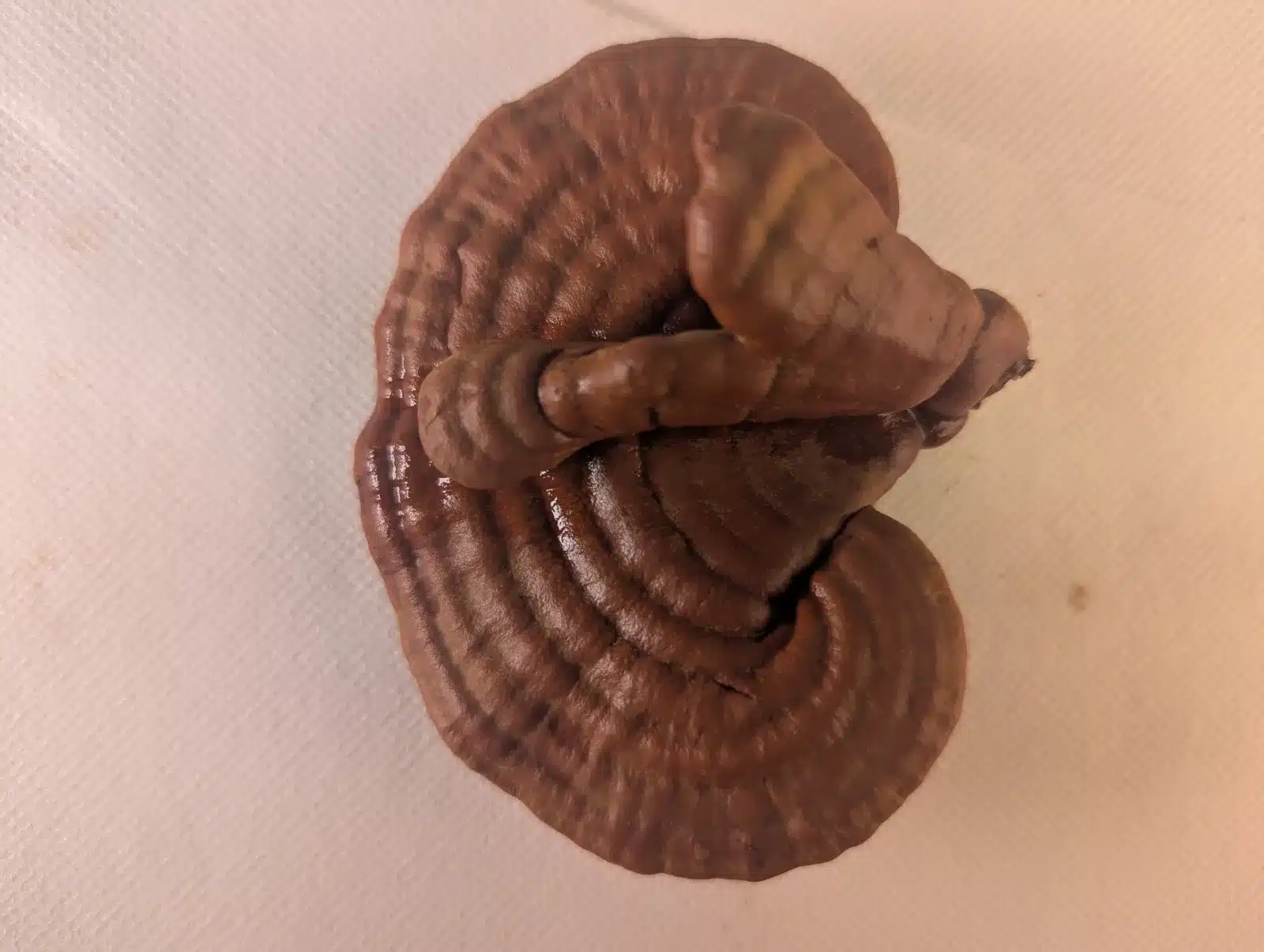
Reishi is a shelf fungus that grows on wood: a kidney- or fan-shaped fruiting body in reddish-brown tones, with a glossy top that looks varnished — hence its scientific name, lucidum, Latin for “shiny.” Unlike culinary mushrooms it has tiny pores instead of gills on its underside, and its texture is hard and woody. It is also intensely bitter — and as you’ll see shortly, that bitterness is actually a quality marker.
Those two traits — wood and bitterness — are why reishi was never food. Chinese tradition sliced and simmered it for hours; today it is concentrated into extracts. That is also the key to understanding the entire reishi market: the value is not in the mushroom itself but in what you manage to get out of it, which makes the extraction method matter as much as the mushroom. More on that below.
| Quick facts | Details |
|---|---|
| Scientific name | Ganoderma lucidum; see below for the taxonomic update to Ganoderma lingzhi |
| Traditional names | Lingzhi (Chinese: “mushroom of spiritual potency”) · Reishi and mannentake — “10,000-year mushroom” (Japanese) |
| Habitat | Wood-decomposer of hardwoods — oak, maple, plum; extremely rare in the wild |
| Appearance | Lacquered, kidney-shaped reddish-brown cap with pale growing edges; pores, not gills |
| Taste | Distinctly bitter — the bitterness comes from the triterpenes, its signature researched compound family |
| How it’s consumed | Not as food: long decoction traditionally, concentrated extract today |
| Measured in our extract | 25.65% beta-glucan (TÜV Austria, in the finished extract) |
Two thousand years before the lab: the history of lingzhi
Very few medicinal plants — and exactly one mushroom — ever reached the status lingzhi held in Chinese culture. The name itself tells the story: ling (靈) means spirit, soul, divine; zhi (芝) was a term for plants of longevity. The common translations: “herb of spiritual potency,” or simply “the mushroom of immortality.”
Legend versus record: what do the sources actually say?
Many websites claim “reishi has been used for 4,000 years.” The documented truth is impressive enough without exaggeration: legend attributes its discovery to the mythical emperor Shennong, the “Divine Farmer,” but the text that actually mentions it — the Shennong Ben Cao Jing, China’s classic materia medica — was compiled during the Eastern Han dynasty, roughly 1,800 to 2,000 years ago. And what it says is more interesting than any legend: the book ranks hundreds of remedies into three classes, and lingzhi was placed in the highest one — the class of substances considered safe for long-term use. The text lists six types of zhi by color; the red one, chizhi, is the one identified with today’s reishi, credited with “benefiting the heart qi and calming the spirit.”
Some fifteen hundred years later, the Ben Cao Gang Mu — the great Ming-dynasty medical encyclopedia (completed in 1578, printed by 1596, today inscribed in UNESCO’s Memory of the World register) — still counted lingzhi among the “herbs of the immortals.” Taoist tradition attributed outright mystical powers to it, and the ceremonial ruyi scepters of the imperial courts were carved in the mushroom’s shape — the Palace Museum in Beijing holds nearly three thousand of them. Let’s say it plainly: these are fascinating cultural testimonies to the mushroom’s status — not scientific evidence of efficacy. What modern research has examined comes later on this page, separately and honestly.
Why was it reserved for the wealthy?
Simple: extreme rarity. In the wild, lingzhi appears on only two or three out of ten thousand aging trees in its growing regions. For millennia, finding a single fruiting body in the forest was an event — so in practice only nobility and the rich could obtain it. The gap between its enormous reputation and near-zero availability is what shaped its myth.
1971: the year everything changed
The revolution came from Japan: in 1971, researcher Yukio Naoi of Kyoto University’s Food Science Research Institute developed the first controlled cultivation method for reishi. Within a decade, a mushroom rarer than pearls became available — and that is what enabled the wave of scientific research that began in those same years: Japanese chemists isolated the first ganoderic acids in 1982, and hundreds of unique compounds have been identified since. Today virtually all reishi in the world — including ours, in the Galilee — is cultivated.
Ganoderma lucidum or Ganoderma lingzhi? One name, two mushrooms
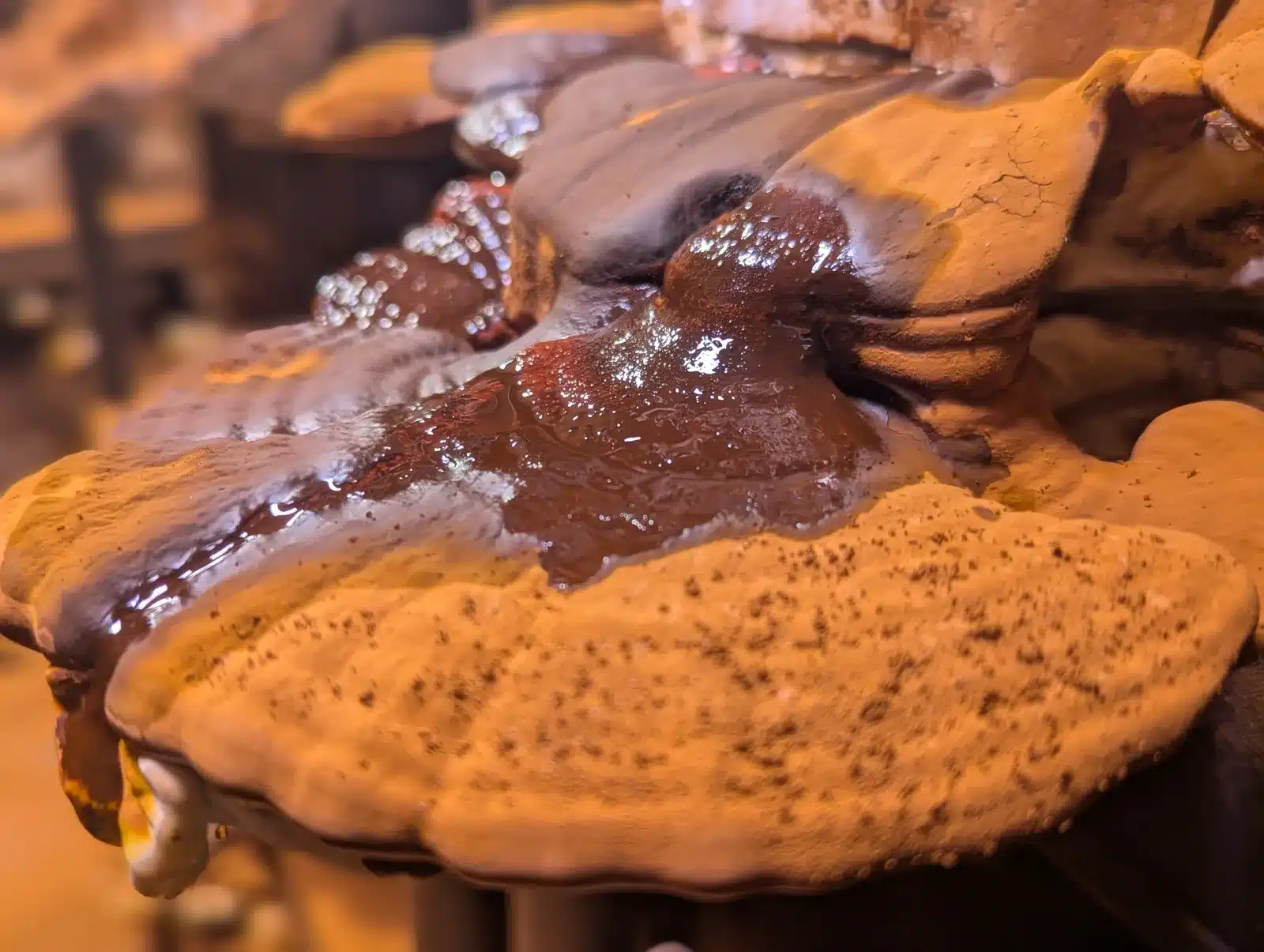
Here is a fact almost no consumer page tells you: the name Ganoderma lucidum was given in 1781 to a European mushroom. For two hundred years every similar glossy polypore worldwide was called by that name — until DNA work showed that the East Asian mushroom of Chinese tradition is a separate species, named Ganoderma lingzhi in 2012. A 2018 study that DNA-sequenced twenty commercial reishi products found that 93% of them were actually G. lingzhi — and not one contained the “true” European lucidum. In other words: the reishi that has been researched, traded and consumed worldwide is the traditional lingzhi, even when the label says lucidum. It’s a matter of taxonomy, not quality — but a page that claims to be serious should know to tell you.
And in Israel? The genus Ganoderma is present here too: Ganoderma species are documented on mature trees in the coastal and northern regions. But precise species identification requires genetic sequencing, and the wild Israeli material is not the reishi of tradition — which is why controlled cultivation of a defined strain is the only route to a consistent extract.
What’s inside? The compounds research focuses on
Reishi’s research reputation rests mainly on two compound families — and the difference between them matters to anyone buying an extract, because each requires a different extraction:
- Beta-glucans (polysaccharides): long-chain sugars from the cell wall, with a distinctive branched (1,3/1,6) structure. These are the focus of the immune research: the immune system recognizes them through a dedicated receptor called Dectin-1 on immune cells — hence the accurate term, immunomodulation, regulation of the response, not crude “boosting.” Beta-glucans dissolve in hot water — which is why the tradition’s long decoction actually worked.
- Triterpenes (ganoderic acids): the Ganoderma family’s signature compounds — more than 380 distinct triterpenes identified since 1982, most unique to the genus. They are studied mainly in inflammatory contexts and in the lab, and they are the source of the mushroom’s bitter taste. Important: they are barely water-soluble — only alcohol extraction releases them. A water-only extract gives them up in advance.
- Adenosine and nucleosides: compounds known from blood-related research; they are the mechanistic basis for the most important caution below — care with blood thinners.
One practical takeaway from this chapter: bitterness is quality control you can taste. A study comparing strains found that a strain low in triterpenic acids simply wasn’t bitter. A reishi extract with no bitterness at all is telling you what’s not in it.
What has human research actually found?
Here we do something almost no consumer reishi page does: grade the evidence domain by domain, with the studies themselves — sample size, dose, duration and outcome — including the domains where results were negative. Table first, details after:
| Domain | Best human evidence | What was found | Evidence level |
|---|---|---|---|
| Immune function | Randomized double-blind trial, 135 healthy adults, 84 days | Significant increase in NK-cell activity and T-cell markers vs placebo | Reishi’s strongest |
| Oncology support | Cochrane review 2016: 5 trials, 373 participants | Improved immune markers and quality of life as an adjunct; not a treatment by itself | Low-quality evidence, adjunct only |
| Fatigue | Two randomized trials (123 and 48 participants) | Significant improvement in fatigue and wellbeing scores vs placebo | Promising but limited |
| Sleep | No dedicated human trial | Long tradition + mechanisms in animal models only | Traditional/preclinical |
| Blood pressure and lipids | Double-blind trial, 84 participants, 16 weeks | No significant effect; same conclusion in the 2015 Cochrane review | Results negative |
| Blood sugar | One early positive trial vs larger later ones | The early promise was not confirmed | Conflicting, leaning negative |
| Liver markers | Small crossover trial (39 participants, 6 months) | Reduced liver enzymes — alongside rare case reports of harm from raw powder | Preliminary, two-directional |
Immune function: the strongest domain
The most convincing modern trial was published in 2023: 135 healthy adults received 200 mg/day of reishi beta-glucan or placebo for 84 days, randomized and double-blind. The reishi group showed an 83% increase in NK-cell cytotoxicity — the immune system’s “natural killer” cells — along with significant increases in several T-cell markers, with no liver or kidney toxicity signals. Read it correctly: these are changes in immune markers, not proof of disease prevention. But in the supplement world, a trial like this in healthy people is a rare asset. We expand on the allergy context in Reishi and Seasonal Allergies.
Fatigue: two real trials
A 2005 Chinese trial enrolled 123 people diagnosed with neurasthenia: eight weeks of a polysaccharide extract (5.4 g/day) produced a 28% drop in fatigue scores versus 20% on placebo — a significant difference. A smaller 2012 trial, in 48 breast-cancer survivors with chronic fatigue, found significant improvement in fatigue, anxiety and quality-of-life scores after four weeks. Both trials are small, but both are randomized and controlled — real human evidence, not testimonials.
Sleep: surprise — honesty required
This is the domain with the biggest gap between marketing and research, and we say so even though reishi is marketed worldwide as a sleep mushroom: to date there is no dedicated human clinical trial for insomnia. The connection comes from tradition (the chizhi “calms the spirit”) and from animal studies that found interesting mechanisms — GABA-system involvement and a gut-microbiome link. In humans there are only indirect signals: the fatigue trial also improved wellbeing scores, and the breast-cancer trial reduced anxiety scores. And a genuine irony: some trials reported insomnia as a rare side effect. We wrote about this at length in Reishi for Sleep and Reishi for Stress and Anxiety.
Heart, sugar and cholesterol: here the results are negative — and we publish that too
The most rigorous trial in the field — 84 participants with type 2 diabetes and metabolic syndrome, 3 g/day for 16 weeks, double-blind — found no effect on any endpoint: not HbA1c, not fasting glucose, not blood pressure, not blood lipids. A 2015 Cochrane review reached the same conclusion, and a 2025 meta-analysis (17 trials, 971 participants) found only marginal changes — with very low certainty across the literature. Anyone selling you reishi as a cholesterol or blood-sugar fix simply hasn’t read the trials — or read them and preferred not to tell. The full picture is in Reishi and Cholesterol: What Research Explores.
So what does the whole picture show?
Looking at the literature as a whole, the fair summary is this: reishi is seriously researched in the contexts of immune modulation, fatigue and general wellbeing, with real but modest human evidence; the traditional calm-and-sleep contexts are supported by preclinical mechanisms but have not been tested directly in humans; and in the metabolic domains the results are negative. The inflammatory response is studied as well — mostly preclinically. The full study-by-study review lives on our Reishi Science page and in the research hub filtered for reishi.
What reishi does not do — and why we want you to know
The Cochrane review of reishi as a cancer-treatment adjunct put it sharply: there is no justification for reishi as a first-line treatment, its standalone effect is “almost negligible,” and there is no evidence of a survival benefit — alongside recognition of improved immune markers and quality of life as an add-on. We grow and sell reishi, and we’ll still say it plainly: reishi does not cure disease, does not replace medication, and does not work overnight. It is a dietary supplement that research examines in support-and-balance contexts over weeks. Anyone promising you more is selling you a story. That honesty is why you’ll find the negative trials here too; the customer who knows exactly what they’re buying is the customer who stays.
Safety, side effects and medications: the table nobody publishes
In controlled trials reishi was well tolerated: reported side effects were mild — dry mouth and throat, mild dizziness, digestive discomfort, itching or rash — and the Cochrane review found no major toxicity in any trial. Extracts at study doses (up to 3 g/day) did not elevate liver enzymes. Alongside this, the literature holds rare case reports of liver injury — almost all associated with raw mushroom powder rather than extracts; the most serious documented case occurred after switching from traditional decoction to powder. Rare, but real — which is why it’s here.
| If you take / your situation | The theoretical risk | What to do |
|---|---|---|
| Blood thinners and antiplatelets (warfarin, aspirin, clopidogrel) | Reishi compounds have been studied as platelet-aggregation inhibitors — increased bleeding risk | Talk to your doctor before starting; this is the most important caution |
| Scheduled surgery | Same bleeding mechanism | Stop at least two weeks before surgery |
| Blood-pressure or diabetes medication | Theoretical additive effect | Monitor values and consult |
| Immunosuppressants / after transplant | Reishi is studied as stimulating immune markers — opposing action | Avoid unless your doctor explicitly approves |
| Active oncology treatment | Possible interactions; spore powder has even distorted a lab marker (CA72-4) used in monitoring | Full transparency with your oncologist — always |
| Pregnancy and breastfeeding | Not enough data — period | Avoid. We’ll write that even when other sites write “permitted” |
| Mushroom allergy | Possible itching/rash | Stop at any sign and consult |
Note the pregnancy row: some consumer sites state reishi is “fine in pregnancy.” The position of the world’s leading medical references is the opposite — there is not enough reliable data, so avoid. When you see that kind of gap between sites, always choose the cautious one. More on the whole topic in Side Effects of Medicinal Mushrooms.
How to choose a reishi extract: the short consumer guide
In 2017, Scientific Reports published a study testing 19 reishi products on the US market. The result: only 5 of them matched their own label claims. The branched beta-glucan — the central active fraction — was detected in only 5 of 19, while starch, which does not exist in genuine fruiting body, was found in 13. In plain words: most of the reishi market sells something other than what the box says. Here’s how to filter:
- Fruiting body, not mycelium on grain. The researched compounds concentrate in the fruiting body; “mycelium on grain” is mostly the grain the fungal network grew on — hence the starch in the market surveys. Quality fruiting-body extracts measure 25–40% beta-glucan; mycelium products usually under 7%. The full how-to-read-a-label guide.
- Dual extraction at minimum — ideally triple. The mushroom’s cell wall is built of chitin, which the human body doesn’t break down, so raw unextracted powder is wasted money. For reishi this matters doubly: hot water releases the beta-glucans, and only alcohol releases the bitter triterpenes. A single-step extraction gives up half the mushroom in advance.
- A measured number, not an “extract ratio.” “10:1” only says how much raw material went in — not what came out. The only number that testifies to content is a beta-glucan percentage measured by an external lab (using the dedicated enzymatic assay that separates beta-glucan from starch), with an open certificate you can verify.
- Careful with spore powders. “Spore powder” sounds premium, but a 2020 analytical study found it very low in triterpenes — which barely release during digestion anyway. Add the case reports of a distorted oncology monitoring marker, and we stay with fruiting-body extract.
The reishi that grows here: from the Galilee to the bottle
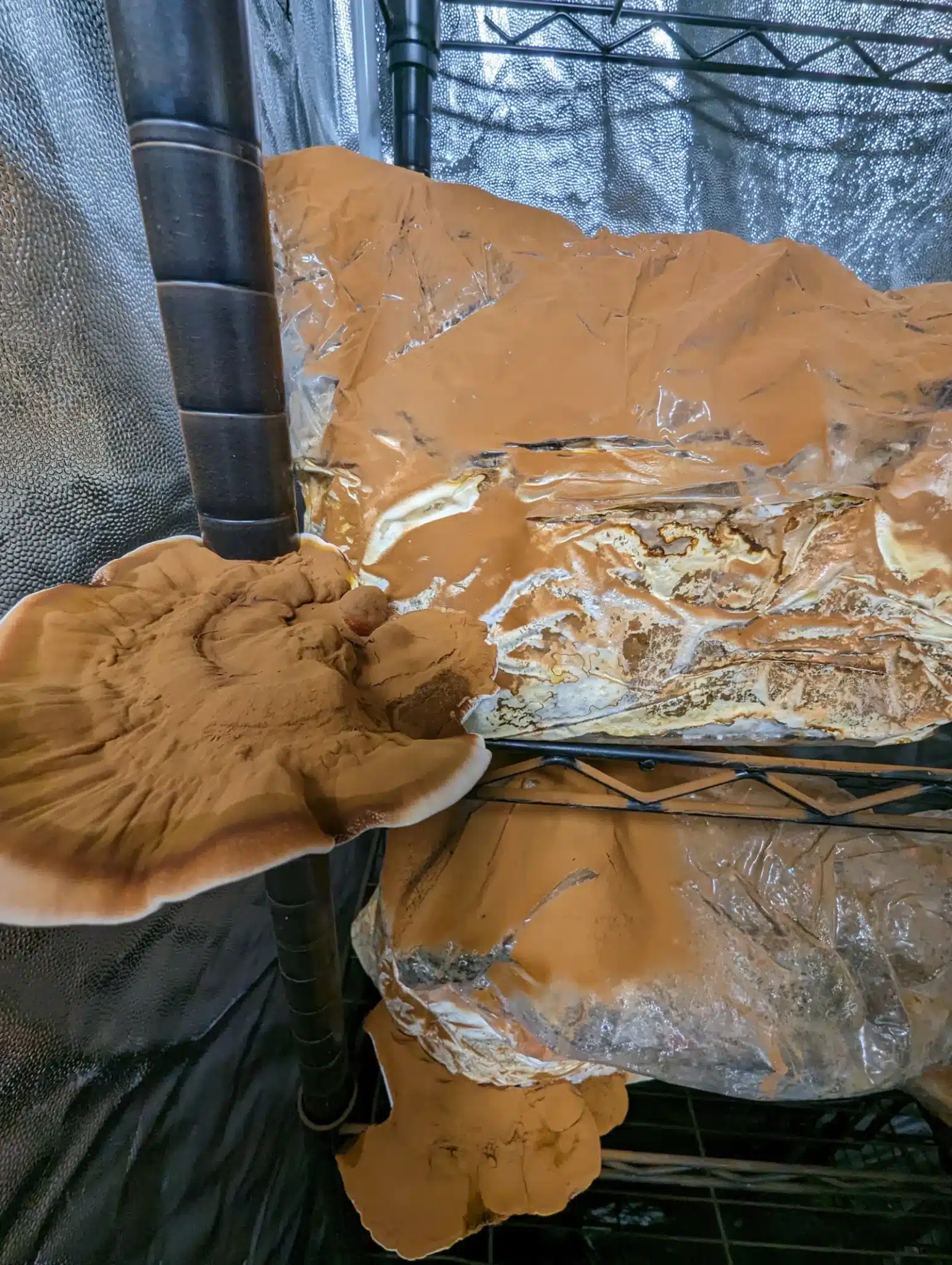
Everything above, we simply practice — that’s the whole story: our reishi grows at our farm in the Galilee on a controlled substrate, is harvested as whole fruiting bodies, and undergoes triple extraction at a 1:3 mushroom-to-liquid ratio — about 16 grams of dried fruiting body per 50 ml bottle. In the finished extract — not the raw material — TÜV Austria measured 25.65% beta-glucan, with starch (alpha-glucan) not detected at all. The certificate of analysis (COA) is open for every extract tested, with a certificate number you can verify directly with the lab — on our lab results page. The extract is also kosher-certified — a rarity in the mushroom-supplement world. And yes — it is as bitter as real reishi should be.
Reishi extract — fruiting bodies only, triple extracted
25.65% beta-glucan measured in the finished extract · open TÜV Austria certificate · grown in the Galilee, Israel
See the reishi extract →How much, when, and who is it for?
Briefly, because we have a full guide on this: clinical trials mostly used 1.4 to 5.4 grams of extract per day, and tradition takes it in the evening. With a concentrated liquid extract that translates to a few milliliters a day, and the principle that outweighs any timing trick is consistency over weeks. The precise calculations by body weight, how to start gradually and every timing question live in the complete reishi dosage guide.
And is reishi the right mushroom for you at all? If you’re weighing options, start with the goal-based matching guide, which maps every mushroom in one table. Reishi is the classic pick around calm and load management and evening routine and sleep — with the realistic expectations we detailed above.
Not sure reishi is your mushroom?
Our short quiz helps you pin down the goal and leave with a clear direction — and our chat is there for any question.
Take the matching quiz →Frequently asked questions about reishi
How long until you feel anything from reishi?
The clinical trials ran 4 to 12 weeks of consistent daily use — and that is the realistic window for expectations too. Reishi is not a substance with an immediate effect, and anyone promising you’ll feel it within days is not presenting the research.
When should you take reishi — morning or evening?
Tradition takes it in the evening, around the calm and sleep-routine contexts, and that remains the common timing today. But reishi is not sedating, so there is nothing wrong with another hour — daily consistency matters more than timing.
Why is reishi extract bitter?
The bitterness comes from the triterpenes — the ganoderic acids unique to the mushroom, one of its researched compound families. Since they only release in alcohol extraction, a bitter extract is evidence the extraction actually pulled them out. A reishi extract with no bitterness tells you what it lacks.
Does reishi make you sleepy?
No. Reishi is not a sleeping pill and has no sedating effect — the sleep research examines an indirect effect through stress-response regulation over weeks, and there is still no dedicated human insomnia trial. You can drive and function normally after taking it.
Is reishi safe for daily long-term use?
In controlled trials reishi extracts were well tolerated for months, with only mild side effects such as dry mouth or digestive discomfort. The exceptions that require a doctor: blood thinners, blood-pressure and diabetes medication, immunosuppression, oncology treatment, pregnancy and breastfeeding, and before surgery.
Can you take reishi during pregnancy or breastfeeding?
Not recommended — there is not enough reliable safety data for pregnancy and breastfeeding, so the guidance of the leading medical references is to avoid. Sites that call it “permitted” do not present a source for that.
Reishi or Lion’s Mane — which one is for me?
It depends on the goal: reishi is researched around calm, load and immune function; Lion’s Mane around focus, memory and mood. Many combine both — Lion’s Mane in the morning and reishi in the evening. Our goal-based matching guide maps all the options in one table.
Can you eat reishi like a culinary mushroom?
No. The fruiting body is hard and woody, and the taste is intensely bitter — which is why reishi was never food. Tradition sliced and simmered it for hours; today it is consumed as an extract, which concentrates the compounds in a form the body can use.
Where can I see the reishi extract’s lab test?
On our lab results page — the certificate of analysis (COA) of the reishi extract is fully open: 25.65% beta-glucan measured in the finished extract at TÜV Austria, starch not detected, and a certificate number you can verify directly with the lab.
Scientific sources (peer-reviewed studies and monographs)
- Cochrane review of reishi as a cancer-treatment adjunct — 5 trials, 373 participants.Jin X, Ruiz Beguerie J, Sze DM, Chan GC. Cochrane Database Syst Rev, 2016.View on PubMed
- Randomized double-blind trial in healthy adults: reishi beta-glucan and immune markers (N=135).Chen SN et al. Foods, 2023.View on PubMed
- Randomized trial in neurasthenia: polysaccharide extract, 8 weeks (N=123).Tang W, Gao Y, Zhou S et al. J Med Food, 2005.View on PubMed
- Controlled trial in fatigue after breast cancer (N=48).Zhao H et al. Evid Based Complement Alternat Med, 2012.View on PMC
- The rigorous metabolic trial: no effect on glucose, blood pressure or lipids (N=84, 16 weeks).Klupp NL et al. Scientific Reports, 2016.View on PubMed
- 2025 meta-analysis: 17 trials, 971 participants, GRADE assessment.Jafari A et al. Food Science & Nutrition, 2025.View on PMC
- Crossover trial on liver markers: reduced liver enzymes after 6 months (N=39).Chiu HF et al. Pharmaceutical Biology, 2017.View on PubMed
- Sleep mechanism in an animal model: GABA-system involvement in rats.Chu QP et al. Pharmacol Biochem Behav, 2007.View on PubMed
- Microbiome-dependent sleep promotion in mice.Yao C et al. Scientific Reports, 2021.View on PubMed
- Isolation of the first ganoderic acids — the start of modern reishi chemistry.Kubota T et al. Helvetica Chimica Acta, 1982.View article (DOI)
- DNA sequencing of 20 commercial reishi products: 93% are Ganoderma lingzhi.Loyd AL et al. Frontiers in Microbiology, 2018.View on PMC
- Testing 19 reishi products on the US market: only 5 matched their labels.Wu DT et al. Scientific Reports, 2017.View on PMC
- Ganoderma spore powder contains little triterpenoids — analytical study.Chinese Medicine (BMC), 2020.View on PMC
- The comprehensive academic chapter on reishi: history, compounds and research.Wachtel-Galor S et al. Herbal Medicine: Biomolecular and Clinical Aspects, 2nd ed. (NCBI Bookshelf), 2011.View on NCBI
- Memorial Sloan Kettering Cancer Center reishi monograph — interactions and safety.Memorial Sloan Kettering Cancer Center, About Herbs: Reishi Mushroom.View the monograph
- NIH LiverTox monograph: reishi’s hepatic safety profile.LiverTox: Clinical and Research Information on Drug-Induced Liver Injury (NIH), Lingzhi/Reishi.View on NCBI
This article is for informational purposes only and does not constitute medical advice, diagnosis, or a substitute for professional care. Medicinal mushroom extracts are dietary supplements, not medicines. These statements have not been evaluated by the Food and Drug Administration. This product is not intended to diagnose, treat, cure, or prevent any disease. Consult a physician before use, especially in cases of pregnancy, breastfeeding, an existing medical condition, or regular medication. The tradition and history described here are cultural background, not evidence of efficacy.
The research behind Reishi — 16 PubMed studies, the good and the bad →
