
How to Choose a Quality Medicinal-Mushroom Supplement: Fruiting Body, Extraction & Lab Testing
- The single most decisive marker of quality is a label that explicitly reads fruiting body extract, since that is what most studies used.
- Wording such as mycelium on grain, or an unqualified full spectrum, often means you are mainly paying for leftover grain starch.
- Extraction decides availability: hot water pulls the beta-glucans, while alcohol is what releases triterpenes in mushrooms like reishi and chaga.
- Ask for a specific beta-glucan figure rather than generic polysaccharides — quality fruiting body sits around 25%–40%, mycelium-on-grain usually below 7%.
- Third-party certificates covering heavy metals, pesticides, microbiology and species identity are the proof a label alone cannot give.
A quality mushroom supplement is identified by three checks: a fruiting-body extract rather than mycelium grown on grain, since the fruiting body holds the highest concentration of active compounds like beta-glucans; a proper extraction method that makes those compounds available to the body; and published lab testing. Beware labels reading "mycelium biomass" or vague "full spectrum."
Want to feel better? Mental clarity on a different level? More energy throughout the day, even when the seasonal clock change insists on throwing you off? Welcome to the intriguing, fast-growing world of functional-mushroom supplements. A world full of promises — some well founded, and some less so.
The market is flooded. Sky-high promises come from every direction. And plenty of “experts” who appeared out of nowhere, with advice worth about as much as the packaging it comes in.
So how do you know what’s really worth your money, and what’s just expensive powder in fancy packaging with empty promises?
This guide is here to give you practical tools for an informed choice — what to check on the label, which terms hide dilution, and how to spot a transparent company.
By the end, you’ll know how to tell a quality supplement from a low-value product, without needing to compare hundreds of products or wonder whether you’ve been misled.
No stories and no empty promises — just what matters to know before you buy.
Have not picked a mushroom at all yet? Start with the goal-based matching guide, then come back here to judge product quality.
How to Choose a Quality Mushroom Supplement: What Really Goes Into Your Body?
Functional mushrooms — this impressive-sounding name has become a trend in recent years, and not for nothing.
From calming reishi to lion’s mane, they are researched in the context of a variety of areas: supporting immune-system function, improving focus, coping with stress, and supporting energy levels.
But wait — before you rush to buy the first supplement that pops up in your feed (because “wow, an insane deal!”), let’s talk a little about reality.
Because between a promise and a quality product, there is sometimes an enormous gap. And that gap, dear friends, costs you money — and sometimes safety too. None of us wants to invest in a product that ultimately turns out to be ineffective, or worse — unsafe. So how do you navigate the mushroom-supplement market? That’s exactly why we’re here.
1. Fruiting Body vs. Mycelium: Why It Matters for Supplement Quality
This is probably the single most important point, and it’s a decisive factor in the quality of the supplement you buy.
It’s worth understanding in depth, because this is where the difference lies between a supplement that will work for you and an expensive powder that stays stuck in the cupboard.
When we picture a mushroom, we usually imagine the part above the ground — the “cap” and the “stem.” That is the fruiting body. It’s the “steak” of the mushroom. But beneath the surface, a sprawling network of fine threads branches out, called mycelium. The mycelium is like the tree roots of the mushroom, and it usually lives on a substrate (wood, soil, or… grains).
Now pay attention: the overwhelming majority of scientific studies on the researched properties of mushrooms were carried out on extracts derived from the fruiting body.
Why? Because it contains the highest concentration of active compounds.
Especially the beta-glucans — the complex compounds researched in the context of supporting immune-system function and other health areas. They’re the “heroes” of the story.
But — and this is a big but — growing fruiting bodies takes time, knowledge, and resources. It’s more expensive. Much more. What’s the cheap solution used by less honest manufacturers? Growing mycelium on a substrate of grains such as rice or oats. Cheaper, faster — and significantly less effective. Why less effective? Because the final product is a mixture of the mushroom’s mycelium and the residue of the grains it grew on.
Instead of a high concentration of active compounds, you mainly get starch from the grains. It’s like paying for fine wine and receiving grape juice watered down.
So what do you do? Check the label, carefully:
- “Fruiting Body Extract” — that’s what you want to see.
- If it says “Mycelium Biomass,” “Mycelium on Grain,” “Full Spectrum,” or just “mushroom” with no detail — be careful. You’re probably paying mainly for rice powder with little added value.
Quick Q&A:
Q: Is mycelium completely useless?
A: Not necessarily, but it is less concentrated in the specific active compounds on which most of the research was carried out (such as beta-glucans). It also contains parts of the growth substrate (usually grains), which significantly dilutes the product. It’s simply not in the same league as the fruiting body.
2. Extraction Methods: How to Make Sure the Mushroom Is Truly Available to the Body
Think of it this way: the mushroom is like a safe with valuable contents inside. You can’t just swallow the safe and hope for the best. You need to open it and take out the good stuff. That’s exactly the job of extraction. The walls of mushroom cells are made of chitin — a material that is hard for the human body to digest, similar to the shell of insects.
For the mushroom to release its active compounds, it needs to undergo a careful extraction process. There are two main methods, and each has its role:
Hot Water Extraction
This is the “classic” method, the oldest and most essential one for beta-glucans and most other polysaccharides. Beta-glucans are water-soluble molecules. So if you want the full range of compounds researched for supporting the immune system — it’s important that the mushroom undergoes hot water extraction.
Most of the well-known functional mushrooms (such as reishi, shiitake, maitake, trametes) contain beta-glucans as central active compounds, and hot water extraction is important for them. Without it, it’s like drinking tea without putting the tea bag in hot water.
Dual Extraction / Alcohol Extraction
Some mushrooms also contain additional compounds, such as triterpenes, which are not water-soluble. To extract them, alcohol extraction is required. Mushrooms such as reishi and chaga, for example, are rich in triterpenes researched in the context of supporting the nervous system and coping with stress.
For these mushrooms, dual extraction (combining hot water and alcohol) is the best way to ensure a broad range of active compounds. At Triterra, we take this further into a triple extraction.
How will you know? Look on the label for the terms: “Hot Water Extract”, “Dual Extract”, “Ethanol Extract”, or a mention of “Triterpenes”.
If nothing is specified, it’s most likely just a ground powder of dried mushroom (at best) or poor mycelium (at worst), and the bioavailability will be low.
Quick Q&A:
Q: Is extraction always better than ground mushroom powder?
A: In terms of the availability of the active compounds — yes. Ground mushroom powder is essentially a raw material. Most of the active compounds are locked inside the tough chitin cell walls, and the body struggles to break them down efficiently without extraction.
3. Standards and Testing: How to Make Sure You’re Not Consuming Contaminants
“Organic,” “natural,” “pure,” “superfood” — nice words, right? But in the supplement industry, and especially in the mushroom one, they can be empty of meaning if there is no proof behind them.
You don’t want to put something into your body that will be expensive and have no effect — or worse, contaminated. That’s why transparency and third-party testing are so critical.
Beta-Glucans: The Numbers Worth Reading Correctly
When you choose a supplement, look for products that explicitly state the percentage of beta-glucans. This is the central component you’re looking for in mushrooms, so it’s important to know its concentration.
If it only says “polysaccharides” (Polysaccharides) with no detail — be careful. Starch from the grains (which we talked about earlier) is also a polysaccharide!
Dishonest manufacturers can inflate this figure with cheap starch to make the product look rich in active compounds, when in practice it’s thin. It’s like saying a food contains “carbohydrates” without specifying whether it’s broccoli or white sugar.
Look for specific beta-glucans (usually 1,3/1,6 Beta-Glucans).
To give a sense of scale: a quality fruiting body usually reaches a range of 25%–40% beta-glucans, while mycelium-on-grain products usually fall below 7%. As an example of numerical transparency, independent lab tests (TÜV, 07/2025) measured in Triterra extracts: cordyceps 28.16%, reishi 25.65%, lion’s mane 23.93%, and turkey tail + reishi 23.21% — with starch not detected above the detection threshold. This is exactly the kind of data worth asking any manufacturer for.
Third-Party Testing: Proof You Can’t Fake
A company that is truly committed to quality won’t just tell you how good it is — it will also carry out external lab tests and display them openly. What is checked in these tests?
- Heavy metals: lead, mercury, cadmium, arsenic. Mushrooms absorb substances from the soil, so it’s important to make sure the product is clean.
- Pesticides: especially if it isn’t clearly organic cultivation.
- Microbiology: bacteria, mold, yeast.
- Mushroom identification: to verify that what’s written on the label is indeed what’s in the bottle.
Look for “Certificates of Analysis” (COA) or lab reports on the company’s website. If there aren’t any — and there’s no good explanation — that’s a red flag. You’re welcome to see what it looks like on our transparency page.
Quick Q&A:
Q: Does an “organic” supplement guarantee it’s better?
A: “Organic” is an advantage, because it reduces pesticides. But it doesn’t guarantee extraction quality or the absence of heavy metals (which the soil can contain regardless of pesticides). Third-party testing is also essential to be truly reassured.
Want to see what a transparent supplement looks like?
We openly publish the lab tests and beta-glucan percentages of every product, alongside our full transparency policy. You can also explore the complete guide to medicinal mushrooms and compare what matters: fruiting body, extraction method, and active percentages.
4. Where Does Your Mushroom Grow? Why the Source Matters
“Made in China” — a phrase that can raise an eyebrow, and rightly so, when it comes to dietary supplements.
Not that China can’t produce quality products — it can. But in the mushroom industry, oversight there can be loose, and quality and safety standards can be too flexible.
Mushrooms, as mentioned, are excellent absorbers from their environment.
If they grow in an area with contaminated soil or near industrial plants, they will absorb heavy metals and other contaminants from the environment too — very efficiently.
Therefore, the source of the mushroom and the quality of cultivation are critical. Look for companies that clearly state the source of their mushrooms.
Are they grown in controlled facilities with international standards? Do they undergo rigorous testing in independent labs even before they reach the extraction facility?
Quality manufacturers will take pride in their sources and be transparent about their cultivation processes. If the source is vague or too general (“from East Asia”), that’s a good reason to ask questions.
5. Capsule, Powder or Tincture: Does the Form of Consumption Matter?
After you’ve chosen a quality mushroom — how do you consume it? Capsules, powders, or tinctures?
Each form has advantages and disadvantages, but the effect on effectiveness is relatively minor compared with the quality of the extraction and using fruiting body only.
In other words, if you chose a quality raw material, each of the forms will do the job.
- Capsules: convenient, easy to swallow, precise dosage, and no taste or smell. Ideal for those who want to take the supplement quickly.
- Powders: flexible in dosage, can be added to shakes, coffee or cooked dishes (though excessive heat can be damaging). Sometimes more cost-effective per mg. The downside? The taste, which isn’t for everyone.
- Tinctures (liquid extracts): quickly absorbed under the tongue, but usually contain alcohol (a byproduct of dual extraction). Convenient for daily use. It’s important to check the concentration of active compounds and the amount of alcohol.
Ultimately, the choice is personal and derives from your convenience and preference. The main thing is to choose a quality product, in whatever form, and to stay consistent.
Quick Q&A:
Q: Are some mushrooms more suited to different areas? A: Each mushroom has a unique profile and its own areas of research:
- Reishi — researched in the context of calm, sleep, and immune support.
- Lion’s Mane — researched in the context of cognitive support, focus, and memory.
- Cordyceps — researched in the context of energy, stamina, and sports.
- Chaga — rich in antioxidants, researched in the context of immune support.
- Trametes (Turkey Tail) — researched in the context of supporting the immune system.
Not sure which mushroom fits you? The complete guide to medicinal mushrooms will help you focus and dig deeper into each species.
6. Hidden Traps: Which Marketing Tricks to Watch Out For
Now that you’re armed with knowledge about quality, let’s talk about a few tricks the industry likes to use — so you can spot them from afar.
- “Full Spectrum”: sounds good, but in practice it’s often a nickname for “mycelium on grain.” You have no idea how much fruiting body is in there, if any.
- “Raw Mushroom Powder”: as we’ve seen, significantly less effective than extraction. Don’t be tempted by the lower price — you’re getting less.
- Exaggerated promises: “cure-all,” “detoxes your body in a day,” “live to 120 with skin as smooth as a baby’s.” Mushrooms are a supportive dietary supplement, not a miracle drug, and they won’t replace a healthy lifestyle. A sweeping promise like that is a red flag in itself.
- Lack of information: a company that doesn’t detail the fruiting body, extraction method, or third-party testing is a company that probably has something to hide. Transparency is the key.
Quick Q&A:
Q: Can I buy fresh mushrooms and eat them instead of supplements?
A: Many culinary mushrooms are healthy and tasty (such as shiitake or portobello), but functional mushrooms (such as reishi or chaga) are usually not tasty, and more importantly — they are hard to digest without extraction. To get the active compounds from them, extraction is required.
Q: How long does it take to see results from mushroom supplements?
A: It’s individual and depends on the mushroom, the dosage, and your general condition. Usually it’s a matter of weeks to months of regular use. It’s not an instant magic pill — consistency is the key.
Q: Are there side effects to mushroom supplements?
A: In general, functional mushrooms are considered safe to consume. That said, like any supplement, mild individual reactions are possible (such as digestive discomfort). It’s important to start with a low dose and consult a doctor, especially if you take medications, are pregnant or nursing, or have an existing health condition.
7. The Smart Choice: A Checklist for Choosing a Quality Mushroom Supplement
We’ve reached the bottom line. You now have the tools. Let’s sum up the checklist for an informed choice:
- Fruiting body only: make sure it explicitly says “Fruiting Body Extract.” If not, move on.
- Extraction method: look for “Hot Water Extract” for all mushrooms, and “Dual Extract” for reishi and chaga.
- Beta-glucan percentages: look for specific numbers (usually 1,3/1,6 Beta-Glucans). A quality fruiting body ranges from 25%–40%. Avoid generic “polysaccharides.”
- Transparency and third-party testing: a site that displays available COA and lab tests is a sign of reliability. Without it, don’t be tempted by attractive prices.
- Source and cultivation: look for companies that state where and how the mushrooms were grown. Preference for organic and supervised cultivation facilities.
- Packaging and customer service: packaging sealed against light and moisture is important for preserving active compounds, and available customer service is always an advantage.
- Price: truly quality mushrooms won’t be as cheap as rice powder. Don’t be tempted by rock-bottom prices.
You’ve finished the guide — and now you have the tools to choose a mushroom supplement that’s truly worth the investment. Because in the end, your health is the most important investment. Don’t compromise on it — choose wisely.
Ready to choose the right way?
Explore our full transparency policy and beta-glucan lab tests — every figure published openly, alongside our triple-extraction method. Not sure where to start? The complete guide to medicinal mushrooms will help you compare by fruiting body, extraction method, and active percentages.
Disclaimer: This content is an educational overview, based on preliminary research and traditional use, and does not constitute medical advice or a therapeutic indication. Medicinal mushroom extracts are dietary supplements only. Do not begin use, especially while taking medications, during pregnancy, nursing, or with an existing medical condition, without consulting a doctor or a qualified practitioner.
*These statements have not been evaluated by the Food and Drug Administration. This product is not intended to diagnose, treat, cure, or prevent any disease.*
Measured β-glucan in our extracts
| Extract | β-glucan (measured in the finished extract) | TÜV Austria certificate |
|---|---|---|
| Cordyceps extract | 28.16% | CY01082790 |
| Reishi extract | 25.65% | CY01082791 |
| Turkey Tail & Reishi extract (the tested blend) | 23.21% | CY01082793 |
| Market reference: mycelium-on-grain powder | typically under 7% | — |
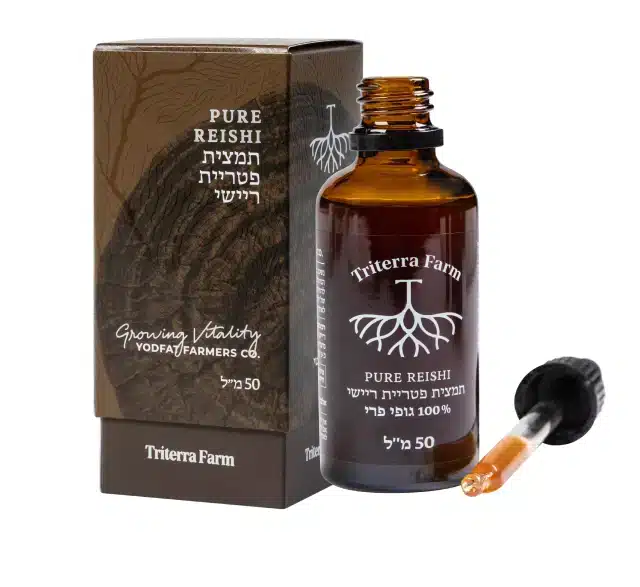
100% fruiting bodies, triple extraction. The test report (COA) is open for every tested extract — see the full lab results. From Triterra Farm — medicinal mushroom extracts from the Galilee.
The research behind Reishi — 16 PubMed studies, the good and the bad →
Frequently asked questions
Why is it important to choose a supplement based on the fruiting body?
The fruiting body is the above-ground part of the mushroom, and most of the research on the active compounds was carried out on it. By contrast, products based on mycelium usually grow on a grain substrate (such as rice), which results in a product containing a large amount of cheap starch and very little of the researched active compounds.
Why must mushrooms be extracted?
The cell walls of mushrooms are made of chitin, a material the human body does not digest efficiently. The extraction process (in hot water or alcohol) breaks down the chitin and releases the active compounds (such as beta-glucans) so they are more available for absorption by the body.
What is the difference between beta-glucans and polysaccharides on the label?
This is an important distinction. Beta-glucans are the specific compound researched in the context of supporting immune-system function. The word "polysaccharides" is general and also includes simple starches (sugar). Some manufacturers use the general term to hide that their product is diluted with rice and starch.
How do you know a mushroom supplement is clean and safe to use?
Always look for third-party lab testing or a Certificate of Analysis (COA). These tests verify that the product is free of heavy metals, pesticides and contaminants, and that it actually contains the percentage of active compounds stated on the label.
Which is better — capsules, powder or tincture?
The form matters less than the quality of the raw material. If the extraction is high quality, all forms are suitable. Capsules are convenient and precise in dosage, powders are flexible for mixing into food, and tinctures are absorbed quickly but contain alcohol. The choice depends on your personal preference.
What beta-glucan percentage should a quality mushroom supplement have?
A quality fruiting body usually reaches 25%–40% beta-glucans, while mycelium-on-grain products usually fall below 7%. Look for a specific 1,3/1,6 beta-glucan number on the label, backed by a lab test, rather than the vague word polysaccharides.
Why should I be wary of the term Full Spectrum on a mushroom supplement label?
It sounds good, but in practice it is often a nickname for mycelium on grain, and you have no idea how much fruiting body is inside, if any. Look explicitly for Fruiting Body Extract, and be cautious of Mycelium Biomass and Mycelium on Grain.
Why does it matter where the mushroom in my supplement was grown?
Because mushrooms absorb substances from their environment, and a mushroom grown in contaminated soil or near industrial plants will absorb heavy metals. Look for companies that state their source and use controlled facilities; a vague origin like East Asia should raise questions.
