
How Long Do Medicinal Mushrooms Take to Work? What the Trials Measured — and What They Didn’t
Reishi (Ganoderma lucidum, lingzhi), lion’s mane (Hericium erinaceus, yamabushitake), cordyceps and turkey tail (Trametes versicolor, yun zhi) are medicinal mushrooms taken as a daily extract — and almost everyone who starts asks the same question: how long until I feel something? The honest answer comes from the controlled trials themselves: the effects that were measured appeared after 4 to 16 weeks of daily use — 4 weeks for mood scales, 8 for fatigue, 12 weeks for cognitive scores and immune cells, and 3 weeks for exercise capacity. “Fast” findings of 60–90 minutes exist in two small pilot studies, on a single test out of a battery, alongside null results. This page lays out every timeline the science has actually measured — mushroom by mushroom, with participant numbers and weeks — so you know when to judge, and when it is still too early.
Why this page is unlike every “timeline” you will find online. We searched this question in English and in Hebrew. Almost every answer is a brand’s chart: “reishi — calm within 3–8 days,” “lion’s mane — clarity within two weeks,” “turkey tail — 2–4 weeks.” None of those charts points to a study, because no study ever measured “how many days until you feel it.” What the research did measure — a fixed daily dose, and an assessment at the end of a period of weeks — is in the table below, with a PubMed link on every row. We sell extracts too; the only fair thing is to bring the numbers exactly as they are.
Key takeaways
- What the trials found: lion’s mane — 4 weeks (depression and anxiety scales in 30 women), 12 weeks (MMSE in adults), 16 weeks (mild cognitive impairment, with gains growing from week 8 to 16). Reishi — 8 weeks (fatigue, 132 participants), 84 days (immune cells in healthy adults). Cordyceps — one week: no significant change; 3 weeks: maximal oxygen uptake rose; 12 weeks: metabolic threshold up 10.5% in older adults. Turkey tail — 8 weeks for the gut microbiome; no trial measured a “feeling.”
- “Within an hour”: it exists — on one attention test (60 minutes) and one motor test (90 minutes) in two lion’s mane pilots, while the composite measures of cognition and mood did not change. That is not a timeline; it is a footnote.
- What happens when you stop: in the 16-week trial, scores dropped significantly 4 weeks after stopping. An NK-cell count that rose after 10 days of reishi returned to baseline 10 days later. The effect is maintained by use — not stored.
- What it means in practice: a 50 ml bottle at a daily dose of about 1.4 ml lasts roughly 35 days — a window of 4–5 weeks. That is your trial window for the faster measures (sleep, mood, energy); for focus and memory the research says 12 weeks. Our 100-day trial period is longer than any 12-week trial in the table.
- What sets your pace: what is in the bottle (measured beta-glucan, not “polysaccharides”), whether you reached the full dose, how many days you skipped, and where you started — in the trials, people with a lower baseline changed the most.
How long does it take to feel an effect from medicinal mushrooms?
In the controlled trials, effects were measured after 4 to 16 weeks of daily intake — not after days. The short end (4 weeks) belongs to mood and sleep scales, the middle (8–12 weeks) to fatigue, immune cells and cognitive scores, and the long end (16 weeks) to a trial in which the improvement kept growing the longer intake continued. So the realistic assumption: a month of consistency before a first judgement, and three months before a final one.
That sentence already appears on our site, in short form, on the timing and stacking page and in the FAQ. What this page adds is the detail: which trial, how many participants, how many weeks, and exactly what was measured — because “feel” and “measured” are two different words, and the gap between them is the whole story. Take the most-quoted lion’s mane finding online: “cognitive improvement after 12 weeks.” It is real — a randomized, double-blind trial from 2019 on the fruiting body found a significant improvement on the MMSE after 12 weeks. But the MMSE is a 30-point screening test physicians use; the participants did not “feel” the improvement — they were measured. That does not shrink the finding. It explains why someone waiting for a sensation might miss it.
Why are the online “timelines” unfounded — and what is?
Because they answer a question no study asked. Clinical trials on medicinal mushrooms are almost all built the same way: a fixed daily dose, over a fixed period, with an assessment at the end. No protocol measured “on which day did you feel something.” So every “days 1–7 / 8–14 / 15–30” chart is a personal experience or a marketing guess — not evidence. What is founded is the measurement point: after how many weeks a difference from placebo was found.
We checked before writing. In Hebrew, the top result for this question tells a “30 days with lion’s mane” story — a personal diary of days 1–7, 8–14 and 15–30, without a single study. In English, a dozen brand blogs promise “calm from reishi within 3–8 days” and “full results within 2–3 months” — also without a citation. That is not necessarily bad faith; it is simply what happens when a question about sensation is answered with the tools of marketing. We preferred to answer it with the only tool there is: the trials, as they are, including the ones that found nothing.
What did the controlled trials actually measure — and after how long?
The table below is the heart of this page: trial by trial, the number of participants, the duration of intake, the measure tested, and when a difference from placebo appeared. Every row is linked to PubMed in the sources at the bottom. Look at the last column — it explains what each finding does not mean.
| Mushroom | Trial | Who and how long | What was measured | When a difference appeared | What it does not mean |
|---|---|---|---|---|---|
| Lion’s mane | Nagano 2010 | 30 menopausal women, 4 weeks (cookies with fruiting body) | Depression scale (CES-D), indefinite complaints, sleep | 4 weeks | Small sample; the sleep index (PSQI) showed no significant difference |
| Lion’s mane | Saitsu 2019 | Healthy adults, 12 weeks (fruiting body) | MMSE, Benton visual retention, verbal paired-associate learning | 12 weeks | Only the MMSE improved; the other two tests did not |
| Lion’s mane | Mori 2009 | 30 adults (50–80) with mild cognitive impairment, 16 weeks | Cognitive scale (HDS-R) | Weeks 8, 12 and 16 — gains grew with time | 4 weeks after stopping, scores fell significantly |
| Lion’s mane | Docherty 2023 | 41 healthy young adults, single dose + 28 days | Cognitive battery, stress, mood | 60 minutes — faster Stroop performance; 28 days — a trend in stress (p=0.051) | Null and some negative findings in the same study; the authors urge caution |
| Lion’s mane | Surendran 2025 | 18 healthy young adults, single dose (3 g of a 10:1 extract) | Cognition and mood at 90 minutes | 90 minutes — pegboard test only | Composite measures of cognition and mood — no difference |
| Reishi | Tang 2005 | 132 participants with chronic exhaustion (neurasthenia), 8 weeks | Clinical severity, sense of fatigue and well-being | 8 weeks — fatigue fell 28.3% vs 20.1% on placebo | The placebo group also improved by 20% — that is what expectation looks like |
| Reishi | Chen 2023 | Healthy adults 18–55, 84 days (reishi beta-glucan) | T-cell and NK-cell counts, IgA, NK cytotoxicity | 84 days | Measured in blood, not in sensation; the authors are linked to the manufacturer |
| Reishi | Wachtel-Galor 2004 | 10 healthy volunteers, single dose + 10 days | Antioxidant capacity in plasma and urine | 90 minutes — plasma peak; 10 days — rise in urine | A transient biochemical marker, not a felt effect |
| Reishi | Wicks 2007 | 16 healthy volunteers, 10 days (2 g twice daily) | Safety, immune cell counts | CD56 cells rose during intake | Did not reach significance; back to baseline 10 days after stopping |
| Reishi | Kwok 2005 | 40 healthy volunteers, 4 weeks (1.5 g/day) | Coagulation and platelet function | No change at 4 and 8 weeks | An example of a measure that did not move — sometimes reassuring |
| Cordyceps | Hirsch 2017 | 28 young adults, a mushroom blend containing cordyceps, 1 week; 10 of them continued to 3 weeks | VO2max, time to exhaustion, ventilatory threshold | 1 week — no significant interaction; 3 weeks — VO2max +4.8 ml/kg/min | The continuation group: only 10 people |
| Cordyceps | Chen 2010 | 20 healthy older adults (50–75), 12 weeks (a Cs-4 preparation) | Metabolic threshold, ventilatory threshold, VO2max | 12 weeks — metabolic threshold +10.5% | VO2max did not change; pilot |
| Cordyceps | Liao 2019 | 14 sedentary young adults, 8 weeks of training + a rhodiola/cordyceps supplement | Body composition, oxidative-stress markers | 8 weeks — body composition improved more | A combined supplement — cannot be attributed to cordyceps alone |
| Turkey tail | Pallav 2014 | 24 healthy volunteers, 8 weeks (PSP) | Stool microbiome composition, 7 samples | Consistent changes across 8 weeks | No trial in healthy people measured a sensation or a symptom |
Three notes on the table. First: the samples are small — 10, 16, 18, 20, 30 participants — and that is true of almost the entire medicinal-mushroom field, so every number here is a foothold, not a law of nature. Second: the trials used different forms — cookies, fruiting-body powder in tablets, isolated beta-glucan, a 10:1 extract — and none of them tested a triple alcohol extract like ours, which is why we never write “our extract works within X.” Third, and most important: in most rows, what was measured is not something you can feel — a cell count, a test score, a metabolic threshold. We expand on that below, because it changes the whole question.
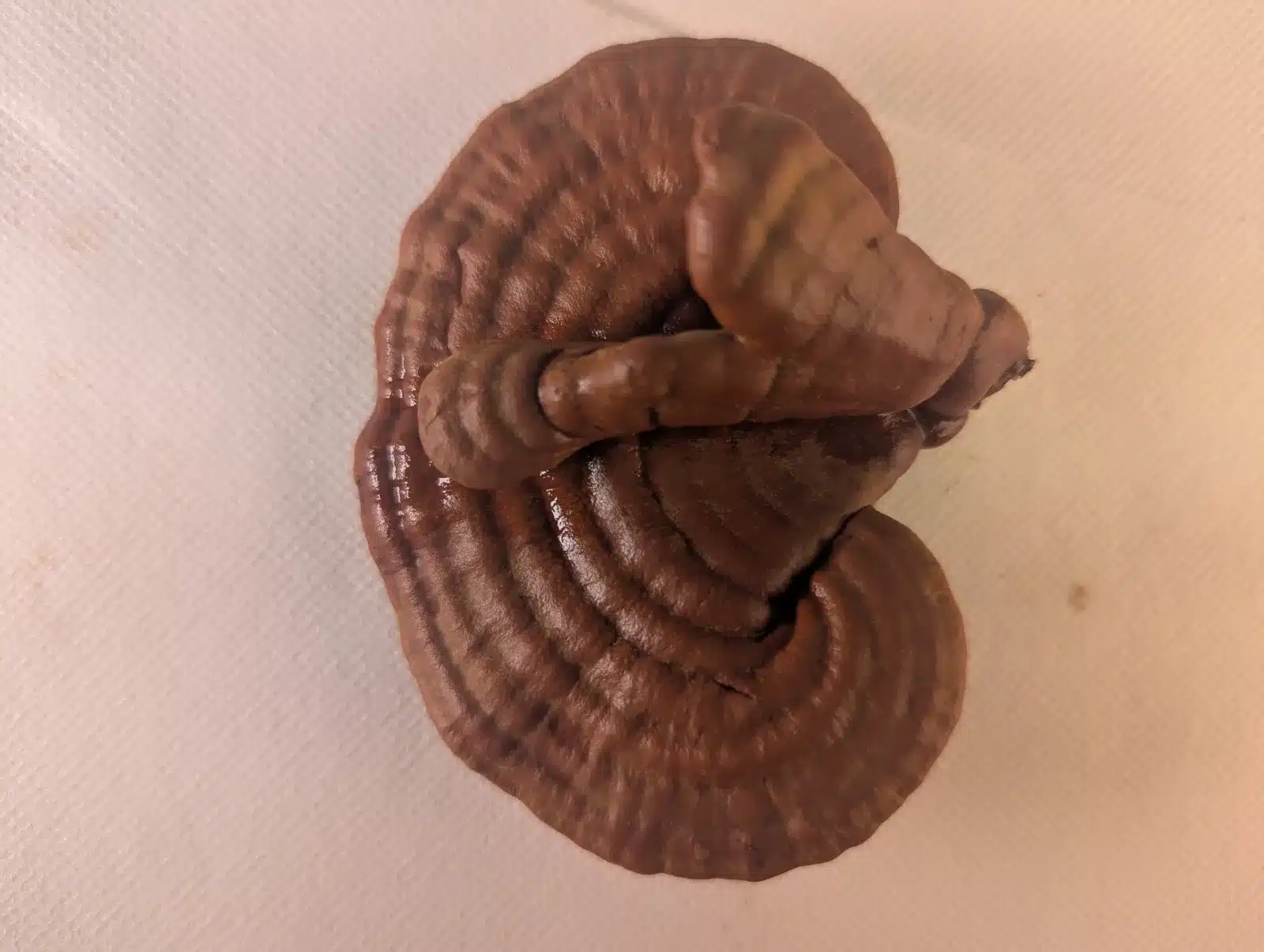
Lion’s mane: four weeks for mood, 12–16 for cognition — and what happens when you stop?
Lion’s mane has the most time-course trials of the four, and they all tell one story: mood and anxiety scales moved after 4 weeks, cognitive scores after 12, and in the longest trial — 16 weeks — the gain kept growing from week 8 to week 16 and then, four weeks after stopping, fell significantly. In other words: cumulative, and erased when you stop.
The 2009 Japanese trial is the source of the “12–16 weeks” you see everywhere, and it is worth knowing in full: 30 participants aged 50–80 with mild cognitive impairment, half of them taking tablets of fruiting-body powder three times a day. The mushroom group scored higher than placebo at weeks 8, 12 and 16 — and the scores rose with duration of intake. That is the positive finding. The second finding, which almost nobody quotes, is in the same paper: when they stopped, the scores dropped within a month. A 2025 systematic review pooling five randomized trials summarised the effect size honestly: an average gain of 1.17 points on the MMSE — a real measurement, not a miracle. If you want the mechanism — the hericenones in the fruiting body and their link to NGF — it is on the lion’s mane science page, and the mood evidence, including the 28-day trial that found only a trend, is in “Does lion’s mane support mood?”. Who should avoid it altogether is on the safety page.
Reishi: eight weeks for fatigue, 84 days for immune cells — and “calm within days”?
The two largest reishi trials measured after 8 weeks (fatigue and well-being, 132 participants) and after 84 days (T and NK cells in healthy adults). The “calm within days” promised online was not measured by any trial. What was measured in the range of days are biochemical markers: plasma antioxidant capacity peaking 90 minutes after a dose, and a CD56 cell count that rose during 10 days of intake — and returned to baseline 10 days after.
The 2005 trial also teaches something important about placebo. 132 participants with chronic exhaustion received a reishi polysaccharide extract or placebo for 8 weeks. The sense of fatigue fell by 28.3% in the reishi group — and by 20.1% in the placebo group. The difference was significant, but look at the second number: people who took an empty capsule reported 20% less fatigue. That is what expectation looks like in the body, and it is why we do not rely on “I felt” — from happy customers or from unhappy ones — but on the difference from placebo. Reishi is not a sleeping pill: it regulates rather than sedates (we explain this in the complete reishi guide), so if you are waiting for a “drop” on the first evening, that is not what the research described. What it described is a difference on a fatigue questionnaire after eight weeks.
Cordyceps: one week — nothing; three weeks — oxygen uptake; 12 weeks — metabolic threshold
Cordyceps is the only mushroom in the table measured after a single week — and after one week no significant interaction was found on any measure. After 3 weeks, maximal oxygen uptake rose by 4.8 ml/kg/min in the mushroom group and not on placebo; after 12 weeks, in adults aged 50–75, the metabolic threshold rose by 10.5%. So even “the energy mushroom” needs weeks — despite being presented online as something you feel “immediately in a workout.”
These data line up with our farm’s own guidance, which is also written on the timing page: cordyceps is not a caffeine-like stimulant and is not a daily baseline for us — take it around need, before effort or during a demanding period. In the 2017 trial, 28 young adults took a mushroom blend containing cordyceps for one week; only ten continued to three weeks, and that is where the improvement appeared. In the 2010 trial, twenty older adults took a cordyceps preparation three times a day for 12 weeks: the metabolic threshold (the point above which lactate accumulates) rose, but maximal oxygen uptake did not change at all. And a 2019 combined trial (rhodiola + cordyceps, 8 weeks with training) found better body composition — but in a combined supplement, you cannot tell what did what. A 2024 review of cordyceps polysaccharides summarises the immunomodulatory mechanisms behind this. Bottom line for athletes: if you are testing cordyceps, give it three weeks of daily use before you measure — not one session.
Turkey tail: what has actually been measured in healthy people?
Very little, and that is the honest answer. The only controlled trial in healthy people we found gave a polysaccharopeptide (PSP) from turkey tail to 24 volunteers for 8 weeks and measured the stool microbiome at seven time points: the changes were consistent and matched prebiotic activity. No trial in healthy people measured a symptom, a sensation or “a stronger immune system” — so any turkey tail timeline you see is a guess.
Most turkey tail research was done in heavy medical contexts, with isolated preparations (PSK/PSP), over months — it does not translate into “how soon will I feel it,” and it lives in full on the turkey tail science page. What can be said carefully is that its mechanism — beta-glucans and polysaccharopeptides read by immune-cell receptors — is one of tuning, not pushing; and a mechanism like that, by its nature, is not something you “feel” in the evening. If you felt nothing from turkey tail within a month, that is exactly what the research would predict — and the right question is not “when will I feel it” but “what am I measuring.”
Is there such a thing as “feeling it within an hour”?
Such a finding exists — but it has to be described precisely. In two lion’s mane pilot studies, a single dose improved one test out of a battery: faster performance on the Stroop task after 60 minutes (41 young adults, 2023), and a pegboard test after 90 minutes (18 young adults, 2025). In both, the composite measures of cognition and mood did not change, and the first also had negative findings. Reishi, too, showed a peak in plasma antioxidant capacity after 90 minutes — a laboratory marker, not a sensation.
When you run ten tests and one comes out significant, statistics itself warns: sometimes it is chance. The authors of both studies wrote so themselves — “should be interpreted with caution,” “larger samples are crucial.” That is why we never write “lion’s mane works within an hour,” and we will not write that an alcohol extract “absorbs fast, so you feel it right away” either: the quick absorption of alcohol is not evidence that the active compounds do anything quickly, and no trial has tested that on an extract like ours. If you feel something in the first hour — maybe you do; and maybe it is what the placebo group of 2005 felt. The only way to know is weeks.
Why does it take weeks — what is happening in the body meanwhile?
Because the mechanisms that have been studied are mechanisms of tuning and accumulation, not stimulation. Mushroom beta-glucan is recognised by a receptor called Dectin-1 on innate immune cells, and mechanism studies describe how that activation can lead to “trained immunity” — a long-term change in how the cells behave, not a momentary response. In lion’s mane, the hericenones are studied in the context of NGF production and neurite outgrowth — a building process. Processes like these are measured in weeks by their very nature.
A 2022 mechanism review in Frontiers in Immunology describes Dectin-1 as the key receptor for beta-glucan-induced trained immunity — and adds, with scientific honesty, that understanding of this complexity “is still scarce.” A 2023 study showed that Dectin-1 binding itself depends on the beta-glucan’s structure and exposure — meaning not every “polysaccharide” does this, and not in every form. That is exactly why we measure beta-glucan and not “total polysaccharides”, and publish the result. And the point that matters here: if the mechanism is training cells and building tissue, then “I felt nothing in the first week” is not a failure — it is what the mechanism predicts. The reason the effect fades when you stop (see lion’s mane, reishi) fits the same picture: the body maintains the change as long as the signal keeps arriving.
What do you actually “feel” — and why did the research measure something else?
Almost no trial in the table measured a sensation. It measured a test score, a structured questionnaire, a cell count in blood, a metabolic threshold on an exercise bike. That means two things: that “I didn’t feel anything” is not evidence that nothing happened — and that “I felt something” is not evidence that it did. The right question is not “when will I feel it” but “what am I tracking, and how will I know it isn’t expectation.”
There is a paradox here worth saying out loud: the things people do feel quickly — calm in the evening, “clarity” in the morning — are precisely the things expectation produces most easily, as the 2005 placebo group demonstrated with 20% less fatigue. And the things the research measured with confidence — MMSE scores, NK cells — are things you do not feel at all. So when a customer tells us “after a week I sleep better,” we are glad and do not argue — but we also do not turn it into a claim about the bottle. The only promise we are willing to sign is about what is in the bottle, not what you will feel: that distinction is behind our open lab tests, and behind the decision not to write a timeline.
Your first bottle is your trial window — a 35-day protocol
A 50 ml bottle at a daily dose of about 1.4 ml lasts roughly 35 days — a five-week window that covers the shortest measurement point in the table (4 weeks). Our suggestion: do not wait for a feeling — measure. Three variables, scored 0–10, once a week, from day one. At the end of the bottle you have five data points instead of one memory.
What a trustworthy n-of-1 experiment looks like:
- Week 0 — baseline, before the first drop. Choose three variables by your goal: for example sleep quality, afternoon energy, focus at work. Score each 0–10. Without a baseline there is no experiment.
- Weeks 1–3 — titration. Start low and increase gradually per the dosage guide. Most trials measured at the full dose from day one — for you, “the weeks” count from the moment you reach the full dose, not from the first drop.
- Week 5 — first judgement, not the final one. Compare the five weekly scores to baseline. For mood, sleep and energy measures, this is the point the research supports. For focus and memory — still early.
- Week 12 — final judgement. This is the measurement point of the cognition and immune-cell trials. A 100 ml bottle (about 70 days) plus a 50 ml gets you there. Our 100-day trial period is longer than any 12-week trial in the table — on purpose.
- What not to do: do not add a second mushroom midway (you cannot attribute), do not change the dose in a judgement week, and do not judge by the best or worst day — judge by the weekly average.
If you want to know what to expect from each mushroom separately before you start, “Which mushroom is right for me” maps goals to mushrooms, and the matching quiz does it in two minutes. What happens inside the bottle before it reaches you — seven weeks of extraction in alcohol, with no drying step — is described in “Fresh or dried mushroom”.
What sets your pace — five variables the research does identify
Five things change “how long” more than anything else: what is in the bottle (the measured beta-glucan concentration, and the product form), whether you reached the dose that was tested, how many days you skipped, where you started, and what you are measuring. Four of them are in your control; the fifth — baseline — is the reason the same bottle “works” for one person and not another.
| Variable | What the research shows | What it means for you |
|---|---|---|
| What is in the bottle | Dectin-1 binds according to beta-glucan structure and exposure; mycelium-on-grain typically holds under 7% beta-glucan, quality fruiting body 25–40% | A product with less active material does not “take longer” — it simply gives less. Check a test report, not a promise |
| Product form | Raw powder arrives with a chitin cell wall; an extract has already been extracted | The full comparison is in powder, capsules or tincture |
| The dose | The trials measured at the full dose from day one (e.g. 3×250 mg ×4 per day, or 1.8 g/day) | Count weeks from the full dose, not from the first drop |
| Consistency | Every trial: daily, no skips; effects declined within 10 days to 4 weeks of stopping | A skipped day is the only day you “lose” — not the hour |
| Baseline | The largest findings were in people who started low (mild cognitive impairment, exhaustion); healthy young adults showed mostly null results | If you sleep well and think sharply — do not expect to feel much. That is not the bottle failing |
One more variable no trial measured, but which colours every sensation: expectation. That is why the protocol above asks for a numerical baseline before the first drop — it is not your placebo, but it is the closest thing to one you can do alone.
What happens when you stop — is the effect “kept”?
By the little that has been measured — no. In the 16-week lion’s mane trial, cognitive scores fell significantly four weeks after stopping. In the 10-day reishi trial, the CD56 count that rose during intake returned to baseline 10 days after. The effect that was measured is an effect of continued use, not a reservoir you fill and then live off.
This bears on the “cycling” question people ask about: no study has compared continuous intake with intake in cycles — we wrote that on the timing page, and we stand by it. What exists are two trials showing the effect fading when you stop. If you take a break, that is a decision of convenience or preference — not of evidence — and it is worth measuring with the same three-line diary. And if you are asking “how long can I take it continuously” — the longest controlled safety trials in the table ran 12–16 weeks without findings of harm, and beyond that the honest answer is in the side-effects guide.
“I felt nothing after a month” — what now?
First, check whether it is even a finding: did you reach the full dose, did you take it every day, is your goal the kind measured at 4 weeks (mood, sleep, energy) or at 12 (focus, memory, immune), and do you have a baseline to compare against. If all yes and the scores did not move — either continue to week 12 per the research, or switch mushrooms by goal. Both options are legitimate; “increase the dose” is not one of them without the dosage guide.
We see three recurring reasons for a one-month disappointment. First: the goal was cognitive, and the measurement was taken at week 4 — the research says 12. Second: three weeks of titration were counted as “a month of use” — in reality there were perhaps ten days at the full dose. Third: the baseline was high — someone who sleeps well will not feel “better sleep,” and that is perfectly fine. If after all that nothing has moved by 12 weeks, the “which mushroom” guide and the quiz will help choose another direction — and the 100-day trial period exists precisely for that scenario. What we will never tell you is “give it another month” without a number behind it.
What this page does not say — and what we do not claim
We do not promise you will feel something by a given time — no trial measured “feeling,” and the samples are small. We do not claim our extract was tested on these timelines — the trials used other forms. We do not say “within an hour” — the fast findings are a single test in a pilot. And we do not say that if you felt nothing, nothing happened — most measures in the table cannot be felt.
What has been measured on our side was measured on the extract, not on how long it will take you. The numbers below say what is in the bottle, and only that — but they are what determines whether the “weeks” in the table are even relevant to what you bought.
| Extract | Beta-glucan (dry basis) | Alpha-glucan (starch) |
|---|---|---|
| Cordyceps | 28.16% | Not detected |
| Reishi | 25.65% | Not detected |
| Lion’s mane | 23.93% | Not detected |
| Turkey tail + reishi | 23.21% | Not detected |
Tested at TÜV Austria on the finished extract, per extract; the certificates are open, and anyone who wants to learn to read them will find the walkthrough in “How to read a mushroom supplement test report (COA)”. What is in the bottle — fresh fruiting body from our farm in the Galilee, an extraction ratio of 1:2 to 1:3, seven weeks in alcohol — is the part we are responsible for. The weeks after are yours.
Ready to open your trial window? Our extracts — reishi, lion’s mane, cordyceps and turkey tail — come with an open lab test per extract, a 100-day trial period (longer than any 12-week trial in the table), free shipping in Israel over ₪285 and a club discount. Not sure which mushroom fits your goal? The matching quiz takes two minutes. Take the quiz All extracts
The bottom line
The effects of medicinal mushrooms were measured in trials after 4 to 16 weeks of daily use — 4 for mood, 8 for fatigue, 12 for cognition and immune cells, 3 for exercise capacity — and faded within weeks of stopping. “Within an hour” exists as a footnote in two pilots; “within days” exists in no trial at all. Most of what was measured cannot be felt, and most of what is felt was not measured — so the best tool you have is a numerical baseline before the first drop, and one bottle as a 35-day trial window. What is in the bottle — we measure and publish. What you will feel, and when — we will measure together, honestly, and without an invented timeline.
Frequently asked questions
How long does lion’s mane take to work?
In the controlled trials: depression and anxiety scales improved after 4 weeks (30 women), and cognitive scores after 12 weeks (MMSE) and 16 weeks (mild cognitive impairment, with gains growing over time). A one-hour finding exists on a single test in a pilot, alongside null results. Realistic assumption: a month for a first judgement, three months for a final one.
How long does reishi take to work?
The two largest trials measured after 8 weeks (sense of fatigue and well-being in 132 participants) and after 84 days (T and NK cells in healthy adults). “Calm within days” was not measured by any trial; what was measured in the range of days are transient biochemical markers. Reishi regulates rather than sedates — do not expect a “drop” on the first evening.
Does cordyceps work immediately in a workout?
Not according to the research. After one week of daily intake no significant interaction was found on any measure; after 3 weeks maximal oxygen uptake rose by 4.8 ml/kg/min, and after 12 weeks in older adults the metabolic threshold rose by 10.5%. Give it three weeks before you measure — not one session.
Why did I feel nothing after a month?
Four common reasons: the goal was cognitive and the measurement was taken at week 4 instead of 12; the titration weeks were counted as full use; the baseline was high (someone who sleeps well will not feel “better sleep”); or there is simply no baseline to compare against. Also: most measures the research found — test scores, cell counts — cannot be felt.
Does the effect last after you stop?
By what has been measured — no. In the 16-week lion’s mane trial, scores fell significantly 4 weeks after stopping; in the 10-day reishi trial, the CD56 count returned to baseline 10 days after. The effect is maintained by continued use, not stored.
Does a liquid extract work faster than a capsule?
No trial has compared time-to-effect between forms. An extract has already been extracted, so the compounds are available, while raw powder arrives with a chitin cell wall — but “availability” is not “speed of sensation,” and we do not write that “an extract is felt within minutes.” The full comparison is on the “powder, capsules or tincture” page.
How long does a bottle last — and is that enough to judge?
A 50 ml bottle at a daily dose of about 1.4 ml lasts roughly 35 days, and a 100 ml bottle about 70 days. 35 days cover the shortest measurement point in the table (4 weeks, mood and sleep scales); for the 12 weeks of the cognition and immune trials you need 100 + 50 ml. Our 100-day trial period is longer than any 12-week trial.
How do I know it isn’t just expectation (placebo)?
On your own — you cannot know for certain; in the 2005 reishi trial the placebo group reported 20.1% less fatigue. What brings you closer to an answer: a numerical baseline before the first drop, a weekly score on three variables, and judging by the average — not by the best day. And remember that most measures the research found cannot be felt at all.
Scientific sources (peer-reviewed)
- Lion’s mane — 4 weeks: lower depression and anxiety scores in 30 menopausal women (fruiting-body cookies vs placebo) — Nagano M, Shimizu K, Kondo R, et al. Biomedical Research, 2010;31(4):231-237. View on PubMed
- Lion’s mane — 12 weeks: significant MMSE improvement in healthy adults (randomized, double-blind, fruiting body); Benton and verbal-learning tests unchanged — Saitsu Y, Nishide A, Kikushima K, Shimizu K, Ohnuki K. Biomedical Research, 2019;40(4):125-131. View on PubMed
- Lion’s mane — 16 weeks in mild cognitive impairment: scores above placebo at weeks 8, 12 and 16, and a significant drop 4 weeks after stopping — Mori K, Inatomi S, Ouchi K, Azumi Y, Tuchida T. Phytotherapy Research, 2009;23(3):367-372. View on PubMed
- Lion’s mane — single dose + 28 days in 41 healthy young adults: faster Stroop performance at 60 minutes, a stress trend at 28 days (p=0.051), alongside null and negative findings — Docherty S, Doughty FL, Smith EF. Nutrients, 2023;15(22):4842. View on PubMed
- Lion’s mane — single dose in 18 healthy young adults: no difference on composite cognition and mood measures at 90 minutes; pegboard test improved only — Surendran G, Saye J, Binti Mohd Jalil S, et al. Frontiers in Nutrition, 2025;12:1405796. View on PubMed
- Lion’s mane — PRISMA systematic review of 5 randomized trials and 3 pilots: a weighted mean MMSE gain of 1.17 points — Menon A, Jalal A, Arshad Z, Nawaz FA, Kashyap R. Frontiers in Nutrition, 2025;12:1641246. View on PubMed
- Reishi — 8 weeks in 132 participants with chronic exhaustion: sense of fatigue fell 28.3% vs 20.1% on placebo; 51.6% vs 24.6% “more than minimally improved” — Tang W, Gao Y, Chen G, et al. Journal of Medicinal Food, 2005;8(1):53-58. View on PubMed
- Reishi — 84 days of reishi beta-glucan in healthy adults: higher T and NK cells, IgA and NK cytotoxicity vs placebo; no change in liver or kidney markers — Chen SN, Nan FH, Liu MW, et al. Foods, 2023;12(3):659. View on PubMed
- Reishi — single dose and 10 days in 10 volunteers: plasma antioxidant capacity peaked 90 minutes after ingestion; urine capacity up after 10 days — Wachtel-Galor S, Szeto YT, Tomlinson B, Benzie IF. International Journal of Food Sciences and Nutrition, 2004;55(1):75-83. View on PubMed
- Reishi — 10 days in 16 healthy volunteers: no adverse effects; CD56 cells rose and returned to baseline 10 days after stopping (not significant) — Wicks SM, Tong R, Wang CZ, et al. The American Journal of Chinese Medicine, 2007;35(3):407-414. View on PubMed
- Reishi — 4 weeks in 40 healthy volunteers: no change in coagulation or platelet function at 4 and 8 weeks — Kwok Y, Ng KFJ, Li CCF, Lam CCK, Man RYK. Anesthesia & Analgesia, 2005;101(2):423-426. View on PubMed
- Cordyceps — a mushroom blend in 28 young adults: one week with no significant interaction; 3 weeks (10 participants) — VO2max +4.8 ml/kg/min — Hirsch KR, Smith-Ryan AE, Roelofs EJ, Trexler ET, Mock MG. Journal of Dietary Supplements, 2017;14(1):42-53. View on PubMed
- Cordyceps — 12 weeks in 20 healthy older adults (50–75): metabolic threshold +10.5%, ventilatory threshold +8.5%; VO2max unchanged — Chen S, Li Z, Krochmal R, et al. Journal of Alternative and Complementary Medicine, 2010;16(5):585-590. View on PubMed
- Cordyceps — a combined rhodiola/cordyceps supplement with 8 weeks of endurance training in 14 young adults: greater improvement in body composition, not in oxidative-stress markers — Liao YH, Chao YC, Sim BY, et al. Nutrients, 2019;11(10):2357. View on PubMed
- Cordyceps — a review of cordyceps polysaccharides and their immunomodulatory effects — Chen L, Liu X, Zheng K, Wang Y. Molecules, 2024;29(21):5107. View on PubMed
- Turkey tail — PSP in 24 healthy volunteers, 8 weeks: consistent microbiome changes matching prebiotic activity — Pallav K, Dowd SE, Villafuerte J, et al. Gut Microbes, 2014;5(4):458-467. View on PubMed
- Mechanism — Dectin-1 as the key receptor for beta-glucan-induced “trained immunity”: long-term memory of innate immune cells — Mata-Martínez P, Bergón-Gutiérrez M, Del Fresno C. Frontiers in Immunology, 2022;13:812148. View on PubMed
- Mechanism — Dectin-1 binding depends on beta-glucan structure and exposure — Anaya EU, Amin AE, Wester MJ, et al. Biophysical Journal, 2023;122(16):3331-3343. View on PubMed
Read next
- When to take mushroom supplements — morning, night, and how to stack them
- Lion’s mane dosage — how much to take per day
- Which mushroom is right for me? The complete guide by goal
- Does lion’s mane support mood?
- Reishi mushroom: the complete guide
- Beta-glucan vs “polysaccharides” — the number that actually matters
- Mushroom powder vs capsules vs tincture — what actually absorbs
- Side effects of medicinal mushrooms: what’s important to know
- How to store a mushroom tincture
- The full FAQ
- The research hub
- Functional mushrooms — the complete guide
- Full lab results
This page is educational and does not constitute medical advice. It describes what published trials measured; it is not a prediction of what any individual will experience, and it is not a recommendation to start, stop or dose any supplement. *These statements have not been evaluated by the Food and Drug Administration. This product is not intended to diagnose, treat, cure, or prevent any disease.*
