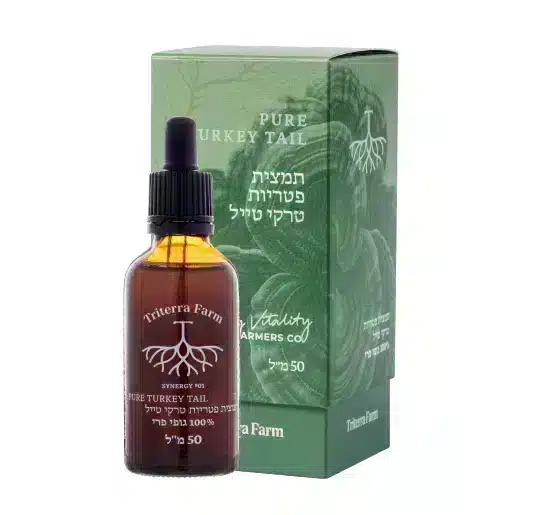
How Turkey Tail Supports Your Microbiome: What Research Explores
Beneath the slightly confusing names of the medicinal-mushroom world hides one of the most researched and long-studied mushrooms in the healing traditions of East Asia: Trametes versicolor (Trametes versicolor), known around the world by the affectionate nickname “Turkey Tail.” It earned that name thanks to the concentric rings of color across its body, reminiscent of a fan of feathers — but that’s where any connection to birds ends. This is a mushroom, and one of the most fascinating of them all.
In recent years, scientific interest has been growing in the connection between medicinal mushrooms and the microbiome — that vast community of trillions of bacteria living in our gut, which influences digestion, the immune system, and the overall sense of wellbeing. Turkey Tail sits right at the heart of this interest, thanks to a unique makeup of complex sugars that are researched as potential prebiotic components.
In this article we’ll dive into what science is beginning to understand about the connection between Turkey Tail and the microbiome, get to know the molecules that make it so interesting, and understand why extraction quality — not just the mushroom’s name on the label — is what counts.
What Is Turkey Tail, and What Makes It Special?
Turkey Tail is a common shelf mushroom that grows on tree trunks around the world. In traditional Chinese medicine it is called “Yun Zhi,” and in Japan “Kawaratake,” and there it has been studied for many decades. What turned it into a subject of modern research is two prominent active components: PSK (Polysaccharide-K, also known as Krestin) and PSP (Polysaccharide-Peptide). Both belong to the “polysaccharopeptide” family — molecules that combine long sugar chains with protein components. It’s important to be clear: PSK (Krestin) and PSP are isolated, standardized compounds used as regulated prescription pharmaceuticals in Japan — and not the mushroom extract sold as a dietary supplement.
Alongside PSK and PSP, Turkey Tail is especially rich in beta-glucans — soluble dietary fibers of a unique kind that the human body cannot break down on its own. And that is exactly the point that makes them interesting when we talk about the gut.
Beta-Glucans: The Fiber the Microbiome Loves
When we eat a dietary fiber that isn’t digested, it continues its journey down to the large intestine — and there the bacteria are waiting for it. Some of the “good” bacteria are able to ferment certain fibers and use them as a source of energy. A process in which a food component nourishes beneficial gut bacteria is called prebiotic activity.
The beta-glucans in Turkey Tail are researched in exactly this context: as a potential substrate that may support beneficial bacteria in the gut. Early studies — some in the lab, some in animals, and a minority in humans — have examined how consuming Turkey Tail extract influences the composition of the bacterial population. Some of the findings point to interesting trends of change in the microbial makeup, but it’s important to remember that the research is still in its early stages, and this is not unequivocal proof.
- A substrate for fermentation: The beta-glucans may serve as food for certain beneficial bacteria in the large intestine.
- Microbial diversity: A rich diversity of bacteria is considered a sign of good gut health, and Turkey Tail is researched in the context of possibly supporting this balance.
- Short-chain fatty acids: Fermenting fibers in the gut produces compounds such as butyrate, which are important to the cells of the gut wall — and this is one of the pathways being researched.
The Connection Between the Gut and the Immune System
A fact many people aren’t aware of: a significant portion of our immune-system activity takes place around the gut. The immune tissue that wraps the digestive system is in constant dialogue with the microbiome’s bacteria, and the makeup of those bacteria influences the way the body regulates its responses.
This is where Turkey Tail’s historical context enters the picture. Its polysaccharopeptides (PSK and PSP) have been widely researched in the context of supporting immune-system activity, and one of the leading hypotheses is that part of their effect is mediated through the gut — through that meeting point between the fibers, the bacteria, and the immune tissue. In other words, it’s possible that the way Turkey Tail “talks” to the body passes first of all through the microbiome.
It’s important to emphasize: these are promising directions of research, not promises. A dietary supplement is not a drug, and is not intended to diagnose, treat, cure, or prevent any disease. The value of Turkey Tail is as a natural nutritional ingredient researched in the context of supporting a healthy balance — not as a substitute for medical care.
Why Does Extraction Quality Matter So Much?
Here lies the point that separates a supplement that’s impressive on paper from a product that truly contains what it promises. Two main factors determine the quality of a Turkey Tail extract:
Fruiting Bodies vs. Mycelium
The beta-glucans and polysaccharopeptides are concentrated mainly in the fruiting body of the mushroom — the visible part, the one with the characteristic rings of color. Some products on the market are based on mycelium (the root network) grown on grain, and they sometimes contain a high percentage of starch from the substrate and fewer active components. An extract based on fruiting bodies only is considered higher quality and more concentrated.
Triple Extraction
Different components in the mushroom require different extraction conditions: the beta-glucans are released well in hot water, while other components require extraction in alcohol. The triple-extraction method (Triple Extraction) aims to draw out the full range of the mushroom’s components, so that the extract faithfully reflects its natural makeup.
Lab Verification and the COA
The word “beta-glucan” on the label isn’t enough — it’s important to know how much of it is actually there. A laboratory test of beta-glucan content, backed by a Certificate of Analysis (COA), distinguishes a product that has actually been tested from a marketing claim. That kind of transparency is the hallmark of a serious producer, and lets the consumer know exactly what they’re getting. You’re welcome to review our lab testing and our full transparency policy.
Frequently Asked Questions
Is Turkey Tail a prebiotic?
Turkey Tail contains beta-glucans — fibers the body does not break down, which reach the large intestine, where they are researched as a potential substrate for beneficial bacteria. In that sense it is studied in a prebiotic context, though the research in this area is still developing.
How long does it take to notice an effect?
Like most natural nutritional ingredients, Turkey Tail works cumulatively rather than as an instant fix. Consistency over time matters more than a single high dose. Listening to your body and staying consistent with use are key.
What is the recommended form to take?
A concentrated extract based on fruiting bodies, which has gone through triple extraction and a lab test for beta-glucan content, gives you the highest confidence about what you are actually taking.
Who should consult before use?
Women who are pregnant or breastfeeding, people taking regular medication, or anyone with a chronic medical condition — it is recommended to consult a medical professional before beginning any dietary supplement, including Turkey Tail.
In Summary
Turkey Tail (Trametes versicolor) is much more than a beautiful mushroom with an amusing name. It is one of the most researched mushrooms in the world, and the researched connection between it and the microbiome — through the prebiotic beta-glucans and the unique polysaccharopeptides — places it at the frontier of scientific interest in gut health. Its effect is researched in the context of possibly supporting the balance of gut bacteria and the delicate link between the gut and the immune system, but as always — this is a supporting ingredient, not a substitute for medical care. To go deeper into the evidence, see the science of Turkey Tail and what Turkey Tail is.
If you’ve decided to add Turkey Tail to your routine, pay attention to the details that count: fruiting bodies, triple extraction, and lab-verified beta-glucan content with a COA. These are the differences between a quality extract and a promise on paper. To learn more, read our complete guide to medicinal mushrooms, browse the glossary of extraction terms, and see our frequently asked questions.
Disclaimer: This content is an educational overview, based on preliminary research and traditional uses, and does not constitute a medical recommendation or a therapeutic indication. Medicinal-mushroom extracts are dietary supplements only — this product is not intended to diagnose, treat, cure, or prevent any disease. Do not begin use — especially while taking medication, or during pregnancy, breastfeeding, or an existing medical condition — without consulting a physician or a qualified practitioner.
*These statements have not been evaluated by the Food and Drug Administration. This product is not intended to diagnose, treat, cure, or prevent any disease.*