
Fruiting Body or Mycelium? How to Read a Mushroom Supplement Label
The number that matters on a mushroom supplement label is the beta-glucan percentage, not “total polysaccharides”. The difference is not semantic: “total polysaccharides” also counts the starch from the grain the mushroom was grown on, so a product that is mostly ground rice can still show an impressive figure. This guide shows exactly what to look for, and what the numbers actually say.
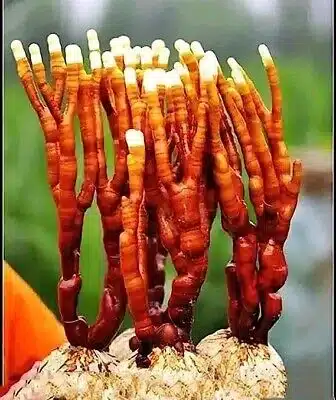
What is the difference between fruiting body and mycelium?
To read the labels you first have to know the organism. Every mushroom has two main parts:
- Fruiting body: the part we recognise as “the mushroom” — the cap and stem that grow above ground or on a log. In nature this is the part responsible for producing spores.
- Mycelium: a fine web of threads growing below the surface. Think of it as the plant’s root system. The mycelium is the main organism, and it can spread across enormous areas.
The distinction is not academic. For centuries traditional Eastern medicine used the fruiting bodies, and most modern scientific research has likewise focused on extracts made from them. You can go deeper in fruiting body mushroom powder and mycelium extract vs. fruiting body, or see the full evidence map in the research hub.
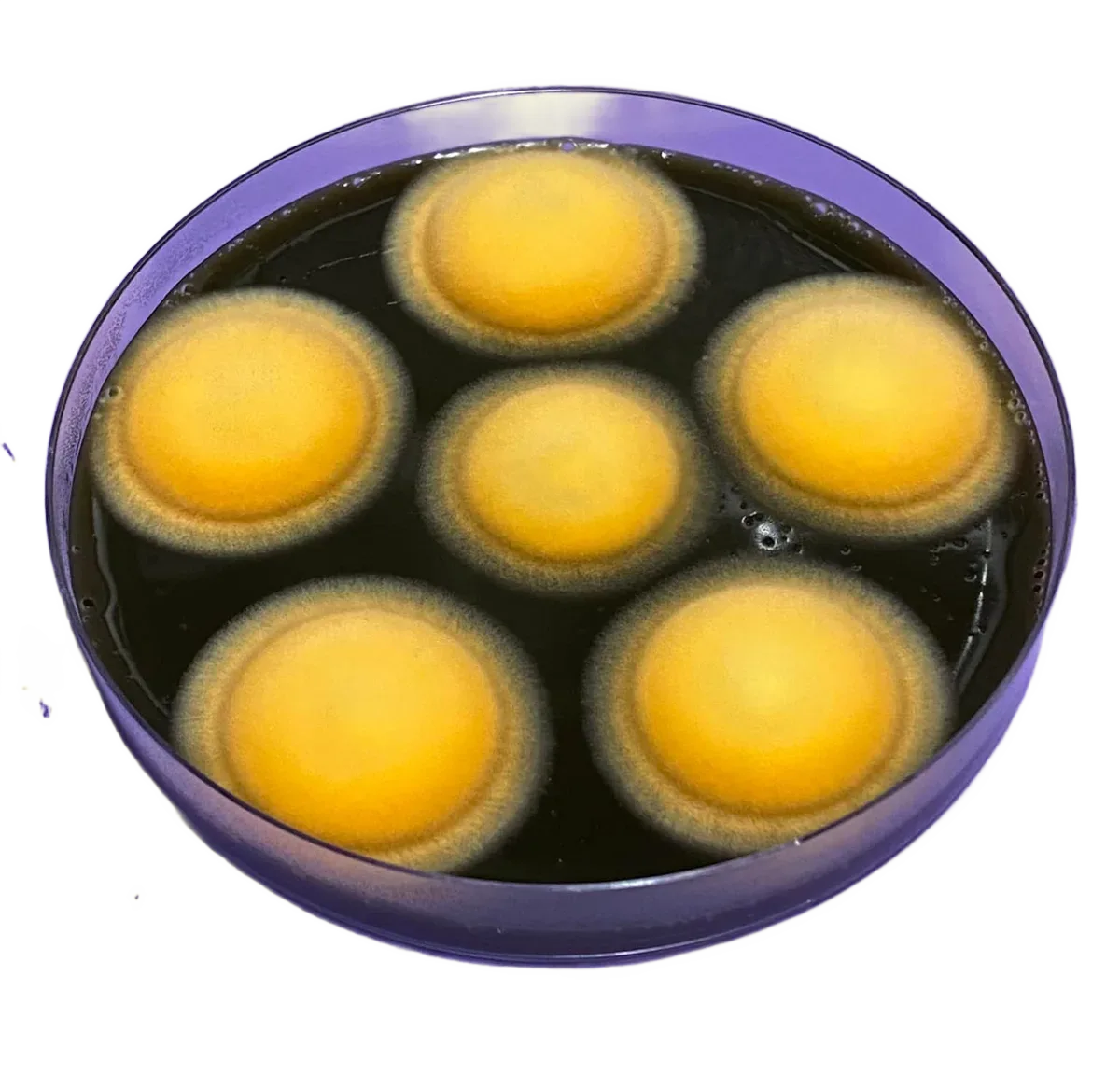
Why does growing on grain change what you are buying?
Growing fruiting bodies takes time and precise conditions. Growing mycelium in a lab is far faster and cheaper. The common industry method is to grow the mycelium on a grain substrate — rice or oats.
This is where the consumer problem begins. The mycelium grows into the grain and becomes inseparable from it. What gets milled into powder and filled into a capsule is a mixture of mycelium and the grain it grew on — a product the industry calls “mycelium on grain”, or MOG.
The result contains a significant amount of grain starch, diluting the concentration of the mushroom’s own compounds. Note the framing: the problem is not that mycelium is “bad”. It is that you pay for mushroom and receive a substantial share of grain — without the label saying so.
| Parameter | Fruiting body | Mycelium on grain (MOG) |
|---|---|---|
| What is actually inside | Mushroom tissue itself | Mycelium + grain substrate, inseparable |
| Typical beta-glucan range | 25%–40% | usually under 7% |
| Starch (alpha-glucan) | negligible | 35%–40% and up |
| How it is reported | a specific beta-glucan % | usually “total polysaccharides” |
| Growing time | weeks to months | a few days |
| Production cost | high | low |
| What appears in the ingredients | the mushroom name only | rice / oats / “biomass” |
Beta-glucan or “total polysaccharides” — which number means anything?
This is the critical point on the label. Beta-glucan and starch are both polysaccharides. The difference is in the chemical bond, and everything follows from it:
- Beta-glucans — polysaccharides with beta (1,3 and 1,6) linkages. These are the compounds that have been studied extensively and are considered the main active constituents in medicinal mushrooms.
- Alpha-glucans — alpha linkages. This is starch. In the context of a mushroom supplement it is an empty carbohydrate: it came from the rice, not from the mushroom.
“Total polysaccharides” adds the two together into a single figure. Which means the number can look most impressive precisely when most of it is starch. We covered the mechanism in beta-glucans in medicinal mushrooms.
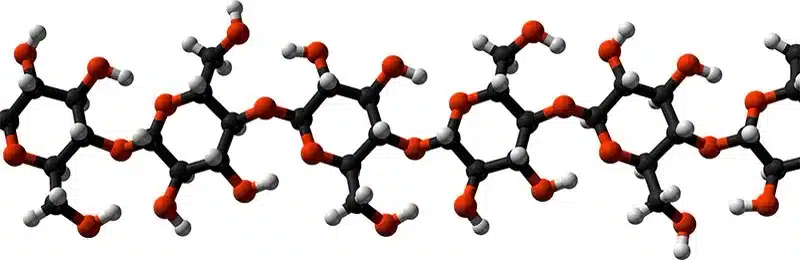
How is beta-glucan measured, and why does the method matter?
How can anyone know with certainty what share is beta-glucan and what share is starch? Fortunately there is a measurable answer.
An accepted enzymatic assay exists (developed by McCleary and Draga, published in J AOAC Int in 2016). It breaks down and quantifies alpha-glucans (starch) and beta-glucans separately.
This distinction is also why we publish a beta-glucan result and not “total polysaccharides”. The full reports are on our lab results page.
What do the numbers actually show?
According to data presented by Nammex at the International Society for Mushroom Science (ISMS) conference in 2016, an analysis of roughly 100 commercial samples showed large gaps:
- In fruiting bodies: beta-glucan ranged from 6.79% to 49.3%, with negligible starch (usually under 1.65%).
- In mycelium on grain: beta-glucan was substantially lower — averaging 1% to 15%. Starch, by contrast, averaged between 35% and 40%, reaching 66.4% in some cases.
These figures come from industry laboratory data rather than peer-reviewed research, and should be read that way. The order of magnitude, however, is consistent: grain makes up a considerable share of the finished product in mycelium supplements, at the expense of beta-glucans.
Our numbers, from the certificate — not from marketing
| Extract | Beta-glucan | Alpha-glucan (starch) |
|---|---|---|
| Cordyceps | 28.16% | not detected |
| Reishi | 25.65% | not detected |
| Lion’s Mane | 23.93% | not detected |
| Turkey Tail & Reishi | 23.21% | not detected |
The “not detected” column is the chemically interesting part: starch is exactly what would appear if a grain substrate were inside the product. Its absence is not a marketing promise but a measurement result. The assay runs on the finished extract, so the figure reflects what is in the bottle. The full certificates are open to inspection.
What does a label that is trying to look good actually look like?
A real-world example illustrates this better than any explanation. A certificate of analysis for another manufacturer’s cordyceps extract came into our hands — a genuine certificate, from a recognised laboratory. Read quickly, it looks excellent. Read carefully, three things emerge:
- Beta-glucan 24.0%. A perfectly reasonable number — and lower than our cordyceps (28.16%). Not a scandal, simply a figure for comparison.
- Fructans (inulin) 14%–17%. This is the interesting addition. Inulin is a prebiotic fibre added as a carrier — and it is counted inside “total polysaccharides”. That is how you arrive at a “total polysaccharides” figure of roughly 38%–44% for a product whose beta-glucan is 24%.
- The beta-glucan line was marked “outside the scope of accreditation”. The test was performed, but not under the laboratory’s formal accreditation for that parameter — a detail that appears on the certificate itself and not in the marketing.
None of the three is a forgery. That is exactly the point: all of the information is on the certificate, and it simply never reaches the label. Someone looking at “total polysaccharides 40%” forms an entirely wrong impression of a product that was measured properly.
We publish the full certificate, for every batch
Beta-glucan, heavy metals, pesticide residues and PAH — the signed report exactly as received, unedited.
See the lab resultsWhere are the active compounds in each mushroom?
The story does not end with beta-glucans. Mushrooms contain a wide range of compounds, and some are concentrated in different parts of the organism. This is also why the answer is not a blanket “fruiting body, always”:
| Mushroom | Main compounds | Where they concentrate |
|---|---|---|
| Reishi | Triterpenes (ganoderic acids), beta-glucans | mainly the fruiting body |
| Lion’s Mane | Hericenones / erinacines | hericenones in the fruiting body · erinacines mainly in mycelium |
| Cordyceps | Cordycepin, nucleosides, beta-glucans | mainly the fruiting body |
| Turkey Tail | PSK and PSP (protein-bound polysaccharides) | mainly the fruiting body |
How much mushroom is in the bottle at all?
The beta-glucan percentage answers “what quality is the material”, but not “how much of it is there”. That is set by the extraction ratio — how many grams of raw material went into each millilitre of extract. Most labels simply do not state it, and without it products cannot be compared.
The ratio is written as two numbers. 1:3 means one gram of fruiting body per 3 ml of extract; 1:2 is more concentrated — a gram per 2 ml. The smaller the second number, the more concentrated the extract. The arithmetic is then simple: divide the bottle volume by the ratio.
| Extract | Ratio | In a 50 ml bottle | In a 100 ml bottle |
|---|---|---|---|
| Cordyceps | 1:2.5 | ~20 g | ~40 g |
| Lion’s Mane | 1:2 | ~25 g | ~50 g |
| Reishi · Turkey Tail · other extracts | 1:3 | ~16–17 g | ~33 g |
The two figures complement each other and are not interchangeable: the extraction ratio says how much raw material went in, the beta-glucan percentage says what came out. A product with an impressive ratio and low beta-glucan is a lot of mediocre material; a product with high beta-glucan and no stated ratio leaves you without half the picture.
What else should appear on the certificate, besides beta-glucan?
Beta-glucan is the quality measure, but a complete certificate also tests purity. Mushrooms are excellent biological sponges — they absorb from the substrate and the environment. A certificate reporting beta-glucan alone tells half the story.
Four sections worth looking for, and how they read on ours:
| Tested | Method | Result in our extracts |
|---|---|---|
| Lead, arsenic, mercury | ICP | not detected in all four extracts |
| Cadmium | ICP | varies by product — the exact value appears on each certificate |
| Pesticide residues | 610-compound screen, EN 15662 | no active ingredient quantified · conforms to EU MRLs |
| PAH (polycyclic aromatic hydrocarbons) | GC-MS/MS, ISO 15753 | below the limit of quantification in all four |
Note the wording in the table. “Not detected” and “below the limit of quantification” are measurement statements, not promises: they say the substance was not found at the method’s sensitivity. That is the difference between a certificate and a slogan — and it is exactly what to look for in a competitor’s paperwork too.
One point of honesty: certificates of analysis do not fill in the “maximum permitted level” column, so they alone cannot support a claim of “below the regulatory limit”. What can be said is what was measured, by which method, and in which batch — and that is precisely what has been published.
When is mycelium actually the right choice?
So are mycelium-on-grain products worthless? Not necessarily, and it is important to be fair.
Mycelium has real advantages. In Lion’s Mane, the erinacines of interest are found mainly in the mycelium, and there is even clinical research on erinacine-A-enriched Lion’s Mane mycelium. Growing mycelium is also faster and cheaper, which allows a more accessible price.
The core criticism is not against mycelium as an organism, but against a lack of transparency: marketing a starch-diluted product as if it were pure mushroom. A mycelium product that declares itself, states a beta-glucan percentage and publishes a test is entirely legitimate. The problem begins when the label does not tell you that you are mostly buying ground rice.
How to read a mushroom supplement label — a checklist
Next time you are standing in front of the shelf, five things to check:
- Look for “fruiting body”. Confirm the product is made from fruiting body extract, not from mycelium or “mushroom biomass” — a phrase that covers MOG.
- Check for a specific beta-glucan percentage. A precise figure, not a vague range. Be wary of “total polysaccharides” — it is not a quality measure.
- Require third-party lab testing, with a certificate and batch number you can verify directly with the laboratory.
- Read the ingredient list. Rice, oats or “substrate” on the list means the growing medium is inside the product.
- Read the fine print on the certificate. Carriers such as inulin or maltodextrin, and notes about scope of accreditation, appear there and not in the marketing.
This knowledge gives you the power to choose well. Instead of relying on marketing, you can look at the numbers and understand what they say. You can go deeper into our method in triple extraction, or start from the complete guide to functional mushrooms. And if you are not sure which mushroom fits you, the matching quiz takes a minute.
Frequently asked questions
What is the difference between fruiting body and mycelium?
The fruiting body is the part we recognise as “the mushroom”, growing above the surface — the cap and stem. The mycelium is the underground thread network, similar to a plant’s root system. Most scientific research and traditional use throughout history focused on fruiting bodies.
Why is mycelium on grain considered problematic?
Because in the common growing method the mycelium grows into a grain substrate (such as rice) and becomes completely mixed with it. They cannot be separated, so the finished product is a mixture of mycelium and ground grain. The result is a significant dilution of the mushroom’s own compounds in a large quantity of starch.
What is beta-glucan and why does it matter?
Beta-glucans are polysaccharides with beta 1,3 and 1,6 linkages, considered the main active constituents in medicinal mushrooms and studied extensively. Starch, by contrast, is an alpha-glucan polysaccharide, which in the context of mushroom supplements is an empty carbohydrate without the properties attributed to beta-glucans.
Why is “total polysaccharides” a misleading figure?
Because that number includes both the desirable beta-glucans and the starch from the grain, and sometimes carriers such as inulin as well. A manufacturer can present a high, impressive polysaccharide figure when in practice most of it did not come from the mushroom. A specific beta-glucan percentage is therefore the only reliable measure.
What is a reasonable beta-glucan range in a fruiting body?
Quality fruiting body extracts commonly fall in the range of roughly 25% to 40%. Mycelium-on-grain products are usually under 7%. For comparison, Triterra’s extracts measured between 23.21% and 28.16% in TÜV Austria testing per batch, with alpha-glucan (starch) not detected in any of them.
What does “alpha-glucan not detected” mean, and why does it matter?
Alpha-glucan is starch. If a grain substrate were present in the product, starch would show up in the assay. A “not detected” result is therefore direct chemical evidence that no grain is in the product — unlike a marketing claim, which cannot be verified.
Does this mean mycelium-on-grain products are worthless?
Not necessarily. It is important to be fair: mycelium contains unique compounds, for example the erinacines found mainly in Lion’s Mane mycelium. The core criticism is not against mycelium itself, but against the lack of transparency and starch dilution in products grown on grain and marketed as pure mushroom.
So how do I know what I am buying?
Look for three things on the label: that the product is made from “fruiting body”, that it states a specific beta-glucan percentage, and that it is backed by third-party lab testing with a certificate number. If the ingredient list includes grains such as rice or oats, you know the product contains the growing substrate.
How is beta-glucan measured in the laboratory?
With an accepted enzymatic method that breaks down and quantifies alpha-glucans (starch) and beta-glucans separately. The common industry kit is the Megazyme Mushroom & Yeast β-Glucan Assay Kit, which includes an alpha-amylase enzyme intended to neutralise starch before the calculation — a detail that shows how far the presence of starch is a built-in assumption in this market.
These statements have not been evaluated by the Food and Drug Administration. This product is not intended to diagnose, treat, cure, or prevent any disease. The information in this article is for informational purposes only and does not constitute medical advice, diagnosis or a substitute for professional care. Medicinal mushroom extracts are dietary supplements, not medicines. Before beginning any supplement — and particularly during pregnancy or breastfeeding, with an existing medical condition, or while taking regular medication — consult a physician or qualified professional.
The research behind Cordyceps — 20 PubMed studies, the good and the bad →
