
Chaga (Inonotus obliquus): Why It Can’t Be Farmed — and What That Means for What’s in the Bottle
Chaga (Inonotus obliquus; “chaga” in Russian, “pakuri” in Finnish, “kabanoanatake” in Japanese) is a parasitic shelf fungus of the family Hymenochaetaceae that grows on birch in the cold north — and what is sold under its name is not a fruiting body but a sclerotium: a black mass of tissue the fungus builds inside a living tree over many years, then harvested from the wild. The short answer: chaga is the exception in the medicinal-mushroom category — it is effectively impossible to farm commercially, most of the research on it is lab and animal work, and it carries a documented oxalate warning. We neither grow nor sell it, which makes this a page with no stake in the answer: what chaga is, the difference between sclerotium and “chaga mycelium”, what to check if you buy it anyway, and who should avoid it.
Key takeaways
- What gets harvested is not a fruiting body but a sclerotium — a hard mass the fungus accumulates inside birch over years. That is why chaga is wild-harvested and does not fit a cultivation cycle the way reishi, lion’s mane and cordyceps do.
- “Chaga” on a label does not tell you what is inside. In a 2026 analytical study of 18 chaga supplements, 44% contained ground mycelium with no detectable triterpenoid markers characteristic of the sclerotium.
- Cultured chaga mycelium is chemically different from the conk — a comparative study found alpha-glucan (starch) in it alongside beta-glucan, the same signature the alpha-glucan test catches in any mushroom supplement.
- Human evidence is thin: a PubMed search for clinical trials or randomized controlled trials with “Inonotus obliquus” in the title or abstract returned zero results (checked 22 Aug 2026). The reviews say so themselves.
- A documented oxalate warning: two published case reports of kidney injury after prolonged use of chaga powder; in one, the powder measured 14.2 g of oxalate per 100 g.
- What chaga proves about us: we only sell what we grow ourselves and test — and chaga cannot meet that condition. So we wrote a page instead of selling a product.
What is chaga, and where does it grow?
Chaga is a parasitic fungus that enters a living birch and develops inside it for years. What you see on the trunk — a black, cracked lump that looks like burnt charcoal — is not the fungus’s fruiting body but a sclerotium (a “sterile conk”): a dense accumulation of mycelium and melanin that builds up for as long as the tree lives. The true fruiting body of Inonotus obliquus is rare, appears only after the host dies, and is almost never sold.
It is found mainly on birch in cold regions — Siberia, Scandinavia, the Baltics, northern Canada and the northern United States. The black colour comes from a very high melanin content, one reason chaga is studied for antioxidant activity. Its chemistry is unlike that of the other mushrooms in this category: alongside beta-glucan it carries phenolic compounds, melanins and lanostane-type triterpenoids, plus betulin derivatives that come from the birch host itself — so part of what is in chaga comes from the tree, not the fungus.
The comprehensive review of sclerotium chemistry (Zheng et al., 2010) maps those three families of compounds and notes that, because of its restricted geography and slow growth, wild chaga is not a reliable source of them — which is exactly why an industry has grown up trying to culture the mycelium instead. The difference between the two is the heart of this page. If the terms are new (sclerotium, fruiting body, mycelium), our functional-mushroom glossary has them.
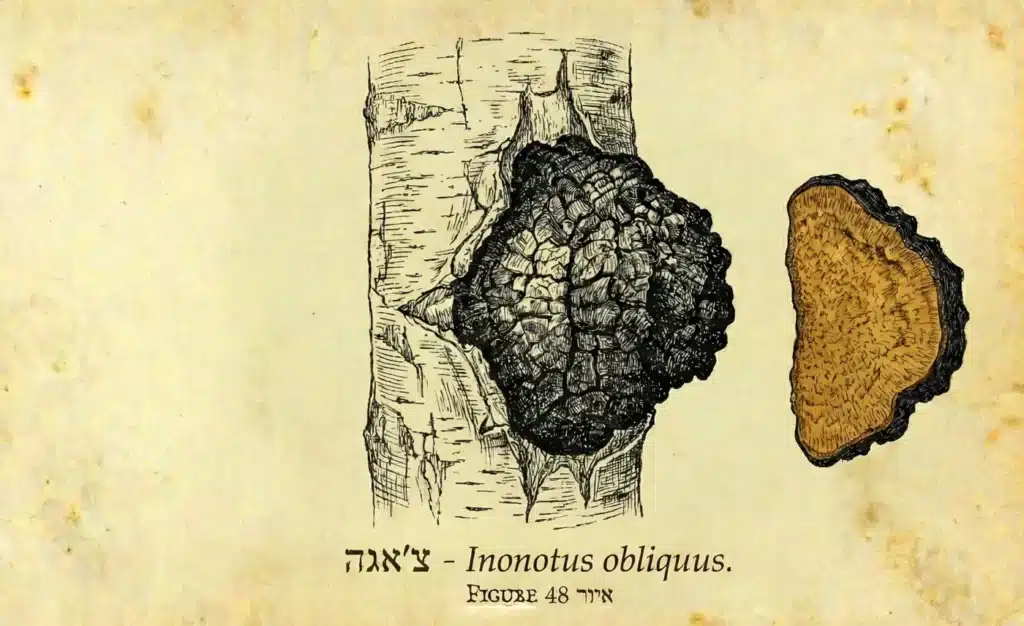
Why can’t chaga be farmed — and why doesn’t it fit on our farm?
Because the sclerotium needs a living birch and years of development — not a substrate, not a grow room, not a cycle measured in weeks. Cultivation trials in Finland (Natural Resources Institute Finland, Luke) succeeded in inoculating living birch with mycelium-bearing wooden dowels, but the researchers themselves describe conk formation as a slow process. That is forestry, not farming.
We grow our mushrooms in clean, controlled grow rooms, harvest them as fruiting bodies, and send every finished extract to an external laboratory. Chaga does not behave like that. A mature sclerotium requires a living tree and years; what can be grown in culture is mycelium, which is not the same material.
| Reishi · Lion’s Mane · Cordyceps | Chaga | |
|---|---|---|
| What is harvested | Fruiting body | Sclerotium cut from the tree |
| Time to form | Weeks to months | Many years |
| Substrate | Controlled substrate | A living tree, usually birch |
| Commercial cultivation | Yes | Not in practice |
| Market source | Cultivation | Wild harvest |
Chaga mycelium can be grown in a lab, and many companies do — but mycelium grown on grain is not the sclerotium and does not carry the same composition. This is precisely the point at which a label can say “chaga” and describe something else entirely.
It also helps to understand why “inoculate the forest” is not a market solution. In the Finnish trial (Miina, Vanhanen et al., Forest Ecology and Management, 2021) inoculation itself worked, but the saleable conk forms at the tree’s pace, not the market’s — and every such cycle means the decline of the host birch, since the fungus is its pathogen. On our farm a reishi cycle from harvest to harvest is measured in weeks, and every batch starts from the same substrate and the same strain. You cannot say that about a forest. This is not a criticism of chaga — it is its definition.
Sclerotium vs. “chaga mycelium” — what is really in the capsule?
A chemical difference, not a semantic one. In an analytical study published in 2026 on 18 commercial chaga supplements, 8 of them (44%) contained ground mycelium that showed mainly fatty acids — with no detectable level of the triterpenoid and phenolic markers characteristic of chaga; only 8 (44%) contained the triterpenoids and hispidin identified as the key bioactives; 2 (11%) contained phenolics only. In other words: nearly half of what is sold as “chaga” is a different material.
That study (Avula et al., Planta Medica) matters less for its headline than for its method: the authors first built a chemical profile of genuine sclerotium (11 samples), of cultured mycelium and of grain-based samples — and only then looked at what was in the capsules. The picture is identical to the one we know from the fruiting-body-versus-mycelium debate in every other mushroom: when a label says “chaga” without saying “sclerotium”, assume you may be buying mycelium grown on grain.
A second comparative study (Beltrame et al., Journal of Fungi, 2021) explains why it is not the same material: polysaccharides from cultured chaga mycelium were rich in both alpha-glucan and beta-glucan at high molecular weights — whereas the polysaccharides of genuine sclerotium were mainly low-molecular-weight, monodisperse beta-glucan bound to phenolic compounds. Alpha-glucan is starch, and it is precisely the marker the alpha-glucan test catches in any mushroom supplement: “not detected” means no grain; a percentage means grain.
| What is measured | Wild chaga sclerotium | “Chaga mycelium” in culture / on grain |
|---|---|---|
| Triterpenoids and hispidin (the characteristic markers) | Present in sclerotium samples | Not detected in the 44% of supplements that contained ground mycelium (Avula 2026) |
| Melanin (the black colour) | Very high | Low — mycelium in culture does not accumulate it as it does in the tree |
| Alpha-glucan (starch) | Polysaccharides mainly beta-glucan | Found alongside beta-glucan (Beltrame 2021) — the grain signature |
| Birch-derived compounds (betulin derivatives) | Present — a product of the relationship with the tree | No tree, no source |
| What the label should say | “Sclerotium / sterile conk” + harvest origin | “Mycelium”, “myceliated grain”, or silence |
The practical conclusion is the one we give for every mushroom: the word on the label is not evidence. The number on the test report is. How to read one, line by line, is in our COA guide.
What should you check if you buy chaga anyway?
Five things, in this order: sclerotium or mycelium; where and when it was harvested; whether there is a heavy-metal test; whether there is a measured number (beta-glucan, not “rich in”); and how the promises are worded. A seller who answers all five without flinching is selling you something they understand.
We do not sell chaga, so we have no stake in the answer. This is what we would check:
What to ask before buying chaga
- Sclerotium or mycelium? “Chaga” on the label does not say what is inside.
- Where was it harvested, and when? Wild harvest varies from site to site and season to season.
- Is there a heavy-metal test? Something that grows for years on a tree absorbs from its surroundings.
- Is there a measured beta-glucan percentage? The same question that applies to every extract.
| Check | Why it matters |
|---|---|
| Sclerotium or mycelium? | “Chaga mycelium” is grown on grain and is not the material that was studied |
| Harvest origin | Unmanaged wild harvest damages the population; regulated harvest and free-for-all collection are not the same thing |
| A measured number | Beta-glucan or polysaccharides — but measured, not “rich in” |
| Heavy metals | The fungus absorbs from the tree and the environment over years — a test matters especially here |
| How the promises are worded | Human research on chaga is limited; whoever promises more than exists should be asked to show it |
This is not a claim that chaga is inferior. It is a claim that it is far harder to know what you got — and in a category whose entire value is what can be verified, that is a material difference.
The last row is not a jab. The scientific reviews of chaga keep repeating the same note: most of the work is in vitro and in animals, and controlled human research is still scarce. That does not mean there is nothing there — it means the gap between what is sold and what has been tested is wider than usual.
And one question that did not make the table but is worth asking: what solvent was used? Chaga’s triterpenoids are not water-soluble; chaga tea extracts mainly polysaccharides and melanin. Anyone selling an “extract” should say whether it also went through an alcohol stage. It is the same logic behind our dual extraction, and it applies to any mushroom whose value sits in two families of compounds.
What does the research show about chaga — and what doesn’t it show yet?
It shows antioxidant, anti-inflammatory and immune-modulating activity in the lab and in animals — four reviews from 2021–2024 summarise this. What it does not yet show: a clinical trial. We searched PubMed (22 Aug 2026) for papers with “Inonotus obliquus” in the title or abstract classified as a clinical trial or randomized controlled trial — zero results. The reviews say the same thing in different words.
It is worth reading the reviews rather than the marketing summaries of them. Szychowski et al. (2021), in a review whose title promises “from folk medicine to clinical use”, conclude that chaga “fits the definition of functional food” — but that “studies that meet the evidence-based medicine (EBM) criteria are needed”. Fordjour et al. (2023) write that its benefits are “virtually untapped due to a limited understanding of its mycochemical composition and bioactivities”. The reviews by Ern (2024) and Camilleri (2024) catalogue mechanisms — in cells, in animals — without pointing to a human efficacy trial. And Memorial Sloan Kettering’s herb monograph, the most-cited source in this niche, puts it in one line: the safety and efficacy of chaga “have yet to be evaluated in clinical studies”.
None of this means chaga does nothing. It means that anyone writing “clinically proven” next to chaga is several years ahead of the literature — and that honesty here is to say: promising in the lab, open in humans. We have collected all of it, including the case reports in the next section, in our research hub’s chaga filter — for better and for worse.
One caution you must know: oxalates — who should not take chaga?
Chaga is among the richest oxalate sources you will find in a dietary supplement, and there are two well-known published case reports of kidney injury after prolonged use of the powder. Anyone with a kidney history, a tendency to kidney stones, or on blood thinners or blood-sugar-lowering drugs should talk to a doctor before regular use. This is not a theoretical warning.
| Case report | What was taken | What happened |
|---|---|---|
| Man, 49, Korea (Lee et al., J Korean Med Sci, 2020) | Chaga powder over years (about 4 years) for a skin complaint | End-stage renal disease; biopsy showed oxalate crystal deposits. The remaining powder was analysed: 14.2 g oxalate per 100 g; the authors estimated his daily oxalate intake at 2× a usual diet for four years and 5× for one year |
| Man, 69, Korea (Kwon et al., Medicine, 2022) | 10–15 g chaga powder daily + 500 mg vitamin C, for 3 months | Acute kidney injury with calcium-oxalate crystals in the tubules; needed dialysis and steroids; kidney function recovered within a month |
Notice two details in the table, because they make this practical rather than frightening: both cases involved powder (the whole sclerotium swallowed, oxalate and all) in large daily amounts over time — not an occasional cup of tea. And in the second case vitamin C was added, which the body partly metabolises to oxalate. The classic chemical characterisation of chaga from Finland, Russia and Thailand (Glamočlija et al., J Ethnopharmacol, 2015) found oxalic acid to be the main organic acid of the sclerotium — so this is a property of the material, not one manufacturer’s defect.
Two further cautions from the MSKCC monograph: care with blood thinners (warfarin) and with blood-sugar-lowering drugs, because of possible additive effects. The broader rules — who should consult before any mushroom supplement — are in our side-effects guide, our drug-interactions guide and our note on mushrooms and kidney health, and they apply to chaga exactly as to everything else.
Is chaga sustainable — and what happens to the forest?
An open question the industry itself acknowledges. The sclerotium grows over years, it is the pathogen of the tree that hosts it, and global demand grows on a consumer-product timeline while supply regenerates on a forest timeline. So “regulated harvest” versus “free collection” is a real question for anyone buying — and one we have no need to answer, because we do not harvest.
The way Finnish foresters are trying to solve it is interesting: inoculate low-value birch already slated for thinning, and turn the “blemish” into a forest product. The trial mentioned above is part of that. It is a solution for forests, not for farms — and for us it illuminates the difference: a mushroom that can be grown on a short cycle, on a substrate you can audit, and harvested as a fruiting body is a mushroom you can measure and measure again. A mushroom that depends on a forest, a season and a picker’s luck — less so. That is the whole difference between what we sell and what we don’t.
What do we grow instead — and why is that relevant to chaga?
Reishi, cordyceps, lion’s mane and turkey tail — four species that can be grown under controlled conditions, harvested as fresh fruiting bodies, and whose finished extracts can be sent for testing. Chaga is relevant here as proof by negation: the fact that we do not sell it is the evidence that “only what we grow and test” is a rule, not a slogan.
Our measured beta-glucan ranges from 23.21% to 28.16%, and every certificate is public. The full lab results · choose by goal
It is worth being precise about what those numbers mean: they were measured at TÜV Austria on the finished extract — not the raw material — on the dry-matter basis of the extract, and alpha-glucan (starch) was not detected in any of them. That is exactly the test we would want to see on every chaga sold, and almost nobody shows it. And there is one more difference chaga helps explain: our mushrooms go from harvest to extraction without a drying step — as far as we know, among the very few in the world — followed by a seven-week alcohol extraction. We wrote about it in “Fresh vs. Dried Mushroom Extract”. A sclerotium cut in a distant forest and shipped dried cannot start that way — no fault in that, just a difference.
And if you were looking for chaga — what instead?
Most people searching for chaga want immune support or antioxidants. In both directions there are mushrooms that can be grown, tested and shown with a number — and that is the only difference we claim: not “better”, but “verifiable”.
| If you were looking for | The direction | Our number |
|---|---|---|
| Immune support | Turkey tail & reishi | 23.21% beta-glucan |
| Balance and calm | Reishi | 25.65% beta-glucan |
The difference is not that they are “better than chaga”. The difference is that for them we can show a certificate per extract, and for chaga — no. The certificates are here.
And for anyone unsure what they were really looking for when they searched “chaga” — the right question is not “which mushroom” but “what is bothering me”. That is what our goal hub and the “which mushroom is right for me” guide are for.
What chaga doesn’t prove — and what we don’t claim
We do not claim chaga is bad, we have not tested chaga in a lab, and we have no number for it. The numbers on this page are ours, on our extracts — and the fact that we do not sell chaga is a choice of method, not a verdict on the mushroom.
In the same spirit, four boundaries we keep: (a) “cannot be farmed” means “a sclerotium cannot be commercially farmed” — cultured mycelium exists, and forest inoculation exists; (b) oxalate is a dose- and form-dependent risk (powder, over time) — not a reason to panic over a cup of tea; (c) “human research is limited” is not “no effect” — it is a fact about the literature, not about the mushroom; (d) our beta-glucan percentage is a number on a finished extract, and we do not convert it into “milligrams per millilitre”, because we have no measurement for that calculation. If someone offers you more precise numbers than these — ask to see the report.
Came for chaga and found an explanation? That’s fine — it’s exactly what we intended. If what you were really after is immune support, calm or focus, our extracts — fresh fruiting bodies grown in Israel, with an open test report — ship with a 100-day trial and free shipping over ₪285. All extracts Take the 2-minute quiz
The bottom line
Chaga is a fascinating fungus that does not fit our rules — which is why it is the best example of why the rules exist. It is harvested rather than grown, often sold as mycelium rather than sclerotium, studied mostly in the lab, and carries an oxalate warning worth knowing. Anyone who wants it anyway should buy it the way you buy any mushroom supplement: identified sclerotium, known origin, heavy-metal test, measured number. And anyone who came to it looking for immune support or calm — there are mushrooms that can be grown, tested and shown with a certificate. We sell only those.
Frequently asked questions
Can chaga be grown on a farm?
Chaga mycelium can be grown in culture, but that is not the sclerotium collected from the wild — the composition differs. The black conk people mean by “chaga” needs a living tree and years of development.
Is there human research on chaga?
Very little. Most of the research is in vitro and in animals, mainly around antioxidant activity and immune modulation. Our PubMed search for clinical trials with Inonotus obliquus in the title or abstract returned zero. If someone shows you clinical promises about chaga, ask to see the study.
Do you sell chaga?
No. We sell only what we grow ourselves and test per extract, and chaga cannot meet that condition. We preferred to write this page rather than sell something we could not stand behind at the same standard.
What is the difference between chaga sclerotium and chaga mycelium?
The sclerotium is the black conk cut from birch, containing melanin, triterpenoids and birch-derived betulin compounds. Mycelium in culture or on grain does not accumulate the same way: in a study of 18 supplements, those containing ground mycelium had no detectable triterpenoid markers, and a comparative study found alpha-glucan (starch) in cultured mycelium.
Is chaga dangerous for the kidneys?
In large amounts over time it can be: chaga is very rich in oxalate, and two case reports documented kidney injury after daily powder use for months to years. Anyone with a kidney history or a tendency to stones should consult a doctor before regular use.
How can I tell whether a chaga supplement is real sclerotium?
From the label and the documents: the words “sclerotium” or “sterile conk” plus an identified harvest origin are a good sign; “mycelium” or “myceliated grain” means mycelium. A test report with measured beta-glucan and alpha-glucan is decisive — alpha-glucan showing up as a percentage is the grain signature.
Why is chaga sold mostly as tea or powder rather than as a fruiting body?
Because it has no fruiting body in the commercial sense. What is harvested is a hard sclerotium, which is ground or chunked for tea. Note that water extraction pulls mainly polysaccharides and melanin; the triterpenoids also need an alcohol stage.
I was looking for chaga for immune support — what instead?
Turkey tail and reishi (23.21% beta-glucan measured on the combined extract) or reishi alone (25.65%) — both mushrooms that can be grown as fruiting bodies and tested in a lab. The difference we claim is not “better”, but “verifiable”.
Scientific sources (peer-reviewed articles and institutional sources)
- Avula B, Katragunta K, Tatapudi KK, et al. Quantitative Analysis and Simultaneous Characterization of Triterpenoids and Phenolics in Inonotus obliquus (Chaga) Using LC-PDA-ELSD and LC-DAD-QToF. Planta Medica, 2026;92(4):494-516. PubMed
- Beltrame G, Trygg J, Hemming J, et al. Comparison of Polysaccharides Extracted from Cultivated Mycelium of Inonotus obliquus with Polysaccharide Fractions Obtained from Sterile Conk (Chaga) and Birch Heart Rot. Journal of Fungi, 2021;7(3):189. PubMed
- Zheng W, Miao K, Liu Y, et al. Chemical diversity of biologically active metabolites in the sclerotia of Inonotus obliquus and submerged culture strategies for up-regulating their production. Applied Microbiology and Biotechnology, 2010;87(4):1237-1254. PubMed
- Glamočlija J, Ćirić A, Nikolić M, et al. Chemical characterization and biological activity of Chaga (Inonotus obliquus), a medicinal “mushroom”. Journal of Ethnopharmacology, 2015;162:323-332. PubMed
- Lee S, Lee HY, Park Y, et al. Development of End Stage Renal Disease after Long-Term Ingestion of Chaga Mushroom: Case Report and Review of Literature. Journal of Korean Medical Science, 2020;35(19):e122. PubMed
- Kwon O, Kim Y, Paek JH. Chaga mushroom-induced oxalate nephropathy that clinically manifested as nephrotic syndrome: A case report. Medicine (Baltimore), 2022;101(10):e28997. PubMed
- Szychowski KA, Skóra B, Pomianek T. Inonotus obliquus — from folk medicine to clinical use. Journal of Traditional and Complementary Medicine, 2021;11(4):293-302. PubMed
- Fordjour E, Manful CF, Javed R, et al. Chaga mushroom: a super-fungus with countless facets and untapped potential. Frontiers in Pharmacology, 2023;14:1273786. PubMed
- Ern PTY, et al. Therapeutic properties of Inonotus obliquus (Chaga mushroom): A review. Mycology, 2024. PubMed
- Camilleri E, et al. A brief overview of the medicinal and nutraceutical importance of Inonotus obliquus (chaga) mushrooms. Heliyon, 2024. PubMed
- Miina J, Peltola R, Veteli P, … Vanhanen H. Inoculation success of Inonotus obliquus in living birch (Betula spp.). Forest Ecology and Management, 2021;492:119244. DOI
- Memorial Sloan Kettering Cancer Center, About Herbs: Chaga Mushroom — “the safety and efficacy of chaga have yet to be evaluated in clinical studies”; caution with warfarin and hypoglycemic agents. Monograph
Read next
- Fruiting Body or Mycelium? How to Read a Mushroom Supplement Label
- Beta-Glucan vs. Polysaccharides: The Number That Actually Matters
- How to Read a Mushroom Supplement COA
- Fresh vs. Dried Mushroom Extract
- Side Effects of Medicinal Mushrooms
- Medicinal Mushrooms and Drug Interactions
- Medicinal Mushrooms and Kidney Health
- Medicinal Mushrooms — The Complete Guide
- Full lab results
These statements have not been evaluated by the Food and Drug Administration. This product is not intended to diagnose, treat, cure, or prevent any disease. This page is educational; it is not medical advice. If you take prescription medication, have a kidney condition, are pregnant or breastfeeding, consult your physician before using any dietary supplement.
