
How Much Does Mushroom Extract Cost — and What Actually Determines the Price?
A Triterra medicinal-mushroom extract costs ₪250 for a 50 ml bottle and ₪500 for 100 ml (Israeli shekels) — the same price for every species. You can find cheaper mushroom tinctures, and more expensive ones. The right question is not who charges less per bottle, but how much beta-glucan — the active compound — is actually in it, and who is willing to show you the signed document that proves it. This page explains how to check, including how to spot a number that looks like a lab result and isn’t one.
How Much Does a Triterra Mushroom Extract Cost?
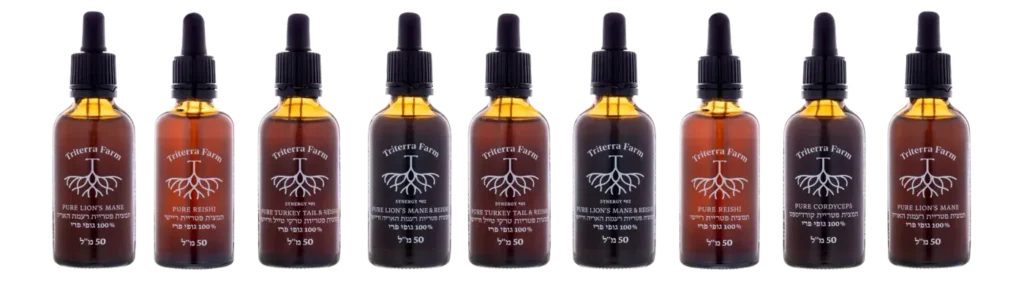
Every extract is the same price — reishi (Ganoderma lucidum), lion’s mane (Hericium erinaceus), cordyceps and turkey tail, with no premium for any species. Choosing between 50 and 100 ml is a choice about length of use; the extract inside is identical.
| What | 50 ml | 100 ml |
|---|---|---|
| One extract | ₪250 | ₪500 |
| Two extracts | ₪500 | ₪960 |
| Three extracts | ₪720 | ₪1,380 |
| Five extracts | ₪1,200 | ₪2,300 |
Free shipping on orders over ₪285. Club members get a permanent 10% discount, and a quantity discount stacks on top — 4% from three units, 8% from six.
Why Is Price per Bottle the Wrong Measure?
Because a bottle is not a unit of active compound. Beta-glucan is the component that research on functional mushrooms centres on, and its concentration ranges from under 7% to over 28% — depending on what was grown and how it was extracted. You can pay less per bottle and end up paying more for every gram of the thing you actually bought it for.
So compare in three steps: price per volume (divide the price by the millilitres), beta-glucan percentage, and finally — whether that percentage comes from a document you can verify. The third step is the one that eliminates most of the field.
What We Measured, and What It Says About the Price
| Extract | Measured beta-glucan | “Total polysaccharides” | Of which — active compound |
|---|---|---|---|
| Cordyceps | 28.16% | 28.16% | 100% |
| Reishi | 25.65% | 25.65% | 100% |
| Lion’s Mane | 23.93% | 23.93% | 100% |
| Turkey Tail & Reishi | 23.21% | 23.21% | 100% |
The measured column is the one that matters. “Total polysaccharides” is a number that can be inflated — it also sums components that are not beta-glucan, such as inulin and starch. In our certificates the two numbers come out identical, because everything else was below the detection limit. There is nothing there to inflate. The full story of that difference is in our guide to beta-glucan vs. “total polysaccharides”.
The test is run enzymatically at the TÜV Austria lab, on the finished extract of each extract — not on the raw mushroom before extraction. The percentage refers to the dry matter of the extract, which is the accepted basis for reporting beta-glucan, and that is what makes comparison possible. The certificates are open in full — the signed report, with a report number and a sample number, not our summary of it. If you want to know what to look for in such a document, our guide to reading a mushroom supplement COA walks through a real one line by line.
Saw a Higher Percentage Somewhere Else? Here’s How to Tell If It Was Measured
You will find higher numbers than ours on the market. Some are entirely real — and some are a marketing specification dressed up as a test result. The difference is not a matter of trust; it comes down to four simple questions.
| What to ask | Why it separates a measurement from a spec |
|---|---|
| Which lab? | A measurement always comes with a lab’s name. A spec doesn’t need one. |
| Report number and batch number? | Without them there is nothing to verify. With them — you can contact the lab and check. |
| Can I see the document? | “Lab tested” is a sentence. A signed certificate is a document. |
| Is the number identical across species? | This is the sharpest test. Reishi, cordyceps and lion’s mane are completely different mushrooms. Real measurements come out different — and almost never round. A round, identical percentage across several species is a target declaration, not a finding. |
That is also why our numbers look the way they do: 28.16, 25.65, 23.93, 23.21. Not round, not identical, and not particularly impressive at first glance. They are simply what came out of the test — and that is the only thing we can stand behind.
One more thing worth knowing: a percentage means little without knowing what it is a percentage of. A concentrated extract powder and a liquid tincture are not the same basis, and even 40% on one basis can be less active compound per serving than 25% on another. When comparing — make sure you are comparing on the same unit, or ask for the amount per serving.
How Do You Compare the Price of Two Extracts?
Divide the price by the amount of active compound, not by the volume. The table shows how much more you would need to buy of a beta-glucan-poor supplement to reach the same amount of active compound.
| Supplement type | Typical beta-glucan | How much you need for the same amount |
|---|---|---|
| Mycelium grown on grain (“biomass”) | Under 7% | 4× or more |
| Mid-grade fruiting body | 7%–20% | 1.3× to 4× |
| Quality fruiting body | 25%–40% | The baseline |
| Triterra — measured per extract | 23.21%–28.16% | The baseline |
The gap between grain-grown mycelium and fruiting body is not a marketing gap. Mycelium is harvested together with the substrate it grew on, so a large share of the powder’s weight is the grain — starch, not beta-glucan. We grow and harvest fruiting bodies only, and in our certificates the starch (alpha-glucan) came out below the detection limit. The enzymatic method measures starch separately and subtracts it — meaning that is not our claim, it is a result.
The Number We Won’t Publish
You might expect this page to end with a tidy “cost per gram of beta-glucan” table. We don’t publish one — deliberately. Our lab percentage is measured on the dry matter of the finished extract; turning it into absolute grams per bottle would require assumptions about extraction yield that we have not measured, and a number built on an assumption is exactly the kind of number this page warns against. What we publish is what we can prove: the price, the measured percentage, the amount of fresh mushroom that went into the bottle, and the signed report. When you see a brand advertising a single confident “grams of actives” figure, ask which two numbers were multiplied to get it — and whether they even share a basis.
Where the Money Goes — a Cost Breakdown
The price of an extract is not one number but a sum of stages, and most of them happen long before the bottle exists. In chronological order:
| Stage | What happens in it | Why it costs |
|---|---|---|
| Growing | A full fruiting-body growth cycle | Weeks to months per extract, under controlled conditions. Grain-grown mycelium is ready in days — and that is the whole difference |
| Deep-freezing and sorting | Preserving the harvest fresh until extraction | We don’t dry: the mushroom goes from harvest to extraction without a drying stage — deep-freezing is preservation only, and cold storage is a real, ongoing cost |
| Three-stage extraction | Water, alcohol, and unification | Every stage is time and equipment — the alcohol stage alone runs seven weeks. One stage is cheaper than three |
| Lab testing | TÜV Austria, per extract | A fixed cost that repeats for every extract, not a one-time expense |
| Bottle and packaging | Dark glass, pipette, label | Identical for 50 and 100 ml — which is why the bigger bottle is better value per millilitre |
Note that the first four stages happen before a product exists, and three of them repeat with every extract. That is why a two-fold price difference between two extracts is not necessarily “double the profit” — very often it is simply a different process.
What It Costs per Day, Not per Bottle
Price per bottle is a number that is easy to compare and impossible to conclude anything from. What decides is the cost per day of use — and that depends on the extraction ratio and the dose, not on the price sticker:
| Bottle | Extraction ratio | Grams of fresh fruiting body | Lasts roughly |
|---|---|---|---|
| Cordyceps 50 ml | 1:2.5 | ~20 g | 25–50 days |
| Lion’s Mane 50 ml | 1:2 | ~25 g | 25–50 days |
| Reishi 50 ml | 1:3 | ~16–17 g | 25–50 days |
| Any 100 ml | Same | Double | Double |
Two honest notes on this table. First, the wide range is not an evasion: the dose varies with the goal and with body weight, so the same bottle can last a month or two. Second, our ratios are stated in fresh mushroom — a 1:2 ratio on a fresh basis is not the same as 1:2 on a dried basis, which is one more reason ratios alone can’t be compared across brands.
What Makes an Extract Cheaper — and What It Leaves on the Label
When a product costs half, something in the process was different. These are the accepted ways to lower the cost, and the trace each one leaves:
| What was cheapened | The saving | How to spot it |
|---|---|---|
| Grain-grown mycelium instead of fruiting body | Very large | “Biomass” · rice or oats in the ingredients list |
| One extraction stage instead of three | Medium | No “dual/triple extraction” stated |
| A diluted extraction ratio | Large | The ratio is simply not stated |
| A carrier such as inulin or maltodextrin | Medium | High “total polysaccharides” next to low beta-glucan |
| No per-extract testing | Small but cumulative | No certificate number, or one old test |
None of these is fraud. All of them are legitimate — the problem only starts when they don’t appear on the label, and two products look identical on the shelf while containing completely different things.
What Lowers the Price at Triterra
| Mechanism | The discount | Note |
|---|---|---|
| Customer club | Permanent 10% | Stacks with the quantity discount |
| Three units or more | 4% | Automatic in the cart |
| Six units or more | 8% | Automatic in the cart |
| Over ₪285 | Free shipping | Two units already cross the bar |
What we will not do: lower the price by thinning the extraction ratio or skipping the test. The discount comes from quantity, not from the contents — which is what lets us publish the same certificate for every extract, sale or no sale.
The Bottom Line
₪250 buys a 50 ml bottle of extract made from fresh fruiting bodies, extracted in three stages over weeks, with a measured beta-glucan percentage and a signed external certificate you can verify. Cheaper exists; so does more expensive. Before comparing prices, compare the only number that matters — and insist on seeing the document behind it.
The Extracts Behind the Numbers
Fresh fruiting bodies from our Galilee farm · measured beta-glucan of 23.21%–28.16% (TÜV Austria) · alpha-glucan: not detected · every report open to all
100-day trial · free shipping over ₪285 · permanent club discount
Frequently Asked Questions About Price
Not sure which extract fits you?
A short quiz translates your goal into a recommendation, including dosing and the reasoning behind it.
Commercial numbers on this page come solely from our open lab reports and our live store prices. This content is educational and does not constitute medical or nutritional advice.
These statements have not been evaluated by the Food and Drug Administration. This product is not intended to diagnose, treat, cure, or prevent any disease.
