
Who Shouldn’t Take Lion’s Mane? Side Effects, Interactions & Safety
Key Takeaways
- Lion’s mane (Hericium erinaceus) was well tolerated in controlled clinical trials; reported side effects are rare and mild — mostly digestive discomfort in the first days.
- Groups that need special caution: anyone allergic to mushrooms (avoid), people on blood thinners or antiplatelet drugs, people on blood-sugar-lowering medication, pregnant or nursing women (no safety data), and anyone before planned surgery.
- A handful of case reports of allergic reactions exist in the medical literature — including one severe respiratory case from 2003. Very rare, and we’re not hiding it.
- The caution around medications is theoretical — based on lab and animal findings, with no documented human interaction case — yet combining lion’s mane with any regular medication belongs in a conversation with your doctor.
Lion’s mane (Hericium erinaceus, known in Japan as Yamabushitake) is a culinary and functional mushroom studied mainly around cognition, nerve health and mood. Most pages about it tell you why yes; on this page we do what one does with a serious medicine — review honestly who it is not for: the reported side effects, the real case reports from the literature, the possible interactions with medication, and when to stop and talk to a doctor. No scare tactics, no minimizing, and an open source behind every claim. For the other side of the story — what the mushroom does and what research explores — see our complete scientific guide to lion’s mane.
Is Lion’s Mane Safe? What Clinical Trials Show
In placebo-controlled clinical trials — four weeks in menopausal women, 28 days in young adults, and a single 3-gram dose of standardised extract — lion’s mane was well tolerated with no significant adverse effects reported. That’s reassuring, but it needs precision: the trials are short, small, and not designed to map rare risks.
Here is what was actually measured: a 2010 Japanese study followed menopausal women through four weeks of fruiting-body intake; a 2019 randomised placebo-controlled trial tested oral intake over time; a 2023 double-blind pilot gave extract to 41 young adults for 28 days and recorded 96% adherence with no significant side effects; and a 2025 study tested a single 3-gram dose of standardised extract. Good tolerability across all of them. What these trials do not examine: multi-year use, populations with underlying conditions, and combinations with medication. Those gaps are exactly why this page exists.
What Side Effects Does Lion’s Mane Have?
Reported side effects are rare and mild: stomach discomfort, gas or loose stools in the first days — much like any new fiber-rich food. In most cases this passes within days, and a gradual dose makes it less likely. An allergic reaction is the important exception: rare, but potentially serious.
Two honest notes. First: some people online also report mild skin tingling — this has never been measured in controlled trials, and the explanations circulating around it have no research backing; if it bothers you or comes with a rash, stop. Second: “rare” is not “zero” — further down you’ll find the full case reports from the literature, because we believe anyone considering a daily supplement deserves to see them too. For side effects across all functional mushrooms, see our general overview.
Who Should Avoid Lion’s Mane — or Ask a Doctor First?
Five main groups: anyone allergic to mushrooms — avoid; anyone on blood thinners or antiplatelet drugs — ask your doctor; anyone on blood-sugar-lowering medication — ask and monitor; pregnant and nursing women — avoid in the absence of data; and before planned surgery — tell your medical team. The table also summarizes the evidence behind each caution.
| Who | The concern | Evidence basis | Our recommendation |
|---|---|---|---|
| Mushroom allergy | Allergic reaction — from skin to respiratory | Documented case reports (1999, 2003, 2022) | Avoid |
| Blood thinners & antiplatelet drugs | Theoretical amplification of the drug’s effect | In-vitro (lab) finding only; no documented human case | Consult your doctor first |
| Blood-sugar-lowering medication | Theoretical additive glucose-lowering | Animal studies only | Consult and monitor your readings |
| Pregnancy, nursing & children | No safety studies | Absence of data — evidence of neither risk nor safety | Avoid; children — only with a physician |
| Before planned surgery | Clotting and blood-sugar considerations around anesthesia | Standard caution for supplements in general | Tell your surgeon and anesthesiologist; stop per their guidance |
People on immunosuppressant medication — for example after a transplant — are a separate category: functional mushrooms are studied for their influence on immune activity, so any such combination belongs with your treating physician, not with a solo decision. We expand on the principle in our general drug-interactions overview.
Lion’s Mane and Blood Thinners — What Do We Actually Know?
The basis for caution is a lab finding: a fruiting-body compound called hericenone B inhibited collagen-induced platelet aggregation — in a dish. In humans, not a single documented case of bleeding or interaction with blood thinners has been published. In other words: the concern is theoretical — but anticoagulants are exactly where you don’t gamble.
If you take anticoagulants or antiplatelet drugs — warfarin (Coumadin), apixaban (Eliquis), rivaroxaban (Xarelto), clopidogrel (Plavix), or daily aspirin — don’t add lion’s mane without talking to your doctor or pharmacist. That’s not defensive legal wording; it’s what we’d tell a friend. Our lion’s mane dosage guide covers how to start low and step up gradually. And before planned surgery: it is standard to stop supplements in advance — tell your surgical team and follow their schedule.
Lion’s Mane, Blood Sugar and Glucose-Lowering Medication
In an animal model — rats with experimentally induced diabetes — an aqueous extract of lion’s mane lowered blood glucose levels. In humans this effect has not been tested or proven, and we cite it here as a safety consideration, not a promise of effect. The logic is simple: if a medication already lowers your blood sugar, a supplement that might push in the same direction requires monitoring.
In practice: if you take glucose-lowering medication and are considering lion’s mane — talk to your doctor, start low, and watch your readings during the first weeks. An unusual change in your measurements = stop and call your doctor.
Lion’s Mane Allergy — What Do the Case Reports Show?
Over the past decades the medical literature has recorded a handful of case reports: occupational allergic contact dermatitis (1999), acute respiratory distress syndrome after consuming an extract (2003), and a 2022 scientific abstract describing anaphylaxis after eating the mushroom. A few cases across decades of use — very rare, and still worth knowing.
| Year | Publication | What was reported |
|---|---|---|
| 1999 | Contact Dermatitis | Patch-test-confirmed allergic contact dermatitis in a worker regularly handling the fresh mushroom |
| 2003 | Internal Medicine | A 63-year-old man developed acute respiratory failure after consuming an extract; he recovered after steroid treatment |
| 2022 | Annals of Allergy, Asthma & Immunology (conference abstract) | A 43-year-old man — abdominal pain, diarrhea, hives and swelling within minutes of eating the mushroom; diagnosed with allergy and prescribed an epinephrine auto-injector |
What this means in practice: a known mushroom allergy — don’t take it, period. For everyone else — an unusual reaction in the first uses (rash, spreading itch, swelling) is a reason to stop immediately; shortness of breath or facial/throat swelling is a medical emergency. This is exactly why clinical trials, too, start with measured doses.
Can Lion’s Mane Make Anxiety Worse?
Controlled trials measured the opposite direction — a reduction in anxiety and depression scores after four weeks (2010) — or no significant effect at all (2023, 2025). And yet, forums and social feeds carry personal reports of restlessness, irritability or worsened anxiety. An anecdote is not a measurement — but it isn’t anyone’s lie either.
Our position is simple: your body is not a statistic. If you started lion’s mane and feel your anxiety, sleep or restlessness getting worse — stop. There is no logic in “pushing through,” and by the reports, the feeling passes once you stop. What research has actually measured on calm and mood — we’ve laid out honestly in our lion’s mane, calm and mood review and the mood evidence page: there too, you’ll see us write “no effect found” where that is what was found.
Pregnancy, Nursing and Children — What to Do When There’s No Data?
There are no safety studies of lion’s mane in pregnancy, while nursing, or in children. “Not studied” does not mean “dangerous” — but it doesn’t mean “safe” either, so the only honest default is to avoid it during pregnancy and nursing, and to give it to children only in a shared decision with a physician. A brand promising you anything beyond that is promising something it has no way of knowing.
What About Dosage?
Dosage deserves its own page, and we have one: Lion’s Mane Dosage — how much to take per day and the truth about the numbers. The principle that matters most for safety: start low, step up gradually, and listen to your body.
What a Good Safety Profile Does Not Mean
Let’s say it explicitly, because this is where most marketing glides past: “well tolerated in trials” does not mean suitable for everyone — you saw above who it isn’t for. It does not mean effective for every goal — for some outcomes research found zero effect, and we wrote that. It does not mean anyone knows what years of use look like — the trials ran for weeks. And it was measured on identified, characterized extracts — a product without full transparency is an unknown variable, which brings us to the last point.
How Are Quality and Transparency Related to Safety?
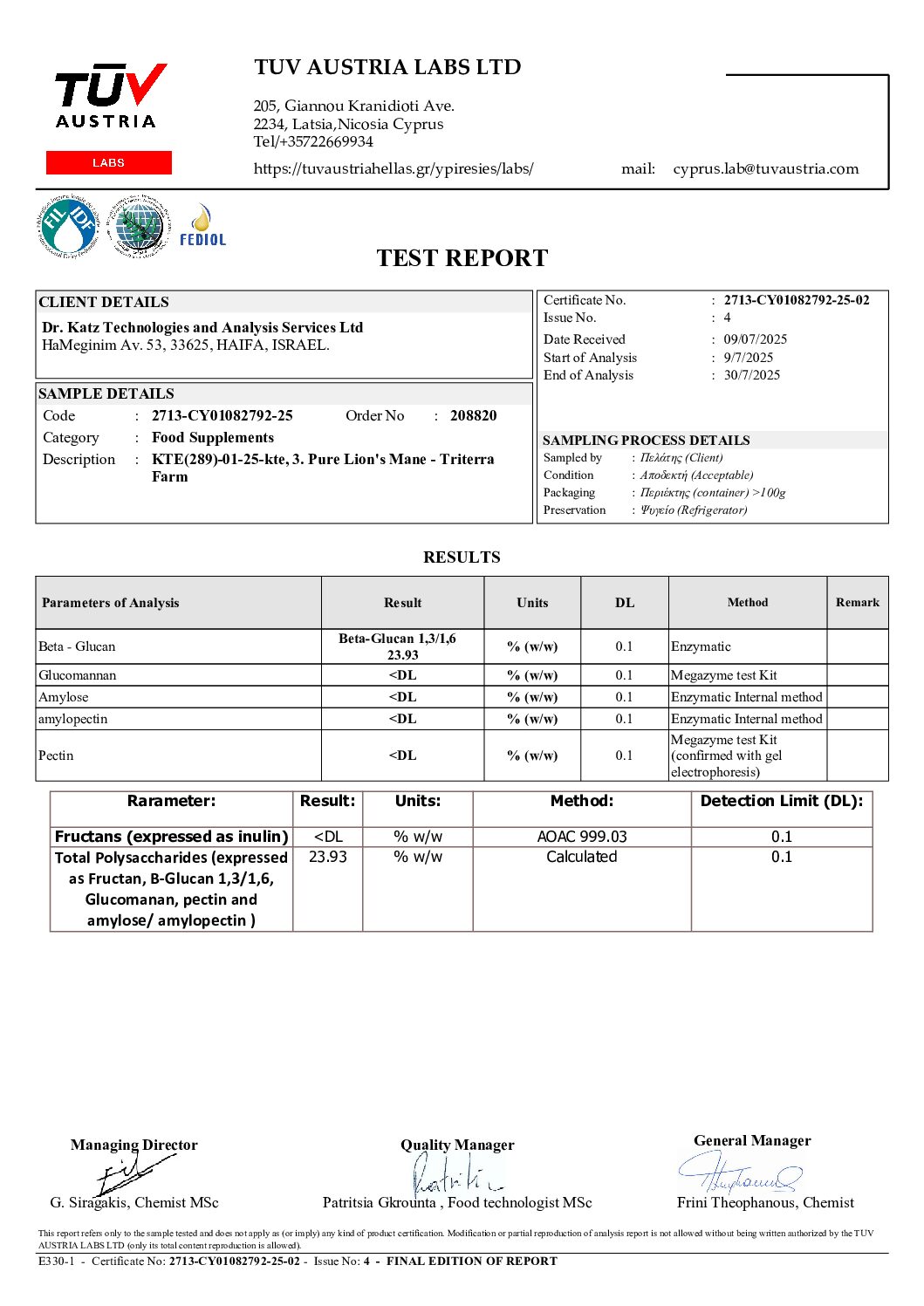
The risk no case report covers is what you don’t know about the product: undeclared carriers, grain starch presented as “polysaccharides,” a label that doesn’t match the contents. That is why transparency here is not a slogan: our extract is made from fruiting bodies only, tested at TÜV Austria — beta-glucan 23.93% on the dry matter of the finished extract, alpha-glucan (starch) “not detected” — and the full report is open to anyone. That is not a medical claim; it is knowing precisely what you’re taking — something you can also show your doctor. How to read such a report line by line — in our guide to reading a COA; and every study we cite on this mushroom — in the research hub, filtered to lion’s mane.
The Extract Behind the Transparency
Fresh fruiting bodies from our Galilee farm · beta-glucan 23.93% tested at TÜV Austria · alpha-glucan: not detected · the report is open to all
100-day trial · free shipping over ₪285 · permanent club discount
Not sure what fits you? Our short matching quiz takes what you just read into account.
The Bottom Line
Lion’s mane is among the best-studied and best-tolerated functional mushrooms — and that is exactly why you deserve to know where the lines are: a mushroom allergy is the one true contraindication; blood thinners and glucose-lowering medication call for a doctor’s input even though the concern is only theoretical; pregnancy and nursing — avoid in the absence of data; and a felt worsening of anxiety, even though trials never measured one, is reason enough to stop. A brand that only sells you the “why yes” is telling half the story. We’d rather you know all of it — and decide, together with your doctor, with open eyes.
Frequently Asked Questions
Scientific Sources (Peer-Reviewed)
- Maes MF, et al. Occupational allergic contact dermatitis from the mushroom White Pom Pom (Hericium erinaceum). Contact Dermatitis, 1999. View on PubMed
- Nakatsugawa M, et al. Hericium erinaceum (yamabushitake) extract-induced acute respiratory distress syndrome monitored by serum surfactant proteins. Internal Medicine, 2003. View on PubMed
- Dangers at the dinner table — a report of anaphylaxis to lion’s mane mushroom (conference abstract). Annals of Allergy, Asthma & Immunology, 2022. View at the journal
- Mori K, et al. Inhibitory effect of hericenone B from Hericium erinaceus on collagen-induced platelet aggregation. Phytomedicine, 2010. View on PubMed
- Liang B, et al. Antihyperglycemic and antihyperlipidemic activities of aqueous extract of Hericium erinaceus in experimental diabetic rats. BMC Complementary and Alternative Medicine, 2013. View on PubMed
- Nagano M, et al. Reduction of depression and anxiety by 4 weeks Hericium erinaceus intake. Biomedical Research, 2010. View on PubMed
- Saitsu Y, et al. Improvement of cognitive functions by oral intake of Hericium erinaceus. Biomedical Research, 2019. View on PubMed
- Docherty S, et al. The Acute and Chronic Effects of Lion’s Mane Mushroom Supplementation on Cognitive Function, Stress and Mood in Young Adults: A Double-Blind, Parallel Groups, Pilot Study. Nutrients, 2023. View on PubMed
- Surendran G, et al. Acute effects of a standardised extract of Hericium erinaceus (Lion’s Mane mushroom) on cognition and mood in healthy younger adults: a double-blind randomised placebo-controlled study. Frontiers in Nutrition, 2025. View on PubMed
Study data source: PubMed and the original journals. Commercial numbers on this page come solely from our open lab reports. This content is an educational review and does not constitute medical advice; for any question about combining with medication or a medical condition, consult your physician.
These statements have not been evaluated by the Food and Drug Administration. This product is not intended to diagnose, treat, cure, or prevent any disease.
