
Beta-Glucan vs. Polysaccharides: The Number That Actually Matters
Key Takeaways
- Beta-glucan 1,3/1,6 is the real measure of a mushroom extract. “Total polysaccharides” is not a quality metric — it also counts grain starch and added fillers like inulin, which makes it easy to inflate.
- The public benchmark: mycelium-on-grain products typically test below 7% beta-glucan; quality fruiting body measures 25%–40%. Our tested extracts: 23.21%–28.16%, measured on the finished extract at TÜV Austria.
- A trustworthy measurement is enzymatic (Megazyme assay), on a dry-weight basis of the finished product — not the raw material.
- The chemical control line: alpha-glucan (starch) — “not detected.” That is the proof there is no ground grain in the bottle.
Beta-glucan (1,3/1,6) is the primary active polysaccharide in functional mushrooms — reishi (Ganoderma lucidum), lion’s mane (Hericium erinaceus), cordyceps, and turkey tail (Trametes versicolor) — and it is the one number worth looking for on an extract label. But the market often shows you a different, bigger, more impressive number: “total polysaccharides.” This guide explains the difference between the two, why the second one is easy to inflate, and how to read the right one — using our own numbers, from open lab reports, as a live example.
What is the difference between beta-glucan and “polysaccharides”?
“Polysaccharides” is an entire chemical family — any long chain of sugars qualifies: fungal beta-glucan, grain starch, and fibers like inulin and pectin all count. Beta-glucan 1,3/1,6 is one specific polysaccharide — the one built into the mushroom’s cell wall, and the one that mushroom research actually studies. A label declaring “polysaccharides” says “there are some long sugars in here”; a label declaring beta-glucan 1,3/1,6 says exactly what is in there, and how much.
This distinction is not chemical pedantry — it is the difference between a mushroom product and a substrate product. The fungal cell wall is built of beta-glucans with 1,3 and 1,6 linkages (in oats, by comparison, the linkage is different — 1,3/1,4 — so even “beta-glucan” alone is worth a second look at which kind). Starch, on the other hand, is an alpha-glucan — the polymer of grain. The two look identical inside a “total polysaccharides” figure, and completely different on a specific beta-glucan line.
Why is “total polysaccharides” so easy to inflate?
Because it counts everything. A mycelium product grown on grain arrives with the substrate’s starch inside — and starch is a polysaccharide, so it counts. A producer who adds a filler fiber like inulin — also a polysaccharide, also counted. That is how a product can display “60% polysaccharides” while the lion’s share is starch and added fiber, with very little fungal beta-glucan at all. The big number isn’t technically lying — it just says nothing about the mushroom.
Nor is this theoretical. On a real test certificate of a cordyceps product on the market that reached us, the fructans (inulin) line showed 14%–17% — a filler fiber inflating “total polysaccharides” by nearly half, while the beta-glucan line itself was lower than ours. On our reports, that exact same line reads “not detected.” To learn how to spot this yourself on a full report, line by line, see our guide: How to Read a Mushroom Supplement COA.
What is a good beta-glucan percentage in a mushroom extract?
The benchmark that repeats across public market testing is clear: mycelium-on-grain products typically test below 7% beta-glucan, because most of their powder is grain substrate; quality fruiting body measures in the 25%–40% range. Every number needs two critical qualifiers: which method measured it, and what it was measured on — raw material or the finished product. Without both, even “40%” is just a slogan.
| Product type | Typical beta-glucan | What is really inside |
|---|---|---|
| Mycelium on grain | Usually under 7% | Mostly substrate starch — it shows up on the alpha-glucan line |
| Quality fruiting body | 25%–40% | Real mushroom; depends on source, process, and what was tested |
| Our tested extracts | 23.21%–28.16% | Measured on the finished extract at TÜV Austria; starch “not detected”; reports open |
Note the nuance: our numbers are measured on the finished extract — the liquid you actually drink, after extraction — not on raw-material powder. A fair comparison between products must ask what the number was measured on; otherwise you are comparing apples to peels. And why an extract made from fresh fruiting body reaches numbers like these at all — that story is in Fresh vs. Dried mushroom extract.
How is beta-glucan measured properly — and what does “dry basis” mean?
The reliable measurement is enzymatic and specific: enzymes that break down beta-glucan in particular, so starch and other sugars are not counted by mistake. Our extracts are tested with the Megazyme Mushroom and Yeast beta-glucan assay — a method that chemically separates beta-glucan from alpha-glucan and reports each one on its own line. Generic methods that measure “total sugars” or “total polysaccharides” simply cannot tell them apart — which is why their number is bigger, and emptier.
“Dry-weight basis” means the percentage is calculated after removing the water: the liquid is taken out of the extract, and what remains — the solids — is what gets measured. So 25.65% in our reishi means: of every gram of dry matter in the extract, about a quarter is fungal beta-glucan. It is the only way to compare products fairly, since water content varies from product to product — and it is also why we do not convert the percentage into “mg per ml”: that number would require assumptions we are not willing to make without measuring.
What is alpha-glucan, and why is “not detected” the proof?
Alpha-glucan is the starch family — amylose and amylopectin — the polymers of grain. A mushroom contains almost none; ground grain substrate is full of them. That makes the alpha-glucan line of a lab report a chemical grain detector: “not detected” means there is no ground substrate in the extract, while a high number means you are paying for grain at mushroom prices. It is the line that settles the “fruiting body or mycelium” debate with a single measurement.
On the reports of all four of our tested extracts, the amylose and amylopectin lines — and the fructans (inulin) line as well — read “not detected” (below the detection limit).
What numbers were measured in our extracts?
These are the numbers from our open test reports — each measured at TÜV Austria on the finished extract, by the Megazyme method, on a dry-weight basis, with a certificate number you can verify directly with the lab:
| Extract | Beta-glucan 1,3/1,6 | Alpha-glucan (starch) | Certificate |
|---|---|---|---|
| Cordyceps | 28.16% | Not detected | CY01082790 |
| Reishi | 25.65% | Not detected | CY01082791 |
| Lion’s Mane | 23.93% | Not detected | CY01082792 |
| Turkey Tail & Reishi (the blend) | 23.21% | Not detected | CY01082793 |
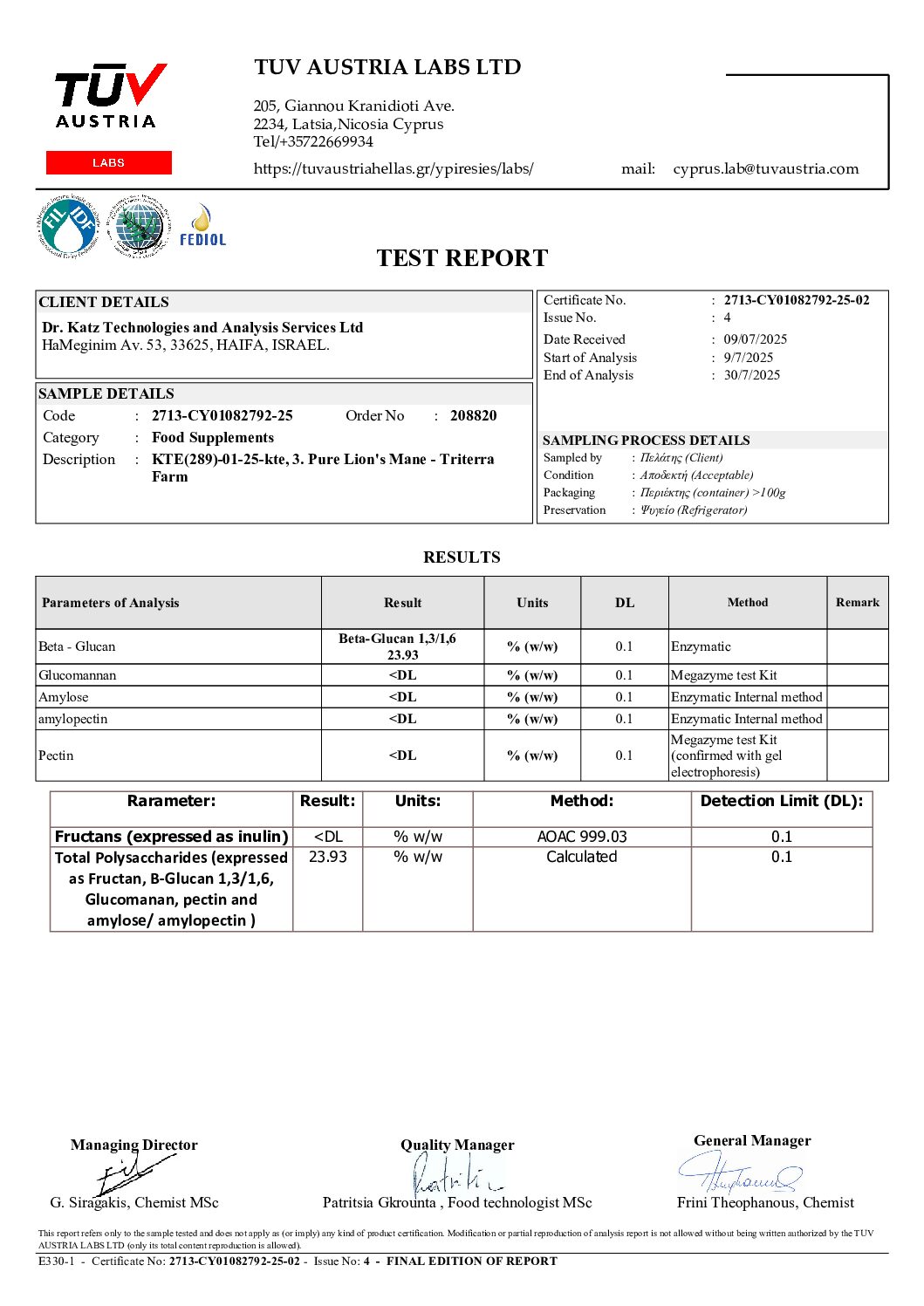
And in the same breath, what this table does not claim: the 23.21% belongs to the combined Turkey Tail & Reishi extract — not to turkey tail alone, which was not sent for a separate test, so we do not cite a number for it. All of our tests are open on the lab results page, which also hosts the full science section on beta-glucans — definitions, mechanism, and research references; this page is its consumer edition, not a replacement.
What does beta-glucan do — and what don’t we know yet?
Fungal beta-glucans are studied mainly for their interaction with the immune system: immune cells carry a dedicated receptor called Dectin-1 that recognizes the 1,3-beta-glucan structure, and research shows this recognition depends on the molecule’s exact architecture. Further research explores how gut bacteria break beta-glucans down as dietary fiber. That is why the structure — 1,3/1,6 — is part of the metric, not just the percentage.
And what don’t we know yet? Plenty. Most mechanistic beta-glucan research comes from lab and model studies, and human clinical trials measuring tangible outcomes are still accumulating. A high beta-glucan percentage proves the product is made from real mushroom at real concentration; it is not a medical promise, and anyone selling it as one has crossed the line from measurement into marketing. We stay on the measurement side: the number, the method, and the open report. And for the research itself — on the mushrooms, not the products — our research hub, filtered to quality-control studies, is waiting.
How do you check a label with three questions?
Facing any mushroom product, in any store, three questions are enough: One — how much beta-glucan 1,3/1,6, explicitly, not “polysaccharides”? Two — measured how and on what: enzymatically, on the finished product? Three — what does the alpha-glucan line show, and is there an open third-party lab report with a verifiable certificate number? A brand that answers all three transparently has earned trust. A brand that answers “we have a high polysaccharide content” has answered — just not what you asked. The full checklist, on a real report, is in our COA reading guide.
The extracts behind the numbers
Fresh fruiting body from our farm in the Galilee · Beta-glucan 23.21%–28.16% measured at TÜV Austria · Starch and inulin: not detected · All tests open
100-day trial · Free shipping over ₪285 · Permanent club discount
Not sure which one fits you? Our short matching quiz will point you right.
The Bottom Line
“Polysaccharides” is a number built to be seen; beta-glucan 1,3/1,6 is a number built to be measured. The difference between them is the whole difference between ground grain substrate and real mushroom — and it is exposed by three lines of a lab report: the beta-glucan percentage, the measurement method, and the alpha-glucan line. Our numbers — 28.16%, 25.65%, 23.93%, 23.21% — are open for your inspection, certificate by certificate. From now on, when a label says “60% polysaccharides,” you will know exactly which question to ask.
Frequently Asked Questions
Scientific Sources (Peer-Reviewed)
- Wu DT, et al. Evaluation on quality consistency of Ganoderma lucidum dietary supplements collected in the United States. Scientific Reports, 2017. View on PubMed
- Ohno N. Fungal beta-glucans: structure and effect on host immune responses. Yakugaku Zasshi, 2021. View on PubMed
- Anaya EU, et al. Dectin-1 multimerization and signaling depends on fungal beta-glucan structure and exposure. Biophysical Journal, 2023. View on PubMed
- Yamanaka D, et al. Quantification of mushroom-derived soluble beta-1,6-glucan using the function-modified recombinant beta-1,6-glucanase. International Journal of Medicinal Mushrooms, 2020. View on PubMed
- Zhang X, et al. Edible mushroom polysaccharides: structural characteristics, chemical modification strategies, and structure-activity relationship: A review. International Journal of Biological Macromolecules, 2025. View on PubMed
- Yu L, et al. Interaction of beta-glucans with gut microbiota: Dietary origins, structures, degradation, metabolism, and beneficial function. Critical Reviews in Food Science and Nutrition, 2024. View on PubMed
Research data source: PubMed. Commercial numbers on this page come exclusively from our open lab reports. This content is an educational review and does not constitute medical advice.
Disclaimer: These statements have not been evaluated by the Food and Drug Administration. This product is not intended to diagnose, treat, cure, or prevent any disease.
