
Turkey Tail (Trametes versicolor) and Inflammatory Processes: What Research Explores About PSK and PSP
Turkey Tail is studied around inflammatory processes and the immune system, through its polysaccharides PSK and PSP. It is not an anti-inflammatory drug and not a substitute for treatment — the research looks at support over time, and mostly in combination with Reishi.
Forget feathers and coops — we are talking about a forest mushroom. As far back as the 1980s, a compound called PSK was isolated from it in Japan and approved there as a regulated pharmaceutical for complementary use in oncology. Here it is important to pause and clarify: this refers to an isolated, regulated pharmaceutical compound — and not the mushroom extract sold as a dietary supplement. Rather than talking about “killing” bacteria, research on the mushroom mainly examines how its components interact with the body’s immune system.
Meet Trametes versicolor, or by its folk and picturesque name, Turkey Tail. It did not come from the supermarket; it grows on tree trunks, looks like a striking multicolored fan reminiscent of a fanned-out turkey’s tail, and is researched in the context of inflammatory processes and support for immune-system function (structure-function).
If you are looking to understand the science rather than the legends, you have come to the right place. Let’s dive into the mycology and understand why this mushroom is so intriguing to researchers. For a broader introduction to the world of medicinal mushrooms, you can start with our complete guide to medicinal mushrooms.
Why is it called “Turkey Tail”? The origin of the name and its distinctive structure
Let’s bust the first myth: there is no connection to an actual turkey, apart from the appearance. This mushroom grows in nature in the form of colorful arcs — brown, white, blue, and gray — that look exactly like a fanned tail. But its real beauty is not in the colors; it is in the chemistry.
Unlike antibiotics, which act directly against bacteria, Turkey Tail is researched in an entirely different direction: not as antibacterial activity, but as components examined in the context of the regulation and balance of the immune response. It is important to emphasize that this is not a substitute for antibiotics — each belongs to a completely different world. For a closer look at the science, see the science of Turkey Tail.
The mushroom contains two components that have drawn research attention for decades: PSK and PSP.
The science behind the compounds: what PSK and PSP are
These are not just acronyms. They are polysaccharide-peptides (complex chains of sugar and protein) found in the mushroom.
An important clarification before we continue: PSK and PSP as they appear in the research are isolated, regulated pharmaceutical compounds (PSK is sold in Japan as a drug called “Krestin”), and not the mushroom extract sold as a dietary supplement. The data on them cannot be applied directly to a supplement.
-
PSK (Polysaccharide-K): the most well-known component. As an isolated compound it has been studied in the context of immune-system activity, and it is regulated in Japan as a pharmaceutical (Krestin).
-
PSP (Polysaccharopeptide): studied in the context of regulating the immune response (structure-function) — that is, support for the balance of the system rather than a one-directional stimulation of it.
3 directions being researched in Turkey Tail
1. Prebiotic fibers and the microbiome
Turkey Tail contains prebiotic fibers that are studied as potential food for the friendly gut bacteria (the microbiome). The research rationale here is one of support for the balance of the digestive system (structure-function) — not action against any specific disease agent.
2. Interaction with immune-system cells
Part of the research examines how the mushroom’s components interact with Natural Killer (NK) cells and macrophages — central cells of the innate immune system. This is a mechanism researched in the context of the regulation of the system’s activity, and not as a treatment that replaces any medication.
3. Balance and inflammatory processes
Turkey Tail is rich in antioxidants (phenols and flavonoids) that are researched in the context of inflammatory processes and of oxidative balance in the body (structure-function). This is a research direction, not a therapeutic indication for any medical condition.
Want to understand how we verify what is actually in each extract? You can review our transparency policy and our beta-glucan lab testing. To go deeper into the research on this mushroom, see what Turkey Tail is.
Quick Q&A: what’s important to know about Turkey Tail
Q: Can you just go to the forest, pick it, and eat it? A: Technically yes — it grows in many regions — but it is not advisable. Its texture is as hard as wood and impossible to chew or digest. To make its components available (such as PSK and PSP), extraction is required — a process of simmering and extracting in water/alcohol that breaks down the mushroom’s rigid cell walls. Eating it raw contributes almost nothing.
Q: Does it replace antibiotics for an acute sore throat? A: No. The mushroom extract is a dietary supplement and is not a substitute for medical care. If your physician prescribed antibiotics for an acute bacterial infection, follow their guidance. Turkey Tail is researched in the context of general support for the body, and is not a “magic bullet” for eliminating an infection.
Q: How is it consumed? A: The common way is via a concentrated liquid extract or capsules containing extract powder. It is worth making sure the product is a “dual extract” in order to capture the full spectrum of components. More on extraction terms in the glossary.
Who might find this mushroom interesting?
-
Those interested in support for immune-system function during winter (structure-function).
-
Those interested in general support for the balance of the digestive system and the microbiome.
-
Those curious about the research directions around antioxidants and inflammatory processes.
-
Anyone who wants to go deeper into the world of medicinal mushrooms from a research-based approach.
The bottom line: between tradition and research
For thousands of years, traditional Chinese medicine brewed tea from Turkey Tail. Today, modern research examines the mushroom’s components and the way they interact with the body. It is important to remember that this is an evolving field of research and not a therapeutic promise. If you want to go deeper, you can start with our complete guide to medicinal mushrooms, review what Turkey Tail is, and browse our questions and answers.
Note: This content is an educational overview of a field of research. Data on PSK and PSP refer to isolated, regulated pharmaceutical compounds, and not to a mushroom extract sold as a supplement. It does not constitute a medical recommendation or a therapeutic indication. Medicinal mushroom extracts are dietary supplements only. Oncology patients, pregnant or nursing women, people taking medication, and transplant patients must consult a physician before taking any supplement.
*These statements have not been evaluated by the Food and Drug Administration. This product is not intended to diagnose, treat, cure, or prevent any disease.*
PSK and PSP are names of research extracts — not of a powder
The interesting Turkey Tail studies were done on concentrated, standardised extracts, not on mycelium powder. That is exactly why we extract from fruiting bodies only and measure the beta-glucan in every extract — so that what is in the bottle is as close as possible to what was tested.
How to start with Turkey Tail
Two routes: the Turkey Tail and Reishi blend — the polysaccharides together with adaptogenic regulation — or focused Reishi, for when chronic stress is part of the picture.
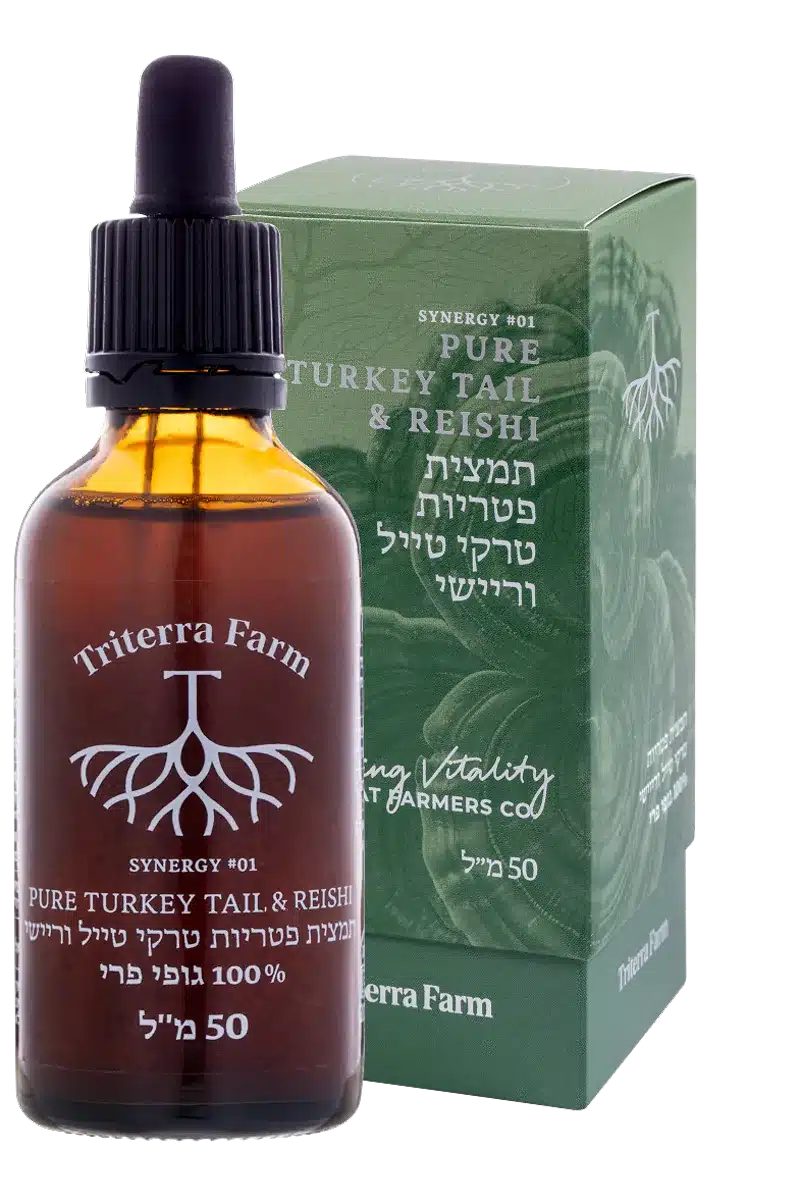
Turkey Tail + Reishi — Fruiting Body Extract
The mushroom you just read about, together with Reishi: triple extraction from fruiting bodies, 23.21% beta-glucan lab-verified.
“Stomach pains that had been with me for years simply stopped. My doctor recommended this extract and I do not see myself without it.” — Inbar Y., verified review (translated from Hebrew)
₪250
about 35 days of use (1.4 ml/day) · free shipping over ₪285
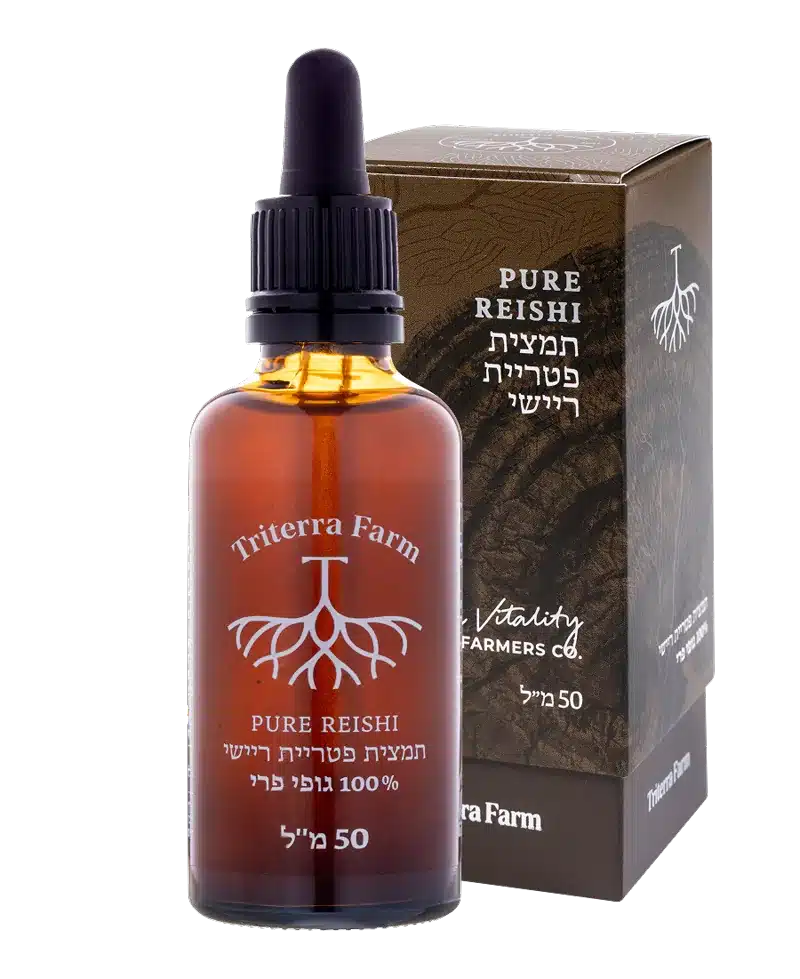
Reishi — Fruiting Body Extract
For when chronic stress is part of the picture: Reishi is an adaptogen studied in the context of the stress response. 25.65% beta-glucan verified.
“Simply magic. Hard to believe how much it helps.” — Kfir H., verified review (translated from Hebrew)
₪250
about 35 days of use (1.4 ml/day) · free shipping over ₪285
Triterra club members get a standing 10% discount on every order, plus a quantity discount on more than one extract. Joining is free, through the matching quiz →
What people who started tell us
Real verified reviews from our customers, translated from the original Hebrew
“Stomach pains that had been with me for years simply stopped. My doctor recommended this extract and I do not see myself without it.”
Inbar Y.Turkey Tail & Reishi Extract
“Simply magic. Hard to believe how much it helps.”
Kfir H.Reishi Extract
“I have used Shlomi's extracts for years, and every time I am moved again by the quality and the effect.”
Noy G.Lion's Mane & Reishi Extract
Want to give your body support you can verify?
Start with a 100-day trial — if you feel no difference, you get your money back.
Choose my extract Not sure what fits? Take the matching quiz — under a minute →Want the mechanism itself, not just the conclusion? Turkey Tail Science →
These statements have not been evaluated by the Food and Drug Administration. This product is not intended to diagnose, treat, cure or prevent any disease. The information here is for general knowledge only and is not medical advice or a substitute for consulting a physician. Consult a qualified professional before using any dietary supplement, especially if you take medication, are pregnant or nursing, or have a diagnosed medical condition.
The research behind Reishi — 16 PubMed studies, the good and the bad →
Frequently asked questions
Is the Turkey Tail mushroom related to an actual turkey?
No. Its name comes from its appearance, which resembles the fanned, multicolored tail of a wild turkey. It is a mushroom that grows on trees and is known scientifically as Trametes versicolor.
Can you eat the mushroom straight from the forest?
Not recommended. The mushroom is very tough and indigestible in its raw form. To make its compounds available, an extract is typically used, produced through a process that breaks down the cell walls.
Does Turkey Tail replace antibiotics?
No. The mushroom extract is a dietary supplement and is not a substitute for antibiotic treatment or any other medical care. For an acute bacterial infection, follow your physician's guidance.
Which compounds in Turkey Tail are studied?
The mushroom contains polysaccharide-peptides called PSK and PSP, which are studied in the context of immune-system activity. It is important to emphasize that PSK and PSP in the research are isolated, regulated pharmaceutical compounds, and not the mushroom extract sold as a supplement.
