
Fresh or Dried Mushrooms — What Really Goes Into Your Extract?
Key takeaways
- Nearly every mushroom extract in the world — including “100% fruiting body” products — is made from dried mushrooms. Drying is a logistics solution, not a quality advantage.
- At our farm, the mushroom goes from harvest to extraction with no drying step — as far as we know, one of very few producers in the world working this way.
- Fresh is not a promise. That is why the result is measured: 23.21%–28.16% beta-glucan in the extracts tested at TÜV Austria — on the dry matter of the finished extract.
- Three tiers of raw material: mycelium on grain → dried fruiting body → fresh fruiting body from the farm. Full table below.
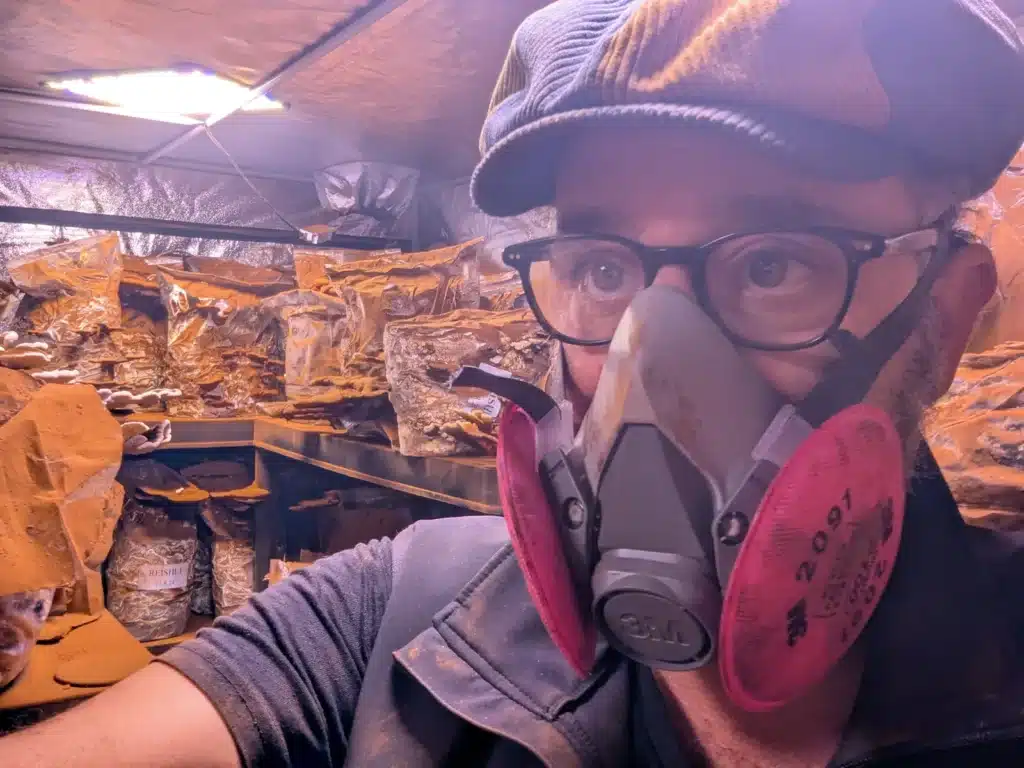
Reishi (Ganoderma lucidum), Lion’s Mane (Hericium erinaceus), Cordyceps and Turkey Tail (Trametes versicolor) — nearly every functional mushroom extract in the world starts from a dried mushroom. Not because drying improves anything, but because it lets raw material be stored and shipped across continents. At Triterra Farm in the Galilee, harvest and extraction happen in the same place, so our mushrooms go from harvest to extraction with no drying step. This guide explains the real difference between the two paths, what that difference is not — and why, in the end, only measurement settles it.
Why does almost the entire industry dry its mushrooms?
Because a fresh mushroom is mostly water and it spoils — and a global industry needs raw material that keeps for months and travels far. The professional cultivation literature recommends drying “for shelf life and concentration” — in other words, a logistics reason. It is an entirely legitimate choice, but it should be called by its name: a storage and shipping solution, not a quality advantage.
That is how most of the market works, including its best brands: even a product honestly labeled “100% fruiting body” is almost always made from fruiting bodies that were dried, often on another continent, then rehydrated in the extraction liquid. We researched the global market in depth and could not find a single commercial brand marketing an extract made from fresh fruiting bodies. That is why we choose our words carefully — not “the only ones”, but: as far as we know, one of very few in the world.
What happens to a dried mushroom on its way to the bottle?
Between the harvest of a dried mushroom and its extraction stand many stations: drying, milling, packing, shipping, customs, warehousing — often long months. In most cases neither the consumer nor even the manufacturer who bought the powder can know when the mushroom was actually harvested. We will not make chemical claims here that we have not measured; we will only note a simple fact: every one of those stations adds time and distance between the mushroom and the bottle.
And here is what we can say with full confidence: when harvest and extraction happen on the same farm, there is no supply chain you have to trust. There is a path of a few meters, under one roof, fully documented — and at its end, a third-party lab report published in full.
Three tiers of raw material — where is your extract?
Behind mushroom supplement labels hide three very different tiers of raw material: mycelium grown on grain, dried fruiting body, and fresh fruiting body. The difference between them is not a marketing nuance — it is measured in a lab as a beta-glucan percentage, and it is the difference between grain powder and a real mushroom extract.
| Tier | What it actually is | What the lab shows |
|---|---|---|
| Mycelium on grain | The fungal network is grown on rice or oats and milled together with its substrate — most of the powder is grain | Public market tests typically show under 7% beta-glucan, alongside abundant grain starch |
| Dried fruiting body (most of the market, including the good part) | The real mushroom — but dried, usually imported, its quality depending on source, time and storage | Quality fruiting body measures in the 25%–40% beta-glucan range |
| Fresh fruiting body from the farm (our tier) | Harvest → deep-freeze for preservation → extraction on the same farm, with no drying step. As far as we know, one of very few in the world | 23.21%–28.16% beta-glucan in the extracts tested at TÜV Austria, with alpha-glucan “not detected” |
Note that the third tier does not “beat” the second by declaration — it beats it by control. And the gap between the first tier and the other two, which is the truly large one, is covered in depth in our guide to functional mushrooms.
What happens on our farm between harvest and bottle?
Three steps, with no stations in between: the mushroom is harvested at peak maturity in our growing tents in the Galilee; it goes straight into a deep freezer — whose only job is preservation; and from there into a triple extraction in which the alcohol stage alone runs for seven weeks. No drying, no shipping, no warehouse waiting. We freeze — we don’t dry.
- Harvest. The fruiting body is picked at its peak, meters away from the extraction point.
- Deep freeze. And let us say this with full honesty: freezing does not “improve extraction” and adds nothing to the mushroom. It is simply our way of preserving the mushroom until extraction — instead of drying it.
- Triple extraction. Cold water, a slow seven-week alcohol extraction, and hot water — with an ultrasonic stage completing the process.
One more disclosure we insist on making out loud: our extraction ratios are stated in fresh mushroom. A ratio calculated on fresh mushrooms is not comparable to a ratio calculated on dried powder — they are two different currencies. So instead of hiding behind a ratio, here is the concrete number:
| Extract | Fresh mushroom per 50 ml bottle |
|---|---|
| Cordyceps (1:2.5 ratio) | 20 grams |
| Lion’s Mane (1:2 ratio) | 25 grams |
| Reishi (1:3 ratio) | ~16.7 grams |
| Turkey Tail & Reishi (1:3 ratio) | ~16.7 grams |
And the real proof was never how much mushroom went into the process — it is what gets measured in the extract that comes out of it.
How do you know it matters? Measure the result, not the story
A beautiful story is not proof — not even ours. Proof is a third-party lab test on the finished extract: our extracts were tested at TÜV Austria using an enzymatic assay (Megazyme), and the full reports are open. The beta-glucan percentage, on the dry matter of the finished extract, is the number that settles the argument.
| Extract tested | Beta-glucan 1,3/1,6 (dry basis) |
|---|---|
| Cordyceps | 28.16% |
| Reishi | 25.65% |
| Lion’s Mane | 23.93% |
| Turkey Tail & Reishi | 23.21% |
And there is one more quiet line in the report, perhaps the most important of all: alpha-glucan — “not detected.” Alpha-glucan is grain starch; when it does not appear in the test, that is chemical proof there is no milled grain substrate in the extract. It is exactly the line separating the first tier in the table from ours.
All of our tests are open on the lab results page — with a report number and sample code you can verify directly with the lab. And if you want to go deeper into the research itself: our research hub, filtered to quality and testing studies.
What “fresh” does not mean
Fresh is not magic. A fresh mushroom does not automatically make a stronger extract, and deep-freezing does not “crack cell walls open” — it is preservation, nothing more. What fresh does give: full control of the chain, zero dependence on powder suppliers, and a mushroom harvested meters from the extraction point. Everything else has to be proven by the test.
That is why we do not ask you to believe a story — not even this one. Every extract that was tested has its number published. And if tomorrow another brand shows a dried fruiting body with a measured result higher than ours — respect to their number. That is exactly the culture of transparency we are trying to build in this market: fewer stories, more open reports.
The third-tier extracts
Fresh fruiting bodies from our Galilee farm · Tested at TÜV Austria · Alpha-glucan: not detected · All tests open
100-day trial · Free shipping over ₪285 · Standing club discount
Not sure which one fits you? Our short matching quiz will point you in the right direction.
The bottom line
Most of the world dries because it must: the mushroom grows far from the extraction point. For us they are the same place — so we have no reason to dry, and you have no reason to settle for a story. A fresh mushroom from harvest, deep-freezing for preservation only, a slow extraction whose alcohol stage runs seven weeks, and at the end — an open third-party test that measures the result. That is the whole method, and it stands up to scrutiny in every report.
Frequently asked questions
Scientific references (peer-reviewed)
- Zhang X, et al. Edible mushroom polysaccharides: structural characteristics, chemical modification strategies, and structure-activity relationship: A review. International Journal of Biological Macromolecules, 2025. PubMed
- Ohno N. Fungal beta-glucans: structure and effect on host immune responses. Yakugaku Zasshi, 2021. PubMed
- Yamanaka D, et al. Quantification of mushroom-derived soluble beta-1,6-glucan using the function-modified recombinant beta-1,6-glucanase. International Journal of Medicinal Mushrooms, 2020. PubMed
- Anaya EU, et al. Dectin-1 multimerization and signaling depends on fungal beta-glucan structure and exposure. Biophysical Journal, 2023. PubMed
Study data source: PubMed. All commercial numbers on this page come exclusively from our open lab reports. This content is an educational review and is not medical advice.
Disclaimer: These statements have not been evaluated by the Food and Drug Administration. This product is not intended to diagnose, treat, cure, or prevent any disease.
