
Reishi and Inflammation: What Human Research Shows
Most of what is written about Reishi and inflammation comes from cell and animal work, not from people. One human trial found a shift toward a less inflammatory immune profile, but it measured a marker, not a disease. When Reishi was tested against real inflammatory illness, it showed no effect. Here is what the research supports.
What is inflammation, and what separates the helpful kind from the harmful kind?
Before looking at the research, it helps to be clear that inflammation is not automatically a bad thing. Acute inflammation is a necessary and healthy immune response. When you cut yourself or catch a virus, the body launches a focused inflammatory response to deal with the intruder and to begin repair. That response is meant to be short, targeted, and to fade once the job is done.
The trouble starts when the switch stays stuck in the “on” position. Low-grade chronic inflammation is a quiet, ongoing process in which the immune system keeps operating at low intensity with no real threat present. It is the kind people usually mean when they ask about “reducing inflammation”.
The goal of a healthy lifestyle is not to suppress inflammation across the board — you need the acute response — but to support the body’s ability to run a balanced inflammatory response.
What has human research actually found on Reishi?
The human evidence on Reishi and inflammation is very thin, and it is worth being precise about it.
A human study published in the British Journal of Nutrition in 2024 gives us a first glimpse. In a randomised, double-blind trial, 39 healthy older women took 2,000 mg of dried Reishi extract per day for eight weeks. The results showed a shift in the profile of their T cells — key cells in the immune system — toward a less inflammatory pattern. Specifically, the researchers observed a drop in pro-inflammatory Th17 cells and an increase in the expression of genes such as IL-10 and TGF-beta.
At the same time, some pro-inflammatory markers also rose, so the picture is mixed. The researchers described the overall effect as leaning mainly in the anti-inflammatory direction, without calling it clear-cut.
One point deserves emphasis. This was an immune marker measured in a laboratory. It is not a measure of overall inflammation in the blood, such as a CRP test, and it is not a measure of disease symptoms. It is an interesting hint at a possible direction, not proof that Reishi lowers inflammation in the body.
The result that did not work out, and why we tell you about it
To get the full picture, you also have to hear about the studies that failed. In 2007, Arthritis & Rheumatism published a study examining the effect of Reishi on 65 patients with active rheumatoid arthritis. Participants received a high dose of 4 grams of Reishi per day, combined with a Chinese herbal formula called San Miao San, for 24 weeks.
The result was unambiguous: nothing. No significant effect of Reishi was found on the patients’ inflammatory measures, immune activity, or antioxidant status. That study matters precisely because it did not test markers in healthy volunteers — it tested the mushroom against a real inflammatory disease, and it came back empty.
A further study from 2016 examined Reishi in 84 patients with metabolic syndrome, a condition characterised by low-grade chronic inflammation. It, too, found no significant effect on any measure.
We report these because a brand that only tells you about the encouraging study is not telling you about the evidence. It is telling you about its marketing.
Why does most of what you read about Reishi come from the lab?
If you search for “Reishi and inflammation”, you will probably find a great many enthusiastic articles. The reason is that the overwhelming majority rest on laboratory work in cell cultures and on animal studies. In a test tube and in mice, mushroom extracts have indeed been shown to modulate inflammatory processes.
But the move from success in the lab to proof in humans is an enormous leap, and most substances do not survive it. As things stand today, where inflammation is concerned, the human evidence is simply not strong enough to support sweeping statements.
What about Turkey Tail?
Turkey Tail is often pulled into this conversation, and it is worth being precise here as well. It has almost no human research on general inflammatory processes. Most of the research on Turkey Tail sits in a completely different context — immune support alongside oncology treatment — which is a separate question with a separate body of evidence. For that reason, we do not attribute properties relating to the general inflammatory response to Turkey Tail.
What Reishi does not do
Given the current state of the science, it is worth being completely clear.
- Reishi is not an anti-inflammatory medicine.
- It does not treat rheumatoid arthritis, inflammatory bowel disease, or any other inflammatory condition.
- It is not a substitute for medical treatment or for a doctor’s advice.
Reishi is used as a food supplement, on the understanding that it may support normal, balanced body function, including communication between immune cells. That is a much smaller claim than the internet usually makes, and it is the honest one.
How is Reishi extract used?
Supporting the body’s systems is a gradual process that rewards consistency. This is not something you reach for when something hurts. Typical use is daily and steady, alongside varied nutrition, physical activity, and stress management — the strongest and best-supported tools for a balanced inflammatory response.
When is inflammation a reason to see a doctor?
It matters to know when a situation calls for medical attention rather than a supplement. If you are experiencing persistent joint pain, swelling, fever, chronic fatigue, or any other symptom suggesting ongoing inflammation, the right address is a doctor. These are situations that require a full medical work-up to reach a correct diagnosis and appropriate care. They are not situations to experiment on with supplements.
Frequently asked questions
Is Reishi anti-inflammatory?
There is no basis for stating that Reishi is proven anti-inflammatory in humans. Most of the evidence comes from laboratory and animal studies, which are an early stage only. The single human study that found a movement in that direction measured immune markers in healthy people, not disease symptoms, so it is not clinical proof.
So does Reishi treat rheumatoid arthritis?
No. A 2007 study examined exactly that question in patients with active rheumatoid arthritis and found no effect of Reishi on their inflammatory measures. There is no scientific basis for presenting Reishi as a therapy for any inflammatory disease.
What is the difference between good and bad inflammation?
Acute inflammation is a healthy and necessary response to injury or infection, and it is meant to pass. The concern is low-grade chronic inflammation, where the system stays on alert without need. The aim is to support a balanced response, not to suppress inflammation wholesale.
Why are there so many articles saying Reishi reduces inflammation?
Because most of them rely on cell-culture or animal studies. The step from a result in a test tube to clinical proof in humans is a very large one, and most substances do not survive it. It pays to read the research itself rather than the headline.
Isn’t Turkey Tail anti-inflammatory?
As of today, Turkey Tail has no human studies supporting a general anti-inflammatory claim. Most of its research was conducted in the context of immune support alongside oncology treatment, which is a different subject. We stay cautious and do not attribute that property to it.
When does inflammation require a doctor?
Symptoms such as persistent joint pain, swelling, fever, or chronic fatigue are a signal to see a doctor. These situations call for a comprehensive medical assessment to reach a diagnosis, and they should not be self-managed with supplements.
How long would someone take Reishi before expecting anything?
Reishi is used consistently over time rather than as an acute response. In the human trial described above, the protocol ran for eight weeks. That describes how the research was structured; it is not a promise of a result within any timeframe.
The honest summary is short. Reishi is studied for its relationship with the immune system, and one human trial hinted at a direction worth following. Two others, tested against real inflammatory conditions, found nothing. Anyone dealing with chronic inflammation deserves that full picture, not the flattering half of it.
Triterpenes are what make an extract an extract
The triterpenes in Reishi are not water-soluble, so a tea or a powder simply does not get them out. That is why we use triple extraction — water, alcohol and ultrasonic — and measure the beta-glucan at an external lab for every batch.
How to start with Reishi
Two routes: focused Reishi, or the blend with Turkey Tail — for the polysaccharides studied in an immune context alongside the adaptogenic regulation of Reishi.
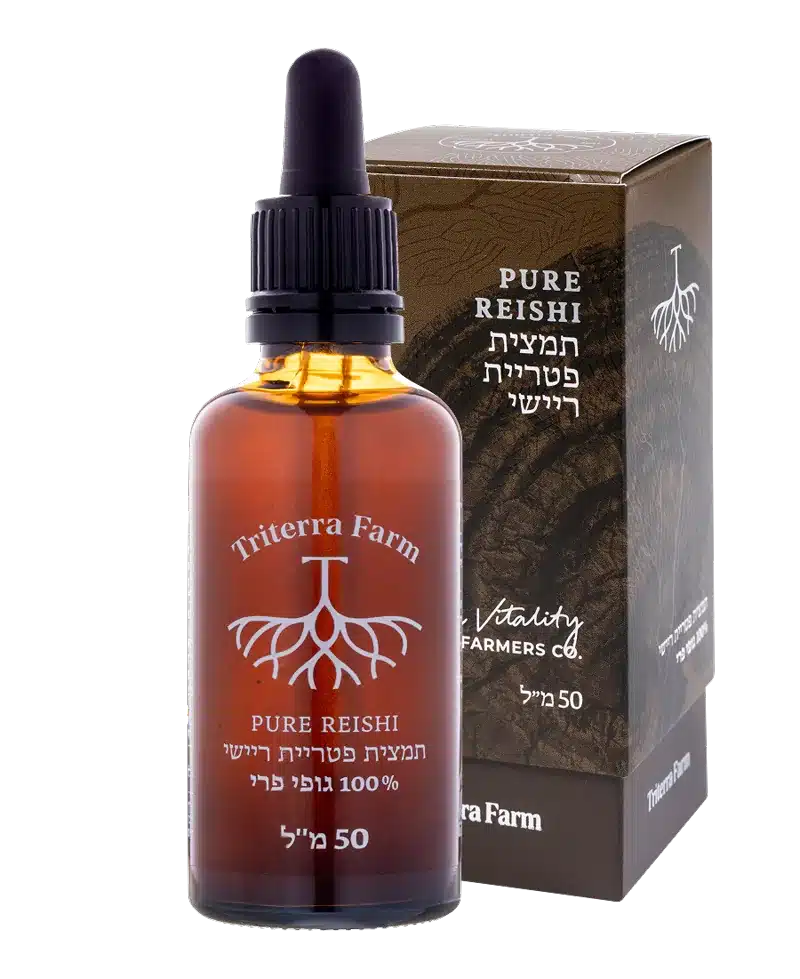
Reishi — Fruiting Body Extract
The mushroom you just read about, in concentrated form: triple extraction from fruiting bodies, 25.65% beta-glucan lab-verified.
“Simply magic. Hard to believe how much it helps.” — Kfir H., verified review (translated from the original Hebrew)
₪250
about 35 days of use (1.4 ml/day) · free shipping over ₪285
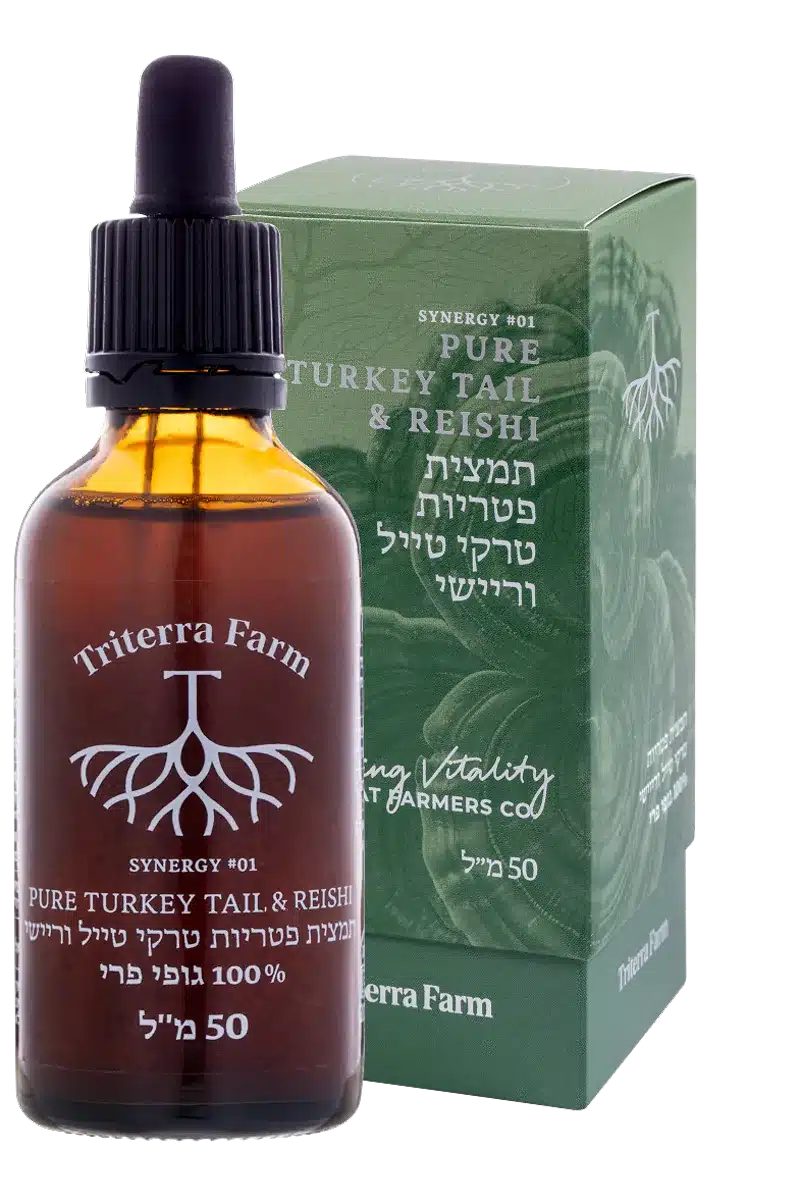
Turkey Tail + Reishi — Fruiting Body Extract
For the polysaccharides studied in an immune context as well: Turkey Tail and Reishi in one bottle. 23.21% beta-glucan verified.
“Stomach pains that had been with me for years simply stopped. My doctor recommended this extract and I do not see myself without it.” — Inbar Y., verified review (translated from the original Hebrew)
₪250
about 35 days of use (1.4 ml/day) · free shipping over ₪285
Triterra club members get a standing 10% discount on every order, plus a quantity discount on more than one extract. Joining is free, through the matching quiz →
What people who started tell us
Real verified reviews from our customers, translated from the original Hebrew
“Simply magic. Hard to believe how much it helps.”
Kfir H.Reishi Extract
“Stomach pains that had been with me for years simply stopped. My doctor recommended this extract and I do not see myself without it.”
Inbar Y.Turkey Tail & Reishi Extract
“I have used Shlomi's extracts for years, and every time I am moved again by the quality and the effect.”
Noy G.Lion's Mane & Reishi Extract
Want to give your body support you can verify?
Start with a 100-day trial — if you feel no difference, you get your money back.
Choose my extract Not sure what fits? Take the matching quiz — under a minute →Want the mechanism itself, not just the conclusion? Reishi Science →
These statements have not been evaluated by the Food and Drug Administration. This product is not intended to diagnose, treat, cure or prevent any disease. The information here is for general knowledge only and is not medical advice or a substitute for consulting a physician. Consult a qualified professional before using any dietary supplement, especially if you take medication, are pregnant or nursing, or have a diagnosed medical condition.
The research behind Reishi — 16 PubMed studies, the good and the bad →
