
The “Dancing” Medicinal Mushroom (Maitake): What Does the Research Say About Immune Support and Blood-Sugar Balance?

Welcome to a journey of discovery into the wondrous world of the maitake medicinal mushroom. At Triterra Farm, this journey is part of our DNA – it begins with blue-and-white Israeli cultivation, under controlled conditions and with attention to every detail, and continues with harvesting at the optimal time for full-spectrum extraction.
Read more about our commitment to quality and local growing.
From the experience and knowledge we have gathered, we have prepared this guide for you, combining fascinating stories, up-to-date research, and everything worth knowing about the supportive potential of the “dancing” maitake mushroom.


Maitake medicinal mushroom (Grifola frondosa): “The Dancing Mushroom” from the forest to modern research

The maitake medicinal mushroom, also known as “Hen-of-the-Woods” due to its unique shape resembling a ruffled hen or a cluster of flower petals, is an impressive, fleshy mushroom that usually grows at the base of oak trees and other deciduous trunks. Its Japanese name, maitake (舞茸), literally means “dancing mushroom”. The origin of the name lies in ancient Japanese folk legends telling how people who found large colonies of the mushroom in the forests danced with joy – not only because of its fine culinary value, but also because of its reputation as precious and as possessing virtues in traditional medicine.
Today, maitake continues to be a prized edible mushroom around the world, while also serving as a focus of modern scientific research examining its active components and its potential health effects.

History, tradition and the “dance of joy”

The mushroom originates in the forests of Japan, China and North America, where it grows wild. In Japan and China, its use has been documented for hundreds of years, both in cuisine and as part of the traditional medicine framework. In Traditional Chinese Medicine (TCM), it was regarded as strengthening “Qi”, supporting spleen and kidney function, helping to disperse dampness and calming the spirit (“Shen”). In general, it was attributed properties that support the immune system, help maintain the body’s internal balance (properties reminiscent of the modern adaptogenic idea) and contribute to vitality and longevity.
The legend of “the dancing mushroom” reflects the great value attributed to it – finding it was considered an especially joyful event, since it provided nourishing food and was also considered to have medicinal and commercial value, to the point that the fortunate finder would break into a spontaneous dance.
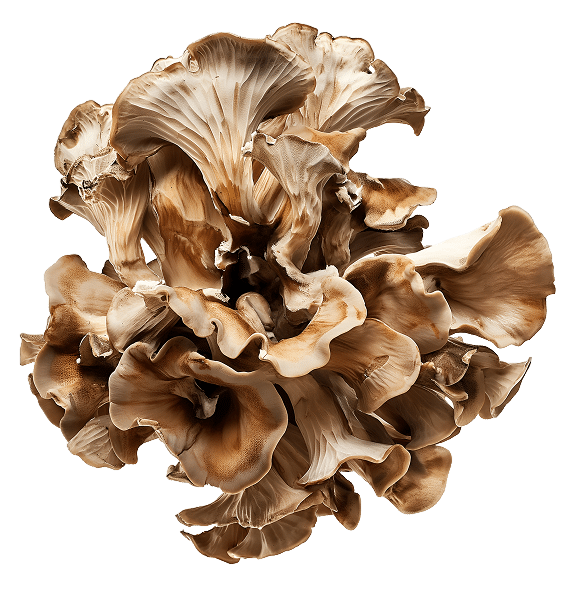

Main active components in the maitake medicinal mushroom

The maitake mushroom is a good source of nutritional components, including B-group vitamins (mainly niacin, riboflavin and pantothenic acid), minerals such as potassium (important for heart and blood-vessel health), copper and zinc, amino acids and dietary fiber. Its uniqueness also lies in specific bioactive compounds that are studied extensively:

Beta-glucans (β-glucans): Maitake is especially rich in complex polysaccharides of the beta-glucan type, mainly those with a branched (1,3/1,6) structure, which is considered significant in terms of biological activity. Specific extracts derived from maitake, enriched in beta-glucans or related compounds (sometimes referred to in research by names such as D-Fraction, MD-Fraction or SX-Fraction, which are usually patent-protected compounds isolated from the mushroom or its mycelium and are studied as distinct isolates rather than as the whole-mushroom extract itself), are at the focus of immunological research.

Ergosterol: A plant sterol that serves as a precursor (provitamin) to vitamin D2. When the mushroom is exposed to UV radiation (such as direct sunlight or special UV lamps after harvest), the ergosterol converts into vitamin D2, making sun-dried or UV-treated mushrooms a possible nutritional source of this vitamin.

Antioxidants: Contains a variety of phenolic compounds, flavonoids and ergothioneine with antioxidant activity demonstrated in laboratory assays. These components may help neutralize free radicals and protect the body’s cells from oxidative stress.

Additional mushrooms rich in beta-glucans and studied for immune support are turkey tail (Trametes) and shiitake.

פטריית מאיטקה טרייה – אשכול מאיטקה (Maitake) בוגר, מרהיב ועסיסי

Main research areas and potential effects

Support for immune system function:
This is the most established and most researched area regarding maitake, mainly because of the activity of the beta-glucans. Numerous studies – from the laboratory (in vitro), through animal models (in vivo), to preliminary clinical studies – have demonstrated how maitake extracts, and in particular beta-glucan-enriched extracts such as D-Fraction (an isolated, often patent-protected research compound, not the whole-mushroom supplement itself), may affect the immune system. The effects studied include increasing the activity of macrophages (the “scavengers” of the system), natural killer cells (NK cells), T cells, and an effect on the production of cytokine proteins such as interleukin-2 (IL-2) and interferon-gamma (IFN-γ).

The link to oncology research: A significant part of the research has been conducted in an oncological context, examining effects on immune support in patients undergoing chemotherapy or radiation treatments. This does not indicate treatment or cure of cancer. Any combination with medical treatment requires medical consultation.

Support for metabolic balance (sugar and insulin):
Another area examines the possible link between maitake and the balance of blood-sugar levels and insulin sensitivity. Studies, mainly in animals, suggest mechanisms such as improved insulin sensitivity, an effect on enzymes such as alpha-glucosidase and the activity of glucose transporters (GLUT4). Small clinical studies have shown inconclusive results, and broad, controlled studies are needed before any clinical conclusions can be drawn. Maitake is not a treatment for diabetes or any other blood-sugar condition; anyone managing their blood sugar should consult their physician.

Support for heart and blood-vessel health (blood pressure and cholesterol):
In this area too the research is preliminary, mainly in animal models. Maitake may affect the blood-lipid profile and the activity of the ACE enzyme. It should not be regarded as a substitute for medical treatment of cholesterol, blood pressure or heart disease.

Antioxidant activity:
Maitake contains components with antioxidant activity, which helps protect the body’s cells from oxidative damage and contributes to general health over time.

Shiitake mushroom, too, is credited in preliminary research with potential for supporting heart and blood-vessel health.


Maitake in the kitchen and in nutrition

Today, fresh maitake mushrooms (mainly from cultivated growing) can be found in certain markets or specialty stores, as well as dried mushrooms available year-round. Its rich, earthy flavor and unique texture make it a prized ingredient in many cuisines. In addition, there are dietary supplements that contain powder or concentrated extracts of the mushroom.

Safety considerations and possible interactions

Maitake is generally considered safe to eat and to use as a supplement at the recommended doses. However, because of its potential effects on the immune system and on metabolism, caution should be exercised and a physician consulted in the following cases:

  • Taking diabetes medications: there is a theoretical potential to enhance the effect of the medications and to over-lower blood-sugar levels.
  • Taking blood-thinning medications (such as Coumadin/warfarin): some studies (mainly in the laboratory) point to a possible effect on blood clotting.
  • Taking immunosuppressant medications (after a transplant or in autoimmune conditions): because of the possible effect on the immune system.
  • Before surgery: it is recommended to stop use about two weeks before surgery, because of a theoretical effect on blood clotting and blood-sugar levels.

Summary

כרזה יפנית סתווית לפטריות יער מובחרות – תצלום פטריות שונות עם עלי שלכת וטקסט ביפנית

The maitake mushroom, “the dancing mushroom”, is much more than an exotic culinary item. It combines a fascinating history of traditional use with modern scientific research that focuses mainly on its unique beta-glucan components and on their potential effect on supporting immune system function. Additional areas, such as support for metabolic balance and for heart and blood-vessel health, are being studied as well, although they require further research for confirmation in humans. Maitake offers a rich nutritional profile and antioxidant activity, and it can be part of a varied diet and healthy lifestyle that support general well-being.

> For more information on maitake extract for immune support and overall balance

> Still deciding? Our matching questionnaire will help you

> Discover all our mushroom products

> Read also: Turkey Tail medicinal mushroom (immune support and gut health)

> You might also like: The complete guide to the shiitake medicinal mushroom (immune and heart support)

> Read about our TRIPLE EXTRACT extraction method

> Interested in learning how medicinal-mushroom synergy can better support your health?

Dietary supplement. The above is based on preliminary research and traditional uses. This information does not constitute medical advice or a therapeutic indication. These statements have not been evaluated by the Food and Drug Administration. This product is not intended to diagnose, treat, cure, or prevent any disease. Please read the label carefully before use. Pregnant women, nursing women, people taking prescription medications, and children should consult a physician. Keep out of reach of children.