
Does Lion’s Mane Help With Brain Fog? What Research Shows
The honest answer is a qualified one. In healthy adults, Lion’s Mane has been studied for cognitive performance, and computerised tests picked up slightly faster reaction times two hours after a dose — measured against each person’s own baseline, not proven better than placebo. Asked how clear-headed they felt, participants reported no difference.
What is brain fog, exactly?
Brain fog is not a medical diagnosis. It is a common name for a cluster of sensations: the mind running a little slower than usual, the right word not coming, concentration slipping away, everything slightly blurred at the edges. It is less a memory problem than one of mental sharpness and processing speed.
Most people meet it during stretches of heavy workload, poor sleep or stress, and for most it passes. When it persists, it can genuinely interfere with daily functioning. The thing to hold onto is that brain fog is a symptom, not an illness. It can point to something else going on in the body — we come back to that at the end.
What has actually been studied?
Several clinical trials in healthy people have examined whether Lion’s Mane (Hericium erinaceus) affects cognitive performance. Three are representative, and the small print matters:
- La Monica and colleagues, 2023 (PMID 38140277): 40 healthy adults were given a single 1 g dose of fruiting-body powder, then completed a battery of computerised attention tests two hours later.
- Saitsu and colleagues, 2019 (PMID 31413233): 31 healthy participants over 50 took 3.2 g of fruiting-body powder daily for 12 weeks and sat three cognitive tests.
- Surendran and colleagues, 2025 (PMID 40276537): 18 healthy adults were given a single 3 g dose of a concentrated (10:1) fruiting-body extract.
The reasoning behind these trials comes from the mushroom’s chemistry. The compounds of interest in the fruiting body are the hericenones. (Erinacines, another studied group, are found mainly in mycelium rather than fruiting bodies.) In laboratory and animal work they encouraged production of proteins called NGF and BDNF, involved in maintaining and growing nerve cells. Said plainly: that mechanism has never been demonstrated in healthy humans taking the mushroom, and there is no evidence it translates into a felt sense of clarity.
These three are representative, not the whole literature. Other trials in healthy adults exist and some found nothing at all; in one, the placebo group actually performed better on a delayed-recall memory test. One further disclosure about the 2023 trial: it was partly funded by a company marketing a competing ingredient, with Lion’s Mane serving as a comparison arm.
What did the research find — and what did it not find?
The results are not clear-cut, and that is precisely the point.
- 2023, single 1 g dose: the computerised tests showed a significant speeding up of reaction time two hours after the dose, measured against those same participants’ own starting point. To be precise: that improvement was not shown to be significantly better than placebo. And on questionnaires about focus, concentration and clarity, no difference from placebo appeared.
- 2019, daily use for 12 weeks: of three cognitive tests, only one showed a small but statistically significant improvement (the MMSE). The two memory tests showed no change. Context matters here too: participants started at 29.19 out of 30 on that test — almost perfect — and improved to 30.00. A gap that small is not clinically meaningful.
- 2025, single dose of concentrated extract: the primary outcome was flat — no significant effect on overall cognitive function or on mood. There was an isolated improvement on a manual dexterity task, a single finding that is hard to draw conclusions from.
The cumulative picture is modest. Changes were recorded on objective measures such as reaction time, but were not shown to beat placebo. On the subjective experience — less fog, more focus — no difference was found at all.
Why doesn’t a measured improvement feel like anything?
How can an instrument detect an improvement the person does not notice? Several answers are plausible. The measured change — a few thousandths of a second on a reaction-time task — may be too small to register in everyday life. Questionnaires may not be sensitive enough to capture subtle shifts. Any effect may be cumulative, or more noticeable in people starting from a lower baseline. These trials ran in healthy people with normal cognitive function, where there is little room to improve.
How does the studied dose compare to the dose people actually take?
The trials used different amounts and preparations, and only the 2019 one tested sustained daily use. Our extract is produced a mushroom-to-liquid ratio of 1:2–1:3, meaning each millilitre is drawn from 0.5 g of dried mushroom. That ratio describes how much raw material went into the process, not how much of the active compounds ended up in the finished extract. So 2 ml comes from a quantity of raw material similar to the 2023 trial — but that is not proof of biological equivalence.
Our guidance is one dropper (roughly 1 ml) a day to start, 2 ml for regular use, up to 3 ml during demanding periods. Note what that means for the long-term study: 3.2 g a day corresponds to roughly 6.4 ml of extract, well above our maximum, so its result cannot be assumed to apply to ordinary use. In practice the dose goes under the tongue for about 30 seconds, or into coffee or tea, in the morning or at midday.
Our triple-extraction process is designed to draw out a wider range of components and break down the mushroom’s cell walls. No study has compared our extract directly with powder, so we cannot claim it is more effective — only that it is different in composition.
What Lion’s Mane does not do
Lion’s Mane is a food supplement, not a medicine. On the existing research, it does not clear, remove or treat brain fog. The evidence points to modest potential in very specific areas, and even that needs further research. We would rather say so openly, commercially inconvenient as it is. Anyone promising guaranteed mental clarity within a week is not showing you the whole of the research.
When is brain fog a reason to see a doctor?
This is the most important section here. If brain fog is persistent and interfering with your ability to function, the first step is not a supplement — it is a doctor. Brain fog can be a symptom of conditions that need proper assessment:
- Iron or vitamin B12 deficiency
- Thyroid dysfunction
- Sleep apnoea
- Depression or anxiety
- A side effect of medication
- Chronic sleep deprivation
A simple blood test and a conversation with a doctor can rule these out and point you in the right direction. Supplements can be part of a healthy lifestyle, but never a substitute for medical diagnosis and care.
Frequently asked questions
So does Lion’s Mane help with brain fog or not?
Research recorded improvement on objective measures such as reaction speed, but found no difference from placebo in people’s own sense of clarity or concentration. Nobody can promise you will feel a change, even where an instrument registers one.
How long does it take to notice an effect?
One trial measured faster reaction times two hours after a single dose. Another tested 12 weeks of daily use. There is no clear-cut answer, and a subjective sense of change has not been demonstrated at all.
What dose of the extract is recommended?
One dropper (about 1 ml) a day to start, 2 ml for regular use, up to 3 ml during demanding periods. Two millilitres comes from a quantity of raw material similar to the 2023 single-dose trial. The 2019 long-term study used considerably more than our maximum.
Does Lion’s Mane have side effects?
It is considered safe for most people and has been eaten as food for many years, though the safety data on prolonged use is limited. Anyone sensitive to mushrooms should be cautious, and it is worth consulting a doctor before combining it with medication — blood thinners in particular.
Is it better to take in the morning or the evening?
Morning or midday. The reasoning is simply that the studies tested daytime dosing, not that any effect on alertness has been established.
Can I take Lion’s Mane with coffee?
You can add the extract to coffee or any other drink. No negative interaction is known — though the question has simply not been studied.
Does persistent brain fog need medical assessment?
Yes. It can stem from conditions such as iron or B12 deficiency, thyroid problems or sleep apnoea. A food supplement is not a substitute for a medical diagnosis.
What is worth taking from this page is the shape of the evidence rather than a verdict. Lion’s Mane has been studied in small groups, over short periods, in people whose thinking already worked well — and what came out was a small measured change that nobody could feel. An interesting starting point for further research; not a reason to expect your fog to lift, and not a reason to delay finding out what is causing it.
The dose that was studied requires an extract, not a powder
The studies used concentrated, standardised extracts. That is why the number on the bottle matters: we extract from fruiting bodies only, measure specific beta-glucan at an external lab, and publish the full certificate for every batch.
How to start with Lion's Mane
Two routes, depending on where the fog comes from: focused Lion's Mane for clarity, or the blend with Reishi — for when the fog arrives with load, tension or poor sleep.

Lion's Mane — Fruiting Body Extract
The mushroom you just read about, in concentrated form: triple extraction from fruiting bodies, 23.93% beta-glucan lab-verified.
“Excellent product — it sharpens thinking and gives energy. Good for the morning hours.” — Tamer A., verified review (translated from the original Hebrew)
₪250
about 35 days of use (1.4 ml/day) · free shipping over ₪285
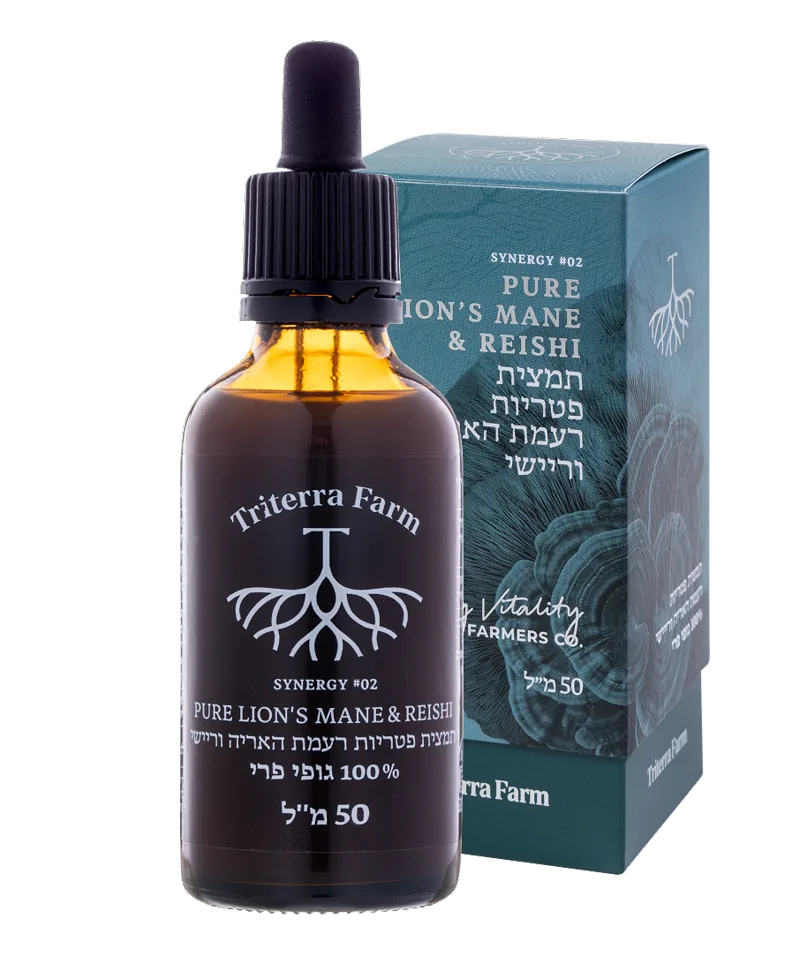
Lion's Mane + Reishi — Fruiting Body Extract
When the fog comes with load and broken sleep: Lion's Mane for clarity, Reishi for calm and sleep — both in one bottle.
“Over the weeks focus, sharpness and clarity start to stand out.” — Tamer A., verified review (translated from the original Hebrew)
₪250
about 35 days of use (1.4 ml/day) · free shipping over ₪285
Triterra club members get a standing 10% discount on every order, plus a quantity discount on more than one extract. Joining is free, through the matching quiz →
What people who started tell us
Real verified reviews from our customers, translated from the original Hebrew
“Excellent product — it sharpens thinking and gives energy. Good for the morning hours.”
Tamer A.Lion's Mane Extract
“Over the weeks focus, sharpness and clarity start to stand out.”
Tamer A.Lion's Mane & Reishi Extract
“Lion's Mane and Cordyceps may be the ultimate combination for focus and energy.”
Mor B.Cordyceps + Lion's Mane
Ready for a slightly clearer head?
Start with a 100-day trial — if you feel no difference, you get your money back.
Choose my extract Not sure what fits? Take the matching quiz — under a minute →Want the mechanism itself, not just the conclusion? Lion’s Mane Science →
These statements have not been evaluated by the Food and Drug Administration. This product is not intended to diagnose, treat, cure or prevent any disease. The information here is for general knowledge only and is not medical advice or a substitute for consulting a physician. Consult a qualified professional before using any dietary supplement, especially if you take medication, are pregnant or nursing, or have a diagnosed medical condition.
The research behind Lion's Mane — 19 PubMed studies, the good and the bad →
