
Cordyceps and Energy: A Scientific and Traditional Overview of the Mushroom
Cordyceps is studied around endurance and oxygen utilisation, not around stimulation. It is not a stimulant and contains no caffeine — the practical difference is that it does not produce a crash afterwards. Human studies looked at weeks of use, mostly during physical exertion.
Energy. That one word moves the world, your business, and life itself. Do you feel like you are chasing after it? Looking for the natural “boost” that will spring you forward without that frantic feeling of running after your fifth cup of coffee? Well, you are not alone. Many people around the world, from athletes to stressed-out managers, are looking for exactly that.
The internet is flooded with information, theories, and a little too much myth around certain mushrooms. One of them, whose name is on everyone’s lips, is the Cordyceps mushroom. Some claim it is linked to energy, endurance, and vitality — but what has actually been researched, and what is still only a matter of tradition?
In this article we will separate the science from the myth: what traditional medicine attributed to the mushroom, what early research examines, and how to choose a quality product. It is important to remember up front — Cordyceps is a dietary supplement, not a medication, and is not intended to diagnose, treat, or cure any disease. Let’s dive in.

A fresh Cordyceps mushroom in its full complexity, from the high-quality strain used for Triterra Farm’s triple extraction.
Cordyceps: what is this mushroom and where did it come from?
So what even is this thing, “Cordyceps”? Sounds like something out of a science-fiction movie, right? The truth is far more interesting, and it comes to us from the frozen mountains of Tibet and from ancient Chinese medicine, where it was regarded as a genuine treasure. It is not just “another mushroom” you can find in the forest.
This is a unique strain, and I have to say, one with a rather dramatic origin story. Originally, it is a mushroom that grows on certain caterpillars, and in particular on the caterpillar of a moth. Yes, you read that correctly. It may sound a little strange, but it is part of its unique story.
Today, most of the Cordyceps in use, especially in the supplement industry, is a cultivated strain such as Cordyceps militaris, grown under laboratory conditions. Don’t worry, there are no caterpillars in the process — only scientific research and modern technology. If you are new to the world of medicinal mushrooms, it is worth starting with the complete guide to medicinal mushrooms.
Ancient history: traditional use in the Far East
The ancient world knew a thing or two that we are only beginning to decipher now, and Cordyceps is certainly one of them. For thousands of years it was used in traditional Chinese and Tibetan medicine as a strengthening, vitality-invigorating herb, and it was traditionally linked in particular to improving physical and mental performance. It is important to emphasize: this is a traditional use, not clinical proof.
Picture this: Tibetan herders noticing that their livestock, which grazed on this mushroom, appeared more energetic. From there it was a short step to applying it to humans as well. For centuries it was worth more than gold, available only to the nobility and to emperors. A sort of currency in its own right.
What really propelled it into the global headlines? Perhaps it was the famous story of the Chinese athletes in the 1990s. Their coaches claimed that one of the ingredients in their drink was Cordyceps. From that moment on, the world began to take interest in the contexts in which this mushroom is researched.
The internal energy engine: 3 mechanisms being researched in Cordyceps
So how is this thing supposed to work? Is it just an ancient belief, or are there research directions behind it? Let’s dive into the depths of the cell and understand which mechanisms are being researched in the context of Cordyceps and energy.
1. The ATP mechanism: the body’s energy currency
Remember biology class? ATP (adenosine triphosphate) is nothing less than the energy currency of every single cell in our body. Every action, from moving a finger to thinking a complex thought, requires ATP. The more ATP we have available, the more energetic we feel.
Early research examines Cordyceps in the context of ATP production in cells. The scientific hypothesis is that it influences the metabolic pathways in the cell, and in particular the mitochondria — the cell’s power stations. A bit like examining whether you can upgrade a car’s engine so that it produces more power from the same amount of fuel. This is a field of research, not a promise.
2. Oxygen utilization and endurance: what the research examines
Imagine yourself climbing a mountain or running a marathon. What is the most important thing? Oxygen. The more efficiently the body uses oxygen, the more endurance rises. Cordyceps is researched in this context too.
Early studies examine whether the mushroom may influence blood flow and oxygen utilization in the body. Some of the work checks whether it helps the blood carry oxygen more efficiently to the muscles and tissues — but these are preliminary findings that require further confirmation.
This could explain why certain athletes subjectively report a sense of improvement in aerobic capacity and recovery time. These are personal reports, not established clinical proof.
3. Adaptogen and stress: balance in the context of load
Modern life is stressful. Chronic stress drains our energy reserves and leaves us exhausted. The adrenal gland is responsible, among other things, for producing stress hormones such as cortisol.
Cordyceps is traditionally classified as an “adaptogen” — a natural substance researched in the context of helping the body adapt to stressful situations and maintain balance. In simple terms, the researched idea is that it may support coping with load, from a structure-function standpoint. Here too — this is a research direction and a traditional use, not a therapeutic indication.
Not sure which mushroom fits your goals? Start with our complete guide to medicinal mushrooms for a research-based orientation, or go deeper into the science of Cordyceps.
Quick Q&A:
- Is Cordyceps researched in the context of energy? Yes — early research examines its relationship to cellular energy production and utilization, and it is used traditionally to support vitality. Results vary from person to person.
- How long does it take to see a change? There is no guaranteed timeline; the effect is cumulative and varies from person to person. A supplement is not a substitute for a healthy lifestyle.
- Is it only suitable for athletes? No. Traditionally it was used by a broad audience seeking to support general vitality and cope with daily load.
Beyond energy: 4 additional aspects being researched in Cordyceps
Energy is important, but Cordyceps is researched in several additional directions too. It is important to remember that all of these are areas of early research and traditional use, and not therapeutic indications.
1. Antioxidants: support for coping with oxidative stress
Cordyceps will not turn you back into a 20-year-old, but it is researched in the context of its antioxidant content. Antioxidants are molecules studied in the context of balancing free radicals — molecules associated with oxidative-stress processes in cells. This is a nutritional-structural context, not a “stopping aging” claim.
2. The immune system: support for and balance of immune function
A balanced immune system is important for overall well-being. Cordyceps is researched in the context of supporting and balancing immune-system activity (structure-function), and not as a “medication” against any disease.
Early studies examine whether it may regulate the immune-system response and influence the activity of natural killer (NK) cells. These are preliminary research directions, described here for educational purposes only.
3. Mental well-being: a possible link between stress reduction and mood
Physical energy and mental well-being go hand in hand. Beyond the energetic context, a possible indirect link between Cordyceps and mood is also being researched.
As an adaptogen, it is researched in the context of reducing the sense of stress, and when we are less stressed, mood naturally tends to improve. This is not a medication against depression or anxiety, but rather a supplement examined in the context of supporting emotional balance and mental clarity.
4. Traditional use: Cordyceps and sexual function
Traditional Chinese medicine also attributed aphrodisiac properties to Cordyceps — that is, a traditional use linked to sexual function and libido. It is important to qualify: this is primarily a traditional use.
Early and limited research examines whether it may influence blood flow and certain hormonal balance. These are preliminary findings only, and not a therapeutic indication for a medical problem.
Quick Q&A:
- Is Cordyceps safe to use? For healthy adults — generally yes, at customary doses. It is always advisable to consult a professional.
- Does it interact with other medications? It may, especially with blood-thinning medication or blood-sugar medication. Consulting a physician is a must.
- Can children take Cordyceps? It is generally not recommended for children or for pregnant or nursing women, unless directed by a physician.
How to choose quality Cordyceps: extraction, beta-glucan, and combinations
So you are convinced to take a closer look? Excellent. But before you buy any product with the name “Cordyceps” on it, there are a few things worth knowing. Because not every Cordyceps is created equal.
1. Not every Cordyceps is created equal: the secret to choosing well
The market is flooded. There is Cordyceps sinensis (the “original,” more expensive strain, which comes from caterpillars), and there is Cordyceps militaris (the more common, cultivated strain). It is important to know what you are buying: look for products held to high standards, with third-party testing that confirms purity and active compounds.
Make sure the product is an extract — ideally from the fruiting body — and not just ground mushroom powder. An extract is more concentrated and has better bioavailability. Look for high percentages of beta-glucan, which are among the central active components. For comparison, Triterra’s Cordyceps extract was tested at the TÜV laboratory and showed 28.16% beta-glucan — you can review the full lab testing and our transparency page.
2. On dosage and timing
As with any supplement, dosage is a personal matter that depends on the goal, the concentration of the extract, and your health status. We do not provide dosage guidance here for any medical condition — for any question related to a health condition, medication, or personal suitability, you should consult a physician or a qualified practitioner.
Always start gradually and listen to your body. What is good for one person is not necessarily good for another, and no supplement replaces proper nutrition and a healthy lifestyle. Because of the invigorating context attributed to it, many people prefer to take Cordyceps in the morning or midday hours; taking it in the evening may interfere with sleep for some people.
3. What to combine it with? Common combinations for synergy
Cordyceps is most often consumed on its own, but it is sometimes combined with additional ingredients. Here are a few common combinations (for general information only):
- With Reishi mushroom: Reishi is traditionally described as calming and balancing, and the combination aims to provide “calm energy.”
- With Ginseng: another adaptogen well known in traditional use for supporting vitality.
- With B vitamins: vitamins essential to the body’s energy-production pathways.
- With Q10: a component researched in the context of energy production in the mitochondria.
4. “But does it really work for me?” — myth versus reality
Let’s be honest: Cordyceps is not a magic solution. It will not turn you into a world champion overnight and it will not eliminate the need for sleep. It is a natural dietary supplement, and still — a supplement.
The idea is to support the body in aspects of vitality and endurance, within the framework of a healthy lifestyle. If you are expecting an immediate “boom” like a double espresso, you may be disappointed: the described effect is subtle and accumulates over time. It is important to remember that the response varies from person to person, and there is no guaranteed result.
Quick Q&A:
- Does Cordyceps also come as coffee? Yes, there are products that blend Cordyceps into coffee and tea mixes, a convenient way to incorporate it into your daily routine.
- Does it have an aftertaste? Usually not, especially in capsule extracts. In powder form there may be a mild earthy taste, but not a particularly strong one.
- Is it legal? Yes, Cordyceps is considered a legal dietary supplement and is available for purchase in most countries around the world.
The bottom line: Cordyceps between tradition and research
So we have come back to the starting point, but this time with much more knowledge. Is the Cordyceps mushroom linked to energy? What can be said cautiously is that it is researched in the context of the body’s natural mechanisms for producing and utilizing energy, and that it has a rich history of traditional use. These are research directions and a traditional use — not a medical promise.
This is a mushroom with an ancient history that today is receiving growing scientific interest. If you are considering natural nutritional support, remember to choose wisely, start gradually, and integrate the supplement into a healthy, active lifestyle.
Want to go deeper? Review the complete guide to medicinal mushrooms, explore the science of Cordyceps, browse our questions and answers, or review our lab testing and transparency.
Note: This content is an educational overview based on early research and traditional uses, and does not constitute a medical recommendation or a therapeutic indication. Medicinal mushroom extracts are dietary supplements only — this product is not intended to diagnose, treat, cure, or prevent any disease. Do not begin use, especially while taking medication or during pregnancy, nursing, or an existing medical condition, without consulting a physician or a qualified practitioner.
*These statements have not been evaluated by the Food and Drug Administration. This product is not intended to diagnose, treat, cure, or prevent any disease.*
The highest beta-glucan reading in our lab results
Cordyceps is the easiest mushroom to fake — most of what is sold worldwide is mycelium grown on rice, where most of the weight is the starch rather than the mushroom. We grow fruiting bodies in the Galilee and extract only those, and the number is measured again for every extract.
How to start with Cordyceps
Two routes, depending on the kind of tiredness: focused Cordyceps for stamina and physical energy, or Lion's Mane alongside it — for when the fatigue is mental and focus is the problem.
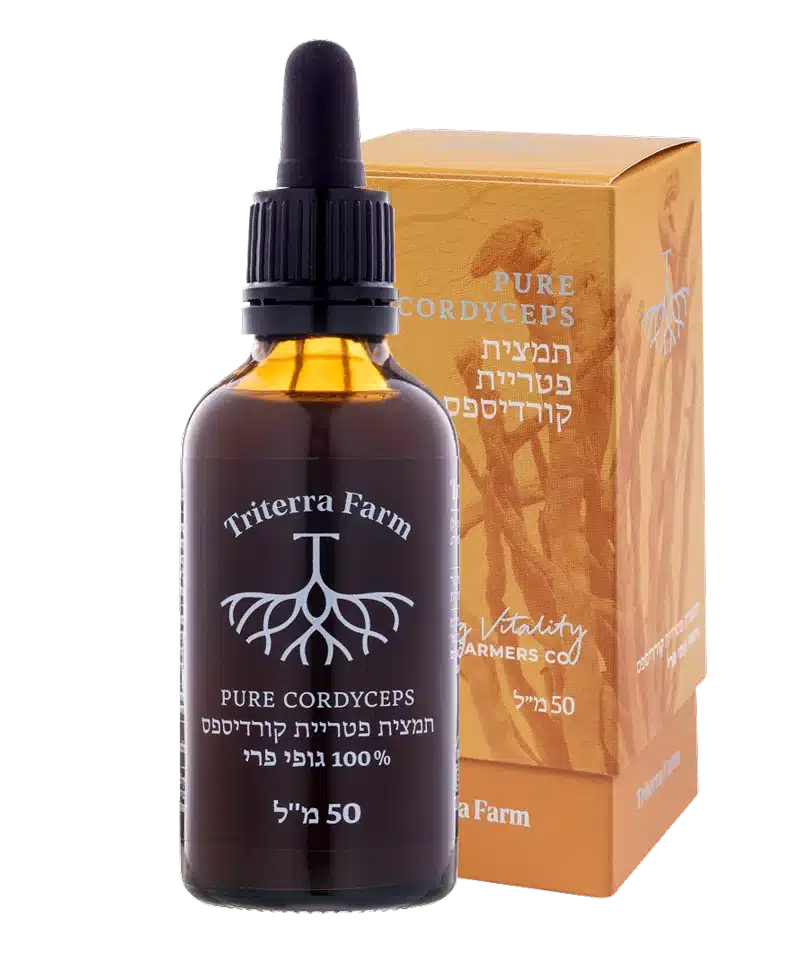
Cordyceps — Fruiting Body Extract
The mushroom you just read about, in concentrated form: triple extraction from fruiting bodies, 28.16% beta-glucan lab-verified.
“The Cordyceps extract gives me a feeling of strength and steady energy through the day — more alertness, more focus.” — Noy G., verified review (translated from Hebrew)
₪250
about 35 days of use (1.4 ml/day) · free shipping over ₪285
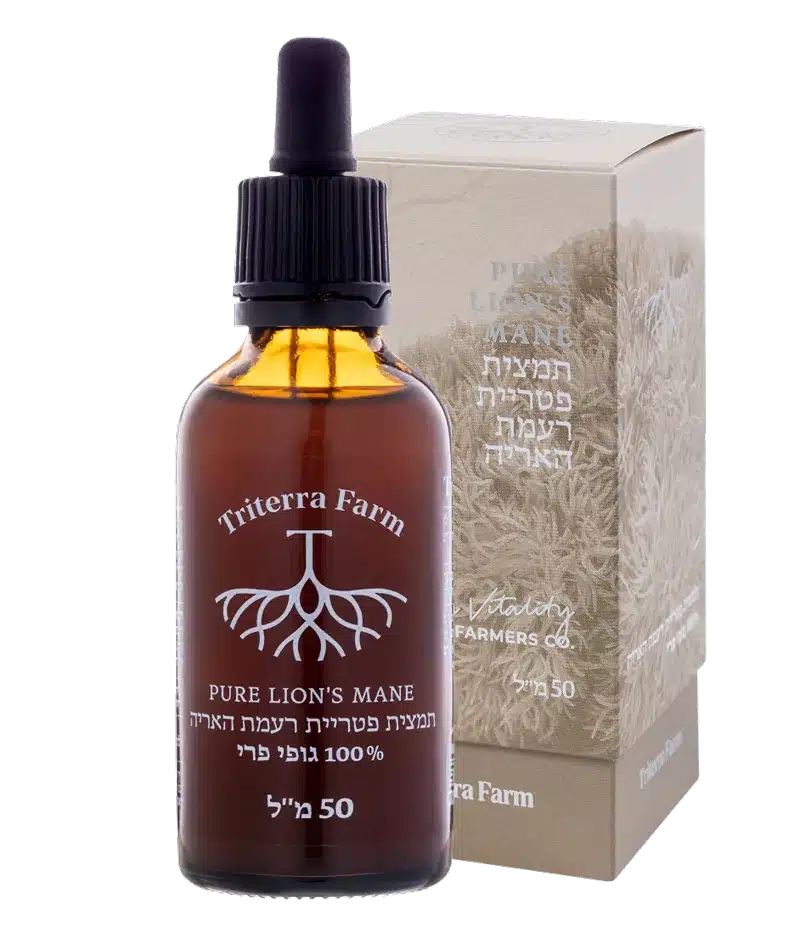
Lion's Mane — Fruiting Body Extract
For when the tiredness is mainly mental: Lion's Mane is studied in the context of clarity and focus — the natural complement to Cordyceps. 23.93% beta-glucan verified.
“Excellent product — it sharpens thinking and gives energy. Good for the morning hours.” — Tamer A., verified review (translated from Hebrew)
₪250
about 35 days of use (1.4 ml/day) · free shipping over ₪285
Triterra club members get a standing 10% discount on every order, plus a quantity discount on more than one extract. Joining is free, through the matching quiz →
What people who started tell us
Real verified reviews from our customers, translated from the original Hebrew
“The Cordyceps extract gives me a feeling of strength and steady energy through the day — more alertness, more focus.”
Noy G.Cordyceps Extract
“Lion's Mane and Cordyceps may be the ultimate combination for focus and energy.”
Mor B.Cordyceps + Lion's Mane
“Effective.”
Dror H.Cordyceps Extract
Ready for energy that does not end in a crash?
Start with a 100-day trial — if you feel no difference, you get your money back.
Choose my extract Not sure what fits? Take the matching quiz — under a minute →Want the mechanism itself, not just the conclusion? Cordyceps Science →
These statements have not been evaluated by the Food and Drug Administration. This product is not intended to diagnose, treat, cure or prevent any disease. The information here is for general knowledge only and is not medical advice or a substitute for consulting a physician. Consult a qualified professional before using any dietary supplement, especially if you take medication, are pregnant or nursing, or have a diagnosed medical condition.
The research behind Cordyceps — 20 PubMed studies, the good and the bad →
Frequently asked questions
How long does it take to notice a change when using Cordyceps?
There is no guaranteed timeline. The effect of mushroom extracts is cumulative and varies from person to person, and a dietary supplement is not a substitute for proper nutrition and a healthy lifestyle.
Is Cordyceps only suitable for athletes?
No. Traditionally it was used by a broad audience seeking to support general vitality and cope with daily load, not only athletes. This is a dietary supplement for general support and not a solution to a medical problem.
Is the Cordyceps mushroom safe to use?
For healthy adults it is generally considered safe at customary doses. If you take medication (especially blood thinners or blood-sugar medication), you must consult a physician before use.
Can children and pregnant women take Cordyceps?
It is generally not recommended for children, pregnant women, or nursing women to use the supplement unless explicitly approved by a physician.
Does Cordyceps have an aftertaste?
Usually not, especially in capsules. The powder may have a mild earthy taste, but it can easily be mixed into coffee or other beverages.
