
Maitake and Blood Sugar: What Research Explores About Glucose Metabolism
- Maitake is a dietary supplement studied in the context of glucose metabolism, and it is not a medication for blood sugar.
- Its beta-glucans draw the most research attention, examined for possible links to insulin sensitivity and the rate of glucose absorption.
- Most of the evidence is preliminary — laboratory models, animals and small human groups — and does not establish clinical efficacy.
- Isolated components such as D-fraction are regulated separately in Japan and do not represent the whole-mushroom extract sold as a supplement.
- Anyone on blood-sugar medication or blood thinners should speak with a physician first, because of possible interactions.
Maitake (Grifola frondosa) does not balance or lower blood sugar — it is a dietary supplement, not a diabetes treatment. What exists is early research examining whether its beta-glucans relate to insulin sensitivity, the rate of glucose absorption, hepatic glucose output, and satiety. Isolated components like the D-fraction, studied separately and regulated in Japan, are not the whole-mushroom extract.
Blood-sugar balance is one of the most-discussed health topics in the modern world, and not by chance — the Western lifestyle, rich in processed carbohydrates, poses a genuine metabolic challenge. In recent years, public and scientific curiosity around medicinal mushrooms has grown, and at its center is the Maitake mushroom (Grifola frondosa). This article is an educational overview: what is actually being researched in the context of Maitake, blood sugar, and metabolism — and what is still unknown.
It is important to say this clearly at the outset: Maitake is a dietary supplement, not a medication. It does not balance blood sugar, does not lower blood sugar, and is not a treatment or a substitute for treatment for diabetes. What does exist is a body of early, interesting research alongside a long tradition of use — and that is exactly what we will lay out here, responsibly.
Maitake (Grifola frondosa): background, tradition, and science
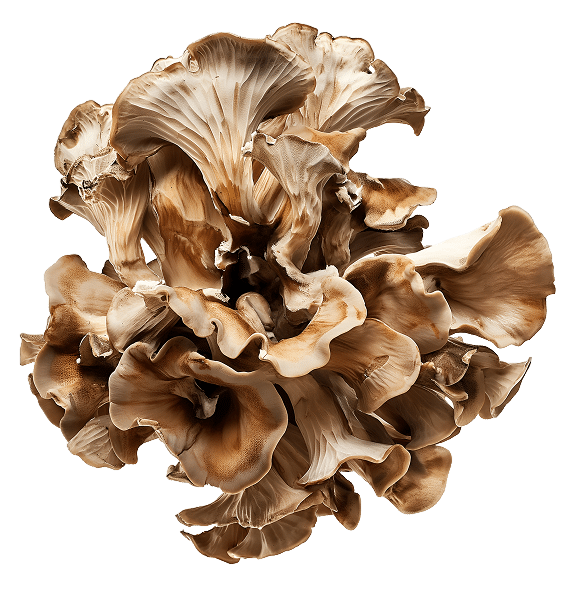
The Maitake mushroom, also known as “hen of the woods” or the “dancing mushroom” in Japan, carries a rich heritage of thousands of years in traditional Eastern medicine, where it was regarded as a prized delicacy and an ingredient in body-strengthening tonics. It grows at the base of old trees, most often oaks. You can read more about the background in the science of the Maitake mushroom and in the complete guide to medicinal mushrooms.
Contemporary scientific interest stems from the mushroom’s biochemical composition. Beyond its nutritional values (B vitamins, vitamin D, potassium, magnesium, zinc, and amino acids), research attention focuses on its complex polysaccharide molecules — first and foremost the beta-glucans.
Maitake and glucose metabolism: what does the research examine?
How is a mushroom connected to metabolic mechanisms at all? This is where careful phrasing is required. What can be said is that research examines several possible directions — not that they have been proven as a treatment. Below are the directions being researched, within the framework of early research:
Beta-glucans: the central researched component
The active components that receive the most scientific attention in Maitake are the beta-glucans — polysaccharides, that is, complex sugar molecules linked together in a distinctive structure. The quality of the extract and the percentage of active beta-glucan are critical, which is why we publish them in full transparency; you can review our transparency policy and our beta-glucan lab testing.
An important note on “D-fraction”: in the literature you will find references to isolated components such as Grifolan and Maitake D-fraction. These are isolated compounds that have been studied in a research context and in some cases are regulated as a pharmaceutical product in Japan — they are not the whole-mushroom extract sold as a dietary supplement. It is important not to equate data about an isolated component with the supplement itself.
Which directions have been examined in the context of metabolism? Early studies examined whether beta-glucans from Maitake may be related to insulin sensitivity and to the rate of glucose absorption in the digestive system. These are open research questions — not therapeutic conclusions.
Insulin sensitivity: a research direction, not a promise
Insulin resistance — a state in which cells respond less well to insulin — is at the center of metabolic interest. Early research examines whether compounds in Maitake may influence cellular signaling pathways associated with insulin sensitivity. It is important to emphasize: these are research hypotheses being tested, usually in laboratory and animal models and in small human groups, and not a conclusion that Maitake “improves insulin sensitivity” in humans as a treatment.
Hepatic glucose production and satiety regulation
Additional directions examined in early research include the question of whether Maitake has any relationship to regulating glucose output from the liver, as well as hypotheses around the sensation of satiety. Here too — early and limited evidence that does not establish a therapeutic indication.
Questions and answers: Maitake and blood sugar
Q: Can Maitake replace diabetes medication?
A: No. Maitake is a dietary supplement and is not a substitute for prescription medication or professional medical advice. If you are being treated with blood-sugar medication, do not begin use or change your treatment without consulting a physician — among other reasons because of the risk of an interaction and of an excessive drop in blood sugar (hypoglycemia).
Q: What does the research examine about Maitake and blood sugar?
A: Early studies examine the relationship between beta-glucans in Maitake and glucose metabolism and insulin sensitivity. This is early research — not therapeutic conclusions. Maitake is not intended to diagnose, treat, cure, or prevent diabetes.
What the research actually shows — and its limitations
Having presented the directions being researched, the fair question is: how strong is the evidence? Here it is important to be precise. Some of the studies — in the laboratory, in animals, and in small human groups — examined various metabolic measures in the context of Maitake. However:
- Most of the studies are preliminary and were conducted in small groups or in non-human models.
- This is not enough to establish clinical efficacy or a therapeutic indication for diabetes or any medical condition.
- Data on isolated components (such as D-fraction) do not represent the whole supplement.
In other words: there is an intriguing research topic here, not a “solution.” Maitake is a dietary supplement researched in the context of metabolism — not a medication. Anyone expecting a fast therapeutic effect will be mistaken in their expectations; anyone seeking well-grounded knowledge and a safe framework will find a good basis here for further inquiry with a professional.
Who is this topic relevant to — and why caution is required
Interest in the subject is broad: people interested in general metabolic health, as well as those under medical monitoring. Precisely because the topic touches on blood sugar, our recommendation is unequivocal: anyone diagnosed with prediabetes, diabetes (of any kind), or metabolic syndrome — and especially anyone taking medication — must consult a physician before any use. Do not rely on Maitake as a substitute for monitoring or treatment, and do not change your medication regimen on your own.
If you are a health professional and would like to go deeper, you are welcome to review our professional information space for practitioners.
Safety and interactions: the critical point
Although Maitake is natural, there are potential interactions that are important to be aware of. This is the heart of the caution on this page:
- Diabetes medication (insulin, metformin, and others): there is a concern that Maitake may amplify their effect and contribute to an excessive drop in blood sugar (hypoglycemia). Therefore it is essential to consult a physician and to monitor blood-sugar levels carefully. Do not begin use on your own.
- Blood thinners: there are reports of a possible effect on blood clotting, which could increase the risk of bleeding when combined with medications such as Coumadin (warfarin).
- Pregnancy and nursing: there is insufficient research on the safety of use during these periods — it is advisable to avoid use unless a physician directs otherwise.
In short: when it comes to blood sugar and medication, consulting a physician or pharmacist is not a casual recommendation — it is a necessary condition.
Product quality: what to look for
The supplement market is flooded, and not every product is worthwhile. Look for extracts that transparently state the percentage of active beta-glucan, accompanied by third-party lab testing and free of unnecessary fillers. Full transparency about the composition is the hallmark of a trustworthy product.
Dosage: what is important to know
On the subject of dosage — here we are firm: we do not provide dosage guidance for any medical condition. For any medical purpose, and especially in the context of blood-sugar balance or diabetes, you should consult a physician — we do not provide dosage guidance for a medical condition. For general support only (and not for treatment), you can work with a qualified practitioner, and always start gradually and cautiously.
A holistic and responsible approach to metabolic health
What emerges from all of this? That Maitake is an intriguing research topic and a dietary supplement with a rich tradition — not a “magic solution” and not a treatment. Metabolic health is built first and foremost on proven foundations: a balanced diet low in processed sugars, regular physical activity, quality sleep, and stress management. These are the anchors; a supplement, however interesting it may be from a research standpoint, can at most be a secondary component in the picture — and only after checking with a professional.
We believe information should be connected: every quality claim is backed by transparency and lab testing, every technical term is linked to a glossary, and every medical question is directed to the appropriate professional.
The right next step: if you are unsure about personal suitability and safety, turn to a professional. Health professionals are welcome to visit our professional information space for practitioners. Want to get oriented in the world of medicinal mushrooms before choosing a direction? Start with our complete guide to medicinal mushrooms to understand where to begin.
Additional questions and answers
Q: Does Maitake have side effects or interactions?
A: Maitake is generally considered safe for healthy adults, and in rare cases mild digestive upset is possible. When combined with diabetes medication or blood thinners there is a risk of interaction — it is essential to consult a physician before use.
Q: Is Maitake suitable for type 1 diabetes?
A: Type 1 diabetes is an autoimmune disease in which the body does not produce insulin. Maitake is not a substitute for insulin and is not a treatment for diabetes of any kind. Any use requires medical consultation.
Q: Can I eat fresh Maitake instead of a supplement?
A: Fresh Maitake is a tasty food, but it is difficult to quantify the concentration of the active compounds in it. A concentrated, lab-tested extract provides greater consistency in the amount of active compound.
Disclaimer: This content is an educational overview, based on early research and traditional uses, and does not constitute a medical recommendation or a therapeutic indication. Medicinal mushroom extracts are dietary supplements only — this product is not intended to diagnose, treat, cure, or prevent any disease. Do not begin use, especially while taking medication or during pregnancy, nursing, or an existing medical condition, without consulting a physician or a qualified practitioner.
*These statements have not been evaluated by the Food and Drug Administration. This product is not intended to diagnose, treat, cure, or prevent any disease.*
Measured β-glucan in our extracts
| Extract | β-glucan (measured in the finished extract) | TÜV Austria certificate |
|---|---|---|
| Cordyceps extract | 28.16% | CY01082790 |
| Reishi extract | 25.65% | CY01082791 |
| Lion's Mane extract | 23.93% | CY01082792 |
| Turkey Tail & Reishi extract (the tested blend) | 23.21% | CY01082793 |
| Market reference: mycelium-on-grain powder | typically under 7% | — |
100% fruiting bodies, triple extraction. The test report (COA) is open for every tested extract — see the full lab results. From Triterra Farm — medicinal mushroom extracts from the Galilee.
The research behind Maitake — 6 PubMed studies, the good and the bad →
Frequently asked questions
What does research examine about Maitake and blood sugar?
Early research — in the laboratory, in animals, and in small human groups — examines the relationship between compounds in Maitake, chiefly beta-glucans, and glucose metabolism and insulin sensitivity. This is early research, not therapeutic conclusions. Maitake is not a medication and is not intended to diagnose, treat, cure, or prevent diabetes.
What is the dosage of Maitake?
We do not provide dosage guidance for any medical condition — for any medical purpose you should consult a physician. For general support only, you can work with a qualified practitioner.
Does research on maitake D-fraction apply to a regular maitake supplement?
Not directly. Grifolan and Maitake D-fraction are isolated compounds, in some cases regulated as a pharmaceutical product in Japan — not the whole-mushroom extract sold as a dietary supplement, so their data should not be equated with the supplement itself.
Can I take maitake during pregnancy or while nursing?
It is advisable to avoid it. There is insufficient research on the safety of maitake during pregnancy and nursing, so our recommendation is not to use it in these periods unless a physician directs otherwise. In any case, consult your doctor before use.
