
The Future of Medicinal Mushroom Research: The Directions Science Is Exploring
The future of medicinal-mushroom research runs along a few clear directions: Lion's Mane compounds examined in the context of nerve growth factor and cognitive function; mushroom polysaccharides studied as prebiotics feeding the gut microbiome and the gut-brain axis; and Cordyceps explored around cellular ATP production and oxygen utilization. Early research and evolving mechanisms — not therapies.
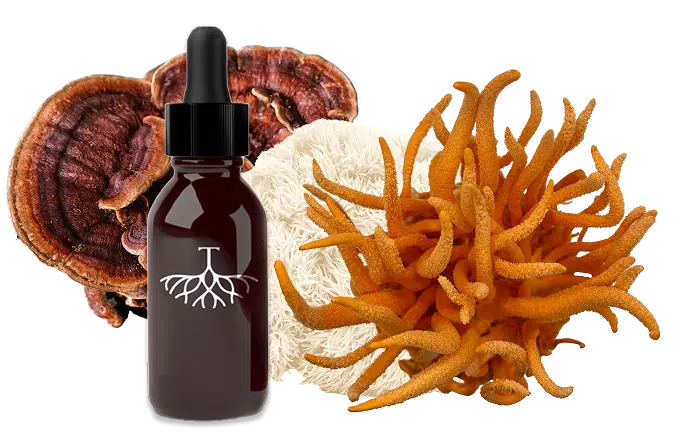
Forget for a moment everything you thought you knew about the future.
We’re used to imagining the future in silicon chips, in artificial intelligence, or in flying cars that still haven’t shown up in the traffic jams on the highway.
But one of the most fascinating directions in science today is right under our noses. Or, to be more precise — under the ground. This is a quiet revolution, with no roaring engines and no smoke. This is the mushroom revolution.
If mushrooms once were just a nice topping on a pizza or something grandma would toss into the soup, today modern science is beginning to understand the biological complexity of this kingdom.
We’re not talking about folk legends here, but about early research, about biotechnology, and about an evolving understanding of the human body.
So where is all of this heading? Join us for a look at the directions research is examining in the future of medicinal mushroom research. For anyone who wants a broader picture, it’s worth starting with our complete guide to medicinal mushrooms.
1. The human brain: how are medicinal mushrooms researched in the context of cognitive function?
Let’s talk for a moment about our brain. It works hard, it’s overloaded, and sometimes it feels like a browser with too many tabs open.
One of the areas being researched today focuses on the ability of certain compounds to encourage neurogenesis — the growth of new nerve cells — a field that until recently was considered impossible.
The star in this area is Lion’s Mane (Hericium erinaceus).
Early research points to compounds within this mushroom (hericenones and erinacines, if you insist on the scientific names) being examined in the context of encouraging the production of a protein called NGF (nerve growth factor).
We’re seeing more and more early evidence that consistent use of a quality Lion’s Mane extract is being examined in research in the context of memory, focus, and cognitive function.
The future of this field isn’t only about “being smarter.” Researchers are now examining how these compounds are studied in the context of brain function, mood, and the mental clarity so many of us are looking for in the modern era.
2. The microbiome revolution: the gut-brain connection in medicinal mushroom research
We once thought our stomach was just a sac of acid that digests food. Today we know that the gut is the “second brain,” and that it influences our mental state, our immune system, and our energy levels.
One of the most fascinating directions in medicinal mushroom research is their effect as a quality prebiotic.
Mushrooms like Turkey Tail (Trametes versicolor) and Maitake contain complex polysaccharides (such as β-glucans) that are being researched as a possible food source for the population of beneficial gut bacteria.
The future of the research focuses on synergy: how combining different mushrooms may create a combined effect (the “entourage effect”) that is researched in the context of supporting the body in a holistic way.
An important clarification about Turkey Tail: a significant part of the well-known oncology evidence refers to PSK (Krestin) and PSP — isolated, regulated pharmaceutical compounds (prescription drugs in Japan), and not to the mushroom extract sold as a dietary supplement. The mushroom extract itself is studied in early research in the context of immune-system support only — this is a research direction, not a treatment and not a substitute for medical care.
This is the shift in the conversation from “alternative medicine” to “integrative medicine.” The research is moving from the question “is there something here?” to the question “how do the mechanisms work, and how can we study them better?”
3. Clean energy: what research is examining about Cordyceps and energy balance
We’re all tired. It’s the quiet epidemic of the 21st century. We drink coffee, get a “boost” for an hour, and then crash.
The research around mushrooms like Cordyceps presents a fascinating direction. This mushroom, once reserved for emperors in China, is today being studied in sports and physiology labs around the world.
The mechanism under study? The production of ATP — in simple terms, the energy currency of our cells.
Instead of stimulating the central nervous system the way caffeine does, Cordyceps is being examined in the context of supporting energy production at the cellular level and improving oxygen utilization. Think of it as a shift from cheap, polluting fuel to clean solar energy — an analogy that illustrates the direction the research is examining.
Sensible use of a product like a Cordyceps extract fits into the daily routine of people looking for support in performance, and not only at the gym.
4. High-tech agriculture: why the growing method is critical to medicinal mushroom research
Here we arrive at the point where a lot of people slip up. For medicinal mushroom research to advance, we need consistency.
You can’t build science on mushrooms gathered randomly in the forest, where every mushroom received different conditions and varying amounts of rain or pollution.
The future belongs to controlled cultivation (Indoor Sterile Growing). Exactly as we do here, in the heart of the Galilee.
When we at Triterra Farm control every variable — from temperature, through humidity, to the composition of the substrate — we can aim for a more consistent active-compound profile in every extract. We verify the consistency of the compounds and their concentrations through independent lab tests: you can see this on our transparency page and in our lab tests (β-glucan).
This is the difference between traditional agriculture and controlled, science-based cultivation. We believe the future is a blend of the ancient knowledge of foraging with the precision of the lab.
That’s why we insist on using fruiting body only.
Why does it matter? Because many products on the market today are based on mycelium grown on rice or grains, which means you get a lot of starch and very little mushroom. You can see the comparison in numbers in our lab tests.
The serious research is done on the fruiting body itself, and that’s exactly what you get with us at Triterra Farm.
5. Extraction of medicinal mushrooms: the secret they don’t always tell you
Here’s a fact worth knowing: the cell wall of the mushroom is made of a material called chitin. It’s the same molecule that makes up the shell of crustaceans, and the human stomach doesn’t really know how to break it down.
So if you simply eat a dried Reishi mushroom, your body will absorb very little of the active compounds inside it.
The future of consuming medicinal mushrooms lies in advanced extraction technologies. We use the “Triple Extract” method — a long and complex process that takes weeks. We extract the mushroom in water, in alcohol, and through processes at varying temperatures.
Why all the effort? To capture the full spectrum: both the β-glucans (water-soluble) and the triterpenes (alcohol-soluble). Without this extraction, a significant part of the active compounds stays locked inside the mushroom.
When we look ahead, we see a world in which the consumer understands the difference between a simple “mushroom powder” and a concentrated, active extract.
Want to understand it in depth? Read more in our glossary about how proper extraction releases the active compounds.
Questions and answers everyone cares about (scientists included)
- Q: Can you just eat supermarket mushrooms and get the same effect?
- A: Button mushrooms are tasty but are not medicinal mushrooms. The concentrations of active compounds in mushrooms like Reishi or Cordyceps are entirely different, and even then extraction is required for the body to absorb them, because of the chitin cell wall.
- Q: How long does it take to feel a difference?
- A: Mushrooms are not a medication for immediate relief; they work gradually together with the body. Some people report a change in their sense of energy within days (especially with Cordyceps), while deeper sensations, such as support for the immune system or for cognitive function, usually build over two weeks to a month of consistent use.
- Q: Is it safe for daily use?
- A: Medicinal mushrooms are defined as adaptogens — substances researched in the context of helping the body find balance, and non-toxic in ordinary use. That said, while taking medication, during pregnancy, nursing, or with an existing medical condition, it’s best to consult a physician before use.
- Q: What’s the deal with “Israeli-grown”?
- A: Freshness, oversight, and transparency. When the mushroom is grown here in the Galilee, we know exactly what conditions it grew in and how it was handled. No long journeys in hot shipping containers and no unnecessary preservatives.
- Q: How do I know which mushroom is right for me?
- A: Start with our complete guide to medicinal mushrooms for an initial sense of which one fits your routine.
6. Personalized medicine: mushrooms as part of your profile
We’re entering an era in which “one size fits all” is becoming less relevant. The future of mushroom research is merging with the future of personalized medicine.
Imagine a world in which a simple test would help match a blend of mushrooms to your routine — for example, to support stress balance or sleep quality.
People are learning to listen to their bodies and to combine different extracts: a little Lion’s Mane for a morning of focused work, a little Reishi for a calm evening.
This isn’t just a passing wellness trend. It’s a return to the roots, but with all the tools of the 21st century.
Our story, which began with a dig inside a wall beneath a parking spot in Hararit, is a small part of this mosaic. The passion, the scent of the forest, the scientific precision — it all comes together.
7. What’s next? The future of medicinal mushroom research
The future of medicinal mushroom research is intriguing and, above all, natural. We’re only beginning to scratch the surface of the potential held in the global mycelial network.
Every new study that’s published adds another layer to our understanding of this fascinating kingdom. Nature created a whole treasure for us, and we’re only learning how to study it with respect.
So the next time you see a mushroom, give it a little respect. It might just hold within it the answer to a question you haven’t even thought to ask yet.
Not sure which mushroom is the best place to start? Dive into our complete guide to medicinal mushrooms for an initial direction, and browse our questions and answers to learn more.
Note: This content is an educational overview, based on preliminary research and traditional uses, and does not constitute a medical recommendation or a therapeutic indication. Medicinal mushroom extracts are dietary supplements only — this product is not intended to diagnose, treat, cure, or prevent any disease. Do not begin use, especially while taking medication, or during pregnancy, nursing, or an existing medical condition, without consulting a physician or qualified practitioner.
*These statements have not been evaluated by the Food and Drug Administration. This product is not intended to diagnose, treat, cure, or prevent any disease.*
Measured β-glucan in our extracts
| Extract | β-glucan (measured in the finished extract) | TÜV Austria certificate |
|---|---|---|
| Cordyceps extract | 28.16% | CY01082790 |
| Reishi extract | 25.65% | CY01082791 |
| Lion's Mane extract | 23.93% | CY01082792 |
| Turkey Tail & Reishi extract (the tested blend) | 23.21% | CY01082793 |
| Market reference: mycelium-on-grain powder | typically under 7% | — |
100% fruiting bodies, triple extraction. The test report (COA) is open for every tested extract — see the full lab results. From Triterra Farm — medicinal mushroom extracts from the Galilee.
The research behind Lion's Mane — 19 PubMed studies, the good and the bad →
