
Medicinal Mushrooms and the Immune System: How Beta-Glucans Support and Balance Immune Function
Beta-glucans are the reason medicinal mushrooms are studied in an immune context. They do not "boost" the immune system so much as train it — the research looks at recognition of the compound by receptors of the innate immune system, and a more balanced response. The measured percentage in the extract is what separates one product from another.
Medicinal mushrooms have been used traditionally for thousands of years, and today an emerging body of scientific research is examining how the unique components within them — chief among them beta-glucans — influence immune-system function. In this article we review what makes a mushroom a “medicinal mushroom,” meet three researched mushrooms (Reishi, Cordyceps, and Shiitake), and understand the mechanism by which their components support and help balance immune-system function — not as a “miracle cure,” but as a dietary supplement that fits into a healthy lifestyle. For broader background, see our complete guide to medicinal mushrooms.
The immune system in the modern world: why it needs support and balance
Today’s world poses real challenges to the immune system. We are surrounded by stress, pollution, processed food, and many factors that may unsettle our natural defenses. The immune system works constantly, and at times it is overloaded. It is like an army on constant alert, and it sometimes benefits from support that helps it function in balance. This raises the question: can we support the system and help it work in a sharper, more focused way?
The evolution of resilience: how the immune system developed
Over millions of years, our immune system evolved to cope with diverse challenges. Viruses, bacteria, and foreign invaders — it learned to identify threats and neutralize them efficiently. It is a complex and impressive system, but like any biological system it needs proper maintenance: quality nutrition, sleep, stress management, and a supportive lifestyle. This is where mushrooms enter the picture — not supermarket mushrooms, but mushrooms with a long traditional history and a developing body of modern research.
Medicinal mushrooms: between ancient tradition and modern science
For thousands of years, ancient cultures — from the Far East to Europe — used certain mushrooms not only as food but as part of traditional medicine. Tradition held that they “strengthen the body and confer resilience.” Today Western science studies the components within them, and laboratories around the world publish preliminary research on their potential. So what really makes a mushroom “medicinal”? The answer lies in its chemistry.
What makes a mushroom a “medicinal mushroom”? The bioactive compounds
The distinctiveness of medicinal mushrooms lies in the bioactive compounds they contain. These are not ordinary vitamins or minerals, but unique molecules the mushroom develops in order to survive in its environment. Here are some of the main “players”:
- Beta-glucans: complex carbohydrates found in the cell walls of the mushroom. They are not digested like ordinary sugars; instead they reach the digestive system, where they meet the cells of the immune system. Immune cells recognize them as a “challenge,” which encourages them to shift into a heightened state of activity.
- Triterpenes: substances studied for their anti-inflammatory and balancing activity. Preliminary research examines their contribution to moderating excessive immune responses and to helping cope with stress — one of the factors that affect immune-system function.
- Polysaccharides: a broad group of complex sugars that contribute to immune support. In fact, beta-glucans are a type of polysaccharide, but there are additional types with varied activities.
These are only part of the nutritional and pharmacological richness of these mushrooms. Each mushroom is a world unto itself, with a unique profile of compounds and activities.
3 leading medicinal mushrooms for immune-system support
There are thousands of mushroom species, but only a small portion are considered “medicinal mushrooms.” Of these, a few have earned special standing thanks to the extensive research conducted on them. Let’s meet three of the best known.
Reishi: an adaptogenic medicinal mushroom for immune balance
In traditional Chinese medicine, Reishi (Ganoderma lucidum) was called the “mushroom of immortality” and was considered so precious that only emperors and nobles consumed it. Today, part of its activity is attributed to its being an adaptogen — a substance studied for its ability to help the body adapt to physical or mental stress and maintain balance (homeostasis).
Key points:
- Moderating the inflammatory response: Reishi is studied in the context of regulating inflammatory responses. Chronic inflammation is considered a factor that affects health, and preliminary research examines Reishi’s contribution to maintaining balance.
- Immune-system balance: Reishi is studied not only for “strengthening” but for balancing the system’s function. In states characterized by heightened immune activity, preliminary research examines its role in regulating the immune response — like a conductor ensuring that all the instruments in the orchestra play in harmony.
- Support in coping with stress: Daily stress affects the body, including the immune system. Reishi is studied in the context of adapting to stress and supporting sleep quality, which may free up resources for the immune system.
Cordyceps: energy, endurance, and immune support
Cordyceps (Cordyceps sinensis) is a mushroom that grows in extreme conditions, usually in the Himalayan mountains. Originally, herders noticed that animals that consumed it became more energetic. The mushroom is studied in the context of energy, endurance, and physical performance — and even athletes use it in a fully legal way. Beyond that, Cordyceps is also studied in the context of supporting immune-system function.
Why is it special?
- ATP production: Cordyceps is studied for its contribution to ATP production in the body — the cell’s energy currency. More available energy also means resources for the immune cells to do their work.
- Improved exercise tolerance: studied for improving oxygen utilization and contributing to physical endurance — relevant not only to athletes but to anyone seeking to feel more vital day to day.
- Respiratory support: in tradition, Cordyceps was linked to lung health and respiratory-tract function, which is studied especially in the context of transitional seasons and environmental load.
- Immune regulation: like Reishi, Cordyceps is also studied in the context of regulating immune-cell activity and supporting certain defensive responses.
Shiitake: lentinan and support for immune cells
The Shiitake mushroom (Lentinula edodes) is familiar from Asian cuisine, but it is much more than a culinary addition. Shiitake is rich in nourishing, immune-supporting compounds and is considered one of the most researched mushrooms. It is likely the first medicinal mushroom to be grown commercially, which attests to recognition of its value thousands of years ago.
The main active compound:
- Lentinan: a unique beta-glucan found in shiitake, studied extensively for its effect on the immune system. It is important to note that lentinan in the research is an isolated compound, distinct from the whole-mushroom extract sold as a supplement. It acts on cells such as Natural Killer (NK) cells and macrophages and is studied in the context of supporting their activity.
- Support for NK cells: NK cells identify and rapidly respond to abnormal cells in the body. Research examines how lentinan may support their activity.
- Gut health: Shiitake also contains prebiotics — dietary fibers that nourish the beneficial bacteria in the gut. Since a substantial part of the immune system is located in the gut, good gut health is important for overall immune function.
How do medicinal mushrooms support the immune system? The cellular mechanism
We have seen that they are studied in many contexts, but how exactly do their components work at the cellular level? This is complex and fascinating science. Medicinal mushrooms do not “grant” immunity; rather, they are studied for their ability to support the body in functioning in balance.
The effect on immune cells: beta-glucans as an activation signal
When compounds such as beta-glucans enter the body, they are not absorbed directly into the bloodstream. They reach the gut, where large populations of immune cells reside. Immune cells — such as macrophages (the system’s “engulfers”), dendritic cells (the “intelligence” that presents threats), and Natural Killer cells — recognize the beta-glucans as a kind of “signal” or “training code.” They shift into a state of activity and begin to secrete cytokines — proteins that act as messengers between cells and place the system on alert. In this way the system learns to identify threats and to respond more efficiently and precisely.
Cytokine balance: regulating the immune response
The immune system is like an orchestra, and the immune cells are the instruments; the cytokines are the conductor. There are pro-inflammatory cytokines (which increase inflammation) and anti-inflammatory cytokines (which reduce it), and health depends on a delicate balance between them. When the immune system falls out of balance, it is essentially playing dissonance. Medicinal mushrooms, thanks to their triterpenes and polysaccharides, are studied for their ability to support the regulation of cytokine secretion — and to help the “conductor” return to functioning. This is a delicate balance, studied in the context of preventing over-responses on one hand and supporting the necessary immune response on the other.
Are medicinal mushrooms a single solution? Their place in a healthy lifestyle
It is important to understand: there is no “magic pill,” and there is no single solution for every aspect of health. Medicinal mushrooms are one tool within a complete picture. They do not replace a healthy diet, regular physical activity, sufficient sleep, or stress management — they complement them.
Synergy: complementing a healthy routine
Think of it this way: you invest in fitness training, and that’s excellent. The mushrooms are like a complementary component — they don’t do the work for you, but they integrate into your efforts. When you combine medicinal mushrooms with a healthy lifestyle, synergy is created: the components support the body through a holistic approach. Medicinal mushrooms are studied in the context of supporting not only the immune system, but also additional systems such as the nervous system and the digestive system.
Not sure which medicinal mushroom fits your needs? Start with our complete guide to medicinal mushrooms for a research-based overview.
Frequently asked questions about medicinal mushrooms and the immune system
We’ve gathered the most common questions. For professional terms, you can use our medicinal-mushroom glossary.
Are medicinal mushrooms safe to use?
Most common medicinal mushrooms are considered safe to consume. That said, as with any dietary supplement, it is important to start with low doses, listen to your body, and choose quality products from a reliable source. If you have an existing medical condition or take medication, you must consult a physician or qualified practitioner before starting use.
How long does it take to feel a change?
It varies from person to person and from mushroom to mushroom. Some will feel a change in energy or sleep within a few days, while others will need consistency of a month or more. This is a process of support and balance, not a “quick fix.”
Are there side effects?
Side effects are rare and relatively mild. On rare occasions, mild digestive discomfort (such as gas or bloating) is reported at the start of use, or rare allergic reactions. If you experience bothersome side effects, stop use and consult a professional. Product quality plays an important role here.
Can they be combined with medication?
This is an important question, and the answer is “with caution, and only in consultation with a professional.” Certain mushrooms may affect blood clotting (for example, Reishi at high doses) or blood-pressure or diabetes medications. Tell your physician about any supplement you plan to take.
Do they replace a healthy diet?
No. Medicinal mushrooms are a supplement, not a substitute. They do not compensate for a poor diet, lack of sleep, or a stressful lifestyle. They complement a solid health routine.
How do you choose a quality supplement?
The market is flooded, and it’s easy to get lost. Look for supplements that specify dual extract (water and alcohol) to ensure a range of active compounds. Make sure the product states the lab-measured beta-glucan percentage and that it is made from the fruiting body — not mycelium grown on grain. You can review our beta-glucan lab testing and our full transparency page.
Can children consume them?
It is better to avoid giving medicinal mushrooms to children unless done on the recommendation and under the supervision of a pediatrician or specialist practitioner. Children’s body systems are still developing, and extra caution is required.
Summary: a mindful approach to medicinal mushrooms for immune support
After this review, you now have useful knowledge about medicinal mushrooms and the connection between their components and immune-system function. These are dietary supplements studied in the context of support and balance — biological partners that evolved over millions of years.
The next step: matching a medicinal mushroom to you
The recommendation is to start small, choose one mushroom that suits you (Reishi is an excellent starting point for general balance), and stay consistent. Not sure where to start? Dive into our complete guide to medicinal mushrooms, and browse our questions and answers. This is the beginning of a journey toward a better understanding of your body and of how natural support fits into a healthy lifestyle.
Note: This content is an educational overview, based on preliminary research and traditional uses, and does not constitute a medical recommendation or a therapeutic indication. Medicinal mushroom extracts are dietary supplements only — this product is not intended to diagnose, treat, cure, or prevent any disease. Do not begin use — especially while taking medication, or during pregnancy, nursing, or an existing medical condition — without consulting a physician or qualified practitioner.
*These statements have not been evaluated by the Food and Drug Administration. This product is not intended to diagnose, treat, cure, or prevent any disease.*
How do you know there is really beta-glucan in the bottle?
It is the only question that matters here, and almost nobody answers it with a number. "Total polysaccharides" on a label can be mostly starch from the rice the mycelium grew on. We measure specific beta-glucan, at an external lab, for every extract.
How to start with immune support
Two routes: the Turkey Tail and Reishi blend — the two mushrooms most studied in an immune context — or focused Reishi, for when ongoing stress is what weighs on the system.
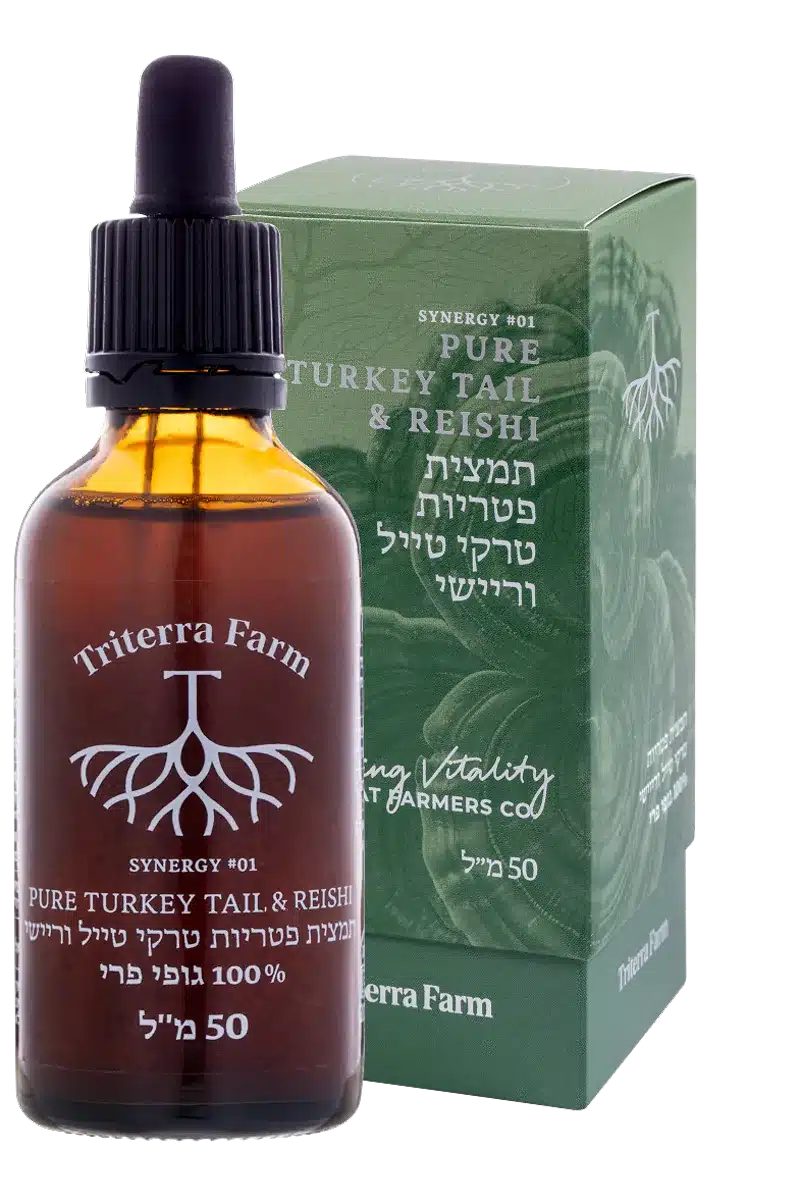
Turkey Tail + Reishi — Fruiting Body Extract
The two central mushrooms of immune research in one bottle: Turkey Tail for its polysaccharides, Reishi for regulation. 23.21% beta-glucan verified.
“Stomach pains that had been with me for years simply stopped. My doctor recommended this extract and I do not see myself without it.” — Inbar Y., verified review (translated from Hebrew)
₪250
about 35 days of use (1.4 ml/day) · free shipping over ₪285
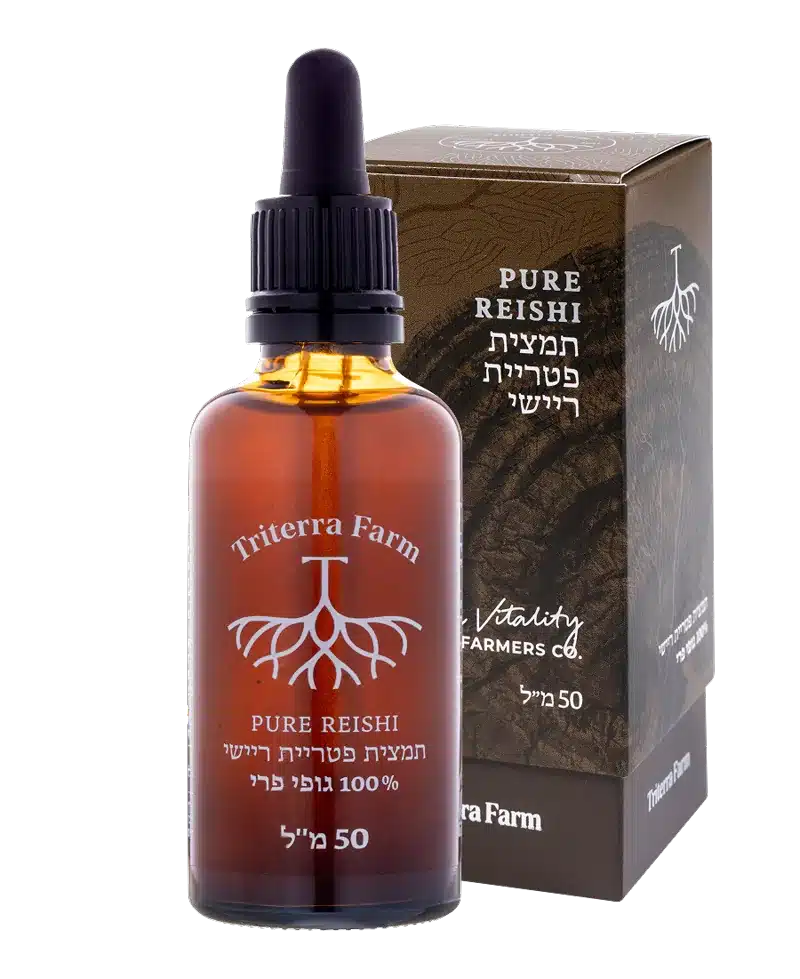
Reishi — Fruiting Body Extract
For when stress is the driver: Reishi is an adaptogen, and a chronic stress response is one of the things that weighs on immune function. 25.65% beta-glucan verified.
“Simply magic. Hard to believe how much it helps.” — Kfir H., verified review (translated from Hebrew)
₪250
about 35 days of use (1.4 ml/day) · free shipping over ₪285
Triterra club members get a standing 10% discount on every order, plus a quantity discount on more than one extract. Joining is free, through the matching quiz →
What people who started tell us
Real verified reviews from our customers, translated from the original Hebrew
“Stomach pains that had been with me for years simply stopped. My doctor recommended this extract and I do not see myself without it.”
Inbar Y.Turkey Tail & Reishi Extract
“Simply magic. Hard to believe how much it helps.”
Kfir H.Reishi Extract
“I have used Shlomi's extracts for years, and every time I am moved again by the quality and the effect.”
Noy G.Lion's Mane & Reishi Extract
Want support you can actually verify?
Start with a 100-day trial — if you feel no difference, you get your money back.
Choose my extract Not sure what fits? Take the matching quiz — under a minute →Want the mechanism itself, not just the conclusion? Turkey Tail Science →
These statements have not been evaluated by the Food and Drug Administration. This product is not intended to diagnose, treat, cure or prevent any disease. The information here is for general knowledge only and is not medical advice or a substitute for consulting a physician. Consult a qualified professional before using any dietary supplement, especially if you take medication, are pregnant or nursing, or have a diagnosed medical condition.
The research behind Cordyceps — 20 PubMed studies, the good and the bad →
Frequently asked questions
How do medicinal mushrooms "train" the immune system?
Medicinal mushrooms contain beta-glucans, components that the immune system recognizes as a "challenge." This prompts immune cells (such as macrophages and NK cells) to move into a state of readiness and become more efficient at identifying real threats, without creating unnecessary inflammation. This describes a research-based mechanism of immune support and balance (structure-function), not a treatment.
Which mushrooms are studied in the context of immune-system support?
The three leading ones are: Reishi (studied in the context of balancing the system and moderating inflammation), Shiitake (which contains lentinan — an isolated compound studied in research, distinct from the whole-mushroom supplement — examined in the context of NK-cell activity), and Cordyceps (studied in the context of cellular energy). Trametes (Turkey Tail) is also studied extensively in this area.
Is it OK to take medicinal mushrooms alongside medication?
Certain mushrooms may affect blood clotting or immunosuppressant medications. You must consult a physician before combining supplements if you take regular prescription medication, and especially during pregnancy, nursing, or an existing medical condition.
How do you choose a quality supplement for immune-system support?
Look for supplements that specify "Dual Extract" to ensure a broad range of active compounds. Make sure the product states the lab-measured beta-glucan percentage and that it is made from the fruiting body — not from mycelium grown on grain.
